
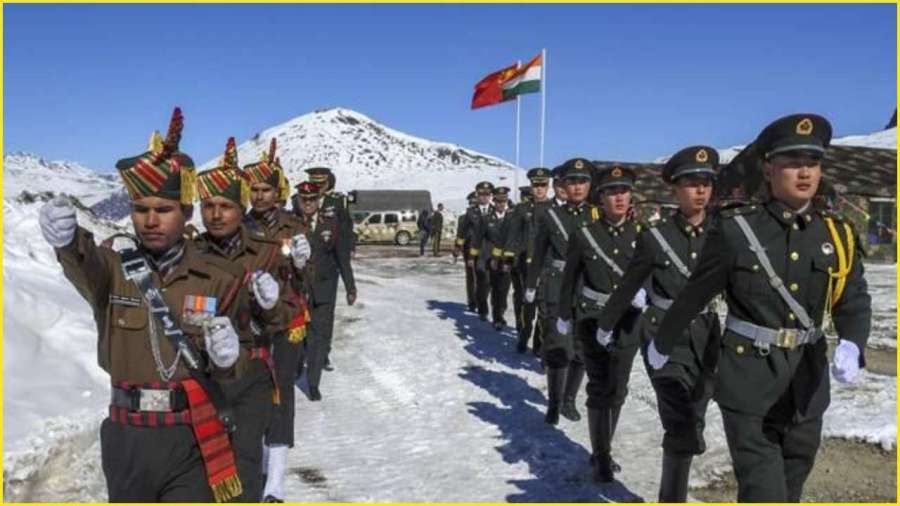
A temporary peace

After a long period of worsening tensions on the contested Himalayan border, the countries India and China have surprised everyone by announcing that their troops are to quickly extricate.

A marathon meeting between Indian Foreign Minister S Jaishankar and his Chinese counterpart Wang Yi in Moscow has been followed by this announcement. It came despite the regular eloquence between the nuclear-armed neighbors, that had suggested increasing bitterness.

Earlier, in this week, China’s state-run Global Times had said Chinese troops would “quickly deal a heavy blow to Indian troops, and they will be all annihilated” if Delhi provoked a war.

India also had upped the ante, Defence Minister Rajnath Singh saying “there should be no doubt” about the country’s resolve to protect its territorial integrity.

The statements reflected the reality on the ground : a hostile face-off between troops.

In June they fought a deadly clash in Ladakh’s Galwan Valley with clubs and stones leaving 20 soldiers dead. Both countries still have a huge development in the region where they have overlapping territorial claims ; and overcoming their differences will not be easy.

Ice breaker’ envoy

Many observers, including Michael Kugelman, deputy director at the Wilson Center think-tank, believe that both countries were ready for a confrontation, but they also realised that a war even a limited one , was not an option.

It would have been catastrophic for both countries and the wider region. The economic stakes were too high to risk a war,” he said.

The fact that Mr Jaishankar served as ambassador in Beijing for many years and is known to share good relations with Chinese diplomats appears to have helped.

It did break the ice, Mr Kugelman says, adding that personal relations often play a role in crucial diplomatic negotiations.

India-China border dispute explained in 400 words
Rivals race to build along a disputed frontier
China and India face off on the roof of the world
Weather, an unlikely factor, may have also played a role. The higher ridges of the Galwan Valley become inhospitable in winters.

Lieutenant General (retired) Vinod Bhatia, who served in the Indian army, says troops are used to operating in harsh conditions, but “given a chance, both armies would want to avoid that”.

Reports also suggest that Indian troops recently occupied some ridges overlooking Chinese posts. Neither country has officially confirmed the reports.

“India may have used this advantage as a bargaining chip,” Lt-Gen Bhatia adds.

Both countries also have many other crises to deal with. India’s Covid-19 caseload continues to rise at an alarming rate and its economy is suffering. Any armed confrontation would affect the country’s ability to overcome these issues.

China, meanwhile, has tensions with the US and a host of other countries to deal with, as well as global condemnation of its controversial security law in Hong Kong.

How soon could peace be restored?

Yun Sun, director of the China Programme at the Stimson Center think-tank in Washington, says the joint declaration lacks details.

Firstly, it doesn’t mention the Line of Actual Control (LAC) – the de facto boundary separating the countries.

“Several points along the LAC are contentious where troops are still stationed, so there is no clarity on the resolution of these issues,” she says.
De-escalation takes time, says Lt-Gen Bhatia, and it will take longer in the current scenario.

“The area is too big and it will take time for commanders to come to an understanding. The military-level talks will happen when tensions are still high and emotions are raw,” he says.

Both countries want to maintain the status quo. And that is tricky, says Ms Yun, because the two sides define the status quo differently.

“Chinese troops have gone deep into the territory India claims, and there is no clarity if they will vacate those positions.”

What caused the escalation will also determine how quickly disengagement can happen. A major factor cited as a source of tension is a new road that connects Indian army stations in the region to a forward air base.

But Ms Yun believes the road can’t be the only source because its construction took 20 years and “it wasn’t a secret”.
She believes many factors, including India’s controversial decision to revoke a law that gave special status to the region and Washington’s improving relations with Delhi, played a role.

“Beijing felt punishing India will give a warning to Delhi and Washington at the same time. But what they did not calculate was that India will refuse to back down,” she says.

China has been in diplomatic confrontation with a number of countries since US officials accused it of not controlling the coronavirus outbreak effectively
So, they became more aggressive, she says, adding that this was reflected in the statements of Beijing officials in recent days. Aggression has been a key factor in China’s foreign policy – particularly in recent months. And Chinese state media often remind the country’s neighbours of its superior military might.

This happened during the stand-off with India as well – but only in the past few days.

Officials in Delhi and Beijing were largely restrained in their comments in June and July, even after the Galwan clash that left the Indian soldiers dead.

Mr Kugleman says this was because they didn’t want to undo PM Narendra Modi and Chinese President Xi Jinping’s efforts in improving relations. The two have met 18 times since Mr Modi came to power in 2014.

“But it all came undone in recent days, and now it will be interesting to see how China and India sell the announcement to their people,” he says.

Ms Yun says China will find it tricky to reverse the rhetoric because “it can’t come across as weak or bullied by India”.

Resolving these core issues, including unsettled disputes going back decades, along the LAC that stretches for 3,440km (2,100 miles), will not be resolved in a few days.

“So, it’s a good start,” Mr Kugleman says. “Talks are better than no talks, but we just have to be cautiously optimistic.”

Rethink China:- it’s high time to realise Beijing is the new imperialist power in Asia

The conflicts among Indian and Chinese soldiers in Galwan valley, that prompted the executing of 20 jawans, ought to at long last power New Delhi to recognize the real factors of Beijing’s desire in the district. For a really long time, India has assumed the best about China and neglected its forceful conduct, regardless of whether it was against Taiwan, Vietnam, Japan or itself. The political insight in New Delhi – spreading over both Congress and BJP governments – has been to co-pick Beijing by racking hazardous issues, ignoring China’s predictable hindering of India at global fora and obvious sponsorship of Pakistan against India, and seeking after collaboration to make respective cooperative energy. This thusly was guided by the old enemy of settler outlook, that considered India to be China as casualties of imperialism and subsequently bound to accomplice up in an Asian century, in view of their immense populaces and antiquated civilisations.

The issue with such sentimentalism is that China never observed it that way. “Chindia” was consistently a build, or fantasy, of the Indian political and scholarly first class – Beijing never bought in to any of it. While China resolutely sought after monetary development and invited remote ventures, India kept on working under its provincial aftereffect and stayed dubious of participation with the West for a long time. Today, it’s China that is demonstrating itself to be the expansionist force in Asia by seeking after indulgent regional cases and requesting acquiescence from every one of its neighbors. Furthermore, the present Party commanded China has little to do with old style China, which looked inwards instead of outwards. The Chinese Communist Party is the new East India Company.

China doesn’t need an Asian century. It needs, explicitly, a Chinese century where Beijing will be the top firearm. Rather than holding figments, India should expand its own national force, improve military and monetary collaboration with the US and other Western vote based systems, and resolve issues with neighbors, for example, Nepal and Bangladesh.

The ongoing war of words among BJP and Congress has seen the previous blame the last for sabotaging national security by scrutinizing the administration on the Chinese interruptions. Be that as it may, subsequent to having itself utilized national security for constituent purposes, BJP is in peril here. Plus, in a vote based system it’s the activity of the restriction to cause the administration to remain alert. What’s more, lucidity on the Chinese interruptions is critical to plan the suitable reactions. It’s the ideal opportunity for some hardcore key reasoning.

Welcome easing of tension with China

The procedure of withdrawal that has begun at the Line of Actual Control (LoAC) is welcome. What India needs isn’t an arrival to business as usual before June 15, yet a progressively dynamic, determined crusade to compel China to forsake its expansionist cases on neighbors’ region and to settle its outskirt with India. Following quite a while of wary commitment with China, driven mostly by India’s 1962 thrashing and somewhat by the conviction that India and China could be accomplices in attempting the Asian Century, India has started to content an alternate methodology. This incorporates venturing up the structure and updating of foundation in outskirt zones, turning down support in the Beijing’s lead Belt and Road Initiative (BRI) and latent participation of the exchange understanding, RCEP.

New Delhi has all the earmarks of being at last advancing a China strategy that recognizes Beijing’s expansionist and mercantilist inclinations and that India imparts to China a long fringe that is yet to be settled. This expects India to keep on keeping up its endeavors versus China on each of the three fronts — military, strategic and monetary. China may have made a stride back for the time being, yet it doesn’t mean it has abandoned its endeavors. Unceasing cautiousness on the fringes, not exactly at the LoAC, is the path forward for India. Simultaneously, New Delhi should proactively work with accomplices, those in the area, Bhutan, Nepal, Myanmar and Bangladesh, and the worldwide ones, the US, Japan, Australia, South Korea and Vietnam among others, to oppose China’s expansionist points, especially in the South China Sea and the Indo-Pacific. India should likewise fortify its organization with France, Germany, UK and the EU, incorporating to advance improvement in Africa.

At last, India must concentrate on building its financial profile for building its own versatility as well as for giving choices as the world tries to differentiate flexibly chains. India should likewise center and put resources into development, business and giving top of the line arrangements over the range. China must figure out how to contend while regarding serene conjunction.

Making sense of China’s calculation

Experts ought to have thought about the pandemic’s effect on its economy and India’s vital arrangement with the U. S.

What strategy organizers in Delhi, and perhaps those in Beijing, have since quite a while ago dreaded, viz. , a face to face showdown prompting deadly losses, happened in the Galwan statures in the late night of June 15. The quantity of losses, 20 on the Indian side was the most elevated since 1967, and incorporated that of a high positioning Colonel of the Bihar Regiment. The quantity of setbacks on the Chinese side has not been officially demonstrated, however they have yielded that in any event one Colonel was among those executed.

No abnormality

With this episode, it ought to have been evident that the bite the dust was given a role as respects the fate of China-India relations. By the by, there was a glimmer of expectation when evidently the Corps Commanders of India and China on June 22-23 seemed to arrive at a “shared accord” to withdraw and leave on bringing down “strains” through a “steady and obvious separation”. This demonstrated shortlived, with the Chinese post in the Galwan zone not exclusively being reestablished, yet in addition, from satellite pictures accessible, greater in size than previously.

What happened in the Galwan statures on June 15, must not, subsequently, be seen as a distortion . It would be progressively prudent to see it as meaning another and irritable stage in China-India relations. Regardless of whether the circumstance returns to what in particular existed in mid-April (profoundly impossible), India-China relations seem set to observe “another and distinctive typical”.

The discussion on the Indian side has so far been to a great extent constrained to China’s dishonesty in disregarding the norm. Previous Prime Minister Manmohan Singh for example, blamed China for “audaciously and illicitly looking to guarantee portions of Indian Territory, for example, the Galwan Valley and Pangong Tso”. Adding flavor to the discussion was the Prime Minister’s announcement at an all-party meeting on June 19 to talk about the fringe issue, that “there was no interloper on our property now and no post in anybody’s care”, which raised the Opposition’s temper.

China’s response has been steady — India must move out of Galwan. This is something that India can’t disregard any more. What occurred in the Galwan statures can’t be seen as a negligible replay of what occurred in Depsang (2013), Chumar (2014) and Doklam (2017). This is another and diverse circumstance and India must not contract from tending to the center issue that relations among India and China are in a risky state.

China’s affirmation of its case to the entire of the Galwan Valley needs close and cautious investigation. For one, Point 14 gives China a virtual stranglehold over the recently finished, and deliberately noteworthy, Darbuk-Shyok-Daulat Beg Oldie Road, which leads on to the Karakoram Pass. For another, the vital ramifications for India of China’s emphasis on keeping the entire of the Galwan Valley are not kidding as it in a general sense changes business as usual. At last, by making a case for the Galwan Valley, China has revived a portion of the issues left over from the 1962 clash, and exhibits that it is eager to set out on another showdown.

Vagueness has existed with respect to the Line of Actual Control (LAC) in this division; the Chinese “guarantee line” is that of November 1959, while for India the LAC is that of September 1962. As of late, the two sides had avoided reviving the issue, yet China has never surrendered its cases. By its one-sided announcement now, China is looking to settle the issue in support of its. India needs to match this test.

Significance of Aksai Chin

A charge that could be leveled against progressive organizations in Delhi as of late is that while China has reliably declared its cases over the entire of Aksai Chin, India has decided to neglect China’s later stances in this locale. The significance of Aksai Chin for China has incredibly expanded generally, as it gives direct network between two of the most grieved districts of China, viz. , Xinjiang and Tibet. This doesn’t appear to have been satisfactorily considered in to our estimations. While Indian approach producers saw the renaming of Ladakh as simply an interior issue, they disregarded the way that for China’s military organizers, the cutting out of Ladakh into a Union Territory (followed later by Home Minister Amit Shah’s announcement a year ago making a case for the entire of Aksai Chin) placed a danger to China’s tranquility and peacefulness.

On insight evaluation

It is in this specific situation, that questions are presently being raised about the disappointment of knowledge. It is aphoristic that pioneers settle on better choices when they have better data, and the suffering estimation of insight originates from this central reality. Truly, the planning and nature of China’s activities ought to have excited distinct fascination for knowledge hovers about China’s vital computations. The Chinese develop in the Galwan Valley, Pangong Tso and Hotsprings-Gogra didn’t require any incredible insight exertion, since there was little endeavor at camouflage by the Chinese. India additionally has top notch symbolism knowledge (IMINT) and signs insight (SIGINT) abilities, conveyed between the National Technical Research Organization, the Directorate of Signals Intelligence of the Ministry of Defense and different offices, which made it conceivable to follow Chinese development.

Where, maybe, insight can be blamed is with respect to lacking energy about what the development implied, and what it predicted for India. This is characteristic of a shortcoming in understanding and investigation of the insight accessible, as additionally a powerlessness to give an intelligible appraisal of China’s genuine expectations. Insight evaluation of China’s expectations, unmistakably missed the mark regarding what was required.

It is simultaneously obvious that while India’s innovative abilities for insight assortment have limitlessly expanded as of late, the limit with respect to translation and examination has not stayed up with this. Advances in innovation, uncommonly Artificial Intelligence have, over the world, enormously expanded endeavors at insight investigation. It is a debatable issue whether such abilities were utilized in this occurrence.

The inability to disentangle China’s aims in time is no uncertainty disastrous, yet it must be comprehended that interpreting China’s goals, understanding the Chinese brain (which will in general be relevant and social), and attempting to understand Chinese reasoning, are a very troublesome undertaking whenever. All things considered, since a year ago when China’s economy started to give indications of a decay followed by the COVID-19 pandemic, China is known to have gotten very delicate to what it saw as endeavors by others to abuse its shortcoming. It has frequently felt constrained to exhibit that no country should endeavor to misuse the circumstance to China’s burden. India’s insight and strategy experts clearly neglected to dissect this perspective sufficiently, while attempting to comprehend China’s most recent forward push.

Another of China’s present distraction, viz. that India is feeling encouraged due to its developing key arrangement with the United States, ought to likewise have been satisfactorily considered by the experts, in any appraisal of putative Chinese reactions.

The key obligation regarding knowledge appraisal and investigation concerning China, rests with the National Security Council Secretariat (NSCS) and India’s outside insight organization, the Research and Analysis Wing (R&AW), and less significantly, the Defense Intelligence Agency. It may not, maybe, not be right to gather that the choice of the NSCS to destroy the Joint Intelligence Committee has added to a debilitating of the knowledge evaluation framework. On account of the R&AW, absence of area mastery, and an insufficiency of China pros may likewise have been a contributory factor.

Impediments of culmination meets

We can’t likewise limit the unfriendly effect of certain arrangement objectives. For one, the inclination offered as of late to Summit discretion over conventional international strategy making structures end up being a serious debilitation. Highest point strategy can’t sub for painstakingly organized remote office strategy making. Any number of occurrences of this nature are accessible. Head administrator Neville Chamberlain of Great Britain was probably the most punctual casualty of Summit strategy. The unfortunate gathering between Prime Minister Indira Gandhi and U. S. President Richard Nixon had long haul antagonistic ramifications for India-U. S. relations. Head administrator Manmohan Singh and U. S. President George W. Shrubbery established a compatibility through continuous Summit gatherings, however this was the special case as opposed to the standard.

At present, India’s Summit strategy has would in general underestimate the External Affairs Ministry with respect to strategy making, and we are presumably taking care of it. For what it’s worth, the Ministry of External Affairs’ (MEA) load of China specialists is by all accounts waning , and its general tilt towards the U. S. in many issues, has brought about an irregularity in the manner in which the MEA sees issues and circumstances.