“It is better to know how to learn than to know.” – Dr Seuss
False Beliefs About Self-Education
Despite having easy access to information, few people take full advantage of the opportunity we have for self-directed learning. We still believe that to learn something, we need to be formally educated on it, when in fact we’re able to educate ourselves.
Self-Education In The 21st Century
Self-education is the core skill for the 21st century. Our ability to respond to changes in the landscape of work and technology will be dictated by how skilled self-educators we are, how well we can take full advantage of the information available to us to grow our skillset.
Learning In The Real World
For 12 years, you’ve been trained to apply information that’s pre-packaged for you. But if you want to do anything independently (entrepreneurship, creative work, etc.) then you have to be able to figure things out without being handed the knowledge beforehand.
The Sandbox Method for Self-Education
This is an ongoing process of self-development and learning, that recognizes that we don’t need to memorize facts, formulas, instead, we need to develop an intuitive understanding of our skills, expose ourselves to different information about the skill, and constantly push ourselves to improve.
Steps of the Sandbox Method
Build an area where you can freely play around with the skill you’re trying to learn – Your Sandbox. It should be: low-cost or free, low stakes and public.
Research: Resources exist, you just have to figure out what’s worth reading, watching, or listening to (books, blogs, MOOCs etc).
Implement and practise purposefully.
Get feedback.
What Practicing the Sandbox Method Means
Honestly assessing your limits to figure out where you need to improve.
Setting a goal just beyond your current ability to motivate yourself to stretch beyond your comfort zone.
Practising with intense focus.
Get feedback, in whatever way you can, and incorporate that feedback into your practice.
Studying time is more efficient if it is spread out over many sessions throughout the semester, with a little extra right before the exam. Cover each piece of info five times from when you first learned it until your exam. It will enable you to retain the information with minimal effort.
2. What and How to Study
Testing yourself, so you have to retrieve the information from memory, works much better than repeatedly reviewing the information, or creating a concept map (mind map). After the first time learning the material, spend the subsequent studying to recalling the information, solving a problem or explaining the idea without glancing at the source.
3. What Kinds of Practice to Do
For a particular exam, use the following:
Mock tests and exams that are identical in style and form.
Redo problems from assignments, textbook questions or quizzes.
Generate your questions or writing prompts based on the material.
4. Make Sure You Understand
Passing and failing rest on whether you understood some important ideas. Your top priority should be to understand the core concepts. Identify the core concepts and make sure you can explain them without looking at the material.
5. Overcome Anxiety
Anxiety makes it difficult to remember things. To help overcome this, make some of your studying sessions like a mock exam, using the same seating posture, materials, and the same time constraints.
Break your study time down into chunks such as 30 minutes and then take a 5-minute break to keep your brain fresh and awake as you are studying.
Teach what you learn to others. This is one of the big values from study groups.
Know the difference between recollection and recognition. Recognition is when you are studying and you turn the page and read something and you think, ‘I know that.’ But what is going on is that you recognize it.
Use specific locations for studying. Have a study chair and a study desk so you know when you are sitting there you need to be studying.
Don’t listen to music when you are studying especially if it has lyrics.
Understand the difference between concepts and facts. The goal of learning is understanding. It is important to learn and remember facts but make your goal of understanding concepts not learning facts.
To remember more of what you learn in class you should take notes. Take enough notes to trigger your brain after class but don’t take so many notes that you can’t focus during class.
Getting enough sleep is key to remembering more of what you study.
Test your memory by writing what you can recall without looking at your notes.
The Survey, Question, read, recite and review method is when you survey or look over what you are going to learn and then develop questions that focus your brain.
Use memory training techniques to study less study smart! When you use memory techniques such as the mind palace or the memory palace you are going to remember more of what you studied.
Every time you get that tired feeling or you start to zone out, drink some water. Drinking cold water helps keep you hydrated to keep you focused. If you don’t drink enough water, your body doesn’t function as well as it could.
Sit at the front of the class
Being closer to the teacher is a great motivator to stay awake in class. Studies have also proven that sitting in the front of the classroom, leads students to receive higher grades on exams. Win-win, am I right? Be active Interact with your professor! Even if they don’t provide engaging activities, you can make them. Don’t be afraid to ask questions.
Chew gum/bring a snack
Chewing something activates specific regions of the brain meaning your brain become more active and you stay more awake!
Take deep breaths
By taking deeper breaths, you raise your oxygen levels, slowing your heart rate, lowering your blood pressure, and improving circulation.
Go to bed early
So you can wake up early and feel well-rested.
Get some exercise before class
The adrenaline from working out, taking a stroll, stretching, or doing some jumping jacks before class will help you stay awake.
Keep a good posture
If you focus on sitting straight up in your seat, you won’t be able to fall asleep. You rest your head and you will crash and burn.
Take notes (or doodle if it helps)
It keeps you active and it helps you focus on what you’re learning in class. Even if it’s random scribbles, it’s better than being asleep.
Walkabout in the back of the classroom
If you get tired, just find a spot in the classroom where you are not distracting anyone and walk about back and forth or take notes while standing.
Mahasweta Devi is a Bengali writer and activist who is known for her strikingly social and poignant stories. She wrote several works ranging from novels and plays to essays and short stories. Her most notable works include Hajar Churashir Maa, Rudali, Aranyer Adhikar etc. She has received highest literary merits in India like Jnanpith Award and Padma Vibhushan. As an activist, she has also worked towards the empowerment and rights of tribal people from West Bengal, Bihar, Madhya Pradesh, and Chhattisgarh.
Draupadi is a thought-provoking short story that deals with the underlying caste system and tribal subjugation in India. Originally written in Bengali, it follows a raw narrative that depicts the struggles of the subaltern in a vastly power-imbalanced society. Draupadi narrates the story of Dopdi Mejhen, a woman belonging to the Santal tribe in West Bengal. Dopdi and her husband Dulna are wanted by the Indian Special Forces as they were the chief instigators in the murder of Surja Sahu, an upper caste man who selfishly drew all source of water to his own wells and tube-wells even during the drought. Their bravery in questioning the authority of the upper caste is seen as a threat and battalions of officers are deployed to capture this ‘untouchable’ couple. Senanayak, the appointed head of the task force, uses the power of knowledge, tactics and violence to capture them. He is pragmatic with his ideology that ‘In order to destroy the enemy, become one.’ He is ruthless and tries everything in his power to achieve this, even going as far as to bait Dopdi with her own husband’s corpse. After her capture, his command allows multiple officers to rape her to extract information. Capturing and torturing them for information becomes a pleasurable game to Senanayak. Where the fugitives struggle for their lives, he takes joy in decoding their language and ‘countering’ them.
Draupadi in this narrative is an implicit reversal of the mythical character Draupadi from the Mahabharatha Mythology. Where the young princess is married off to five princes and leads the life as a fugitive who finally gets back their kingdom, this Dopdi does not grow up in the luxury. She has always been considered an outcast by her country for her identity and she is always on the run. Despite being nearly raped to death, she fearlessly walks out naked and confronts Senanayak, demanding him to ‘Counter’ her.
The people in power always reinforce their power by asserting dominance and by manipulating the internalised stigma against the people born in lower castes. Mahasweta Devi narrates this story of oppression without overtly emotionalising it and yet, it affects the readers in such a way that it provokes these emotions within us. To bring out maximum impact, she portrays reality as it is in all of its rawness which makes us question the power play prevalent in the society. The gradual shift of power in the end can be seen as her way of hinting at a hopeful future.
Mahasweta Devi is a Bengali writer and activist who is known for her strikingly social and poignant stories. She wrote several works ranging from novels and plays to essays and short stories. Her most notable works include Hajar Churashir Maa, Rudali, Aranyer Adhikar etc. She has received highest literary merits in India like Jnanpith Award and Padma Vibhushan. As an activist, she has also worked towards the empowerment and rights of tribal people from West Bengal, Bihar, Madhya Pradesh, and Chhattisgarh.
Rudali is a thought-provoking short story that deals with the underlying class and caste issues prevalent in India. Originally written in Bengali, it follows a raw narrative that depicts the struggles of the subaltern in a vastly power-imbalanced society. Rudali follows the story of Sanichari who labours hard all her life to make ends meet. The story begins by establishing her caste and how despite being the majority, the Ganjus and Dushads live in desperate poverty. They work as cheap labourers for the ‘Malik Mahajan’ who are the wealthy landlords and money lenders of the village. After losing her in-laws and her husband, she works hard to sustain for her son. But after his marriage, he slowly deteriorates due to tuberculosis and eventually after his death, his wife leaves, leaving Sanichari to look after their new born son. Later after he runs away from home, Sanichari finds an unlikely partnership with Bhikni, an old friend.
The two women forge a strong companionship and together they play a cunning game of getting back at their exploiters. ‘Rudali’ refers to a particular Rajasthani culture wherein women of lower castes are hired as professional mourners by the upper-class to mourn the deaths of their family members. The two women build a business together, harnessing this profession to get jobs to local lower-caste women who have been exploited and ostracised and exploited by the society. In no time, the upper-class people try to one up each other even in funerals and even go as far as purposefully killing themselves or the elders to hold grand funerals.
Entitled by the power of money, Devi reinforces the fact that people in power compromise morality to maintain their position through the shenanigans of the upper-class folks who are known as the ‘Malik Mahajan’. Historically, they were Rajput soldiers who pillaged and killed innocent tribes and conquered these lands. And then, Dulan says that “From century to century, their holdings and power increased. Even now, they take possession of land…” (Devi 73) They built up their power over the tribes and the lower caste through violence and debt traps. They spend lavishly on funerals to ‘uphold honour’ and ‘raise prestige’ by extracting money from the poor. Their greed for more lessens their humanity even with respect to their own kind. In this society, the rich are constantly rich while the poor are perpetually poor.
Where the privileged are divided amongst themselves due to greed for more, the powerless, though diverse, are united in their struggles against the elite. In Rudali, the lower caste and the shunned women look out for one another due to their shared resistance against the Malik Mahajan. Mahasweta Devi narrates this story of oppression without overtly emotionalising it and yet, it affects the readers in such a way that it provokes these emotions within us. To bring out maximum impact, she portrays reality as it is in all of its rawness which makes us question the power play prevalent in the society.
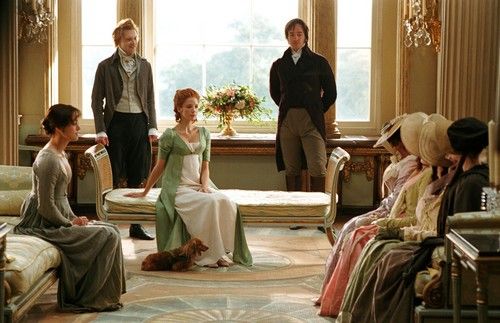
Social Class refers to a hierarchy in a society wherein people are grouped on the basis of their wealth status. Jane Austen’s Pride and Prejudice (1813) is acknowledged for its keen commentary on these aspects of the society. The influence of social class and the greed to climb up this social hierarchy is much of novel’s criticism.
Austen’s works usually focus on the preoccupations of the middle class and the upper class, and are rarely focused on the Aristocrats (people with title) or the working class. But even within that, there are several other differentiations as Regency England so working for money something of low standards. They acquired wealth through property, marriage, and inheritance. For instance, although the Bingley family are economically farer than most, on the basis of class, they are considered equal or maybe even lower than that of the Bennets as they are said to have made their money through trade or business.
A still from Pride and Prejudice (2005)
The novel also portrays characters who react differently to class. Characters like Bingley sisters and Mr. Collins fawn over the rich and try to please them. Especially Mr. Collins who depends on largely on Lady Catherine De Borough to gain social acceptance. He does all their biddings and constantly attempts to flatter them in order to ensure his good associations with them. Lady Catherine on the other hand, is very proud of her richness and sees everyone as beneath her. The novel satirises these characters who move only in relation to class, and are portrays the conceited idea that social distinction is an important factor in judging someone’s character. Lady Catherine is so used to people doing her biddings and obeying her orders that she is taken off-guard when Elizabeth stands up for herself. She objects to Lizzy marrying Darcy due to her fear that it would indirectly affect her own social class through association. Elizabeth in return, replies that she’d marry whomever she wishes to for her own happiness.
“In marrying your nephew, I should not consider myself as quitting that sphere. He is a gentleman; I am a gentleman’s daughter; so far we are equal.”
Jane Austen (Chapter 56)
Characters such as Mr. Bingley and the Gardeners seem much more as they do not discriminate on the basis of class even if they are financially well-to-do. Darcy can be seen as an example of Austen’s ideal high-class gentleman. Despite seeming selfish and arrogant initially, he later proves that he is capable of change. His innocence also becomes evident when Lizzy talks to the residents of Pemberly. The social status of the Bennet family is threatened to a large extant when Lydia runs away with Mr. Wickham. They are saved from ‘social degradation’ only when Darcy covers up the issue with money.
Pride and Prejudice shows that class might determine a character’s social situation, but it doesn’t signify anything about their behavior. The marriage between Elizabeth and Darcy shows that even though class restrictions are rigid, it does not determine one’s character and that love can overcome all material obstacles like class. It proves that class is ultimately an arbitrary and meaningless distinction between people.
Jane Austen’s Pride and Prejudice (Published in 1813) is considered to be a classic in literature. It has often been glossed over as a romantic novel and though it is concerned with human relationships, especially of romantic ones, Austen focuses a great deal on wealth and class. Her infamous opening quote in itself is a testament to the fact that she consciously criticized the influence of money in a society.
“It is a truth universally acknowledged, that a single man in possession of a good fortune, must be in want of a wife.”
Jane Austen (Chapter 1)
Pride and Prejudice is set in Regency England, which was a time of great political unrest and economy volatility. This was mainly due to the shift of the economy from an agrarian one to that of an industrial one. Until then, people were only mainly concerned about food and other primary needs. But the industrialization paved for more materials in the market like clothes, utensils, etc. So more the commodities, the more people wanted money to spend on such items. Thus, the need for money increased, and in the Regency England, being a gentleman was considered more important than merely being rich. And the concept of a gentleman relied highly on inheritance and people wanted to be rich without working for it.
Austen has taken care to include details of each character’s money and their economy backgrounds. The richer characters include people like Bingley who receives €500 per annum and is clearly rich enough to host balls take care of his sisters’ needs. Georgiana Darcy is said to inherit €30,000 pounds and will remain well-to-do even if she is denied legal inheritance of property. Mr. Darcy on the other hand, is a modern equivalent of a multi-millionaire who gets up to €10,000 per year and would get more from his investments. The middle-class characters include Mr. Bennet who receives approx. €2000 per year and would even be considered an upper-middle class. Mr. Wickham inherits €1000 from Darcy’s father and even more from Darcy for leaving the clergy. Although he spends it all and goes into debt, Darcy pays him again to marry Lydia. The Bennet girls on the other hand, would receive only a maximum of €40 per year until the death of their father, after which, their land would legally go to their cousin. Thus, the Bennet sisters had to marry for survival and not just to uphold class. When Elizabeth rejects both Darcy and Mr. Collins, she’s taking a huge risk by choosing happiness over financial security.
Fitzwilliam Darcy
€10,000 per year + more
Georgiana Darcy
€30,000 inheritance
Charles Bingley
€5000 per year
Rich Characters
Mr. Bennet
€2000 per year
George Wickham
€1000 inheritance
The Bennet Girls
€40 per year
Middle Class Characters
Austen also criticises material obsessions through characters like Mr. Wickham and Mrs. Bennet who obsesses despite not being rich, through Caroline Bingley who is pretentious and through characters like Catherine de Borough who exploit their wealth for status.
One of the criticisms against the novel is also that it unconsciously puts out the idea that you need to be rich and have money to be happy. Elizabeth who marries Darcy is happy, Jane who marries Bingley is happy, Charlotte who marries Mr. Collins is not too happy and Lydia is unhappy as she is doomed to pay off Wickham’s debts for the rest of her life. Nevertheless, the Pride and Prejudice’s detailed treatment of money adds to the novel’s realism.
‘To Kill a Mockingbird’ is a Southern gothic bestseller written by Harper Lee. The novel is narrated by Scout Finch, a six-year-old white girl who learns about life, people and the injustices prevalent in her society. Through her, Lee cleverly portrays issues such as gender, race and class discrimination in the fictional setting of Maycomb county, Alabama. Readers have speculated that the character of Scout was based on Lee’s own childhood experiences, wherein she combines the nostalgic elements with the political situation that she witnessed around her in America. Scout’s innocence and her defiance against the social hierarchies in Maycomb cuts a deeper meaning into the futility of these societal constructs.
Race is one of the issues that is evidently portrayed in the novel. Scout’s father Atticus Finch is a lawyer who defends the less privileged. He strives hard to stand by his moral compass and wishes to set an example for his children through his actions. One of the major events in the novel takes place when Atticus chooses to defend Tom Robinson, a black man accused of raping a white woman. The racist residents of Maycomb, as well as his family members are horrified and attempt hard to dissuade him. So much so, that even Scout and her brother Jem are subjected to verbal abuse by other children for his actions. During the trial, Atticus provides clear evidence to prove Tom’s innocence. Despite the impressive evidences, the extremely racist jury sentences him to jail where he later attempts to escape, but is shot and killed. We see that even the law is corrupted when it comes to rendering justice to innocent African Americans. Tom Robinson’s trial scene is monumental in proving the racial discrimination in America.
Calpurnia, the Finch family’s black maid plays a significant role in Scout’s life. Unlike most southern black characters, she is well- educated and is highly respected within the Finch family. Having lost her mother at a young age, Scout regards Calpurnia as a mother-like figure. One of the important moments in the novel is when Calpurnia takes Jem and Scout to the Black Church. Here, the children witness a different side of characteristics in Calpurnia as she interacts with the rest of her community. W. E. B. Du Bois refers to this as “double consciousness”; a phenomenon wherein a person exhibits two different personalities with the blacks and the whites. This can be seen as a defence mechanism to gain acceptance in a white supremist society due to their own internalised racism. Furthermore, despite being a novel that is concerned with issues like racism, it only portrays a subjective version of it. The black community are not given a voice of their own against this prejudice, which marginalises them within the text. If they are given a voice, it is usually to show gratitude to the good white people instead of raising their anger and frustration against the racial injustices in Maycomb.
Social class prejudice is an important element highlighted in ‘To Kill a Mockingbird’. This can be understood clearly when Jem imagines ‘folks’ as being divided into four different kinds. “Our kind of folks don’t like the Cunninghams, the Cunninghams don’t like the Ewells, and the Ewells hate and despise the coloured folks.” (Lee, 249) Through Jem, Lee clearly explains the class hierarchical structure of Maycomb. It is a prejudice engrained in Maycomb which even dictates the relationship between children at school. But the novel also explains that the class system can eventually be dismantled. Initially, when Scout treats Walter Cunningham Jr differently, Calpurnia teaches her otherwise and makes her realise that a person’s financial background has nothing to do with their personality. When Cunningham Sr. arrives with a mob to lynch Tom Robinson, Scout’s innocence humbles him, saving Tom’s life briefly. Scout thus is able to achieve a small proportion of justice by disregarding the class system. Her reply “I think there’s just one kind of folks. Folks.” (Lee, 250) is an innocent yet powerful statement against the prevailing class structure in the society.
“You never really understand a person until you consider things from their point of view…”
Harper Lee
Aside from race and class, the novel also deals with other important issues like gender, disability, and sexuality. As Scout belongs to a middle-class white family, the primary concern that she personally deals with is sexism. She is portrayed as a tomboy, who is forced to confirm to the conventional idea of a girl. Over the years, readers have come up with multiple theories from the book pertaining to current social issues which proves that even after sixty years, it is still contemporary. Atticus’s advice that “You never really understand a person until you consider things from his point of view . . .” is a principle that could serve as a solution for all types of prejudices. And as mentioned by John Green, the “combination of nostalgia and criticism makes Mockingbird both endearing and enduring.” To Kill a Mockingbird is revolutionary in the fact that it brilliantly portrays multiple serious themes through the eyes of an innocent child.











 Eduindex
You must be logged in to post a comment.