

Most people in the world have a fear of snakes. Those with an abnormal fear have a whole fear named for them—“Ophidiophobia”. However, the fear seems perfectly rational seeing as how dangerous some of these snakes can be. But a question begs to be asked— Are snakes really that dangerous? The simple answer is that while a majority of the snakes are harmless, we still need to maintain a distance. Bites from venomous or non-venomous snakes can be extremely painful. There are quite a few dangerous snakes in the world and it is always better to know what kind of snake you are dealing with before you decide your next step. So, in order to be better informed we bring to you the top 10 deadliest snakes in the world.
Here are 5 most Venomous Snakes in the world and what make them so-
1. Saw-scaled Viper (Deadliest in the world)
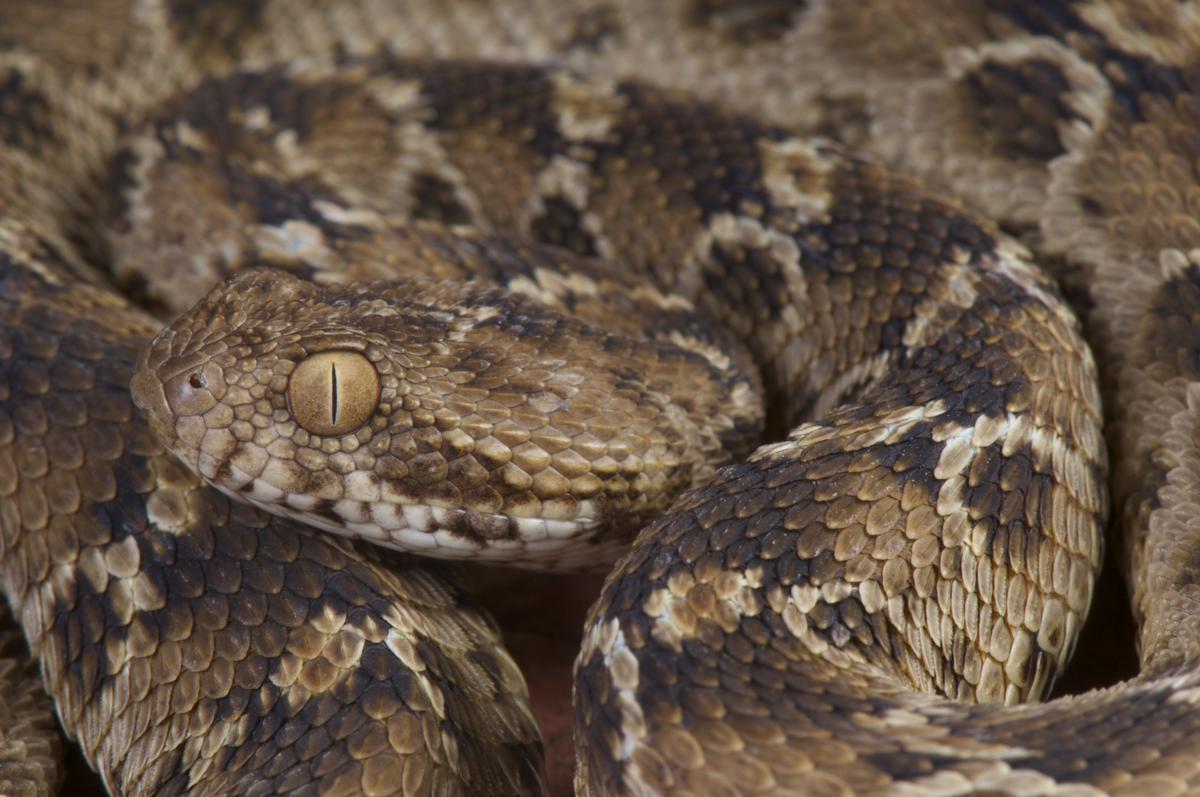
Although its venom is not very potent, the Saw-Scaled Viper is considered as one of the world’s deadliest snakes as it is believed to be responsible for more human fatalities than all other snakes put together. These snakes have a stout body with a pear-shaped head which is distinct from the neck. Adult Saw-Scaled Vipers range in length from 0.3 to 0.9 metres and they come in shades of brown, grey, or orange with darker dorsal blotches and lateral spots. Unlike most snakes, the Saw-Scaled Viper moves sideways (sidewinding locomotion). They are nocturnal and feed on mammals, birds, other snakes, lizards, amphibians, scorpions and centipedes. They can be found in arid regions and dry savannahs north of the Equator across Africa, India, Sri Lanka, Pakistan, and the Middle East. Saw-Scaled Vipers are considered to be one of deadliest snakes of the world because they are often found in populated areas and a lack of readily accessible antivenom in rural areas adds to their lethality. So clearly, the potency of the venom has no bearing on the list of world’s deadliest snakes.
Some fun facts about the saw-scaled viper:
- Saw-Scaled Vipers can live for up to 23 years.
- Up to 80 per cent of these adults climb up bushes and trees when it rains.
- In northern regions, they hibernate during winter.
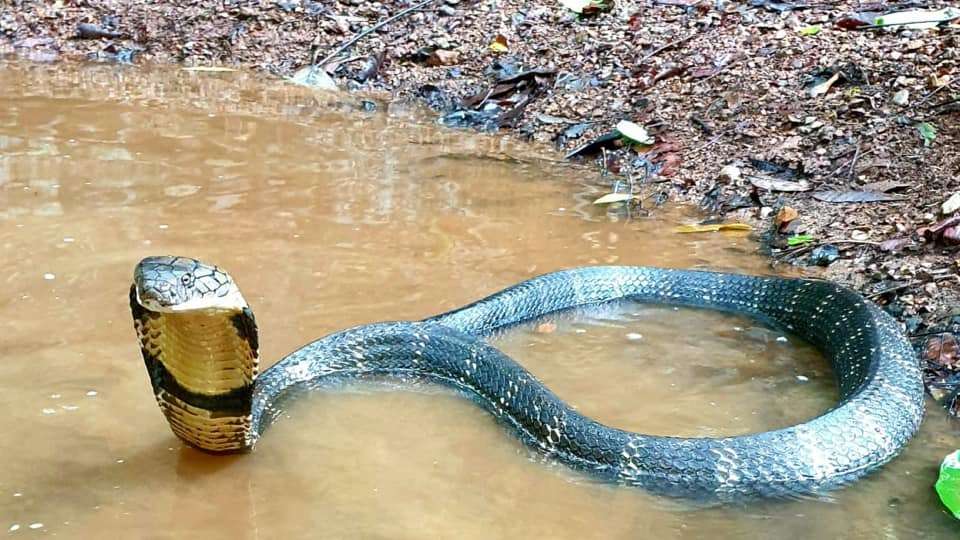
2. King Cobra (World’s Longest Venomous Snake)

In India, the King Cobra is not only revered and worshipped but also feared, as they are one of the most venomous snakes of India. In one bite, a King Cobra delivers a tremendous amount of neurotoxins that induces paralysis. They are so fearsome that they find themselves on almost all lists of world’s deadliest snakes. King Cobra is dark olive or brown in colour with black bands and white and yellow crossbands with cream or pale yellow undersides. A King Cobra measures up to 3 to 4 metres in length and has blackheads with two crossbars near the snout and two behind the eyes. Young cobras are shiny black with narrow yellow bands. King Cobras are found in Bangladesh, Bhutan, Brunei, Cambodia, China, Hong Kong, India, Indonesia, Laos, Malaysia, Myanmar, Nepal, Philippines, Singapore, Thailand and Vietnam. The world’s longest venomous snake, a King Cobra’s venom is so strong that it can kill an elephant in just a few hours and can cause death in 50 to 60 per cent of untreated human cases.
Some fun facts about the King Cobra:
- King Cobras (Ophiophagus Hannah) are monogamous, which means they mate with only one partner for life.
- In the generic name, King Cobra Ophiophagus Hannah, Ophiophagus is derived from Greek and means “snake eater”.
- The longest venomous snake, King Cobras have a slow metabolic rate and so, can go for months without food after a large meal.
- A single bite from a King Cobra can kill an elephant.
- The cobra only spreads its hood when it feels threatened or is disturbed. While most pictures showcase cobras with their hoods fanned, chances are you may spot a cobra without its distinctive hood, so be careful either way.
3. Inland Taipan (Deadliest Venom)
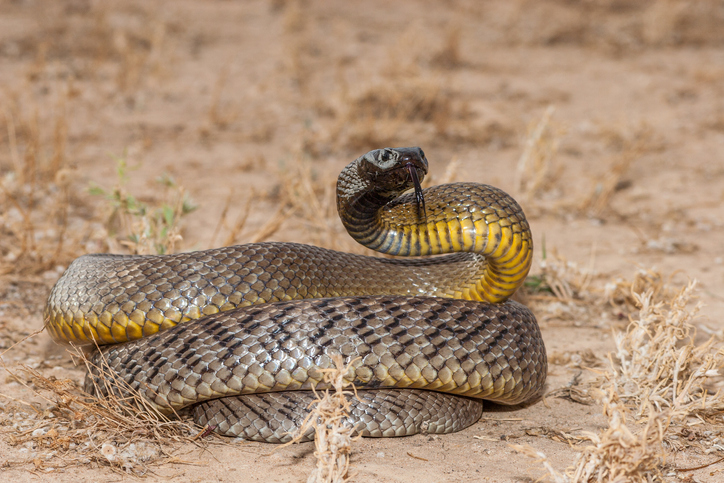
Also known as the “fierce snake”, the Inland Taipan is one of the world’s most venomous snakes. A bite from this variety of Taipan often causes paralysis of the victim’s nervous system and clots the blood. The Inland Taipan, one of three types of Taipans (Coastal, Inland and Central Ranges), is dark tan in colour, ranging from a rich, dark hue to a brownish light-green, depending on the season. This variety of Taipan is found to be smaller than the coastal variety and can grow up to 1.7 metres in length. Although the Inland Taipan is an extremely venomous and dangerous snake, they are usually shy and prefer to escape trouble. They will, however, defend themselves and strike if angered, mishandled or stopped from escaping, earning it a place on the list of the deadliest snakes in the world. The venom of an Inland Taipan consists of taipoxin, a complex mix of neurotoxins, procoagulants, and myotoxins that can hinder breathing, cause haemorrhaging in blood vessels and tissues, and paralyze and damage muscles. Respiratory paralysis can set in anywhere from two to six hours after you are bitten.
Some fun facts about the Inland Taipan:
- Inland Taipans’ venom is specially adapted to kill warm-blooded animals.
- It is an extremely fast and agile snake and can strike instantly with extreme accuracy.
- It is called “fierce snake” for its venom, not its temperament.
- They change the colour of their skin for thermoregulation, allowing them to absorb more light in colder months.
4. Blue Krait (Asia’s Most Venomous)

Also known as the Malayan Krait, the Blue Krait is a highly venomous snake of the elapid family. Its venom can paralyze its victim’s muscular system; a truly scary thought that has earned this snake a place on the list of the deadliest snakes in the world. The Blue Krait has a colour pattern of bluish-black crossbands separated by yellowish-white interspaces. They can grow up to lengths of approximately 1.1 metres. These Kraits are generally not aggressive or strongly defensive and tend to bite only when really provoked. While they primarily feed on other snakes, they also eat lizards, mice, frogs and other small animals. Blue Kraits have been found to be primarily nocturnal while hunting and have shown a preference for fields, holes, and sometimes even homes. A Blue Krait’s venom consists of extremely powerful neurotoxins made up of presynaptic and postsynaptic toxins. This mixture is known to directly attack an individual’s ability to speak or think clearly and can paralyze the muscular system. The venom also attacks an individual’s respiratory system, causing suffocation within hours. The bite causes no pain, giving the victim a false reassurance. However, if left untreated, death can come within four hours.
Some fun facts about the Blue Krait:
- They are widespread in their regions, but encounters are uncommon.
- They prefer the wet season.
- Like other Kraits, they hide their heads under the coils of their body when threatened.
5. Black Mamba (Fastest Snake in the World)

The Black Mamba is the second-longest venomous snake after the King Cobra. They are known for their large size, quickness, and extremely potent venom, making them one of the deadliest snakes in the world. The inside of this snake’s mouth is black, hence its name – Black Mamba. They have a coffin-shaped head and can vary in colours from olive, yellowish-brown, khaki and gunmetal but they are rarely black. An average Black Mamba is 2–2.5 metres long, with a maximum length of 4.3 metres. While they have a reputation for being aggressive, Black Mambas are generally found to be shy and nervous. They primarily eat small mammals and birds. While they prefer warm-blooded prey, a black mamba will also feed on other snakes. They can be found in Angola, Botswana, Central African Republic, DR Congo, Eritrea, Ethiopia, Kenya, Malawi, Mozambique, Namibia, Somalia, South Africa, Tanzania, Uganda, Zambia, and Zimbabwe. f they are disturbed or cornered, Black Mambas will attack with repeated bites. Their venom is extremely toxic and just two drops are reportedly enough to kill most humans.
Some fun facts about the Black Mamba:
- They are some of the world’s fastest snakes and are capable of speeds of more than 12 miles (19 km) per hour and hence will be the one which can kill the fastest.
- In the wild, a black mamba can live for up to 11 years. In captivity, they can live for longer than 20 years.


 Eduindex
You must be logged in to post a comment.