
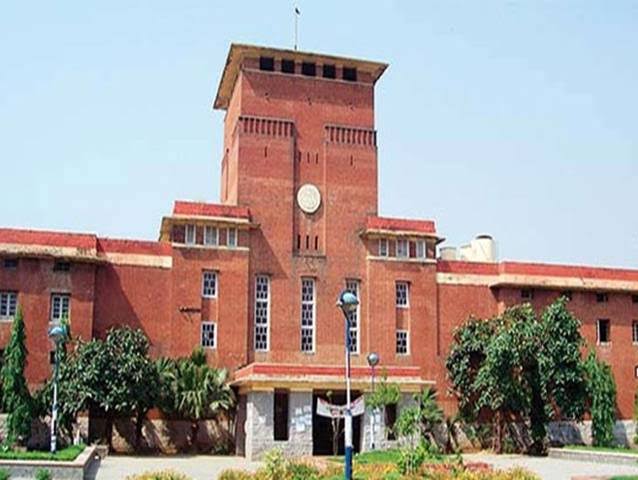
University of Delhi to promote intermediate students with backlog for next semester.

New Delhi: University of Delhi has issued promotion criteria for intermediate semester students of undergraduate and postgraduate courses. According to an official notification, all UG and PG students (except for the Council Mandatory course, including the Non-Collegiate Women’s Education Board (NCWEB) and the School of Open Learning (SOL)), students will be allowed to pursue those subjects , In which they have failed.

“Students will be allowed to pursue subjects in which they failed in one semester or year and will be promoted next year,” an official statement said.

“However, such students may approve the syllabus for the examination in which they failed or in which they were absent, when the examinations are conducted by semester and term next year,” the statement said.

DU said that students in the second semester (part I) or fourth semester (part II) of undergraduate and postgraduate courses are eligible for promotion under the criteria.

Registered with the School of Open Learning and Noncollegiate Women’s Education Board (NCWEB) for second year UG courses under the annual mode and second semester (1 year), first year UG students under Choice Based Credit System (CBCS) Delhi. The university said that the School of Open Learning (SOL) is also eligible for promotion.

University of Delhi further stated that this provision is applicable only for the current academic session (2019-20) in view of COVID-19 epidemic. Courses administered by statutory regulatory bodies or councils will not be covered under this provision.

Campus Politics

Politics is both a study and skill as to how power is exercised and by whom, through the administration of power, to manage people’s affairs. Politics is integral part of the operation of public education. Politics in education is not just about the ways of the election of student board members or local student councils but it is an integral part of day-to-day life. Political activity is about negotiations over the allocation of scarce resources and about deciding who gets what? But all political activities are not the same.

Political struggles in schools and colleges have different views and objectives. The introduction of student council’s and groups has led not only to a healthy student voice but it has become a tool for shaping young people’s minds for voting in the future. Young people today are more informed and civic minded than before and student organization’s provide opportunities for many opinions and various political interest on campus.

Students participate in a wide ranging programmes  including  forums, study groups and conferences. But the young lack the mindset and maturity to see the right respective. It is true that there are a lot of opportunities for people who want to take on leadership positions at the university and in other political organizations. Its elected members are representatives to the administration and the student community and at times the only representatives.

These are also responsible for sponsoring many of the programmes and services which are nearest and dearest to the students hearts like concerts, celebration etc. But another aspect of politics is that students get themselves involved in various outside campus political activities and spoil their results or carriers. They shouldn’t talk part in undemocratic activities within or outside the campus. However they should necessarily have awareness about the political development in their country.

Students of today are the future guardians of our nation’s destiny. They’re the moulders and builders of future India. Political consciousness, is therefore, an indispensable factor, contributing to the growth and development of a healthy public opinion on the part of the future pillars of the nation. But in no case should this young men and women be allowed to be used as cat’s paw of the selfish and self centred shoddy politicians.

Students of India must promote a sub line sense of discipline which is one of the first essential requisites of democracy. Should Indian students take part in politics or not has been one of the most baffling questions before our national leaders. During the British reign, Indian students, on one hand, where stirred up by a section of our leaders to take vagarious part in politics, while on the other advised by the pro-British moderate group of leaders to abstain from taking part in politics, however, we know that in the freedom movement of our country our students played they’re role as much seriously and vigorously as any other section of the community could have done.