Union Minister Shri Piyush Goyal assumes charge of Ministry of Commerce and Industry

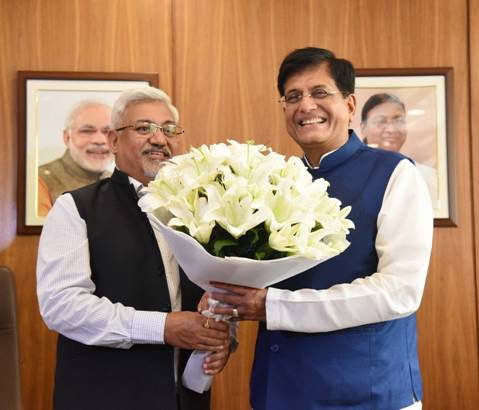
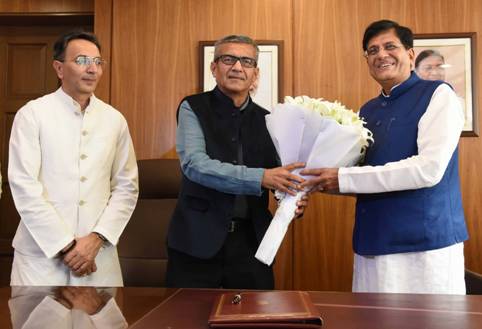
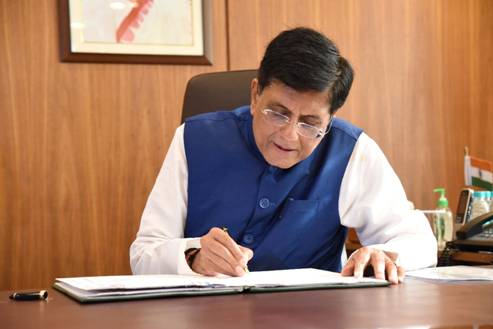
 Union Minister Shri Piyush Goyal officially assumed charge of the Ministry of Commerce and Industry in New Delhi today. Minister of State, Ministry of Commerce and Industry, Shri Jitin Prasada; Secretary, Department of Commerce, Shri Sunil Barthwal and Secretary, Department for Promotion of Industry and Internal Trade (DPIIT), Shri Rajesh Kumar Singh, along with senior officers of the Ministry were present on the occasion.

On the occasion of assuming charge, Shri Piyush Goyal expressed his heartfelt gratitude to Prime Minister, Shri Narendra Modi for giving him the opportunity to serve the nation once again. He said that over the past decade, PM Modi’s strong development-oriented governance has inspired a wave of progress across the country, and it is imperative to continue building on this foundation.

Shri Goyal emphasized the importance of working diligently during the Amrit Kaal to ensure rapid advancements in the field of commerce and industry. He said that the government is committed to creating new opportunities for the youth and working relentlessly for the welfare of all citizens. Under the visionary leadership of PM Modi, the nation is poised to achieve new heights. He also noted that embracing the philosophy of “Sabka Saath, Sabka Prayas,” the collective efforts and trust of the people will drive India towards a brighter future.

***

Union Minister Shri Piyush Goyal holds review meeting with officials of Ministry of Commerce and Industry

 Union Minister Shri Piyush Goyal officially took charge of the Ministry of Commerce and Industry for a second consecutive term in New Delhi today. Upon assuming office, Shri Goyal immediately convened a review meeting with senior officers from both departments within the Ministry of Commerce and Industry.

Minister of State, Ministry of Commerce and Industry, Shri Jitin Prasada also attended the meeting. During the meeting, the Commerce Secretary and DPIIT Secretary presented a brief on the ongoing proposals and action items of the ministry.

Shri Goyal emphasized the importance of continued collaboration and directed that a series of meetings must be scheduled in the coming days to delve into the details of various policies and action items that have to be finalized.

Expressing his gratitude and enthusiasm, Shri Piyush Goyal stated, “I am delighted to be part of PM Modi’s third term and am grateful to the people of Mumbai North for electing me. As I take charge, I come to you with a lot of fresh perspectives about India and about ground zero.”

Shri Piyush Goyal said that there is a need to introspect and coordinate better between departments. Shri Piyush Goyal emphasized upon the importance of Research & Development (R&D) and strengthening Public Private Partnership (PPP) model of governance.

He urged the officers to focus upon integrity, speed, skill and scale. He said that Steering Committee on Advancing Local value-add & Exports (SCALE) Committee and Production Linked Incentive (PLI) Schemes must be utilized to their full potential to boost exports and domestic production.

Highlighting the achievements of his previous term, Shri Goyal cited the boost in overall exports from India, signing of various Free Trade Agreements (FTAs), significant inflow of Foreign Direct Investment (FDI) into the country, etc. With a renewed commitment to driving economic growth and fostering international trade, the Minister expressed hope to lead the Ministry of Commerce and Industry towards new heights, ensuring that India’s progress remains steadfast and inclusive.

Shri Goyal encouraged the officers of the Ministry to make Quality the mantra to ensure India’s progress. Shri Goyal noted that the timely sharing of data and transparency in exports and imports will encourage investors to invest more confidently. He said that India is positioned in a sweet spot and it is the right time to convert our challenges into opportunities.


***

Scope of Silk Industry in India

Silk – the queen of all fabrics is historically one of India’s most important industries. India produces a variety of silks called Mulberry, Tasar, Muga and Eri, based on the feeding habit of the cocoons.
The sericulture industry today employs over 700,000 farm families and is mostly concentrated in Karnataka, Tamilnadu and Andhra Pradesh and to some extent Assam and West Bengal. Karnataka accounts for more than 70 percent of the country’s total silk production.


Sericulture is one industry which is beneficial to the agriculturists. As in today 56 lakhs people are dependent on the sericulture industry, 5.6 million people out of which 4.7 million are agriculturists. The rest are reelers, weavers etc.

India is the second largest producer of silk, contributing to about 18 per cent to the world production. What is however, more noteworthy is the fact that India’s requirement of raw silk is much higher than its current production at present. Thus, there is considerable scope for stepping up production of raw silk in the country, overcome the persistent conflict of interest between exporters of silk products and producers of raw silk.


While sericulturists want imports of raw silk to be restricted to have better market for their produce, exporters want imports of cheaper raw silk so as to be able to export more silk products at competitive rates. India has all the four varieties of silk namely, mulberry, tassar, eri and muga. It is however, disheartening to note that we have not yet been able to fully exploit this advantage and make our presence felt on the international scene more prominently than at present. For this, one has to clearly understand the strengths and weaknesses of different segments of this sector.

The strength of this industry lies in its wide base, the sustaining market demand pull especially from the Indian handloom weaving sector, the infrastructure created by the national sericulture project and the research and training capabilities.


Silk is the most elegant textile in the world with unparalleled grandeur, natural sheen, and inherent affinity for dyes, high absorbance, light weight, soft touch and high durability and known as the “Queen of Textiles” the world over. On the other hand, it stands for livelihood opportunity for millions owing to high employment oriented, low capital intensive and remunerative nature of its production. The very nature of this industry with its rural based on-farm and off-farm activities and enormous employment generation potential has attracted the attention of the planners and policy makers to recognize the industry among one of the most appropriate avenues for socio-economic development of a largely agrarian economy like India.


Silk has been intermingled with the life and culture of the Indians. India has a rich and complex history in silk production and its silk trade which dates back to 15th century. Sericulture industry provides employment to approximately 8.7 million persons in rural and semi-urban areas in India. Of these, a sizeable number of workers belong to the economically weaker sections of society, including women. India’s traditional and culture bound domestic market and an amazing diversity of silk garments that reflect geographic specificity has helped the country to achieve a leading position in silk industry.

Silk production in India

India has the unique distinction of being the only country producing all the five known commercial silks, namely, mulberry, tropical tasar, oak tasar, eri and muga, of which muga with its golden yellow glitter is unique and prerogative of India. 

Mulberry sericulture is mainly practised in states such as Karnataka, Andhra Pradesh, Assam and Bodoland (Kokrajhar, Chirang, Baksa and Udalguri districts of Assam), West Bengal, Jharkhand and Tamil Nadu who are the major silk producing states in the country. North East has the unique distinction of being the only region producing four varieties of silk viz., Mulberry, Oak Tasar, Muga and Eri. Overall NE region contributes 18% of India’s total silk production.

Title of Book

Scope of Silk Industry in India

Editor Name

Deobrat Kumar

ISBN no. 

978-81-951123-8-8

Imprint

IJR

Year

2022

Edition

First

Language

English

Genre

Education

Publisher

Edupedia Publications Pvt Ltd

Pharmaceutical industry has an important role in Aatamnirbhar Bharat

The Commerce and Industry Minister Shri Piyush Goyal today interacted with the captains of the Pharmaceutical industry, and Office-bearers of the Pharma Associations, through the Video Conference. The meeting was attended by the Ministers of State Shri H.S.Puri and Shri Som Parkash, Secretaries of the Department of Commerce, and Pharmaceuticals, and Officers from Departments of Commerce, Pharmaceuticals and Health.

During his interaction, Shri Goyal lauded the pharma industry for making India proud, by rising to the occasion during the Covid crisis. He said that India has been recognized as the ‘Pharmacy of the World’, as over 120 countries got some essential medicines, during the last two months, including 40 of them getting them in the form of grant, free of cost. He said that during the crisis, the officials of DGFT, MEA, Health and DoP burnt midnight oil to ensure that the export consignments are delivered at the earliest. The whole world appreciated India’s gesture, and this has swelled India’s goodwill and reputation. He said that India had adequate production capacity and abundant stock of HCQ and PCM for its projected domestic requirements, and putting restrictions on their exports was to ensure that the medicines are made available to all the needy nations, and no unscrupulous element stocks them for unwarranted gains.

The Pharma industry received accolades from the Minister for their extra-ordinary performance, in ensuring that the Country did not face any type of shortage of medicines during this period.  Shri Goyal said that early announcement of the Lockdown helped the country in preventing and containing the scourge of pandemic, and also scaling up the health infrastructure and build capacity, besides generating awareness among the people about the precautions and preventive measures. He said that India has set an example, under the able guidance and leadership of the Prime Minister Shri Narendra Modi, in being pro-active in management of Covid-19, and also following it up with welfare and relief packages for mitigating its consequences.

Shri Goyal assured the industry that the Government will fully support the industry in its expansion, diversification and strengthening. He said that the industry has an important role to play in the Aatamnirbhar Bharat campaign. The country should become Aatmanirbhar in APIs as early as possible, as the government has taken a number of steps in this regard. It has already approved the scheme on Promotion of Bulk Drug Parks for financing Common Infrastructure Facilities in 3 Bulk Drug Parks. Also, Production Linked Incentive Scheme for promotion of domestic manufacturing of critical KSMs/Drug Intermediates and APIs in the country has been given a go ahead.

The Minister said that anti-dumping investigation process has been expedited. The Minister said that in case of ongoing bilateral FTAs, if any roadblock or unfair competition is being noticed, the Government may be informed and prompt remedial action will be taken. He said they should look at large untapped market in Eastern Europe and Russia. Calling upon a collaborative route in the R&D efforts, Shri Goyal said the Academicians, Universities, ICMR and private sector should join hands. Informing the gathering that the Government has decided to disinvest in certain Pharma PSUs, the Minister invited the Indian companies to use PSUs for plug and play model of manufacturing. The Minister assured the industry that all suggestions presented in the meeting will be quickly examined and wherever required, the inter-ministerial consultations will be completed at the earliest.

Credit benefit announced under the Aatamnirbhar package for the MSMEs

Minister of Commerce and industry Shri Piyush Goyal on Thursday met the representatives of traders associations, via video conferencing. He said that during the lockdown period, the nation geared itself to fight against the Covid-19 pandemic and built capacities. The domestic manufacturing of the protection equipment (like masks, sanitizers, gloves, PPE) got a boost, health infrastructure was scaled up, and awareness was generated among the people. He said that people responded to the Prime Minister’s call to work unitedly to face the unprecedented crisis, by adhering to the Government’s guidelines and directions. Aarogya Setu has been developed during the period, which acts as a shield, friend and messenger in such crisis. People changed their lifestyles and adapted quickly to live, work, study differently under the circumstances. Shri Goyal said that timely and correct decisions taken by the Prime Minister, and adhered to by the people, have helped the country, as we are in a better position compared to many other nations of the world, with more resources and lesser population. 

            Regarding some of the hardships being faced by the Retail traders even after the relaxations of the guidelines, the Minister said that a majority of shops have been allowed to be opened, without any distinction of essential and non-essential. The decision to open the remaining shops in the malls, will be taken soon, after taking into account the guidelines of the Health Ministry. He said that Aatmanirbhar package announced by the Union Finance Minister to fight Covid-19 provided for Rs 3 lakh crore credit guarantee for MSME, and it also covers traders. He said that the changes made in the definition of the MSME sector will also help them.  He said that the Finance Minister has also indicated that she has an open mind on finding solutions for the problems that may have remained unresolved. Shri Goyal told the retail traders not to feel threatened by the e-commerce juggernaut, as the Common person has now realized that the Brick and Mortar kirana neighbourhood shopkeepers only helped them in their hour of crisis. He said that the Government is working on mechanism to facilitate B2B for the retail traders and providing technical support to them to expand their reach. He said that under the Prime Minister Narendra Modi, the Government has taken transformational initiatives, which will help India become a strong nation. Regarding other problems of the trader community pertaining to term loans, Mudra loans and other issues, Shri Goyal said that the matter will be taken up with the finance ministry to find a solution. 

            The Minister said that several indicators show that the economic recovery is on the anvil. The power consumption this month is almost at par with the corresponding period last year, Oxygen production has come up. The Exports, which went down in April by almost 60%, have started showing upward trend, and the preliminary figures indicate decline this month will be smaller. The Services exports, on the other hand, went up even the last month. He indicated that more than the fall in merchandise exports, the imports showed sharper decline last month, lowering the trade deficit.

 The Minister said that during the last two months, the government has taken measures to ameliorate the hardships of the traders and Indian manufacturers, and in future also, will support them. He called upon the traders to use, promote and support the Indian goods. The Minister exhorted them to work with confidence, boldness and determination, and the success will be there to achieve.