Why Attending and Publication in Conference Proceeding is Useful

Reasons to attend a conference in your domain
You might be wondering why in this age of information where anybody can learn about their favorite topic of interest right from the comfort of their own home, why attending an international conference is still advantageous. The simplest answer is that there are some things that one simply cannot learn online on a computer or gadget. Listed below in detail are the many ways in which attending an international conference can have a tremendous positive impact on your career and work.
Why Attending and Publication in Conference Proceeding is Useful
Add caption
1. Regaining the Initial fervour and Passion That You Had
Very often, researchers, scientists, and academicians find that they no longer have the same love for their subject and work that they did when they first began. Gradually over the years, many of these researchers begin to forget how much their work really means to them because of several factors including discouragements, lack of results, lack of funding, etc. A number of such researchers have found that by attending an international conference and learning new things as well as meeting new people, they have been somehow become inspired and have managed to regain the \”beginner’s passion\” that they once had about their work.
2. Face To Face Meetings with Influencers
Even if you do somehow manage to connect with top influencers in your field via social media, nothing can live up to a face-to-face discussion with someone whom you look up to in the industry or an influencer. Technology with all its advances still cannot replicate the magic of a face-to-face meeting. There are some things that just cannot be said over a video call or conference with an influence who draw inspiration from. By meeting a person face-to-face you get the measure of that person, otherwise impossible over a text, voice or video conversation.
3. Get Up-To-Date On the Latest Industry Trends
An important of a researcher’s career is to stay up-to-date with all the advances and developments in their respective fields. Getting to know about such developments and breakthroughs can prove to be incredibly beneficial to your own line of research, even though they might be completely unconnected. A number of veteran researchers have attested to the fact that they have managed to come up with solutions to their own research after learning about how someone else solved a completely unrelated problem.
4. Crucial Networking
Although your new company or research work might be in the works and not completed yet, you might want to make some serious industry connections that are guaranteed to be a benefit sooner or later. Making a connection with someone in the industry over a coffee break, during lunch or during pauses at an international conference is one of the best ways to network. In fact, most attendees at international conference are there for the sole purpose of making valuable connections with key members in the industry.
5. Awareness of All the Latest Tools
International conferences are often where a lot of companies choose to advertise or spread awareness of their products and tools. A researcher who is aware of the existence of these new tools can now choose to shift to more productive and reliable methods of performing their research, than someone who has no idea about their existence and is continuing to use old and outdated tools that yield unsatisfactory results.
6. Connecting With Peers
Any researcher, scientist or academician worth their salt will tell you that being positive plays a crucial role in the long-term success of your work. Very often being positive is easier said than done. That is why it is highly recommended that researchers, who are in a rut with respect to their research and work, attend international conferences where they will get to meet like-minded people who are undertaking the same journey as them. Connecting and talking to such people can give you an idea of how they solved problems that you are currently facing or even how not to commit the same mistakes as they did.
Do you encouraged to attend an international conference after reading all the above advantages, but do not know how to find out about conferences to attend? Not to worry!  At Eduindex Conference, we are dedicated to being a highly reliable and trusted source of any and all information regarding top-level international conferences happening across the globe.

Delivering a Poster Presentation

Poster presentations can be an excellent way to share research findings and the format of poster sessions has several advantages.  Presenters are able to engage with the audience in an interactive setting that allows them to get feedback and network with other scholars.  Poster sessions also have the potential to reach a larger number of people.  An appealling poster that is done correctly is the first step in drawing in the audience.  However, while the poster serves as a visual aid or illustration of the work, the poster session is really an opportunity for the researcher to personally educate others about the research findings.
Tips on Delivering the Presentation
  • Prepare and practice a 2-3 minute oral explanation of your poster and your work.
  • Do not read the poster to the audience!  The poster is there as a visual aid and illustration of the research.  The presenter should be making eye contact and engaging with the audience.
  • The presentation should explain the big picture and why the project is important.  It should provide a \”take home\” message.  Too much detail will lose the audience.
  • Refer to graphics/charts/data on the poster to illustrate and support findings and conclusions.
  • Do give the audience some time to absorb the information on your poster.  Do not stand directly in front of the poster so that they a full opportunity to view it. 
  • Prepare a summary handout so that people will remember the highlights of your work.  Be sure to include full contact information in the handout.
  • Know your poster well so you can refer to any section if questions arise.
  • Expect questions!  Questions may be very broad asking about the overall project or they may be specific, such as asking about the type of statistical analysis used.  Be prepared!
  • Admit when you do not know the answer to a question or when it is beyond the scope of the project.
  • Have business cards, summary handouts, or contact information ready for those who may want to contact you to discuss it further at a later date.
Tips on Professional Behavior
  • Dress professionally.  It lends credibility to your work. Wear comfortable shoes as you will be standing for long periods of time.
  • Wear your nametag, smile and make eye contact with potential viewers.
  • Be on time for the poster session and stay until the session is over.
  • Stay next to your poster so that you are available for discussion.
  • Do not get too in depth with any one viewers or others will not have an opportunity to learn about your research and ask questions.
  • Do not take criticism personally. The ability to get feedback is an advantage of a poster session.  This may be especially helpful if you plan to submit a manuscript for publication.
  • Focus on the viewers.  Do not get involved in social conversations with other presenters and colleagues at the expense of the audience.
  • Do not force handouts on those that do not seem interested.
The poster presentation is an excellent way to disseminate your research findings. A well-designed poster, a polished presentation and professional behavior will give you the opportunity to educate others and share your work.

Workshop/Interactive Presentation

Workshops are interactive sessions that can vary in length from approximately an hour to a full day. 

These sessions usually begin with explanatory or introductory information and then move on to involve the audience in some type of interactive, participatory activity.  Workshops and interactive presentations are particularly well suited for demonstrations, learning new skills or procedures, debates, exhibitions and so forth.

Symposium

A symposium is a type of conference or session that focuses on one particular topic. 

It is often a collection of papers from a number of contributors.  Each contributor will have an opportunity to present and a time for discussion.  This type of session is valuable when multiple perspectives on a particular subject may be of interest to the audience and can be put together in one session.  A symposium is also a time for networking and collaboration with peers and colleagues since these sessions are often comprised of experts in the field who have come together to share ideas.

Colloquium

This type of conference session is longer (often 90 minutes) and entails 5 or more presenters who are proposing papers on the same topic or theme. 

All presenters will speak individually (15 minutes approximately) and there will be additional time for discussion and questions.  These sessions have a more narrow focus and therefore attract attendees with a genuine interest in the topic. However, while the audience is well-educated, they are usually not specialists or experts on the topic. 

Poster Presentations

Poster presentations are opportunities for a larger number of researchers to present their research in the form a visual poster presentation. The posters are large (often 3\’ x 4\’) and provide the researcher with enough space to fully summarize their research in an attractive and professional way. 

The presenter typically prepares a short oral summary that can be given to those who are interested.  Attendees are free to move about the room and examine posters and talk individually to the presenters.  This format does allow the opportunity for a research target those that are genuinely interested and engage them in discussion that often allows for more detail.  Another advantage of this type of format is that researcher can receive valuable feedback from the attendees.  

Oral Presentations

Oral presentations are short talks that may be given individually or as part of a panel or group discussion.  Researchers often prefer oral presentations over poster sessions and other formats because many view them to the prestigious option.  There are several types of oral presentations:
  • Individual Presentations – These may be contributed or invited talks that are often 15-30 minutes in length and leave just a short time, if any, for questions from the audience.  The presenter will prepare a conference paper that will be presented and is typically a more focused, narrower version of their overall project. Paper presentations are assigned to the appropriate session and the most common formats include:    
    • Themed Session – These sessions at conference primarily include completed research or scholarly work.  The presentations will be grouped by topic or theme into sessions that include several related presentations.  This facilitates audience attendance and organizes topics at the conference.
    •  Roundtable Session – Roundtable sessions allow the presenter the opportunity to interact and converse more with the audience.  Presenters are assigned to a table in a conference room for the duration of the session and interested attendees may join them at their table. These sessions are typically best for position papers, policy analyses, and other types of topics that benefit from extended discussion time.
  • Panel Discussions – In panel discussions, two or more speakers will present different aspects, perspectives or thoughts on a particular topic, research problem, or question.  Each speaker will have an opportunity to present their information and when all the speakers are finished, there is typically time for discussion.

Debate

Two or three debaters should hold clearly differing points of view as they exchange insights on a topic of import to evaluators.

The interaction should be moderated by a chairperson with a prepared set of questions. Half of the presentation time should be devoted to response to audience questions. The main abstract should identify the topic, why the topic is of interest to evaluators, and the contrasting positions of the debaters. An alternative format would be to debate a specific proposition that would be directed towards a specific organization or institution, such as the EduINDEX.

Expert Lecture

Expert Lectures are formal presentations by an acknowledged expert in the field who will share conceptual or methodological innovations through a lecture followed by response to audience questions.

The abstract should detail both the background of the lecturer as well as the importance of the material to be presented. Please note that an expert lecture is longer in duration than are standard paper presentations. As such, the breadth and depth of the content, and the expertise of the presenter, should warrant such an extended exploration. Each presentation should be no longer than 45 minutes, with an additional 10 to 15 minutes for questions.

Roundtable Conference

Maximize your networking in these exciting, parallel sessions, where you get to exchange with other evaluators on your topic. Each presenter delivers their content to a table of approximately 10 participants in 15 minutes or less, followed by a 10 minute interactive discussion. Participants will then move to another table. Presenters will deliver their content 3 times with different sets of participants, benefiting from the ideas and practical experiences of all.

A Roundtable is a 60-minute group discussion on a precise theme among up to 15 participants seated around a table. Roundtable presentations typically include a 5 to 10 minute presentation by the organizer to introduce the topic, followed by discussion and feedback from participants. Roundtable presenters should bring targeted questions to pose to participants at the table in order to learn from and with those attending. The presenter is also asked to summarize and conclude on the subject at the end of the session (5 minutes). Roundtables are excellent venues for getting targeted feedback, engaging in in-depth discussions, and meeting colleagues with similar interests. Note that roundtable is addressed to a limited number of participants. The abstract should detail the focus of the presentation and the way(s) in which it contributes to the body of knowledge in the field of evaluation. Each presenter is in charge of his or her discussion group, but most will include a short introductory presentation (5 to 10 minutes), a discussion (around 45 to 50 minutes) and a conclusion (5 minutes).

EduINDEX International Multidisciplinary Conference 2019

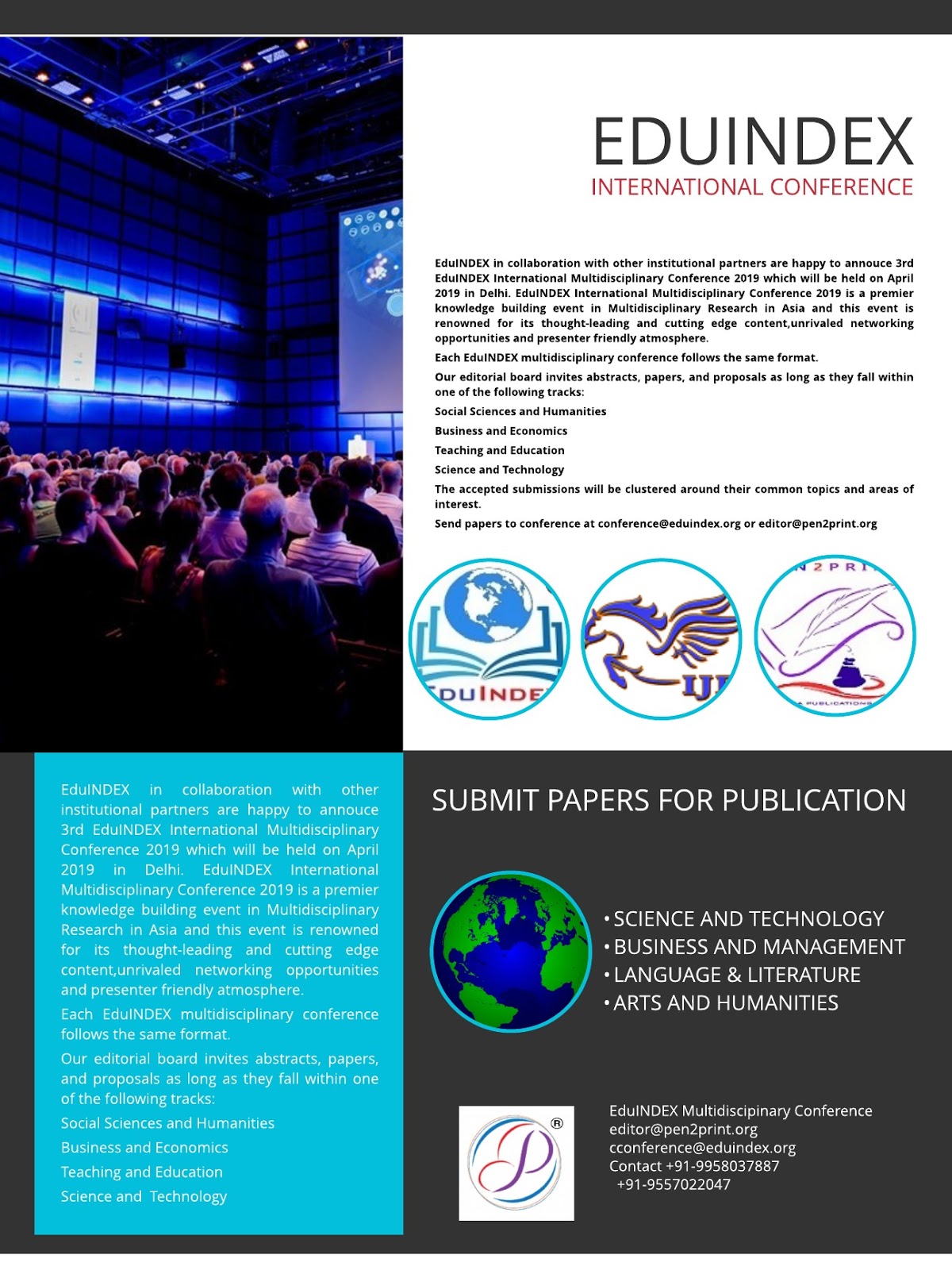
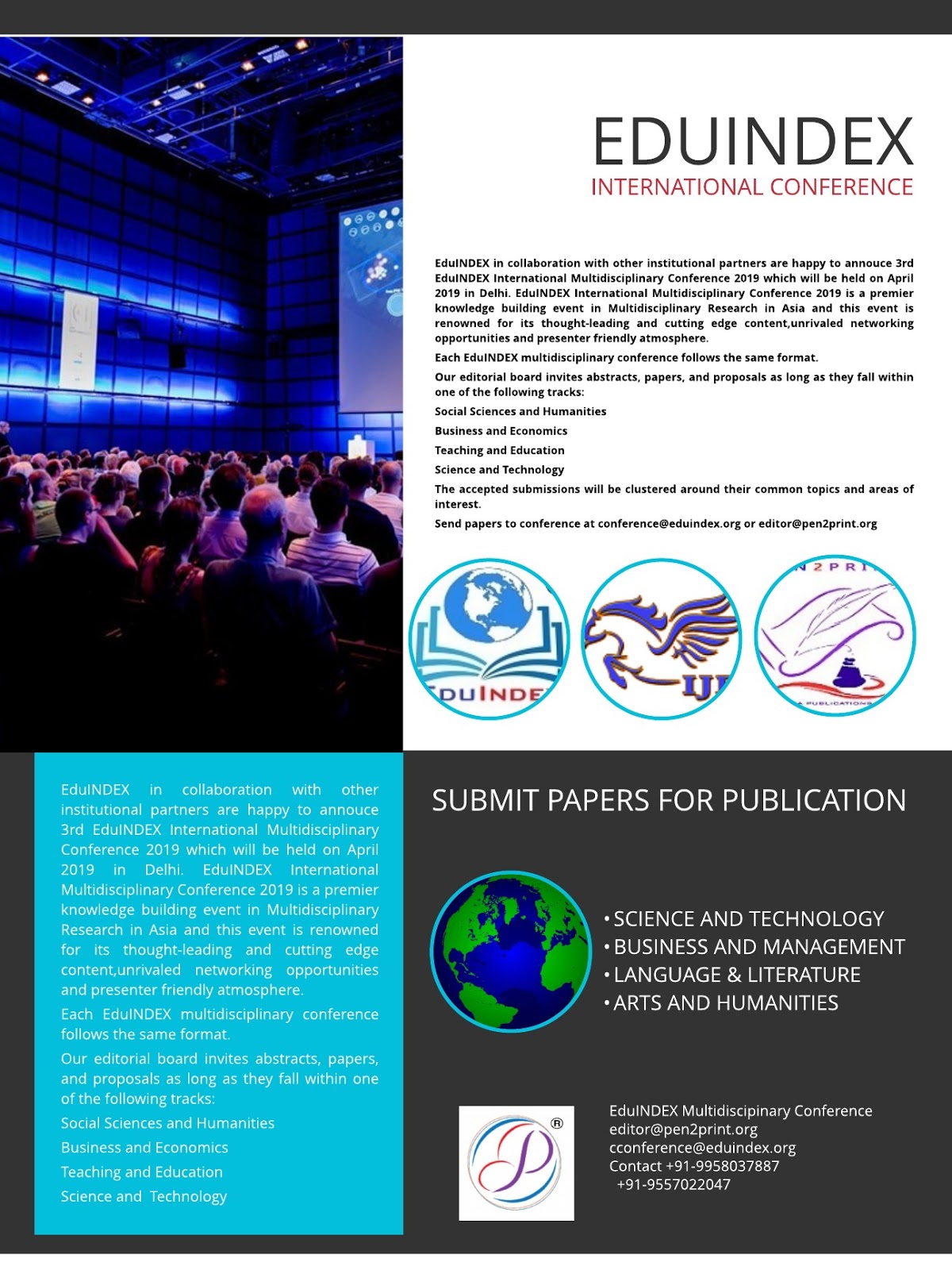
EduINDEX in collaboration with other institutional partners are happy to annouce 3rd EduINDEX International Multidisciplinary Conference 2019 which will be held on April 2019 in Delhi. EduINDEX International Multidisciplinary Conference 2019 is a premier knowledge building event in Multidisciplinary Research in Asia and this event is renowned for its thought-leading and cutting edge content,unrivaled networking opportunities and presenter friendly atmosphere.
Each EduINDEX multidisciplinary conference follows the same format. 
Our editorial board invites abstracts, papers, and proposals as long as they fall within one of the following tracks:
Social Sciences and Humanities
Business and Economics
Teaching and Education
Science and Technology
The accepted submissions will be clustered around their common topics and areas of interest. 
Send papers to conference at conference@eduindex.org or editor@pen2print.org