

Termination Of Agency

Introduction

In a contract of agency, a person appoints another to act on his behalf with the third party it is called ‘Agency’. According to Section 183 of the said Act, Principal must be competent to contract. Any person may be an agent (Section 184). According to Section 185, in the contract of agency, consideration is not necessary. Termination of agency means putting an end to the legal relationship between principal and agent. Section 201 to 210 of the Indian Contract Act 1872 lay down the provision relating to the termination of Agency.

As above said termination of agency means putting end to the legal relationship between principal and agent. Section 201 to 210 of the Indian Contract Act 1872 lay down the provision relating to the termination of Agency.

Section 201, Indian Contract Act 1872 provides for termination of an agency –

An agency is terminated by the principal revoking his authority, or by the agent renouncing the business of the agency; or by the business of the agency being completed; or by either the principal or agent dying or becoming of unsound mind; or by the principal being adjudicated an insolvent under the provisions of any Act for the time being in force for the relief of insolvent debtors.

Agency may be terminated two ways –
1) By the Act of the Parties
2) By Operation of Law
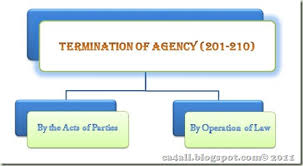
1) By the act of the parties
i) By agreement – The Contract of Agency can be terminated at any time by mutual agreement between the principal and agent.
ii) By revocation of the principal – The Principal revoke agency at any time by giving notice to the agent.
iii) By Renunciation of an agent – Renunciation which means withdrawing from responsibility as Agent. Like Principal, Agent can also renounce the agency. According to Section 206 of the Indian Contract Act 1872, the agent must give to his Principal reasonable notice of renunciation. Otherwise, he will be liable to make good for the damage caused to the principal for want of such notice.

2) By operation of law
Agency can be terminated by operation of law-
i) By the completion of agency – Agency can become to an end after the completion of work for which the agency is created.
ii) By expiry of the time – Agency can also be terminated by the expiry of time. if the agency is created for the specific period, it is terminated after the expiry of the time.
iii) Death or insanity of principal or agent – Section 209 of the Indian Contract Act 1872 imposes an agent, duty to terminate the contract of agency on the death of the principal. In other words, Agency comes to an end on the death or insanity of the principal or agent.
iv) Insolvency of principal – According to Section 201 of the Indian Contract Act 1872, an insolvent or bankrupt is a person who is unable to run the business due to Excess of liabilities over assets. In this way, if the principal becomes an insolvent agency can be terminated.
v) Destruction of the subject matter – If this subject matter of the agency is destroyed agency comes to an end.
For example – Any agency is created for sale of an Airplane if the Airplane caught fire before the sale the agency comes to an end. In this contract Airplane is the subject matter.
vi) Principal becoming an alien enemy – If the Principal becomes an alien enemy the contract of agency comes to an end. vii) Dissolution of company or firm – A Firm or company may be regarded as a Principal in the contract of Agency. If the company or firm is dissolved the agency comes to an end.

Relationship between Principal agent and sub agent

Relationship between principal agent and sub-agent depends on the question whether the agent has an authority to appoint sub-agent and whether the sub-agent is properly appointed.
If then sub-agent is properly appointed:
1) The principal is bound by and responsible for the acts of a sub agent;
2) the agent is responsible to the principal for the acts of the sub-agent;
3) the sub agent is responsible for his acts to the agent, but not to the principal except in case of fraud or willful wrong.

It is of interest to observe clause (3) above. Sub-agent is responsible and accountable to the agent and not to the principal by clause (1). Principal is liable for acts of the sub-agent if he is properly appointed. Sub-agent is not responsible to the principal because there is no privity of contract between the principal and sub agent. It is case of fraud or willful wrong that the principal can proceed against the sub-agent. Principal can, however, against the agent for acts of a sub-agent. As far as the rights of a third party are concerned, he can enforce the wrongs of a sub-agent on the principal if the sub-agent is properly appointed. Principal is therefore liable for acts of the sub-agents if he is properly appointed.

If the sub-agent is not properly appointed: Where an agent has appointed a person to act as sub agent without having authority to do so, the principal shall not be deemed to be represented or responsible for the acts of the sub-agent so employed, nor is such a sub-agent responsible to the principal. The agent is responsible for the acts of such a sub- agent both to the principal and to third persons.

Sub-agent is said to be improperly appointed where agent delegates his powers without authority from the principal or where none of the circumstances stated above exist which necessitate appointment of a sub agent.

It will be observed that where a sub-agent is not properly appointed, the liability of agent is also towards third parties. As a rule, we have seen that an agent is responsible to the principal and it is the principal who is responsible for the acts of his agent to the third party. However, the section throws additional liability on the agent where he has improperly appointed a sub-agent. Agent stands liable to the third party for the acts of a sub-agent.

Termination of sub-agent’s authority: (Sec 210) Lastly it must be noted that the termination of the authority of an agent causes the termination of the authority of all sub-agents appointed by him

Liabilities of principal, agent and sub-agent: The agent is responsible to the principal for the acts of a sub-agent and the sub-agent is responsible for his acts to the agent but not the principal, except in cases of fraud and willful wrong.

Where an agent improperly appoints a sub-agent, the agent is responsible for his acts both to the principal and to third parties. The principal in such cases is not responsible for the acts of the sub-agent nor is the sub-agent responsible to the principal. But where a sub-agent is properly appointed, the principal as regards third person, is represented by the sub-agent, and is bound by and responsible for his acts, as if he were an agent originally appointed by the principal.

Where an agent under an express or implied authority has named another person to act for the principal, such a person is not a sub-agent, but an agent of the principal. There is no liability on the agent appointing him provided the agent so appointing exercises discretion as a man of ordinary prudence would exercise is his own case (Sec 194 & 195). Such an agent is called a substitute agent.

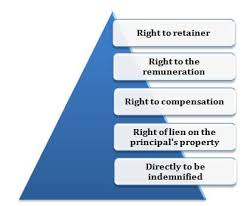
Rights Of An Agent

An “agent” is a person employed to do any act for another, or to represent another in dealing with third persons. The person for whom such an act is done, or who is so represented, is called the “principal”. Section 182 of the act defines the terms “Agent” and “Principal”.

Rights of an Agent

  1. Right to Receive Remuneration: According to Section 219 of the Indian Contract Act, an agent is entitle to his remuneration. But Section 220 of the said act says that, an agent who is guilty of misconduct in the business of an agency is not entitled to any remuneration in respect of that part of the business which he has misconducted.
  2. Right of Lien (Section 221): Agent’s lien on principal’s property- In the absence of any contract to the contrary, an agent is entitled to retain goods, papers and other property, whether movable or immovable, of the principal received by him, until the amount due to himself for commission, disbursements and services in respect of the same has been paid or accounted for to him.
  3. Right to Indemnity: Agent to be indemnified against consequences of lawful acts. Indemnity means promise make good the loss. According to Section 222 of the Indian Contract Act, 1872 “The employer of an agent is bound to indemnify him against the consequences of all lawful acts done by such agent in exercise of the authority conferred upon him. Illustrations: B, at Singapore, under instructions from A of Calcutta, contracts with C to deliver certain goods to him. A does not send the goods to B, and C sues B for breach of contract. B informs A of the suit, and A authorities him to defend the suit. B defends the suit and is compelled to pay damages and costs and incurs expenses. A is liable to B for such damages, costs and expenses.
  4. Right to Compensation: According to Section 225 of the said act, an agent is entitled to claim compensation for the injuries suffered as a consequence or want of skill of the principal. Section 225 reads as follows- “The principal must make compensation to his agent in respect of injury caused to such agent by the principal’s neglect or want of skill. Illustration: A employs B as a bricklayer in building a house, and puts up the scaffholding himself. The scaffholding is unskillfully put up, and B is in consequence hurt. A must make compensation to B.
  5. Right to Retain Sums (Section 217 and 218): The agent has a duty to pay to his principal all sums received on principal’s account. But he also has a right to retain, out of any sums received on account of principal in the business of agency, all money due to himself in respect of advances made or expenses properly incurred by him in conducting such business and also such remuneration as may be payable to him for acting as agent. Similarly, when an agent sells his principal’s goods, he may detain the money received, for his remuneration on account of the goods sold by him. Such right can be exercised by an advocate also but lien must be confined to the costs incurred in that particular case.

SECTION 10 AND 11, COMPETENCY TO CONTRACT

WHAT IS A CONTRACT?

The contract is an agreement between various parties which is validated and framed by Indian Contract Act, 1872. It defines the term “Contract” under its section 2 (h) as “An agreement enforceable by law”. An agreement is a deliberate, mutual, legally binding between two or more competent parties. The Agreement creates reciprocal legal obligations between two private parties. Generally, contracts are written, but they may be implied or spoken. A contract is therefore a legal agreement that provides special rights (as specified by the contract itself) to the parties as well as responsibilities that all parties to the contract have created, established, and agreed upon.

SECTIONS 11 AND 12 AS GIVEN IN ICA,1872

SECTION 11: Every person is competent to contract who is of the age of majority according to the law to which he is subject,1 and who is of sound mind and is not disqualified from contracting by any law to which he is subject.

SECTION 12: A person is said to be of sound mind for the purpose of making a contract, if, at the time when he makes it, he is capable of understanding it and of forming a rational judgment as to its effect upon his interests.”

A person who is usually of unsound mind, but occasionally of sound mind, may make a contract when he is of sound mind.

A person who is usually of sound mind, but occasionally of unsound mind, may not make a contract when he is of unsound mind. 

PROVISIONS UNDER SECTION 11

  • Attaining the age of majority
  • Sound minded
  • Not a disqualified person by law from contracting

ATTAINING THE AGE OF MAJORITY

The age of majority in India is specified as 18 years, according to the Indian Majority Act of 1875. Any person who has not reached 18 years of age and is a resident of India is considered a minor.

Contract with minor is void

Because a person under the age of 18 does not have the potential to enters a contract, any agreement entered into with a minor is void or void ab-initio.  However, if a minor entered a contract, he cannot ratify it even though the majority has been reached because the contract is invalid.

Conditions when contract with minor is not void

A minor could be a beneficiary of a contract:

While a minor may not be able to enter into a contract, he may be the beneficiary of one.

A minor is always given the advantage of being a minor:

Even if a minor falsely represents himself as a major and takes a credit or enter into an agreement, he may plead a minority.  The estoppel rule will not be extended against him/her.

Contract by a guardian:

In certain conditions, the guardian of a minor may enter into a valid contract on behalf of the minor. Such a contract entered into by the guardian for the benefit of the minor.

Insolvency:

A minor cannot be declared insolvent because he cannot afford debts.

A Minor and an Adult shared contract:

In the case of a joint contract between an adult and a minor, performed on behalf of the minor by the guardian, the adult shall be held liable for the contract.

SOUND MINDED PERSON

According to Section 12 of the Indian Contract Act , 1872 describes the principle of soundness of brain as follows:

A person is said to have a sound mind if he or she is capable of comprehending the contract and its effect on his or her interests. Besides, who is typically of a sound mind, but occasionally of an unsound mind, cannot enter a contract during the period of his/her unsound mind. Similarly, a person who is normally of an unsound mind, but occasionally of a sound mind, can make a contract when he is of a sound mind.

Analogy between English law and Indian law:

In England, mere unsoundness of mind is no defense; a lunatic’s contract is binding on him, unless he can prove that he was entirely incapable of comprehending what he/she was doing at the time of entering the contract and that the other party was known to his/her lunaticism. In India, the contract of a person with an unsound mind is void.

PERSONS DISQUALIFIED BY LAW

A person who is blacklisted person by law. Grounds for disqualification by law include political affiliation, legal status, etc. Some of such people are foreign sovereigns and ambassadors, alien enemies, convicts, insolvents, etc.

Alien enemy: A person who is not an Indian citizen is called an alien or non-citizen of the Republic of India. An alien enemy is a person whose country is at war with India.

Convicts: A convict is a person, who is sentenced by a competent court to the death sentence or imprisonment.

Insolvent: There is no prohibition against a contract by an insolvent after the insolvency proceedings have commenced but before adjudication.

Foreign sovereigns and diplomats: Foreign sovereigns have some special privileges. Generally, they cannot be sued unless they, themselves surrender under the jurisdiction of the Indian court of law.

Corporations: A corporation’s ability to establish a contract varies according to the corporation’s character. A corporation is an artificial entity created by law and is capable of contracting but its contractual power is subject to the limitation.

CONCLUSION

Some of the most important conditions for making an arrangement legal and enforceable in a court of law is the integrity of the parties to contract.

A contract made by a person who does not have the intellectual capacity to understand the meaning of the contract and its effects is void ab initio. In the other hand, arrangements with lunatics can / may not be void for persons under the influence of the drug depending on the circumstances surrounding the case.

A person regains the legal capacity to contract if any of the disqualifications are removed.