
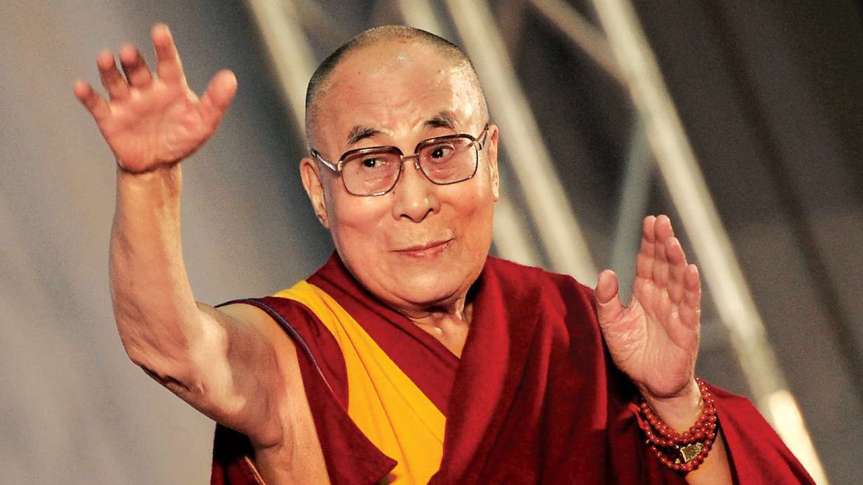
Who is the Dalai Lama?

In Tibetan Buddhism, a ‘Lama’ is a spiritual teacher and ritual expert who fulfils many types of roles for his community, and ‘Dalai’ generally refers to big or mighty. So, the Dalai Lama is a title conferred to the spiritual and political leaders of the Tibetan People. The Dalai Lamas are believed by Tibetan Buddhists to be manifestations of Avalokiteshvara or Chenrezig, the Bodhisattva of compassion and the patron saints of Tibet. Bodhisattvas are realized beings, inspired by the wish to attain complete enlightenment, and who have vowed to be reborn in the world to help all living beings. Throughout much of history, the Dalai Lamas were just as much political leaders as they were spiritual leaders. Tibetan Buddhists believe that the Dalai Lama reincarnates as a child when he dies, and thereby establish a line of successors based on who they identify as the reincarnations of the previous Dalai Lama.

The Current Dalai Lama

Tenzin Gyatso is the 14th and current Dalai Lama of Tibetan Buddhism. He was born on July 6, 1935, to a farming family located in Taktser, Amdo, north-eastern Tibet. He was recognized as the incarnation of the 13th Dalai Lama in 1937, and was thereafter enthroned as the 14th Dalai Lama in 1940. After China’s invasion of Tibet in 1950, His Holiness was vested with full political powers as head of state in Tibet. Using his political power, In 1954 he went to Beijing and met with Mao Zedong and other Chinese leaders to negotiate over China’s invasion of Tibet. Eventually, in 1959, following the brutal suppression of the Tibetan national uprising in Lhasa by Chinese troops, His Holiness was forced to escape into exile for fear of being kidnapped by the Chinese government. Since then, he has been living in Dharamshala, northern India.

The Dalai Lama set up a government-in-exile in Dharamshala, in the Himalayan Mountains. In 1989 he was awarded the Nobel Peace Prize for his non-violent struggle for the liberation of Tibet. He has consistently advocated policies of non-violence, even in the face of extreme aggression. He also became the first Nobel Laureate to be recognized for his concern for global environmental problems. Despite his past as a political leader, in 2011 he gave up his political powers and focused more on religious and ethical teaching.

The succession of the current Dalai Lama is under threat, due to his history of anti-Chinese resistance in Tibet, and the Chinese government has long worked to undermine the Dalai Lama’s authority. They have banned displaying a photo of the Dalai Lama and have launched re-education campaigns that force Tibetan dissenters to disown the Dalai Lama and embrace Chinese authority. In the first decade of the 21st century, the Dalai Lama suggested that his successor could be appointed by him rather than selected as his reincarnation, but this idea was rejected by the Chinese government. The Chinese government declared that the tradition of appointing a new Dalai Lama had to be upheld, as the title of ‘Dalai Lama’ itself is granted by China’s central government. Since 2011, after he stepped down as head of the Tibetan government-in-exile, he has written a number of books on Tibetan Buddhism and an autobiography.

The Future

The current Dalai Lama has gone on record to say that he may be the last Dalai Lama. He stated that the Dalai Lama institution will cease one day, and that there is no guarantee that some incompetent Dalai Lama won’t come next, who will disgrace himself or herself. So, it is much better that a centuries-old tradition should cease to exist at the time of a quite popular Dalai Lama.

Even if the institution continues, the Dalai Lama has stated that no recognition or acceptance should be given to a candidate chosen for political ends by anyone, including those in the People’s Republic of China. In other worlds, the Dalai Lama cannot be chosen as political puppet by anyone, especially China who would benefit from having a candidate that is submissive to their interest. Therefore, on 24 September 2011, clear guidelines for the recognition of the next Dalai Lama were published, leaving no room for doubt or deception.

As of today, the Dalai Lama has still not made his intentions clear, but has said that he will consult leading Lamas of Tibet’s Buddhist traditions, the Tibetan public, and other concerned people with an interest in Tibetan Buddhism to assess whether the institution of the Dalai Lama should continue after him. However, the Chinese government probably has their own plans too. This is an example of politics and religion being intertwined. As a historically political figure, the reincarnation of the Dalai Lama is not just a matter of theology and doctrine, it also has major implications on the future of the Tibetan people and the future of religious freedom rights in China.

Why China Wants To Choose The Next Dalai Lama

Tenzin Gyatso, the 14th Dalai Lama and Tibet’s spiritual leader, will turn 86 years old on July 6, 2021. As the Tibetan spiritual leader becomes older, doubts about his succession resurface. China recently released a white paper demanding that the next Dalai Lama be chosen with Chinese official permission, claiming historical practices.

The Dalai Lama, one of Buddhism’s most known faces, is a significant aspect in disseminating Buddhist teachings to the international population. Senior monastic disciples have historically recognised the Dalai Lama’s successor, relying on spiritual indications and visions. However, the Chinese foreign ministry announced in 2011 that only the Chinese government can choose the next Dalai Lama, and that no other candidate ought to be acknowledged.

CHINESE OPPRESSION AND TIBETAN UNREST

Even after six decades of occupation in Tibet, the Chinese government has failed terribly in its attempts to win the hearts and minds of Tibetans. Tibetans have never used violence in the course of their resistance, no matter what they’ve done.  The selection procedure for the next Dalai Lama is now in limbo. China’s communist regime annexed Tibet in 1950, claiming that it has always belonged to China. The Dalai Lama escaped in 1959 and established an exile administration.

Presently, the Central Tibetan Administration (CTA) is one of the world’s most well-established democratic exile governments. Many refer to it as a “bonsai democracy.” In reality, such an exile setup isn’t really a low-hanging fruit. It was envisaged by Tibet’s Dalai Lama and yielded fruition after six decades.

When he was six years old, the Chinese government arrested the Dalai Lama’s candidate for the 10th Panchen Lama’s successor, Gendun Choeki Nyima, in the year 1995. China has remained tight-lipped regarding his location since then. When the freshly elected 11th Panchen Lama was arrested, the Tibetan people revolted. In response, the Chinese government appointed its own Panchen Lama, the son of a Chinese security officer. Historically, the panchen lamas and dalai lamas have played important roles in identifying each other’s upcoming incarnations.

OPTIONS FOR THE FUTURE

Because of the Chinese threat, the 14th Dalai Lama has made a series of remarks that would make a Chinese-appointed 15th Dalai Lama difficult to regard as genuine.

For instance, he has said that the institution of the Dalai Lama may no longer be required. However, he has also stated that it is up to the people to preserve this part of Tibetan Buddhism and the Dalai Lama lineage. Another possibility offered by the Dalai Lama is to announce his future reincarnation before he dies. In this situation, the Dalai Lama will pass on his spiritual enlightenment to the next Dalai Lama.

Tenzin Gyatso has also stated that if he dies outside of Tibet and the Panchen Lama remains absent, his reincarnation would be found elsewhere, probably in India.Lastly, he has suggested the idea of reincarnating as a woman — although he added in 2015 and 2019 interviews that he’d have to be an extremely attractive lady. After this remark drew considerable criticism in 2019, his staff issued an apology and expression of remorse for the harm he had caused.

The Dalai Lama is certain that no one would accept the Chinese government’s choice. As he has stated, the Tibetan population will never recognize a Chinese-appointed Dalai Lama.

INDIA’S STAKES IN TIBET

The Tibetan elite tended to view the  world through the lens of India, and thousands of Tibetans fled to India as refugees in 1959. Today, India is home to the world’s biggest Tibetan community, with over 75,000 individuals.

Today, India’s land boundaries with China are largely those which exist between India and Tibet. China’s views on India are impacted in many ways by its Tibet policy. If a puppet Dalai Lama emerges from China, India could face significant geopolitical issues. Not only India, but also the entire Himalayan area. It is very likely that China would utilise the ‘Dalai Lama Institution’ as a political tool to encroach on these areas. China is skilled at fabricating tales that even history cannot follow. 

To discourage China’s politicisation of the Dalai Lama and leadership in Buddhism, New Delhi must give the  Dalai Lama more realistic attention, similar to US legislation on Tibet, which explicitly says that China must not intervene in the selection of the next Dalai Lama. So far, India has opted not to intervene in the matter.

Dalai Lama, Panchsheel, Indo-China war 1962

Dalai Lama fled to India on 30 March 1959 as Chinese troops crushed an attempted uprising in Tibet.
India is claiming it’s liberty on the Panchsheel agreement signed on April 1954.

Panchsheel is the five principles of peaceful co existence were first formally enunciated in the agreement on trade and intercourse between the Tibet region of China and India. Panchsheel agreement stated that in its preamble that the two govt have resolved to enter into the present agreement based on the five principles.

1) Mutual Non aggression,

2) Mutual respect for each other territorial integrity,

3) Mutual Non interference,

4) Equality and mutual benefit,

5) Peaceful co existence.

The vision of Panchsheel is the framework not only for relations between India and China but also for their relations with all other countries.

Panchsheel as the principle core of the non aligned movement. Panchsheel continued to be reflected in world events even if there was no conscious attribution, finding, expression in the position of the developing countries in the north-south dialogue and in other groupings.


However in today’s world it is not enough that panchsheel be promoted as an alternative ideology that empowers the less developed. It should be made clear that panchsheel is an ideology for the entire world and is as relevant to the developed countries of the globe as it is to the less developed.

Indo china war also takes place in 1962 many claims its because of Dalai Lama as china wants him back when he fled to India. India claiming it’s liberty on the basis of Panchsheel agreement actually it was a renewed agreement of trade with Tibet, but with a new preface. China decided that the agreement would be renewed every eight years and not 10 years. Then the eight years were over in 1962. So the 1962 indo china war was planned long back in the 1950s. The 1962 war was already planted in the Panchsheel agreement. It has nothing to do with the Dalai Lama.