

World to witness 1st Indian in Space and other Indian in Deep Sea by 2025, says Union Minister Dr. Jitendra Singh on the stage of Bharat 24 News network during his address here today.
Speaking on India’ s progress in Space and Marine sector, Dr. Jitendra Singh shared that four astronauts-three Group Captains and one Wing Commander have been selected for India’s 1st Human Space Mission- Gaganyaan. Similarly, he also shared that India’s Deep-Sea mission will send three Indians to deep sea in 2025.
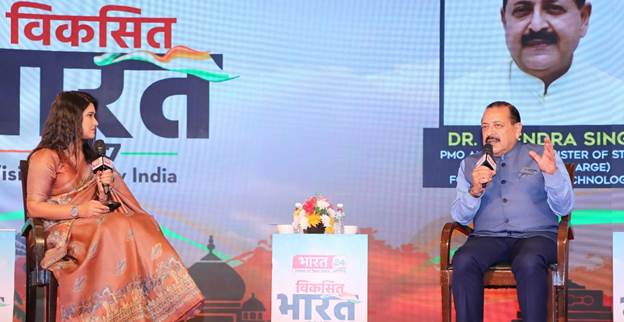
Union Minister Dr. Jitendra Singh at the programme hosted by Bharat 24 News network
During his address highlighting the Development in the Northeast India, Union Minister of State (Independent Charge) for Science and Technology, Minister of State (Independent Charge) for Earth Sciences, MoS PMO, Department of Atomic Energy and Department of Space and MoS Personnel, Public Grievances and Pensions Dr. Jitendra Singh said Infrastructure overhaul in Northeast India in the last decade is the role model of PM Modi’s development.” Going further he recalled the new airports made operational in Northeast. Increase in network of all-weather roads and highways along with remote connectivity. The railways operating trains from Itanagar and new waterways that have been opened. He categorically mentioned that not only in terms of Infrastructure but also in human resources development is commendable as recruiters in the hospitality and aviation industry are now visiting these states for talent acquisition. Going further he stated that Prime Minister is fond of the region and preferred Mizoram to establish a ‘Citrus Fruit Park- A Centre of excellence’ in Mizoram due its favorable conditions.
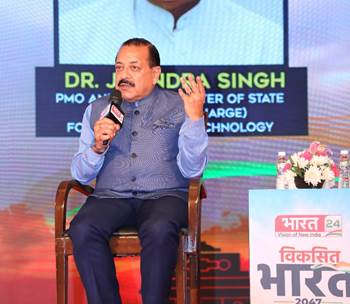
Dr. Jitendra Singh when asked about the progress of Jammu Kashmir in the last decade said “Record number of tourists visiting Kashmir nearly 2.5 crore in the last season is the testimony of development and peace in the region.” He also added that 1 lakh people have already arrived for Amarnath Yatra which also highlights boom in domestic tourism. He also mentioned that terrorism is in its last phase.
The media group congratulated Dr. Jitendra Singh for making a hattrick by winning from Udhampur constituency and also being the Minister for the 3rd time. The Science and Technology Minister recalled the recent progress and shared the path of India’s vision. He said “Space sector is limited to launch rockets and satellites but it will also propel growth and positively impact agriculture, infrastructure, communication, healthcare etc. Land Record management, new geospatial policy, new space policy, and initiatives such as soil health card, DBT, land mapping etc. will boost farmer productivity,”
He said, “In 2022 we had just one space Startup and in 2024 after opening the space sector for private participation we have nearly 200 startups and many among them have global capacity. He also shared that in just few months 1000 crore of Private sector investment has come into Space sector.
Dr. Jitendra Singh said, “India is among the frontline nations in terms quantum technologies as we have National Quantum Mission”. He also highlighted India’s Vast resources which are untapped such as Himalayan resources, Marine Resources of 7500km long coastline. The minister also shared that the government is successful in bringing agriculture and entrepreneurship together by Aroma Mission which promotes lavender cultivation and empowers farmers economically with the help of technology.
*****
 Eduindex
You must be logged in to post a comment.