India is emerging as a leader in sports gaming, a growing field that has fascinated the interest of millennials like never before. The Indian digital gaming industry is growing rapidly with behemoths like Dream11, Mobile Premier League, Junglee Games creating their footprints globally.In the past couple of years, the country has witnessed multiple e-sports startups, namely JetSynthesys, Cobx Gaming, FanMojo, Playtonia and Nodwin Gaming, joining the online gaming space, establishing E-sports as an investor-friendly industry. According to the IFSG-KPMG report, the industry is already worth INR 43.8 billion and is said to reach INR 118.8 billion by FY23 with a growth rate of CAGR 22.1 per cent.
This is to solicit a story on how e-sports platforms are evolving the landscape of sports gaming in India. The primary reason for investors to take an interest in the e-sports section is because India is growing as a sporting nation and the people are taking an interest in building and popularizing leagues for Football, Kabaddi, Hockey, Badminton and other sports.
Why E-sports?
More than often people confuse E-sports with Fantasy gaming. While the former is catching a certain interest, electronic sports are not far behind. This form of video gaming has a professional and competitive nature that is facilitated by an electronic system and is often based on organized multi-player video games.Sports gaming is a growing field in India and E-sports is said to be leveraging the country’s love for real sports. “Watching real sports is a passive activity. You switch on your television or open up your mobile app, sit back and enjoy the game,” Ankush Gera, CEO and Founder of Junglee Games started, adding that Online gaming has recognized India’s love for action by making a passive activity engaging.
“Today’s consumers are no longer satisfied with just clicking a button. They want action. They want to do more. They want to be a part of the experience,” he shared. A leader in skill gaming space with over 10 million users across the globe, Junglee Games has emerged as India’s answer to PUBG. The success story specifies that the growth of Indian E-sports platforms is only limited by the initiative.
The Rise of Esports
Currently, India stands at a global number 17 in the soon-to-be USD 1.5 billion Esports industry. Estimated to be about $818 million, the Indian Esports sector while vastly unstructured, is growing rapidly. The number of online gamers worldwide has increased from 20 million in 2010 to 250 million in 2018, whereas the number of game developing companies has grown from 25 in 2010 to 250 in 2018.The IFSG-KPMG reports suggested that fun and excitement are the primary motivators for 72 per cent users for playing online sports across all age and income groups. For around 81 per cent of respondents, the ‘ability to manage teams virtually’, ‘remain connected with the sport’ and ‘utilization of sports knowledge’ was other important motivators for engagement.
The mass penetration of mobile 4G, triggered by Reliance Jio, has further popularized online gaming sports (along with several other internet services) in the country. Thanks to digital innovation, sports have become more interactive, engaging and fun. However, both the real world and online sports have their own charm.Real-life games have their own adrenaline rush whereas the online community to fulfil their urge to play sports, expressed Asifa Sunar, SVP (Head of Product Quality) of Mobile Premier League. Sharing their idea of E-sports, she stated, “MPL is bridging the gap in terms of access to sports by connecting people online who were left out by the world of physical sports.”
Impact over Sports Viewership
Indians harbour a special love for sports. Cricket, especially, has been treated as more like a religion in India. However, a significant change has been noted in the consumption patterns and genre expansion, formulating a jump in the popularity & viewership of other games such as Kabaddi, Badminton, Wrestling & even Football.
“The popularity of a particular sport depends completely on the achievements of the national level teams,” provided Mujahid Rupani, the Co-founder & CEO, Cobx Gaming, an Indian E-sports company. Traditional sports are losing their appeal for the younger viewers due to the multi-hour formats and length of tournaments, making E-sports attractive for quicker gratification and results.While almost every Indian follows at least one sport and has a point of view on the game, players & team selection. Online gaming platforms are now rewarding them for testing their skills as a team selector or coach. Online gaming platforms give the nation an outlet for what they think sports should look like.
Technology Over Traditional Mediums
“The conventional model of the single-screen broadcast is now only one of the many options at a fans disposal,” provided Sumesh Menon, Co-founder and Group CEO of U2opia Global, the parent company of FanMojo, a homegrown fantasy e-Sports platform that handpicks their players, use their skill to play games, compete and win prize money.Gera argues that Sports gaming does not negate the attraction sports fans have to view the game, in fact, it increases it. “They (Sports viewers) are so much more invested in the performance of the players, (that) watching the match on mobile or catching scores on a mobile app may hold appeal when travelling or busy, the appeal of viewing the match live on a bigger screen is much higher.”
However, he does agree that digital formats might encroach on some market share of traditional media. It would be interesting to see how traditional media adapts to technology. There could be some interesting crossovers between the two formats.
Big players in the market
With a larger appetite for gaming in India, there’s more money moving through the industry, with increased overseas investment and partnership, mostly from China. Alibaba-backed digital payments startup Paytm and Hong Kong’s AGTech Holdings launched a gaming platform Gamepind; Tencent, which has stakes in legendary games like League of Legends, Call of Duty and World of Warcraft, is planning to investin gaming in India this year, and Chinese gaming company Youzu launched local casual strategy games last year. Vietnam-based StomStudio also partnered with mobile game publisher Gamesbond to create mobile games in India.
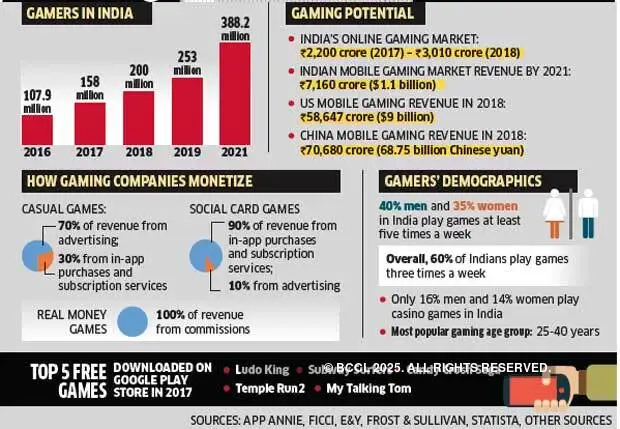
Although most mobile games in India have a very low average revenue per user, except the casino and strategy genre games, Manojh says, “As the market is maturing, the sector has been getting increasing attention from investors, with many startups raising funds to create niche games.”Globally, over the last few years, the games industry has seen free-to-play (F2P) hit the mainstream, tablet and smartphone games have come into the ascendent and we’ve seen Facebook gaming rise and fall, but in India though, F2P business model – in which games can be downloaded for free, but then make money through adverts – continues its growth.Between 2014 and 2016, game downloads in India more than doubled. “In terms of downloads, casual and sports genre games perform very well,” says Manojh. A survey reveals that mobile gaming is part of daily lives of more than one-third Indians — 40% men and 35% women play mobile games at least five days a week.
AI in gaming
There’s no question that there’s more interest than there has ever been. Virtual-reality gaming is also a fast-evolving vertical in the country. Digital advertising is forcing companies to look at gaming in a big way, embedding commercials through games.What makes all of this even more exciting is the introduction of artificial intelligence into gaming. Tech startup Absentia has developed Norah.ai, a AI-powered tool for quick creation and incorporation of all game elements. “Our engine is trained over 40 million data points, it generates variety at each step thereby adding countless number of possibilities to the terrains, 3D models and game play environments among others,” says Shubham Mishra, co-founder of Absentia. “At the click of a button, a fleet of 100 different variants are generated, empowering the developers with more options.”
This means that games developers don’t need to have particularly powerful hardware — they will be able to create assets for games, ranging from story, to animations, and even models quickly, and affordably. And, it’s all adding up to a fast-growing business.


 Eduindex