\’National Girl Child Day: 24 January\’ in India | \’Rashtriya Balika Diwas\’ (219 Words)

In India, \’National Girl Child Day\’ or \’Rashtriya Balika Diwas\’ is observed on 24th January every year. It is a day dedicated towards the welfare of the girl child in India. The day is observed to address the needs and concerns of a girl child’s health, nutrition and education among the masses.

The initiative of setting up this day as a Rashtriya Balika Diwas was undertaken by the Indian Government during 2009. The date 24th marks the day in 1966 when Indira Gandhi became the ‘First Woman Prime Minister of India’. The Ministry of Women and Child Development took the initiative of implementing and organizing the day.

Rashtriya Balika Diwas is a day dedicated towards the welfare of the girl child in India. On this day, many functions and events are organized by the NGOs all over the country. The government ministry participates by organizing functions for the cause along with NGO’s and other organizations. Public speeches are special part of these proceedings. Various state departments of child development, education, health, women, mahila mandals and others also organize functions and exhibitions. Cultural events comprising of song and dance sequence dedicated to the girl child are organized in various concerned institutions. Girl students are honoured for their outstanding achievements in various fields at State level functions organized by the respective departments. 

\’National Girl Child Day: 24 January\’ in India | \’Rashtriya Balika Diwas\’ (219 Words)

In India, \’National Girl Child Day\’ or \’Rashtriya Balika Diwas\’ is observed on 24th January every year. It is a day dedicated towards the welfare of the girl child in India. The day is observed to address the needs and concerns of a girl child’s health, nutrition and education among the masses.

The initiative of setting up this day as a Rashtriya Balika Diwas was undertaken by the Indian Government during 2009. The date 24th marks the day in 1966 when Indira Gandhi became the ‘First Woman Prime Minister of India’. The Ministry of Women and Child Development took the initiative of implementing and organizing the day.

Rashtriya Balika Diwas is a day dedicated towards the welfare of the girl child in India. On this day, many functions and events are organized by the NGOs all over the country. The government ministry participates by organizing functions for the cause along with NGO’s and other organizations. Public speeches are special part of these proceedings. Various state departments of child development, education, health, women, mahila mandals and others also organize functions and exhibitions. Cultural events comprising of song and dance sequence dedicated to the girl child are organized in various concerned institutions. Girl students are honoured for their outstanding achievements in various fields at State level functions organized by the respective departments. 
\’National Girl Child Day: 24 January\’ in India | \’Rashtriya Balika Diwas\’ (219 Words)

In India, \’National Girl Child Day\’ or \’Rashtriya Balika Diwas\’ is observed on 24th January every year. It is a day dedicated towards the welfare of the girl child in India. The day is observed to address the needs and concerns of a girl child’s health, nutrition and education among the masses.

The initiative of setting up this day as a Rashtriya Balika Diwas was undertaken by the Indian Government during 2009. The date 24th marks the day in 1966 when Indira Gandhi became the ‘First Woman Prime Minister of India’. The Ministry of Women and Child Development took the initiative of implementing and organizing the day.

Rashtriya Balika Diwas is a day dedicated towards the welfare of the girl child in India. On this day, many functions and events are organized by the NGOs all over the country. The government ministry participates by organizing functions for the cause along with NGO’s and other organizations. Public speeches are special part of these proceedings. Various state departments of child development, education, health, women, mahila mandals and others also organize functions and exhibitions. Cultural events comprising of song and dance sequence dedicated to the girl child are organized in various concerned institutions. Girl students are honoured for their outstanding achievements in various fields at State level functions organized by the respective departments. 
\’National Girl Child Day: 24 January\’ in India | \’Rashtriya Balika Diwas\’ (219 Words)

In India, \’National Girl Child Day\’ or \’Rashtriya Balika Diwas\’ is observed on 24th January every year. It is a day dedicated towards the welfare of the girl child in India. The day is observed to address the needs and concerns of a girl child’s health, nutrition and education among the masses.

The initiative of setting up this day as a Rashtriya Balika Diwas was undertaken by the Indian Government during 2009. The date 24th marks the day in 1966 when Indira Gandhi became the ‘First Woman Prime Minister of India’. The Ministry of Women and Child Development took the initiative of implementing and organizing the day.

Rashtriya Balika Diwas is a day dedicated towards the welfare of the girl child in India. On this day, many functions and events are organized by the NGOs all over the country. The government ministry participates by organizing functions for the cause along with NGO’s and other organizations. Public speeches are special part of these proceedings. Various state departments of child development, education, health, women, mahila mandals and others also organize functions and exhibitions. Cultural events comprising of song and dance sequence dedicated to the girl child are organized in various concerned institutions. Girl students are honoured for their outstanding achievements in various fields at State level functions organized by the respective departments. 

\’National Girl Child Day: 24 January\’ in India | \’Rashtriya Balika Diwas\’ (219 Words)

In India, \’National Girl Child Day\’ or \’Rashtriya Balika Diwas\’ is observed on 24th January every year. It is a day dedicated towards the welfare of the girl child in India. The day is observed to address the needs and concerns of a girl child’s health, nutrition and education among the masses.

The initiative of setting up this day as a Rashtriya Balika Diwas was undertaken by the Indian Government during 2009. The date 24th marks the day in 1966 when Indira Gandhi became the ‘First Woman Prime Minister of India’. The Ministry of Women and Child Development took the initiative of implementing and organizing the day.

Rashtriya Balika Diwas is a day dedicated towards the welfare of the girl child in India. On this day, many functions and events are organized by the NGOs all over the country. The government ministry participates by organizing functions for the cause along with NGO’s and other organizations. Public speeches are special part of these proceedings. Various state departments of child development, education, health, women, mahila mandals and others also organize functions and exhibitions. Cultural events comprising of song and dance sequence dedicated to the girl child are organized in various concerned institutions. Girl students are honoured for their outstanding achievements in various fields at State level functions organized by the respective departments. 
Short Essay on \’Importance of Advertisements\’ (160 Words)

Advertisements play a vital role in our lives. Advertisements are essential for starting a new business. Promoting sales is the main motive of a large enterprise. Advertisements rule every aspect of our lives and provide a link between an individual and the world.
 
Advertising, by the definition, is a paid form of non-personal communication to promote the goods and services. It simplifies the choice of consumers by creating an awareness among people about several brands and products available in the market. As advertisements help in business expansion, the companies spend crores or millions on them.
 
Advertisements are contained in various means of communication such as magazines, newspapers, television, radio, bill boards etc. Attractive pictures, slogans, taglines etc shown in the advertisements lure customers, thereby pushing up sales.
 
Advertisements are popularized by the government for betterment of the society in the field of education, providing better facilities, housing facilities for poor, medical facilities like polio drops and other vaccines etc. So, we can conclude by saying that advertisements greatly influence our lives. 

Short Essay on \’Importance of Advertisements\’ (160 Words)

Advertisements play a vital role in our lives. Advertisements are essential for starting a new business. Promoting sales is the main motive of a large enterprise. Advertisements rule every aspect of our lives and provide a link between an individual and the world.
 
Advertising, by the definition, is a paid form of non-personal communication to promote the goods and services. It simplifies the choice of consumers by creating an awareness among people about several brands and products available in the market. As advertisements help in business expansion, the companies spend crores or millions on them.
 
Advertisements are contained in various means of communication such as magazines, newspapers, television, radio, bill boards etc. Attractive pictures, slogans, taglines etc shown in the advertisements lure customers, thereby pushing up sales.
 
Advertisements are popularized by the government for betterment of the society in the field of education, providing better facilities, housing facilities for poor, medical facilities like polio drops and other vaccines etc. So, we can conclude by saying that advertisements greatly influence our lives. 

Short Essay on \’Importance of Advertisements\’ (160 Words)

Advertisements play a vital role in our lives. Advertisements are essential for starting a new business. Promoting sales is the main motive of a large enterprise. Advertisements rule every aspect of our lives and provide a link between an individual and the world.
 
Advertising, by the definition, is a paid form of non-personal communication to promote the goods and services. It simplifies the choice of consumers by creating an awareness among people about several brands and products available in the market. As advertisements help in business expansion, the companies spend crores or millions on them.
 
Advertisements are contained in various means of communication such as magazines, newspapers, television, radio, bill boards etc. Attractive pictures, slogans, taglines etc shown in the advertisements lure customers, thereby pushing up sales.
 
Advertisements are popularized by the government for betterment of the society in the field of education, providing better facilities, housing facilities for poor, medical facilities like polio drops and other vaccines etc. So, we can conclude by saying that advertisements greatly influence our lives. 

Short Essay on \’Importance of Advertisements\’ (160 Words)

Advertisements play a vital role in our lives. Advertisements are essential for starting a new business. Promoting sales is the main motive of a large enterprise. Advertisements rule every aspect of our lives and provide a link between an individual and the world.
 
Advertising, by the definition, is a paid form of non-personal communication to promote the goods and services. It simplifies the choice of consumers by creating an awareness among people about several brands and products available in the market. As advertisements help in business expansion, the companies spend crores or millions on them.
 
Advertisements are contained in various means of communication such as magazines, newspapers, television, radio, bill boards etc. Attractive pictures, slogans, taglines etc shown in the advertisements lure customers, thereby pushing up sales.
 
Advertisements are popularized by the government for betterment of the society in the field of education, providing better facilities, housing facilities for poor, medical facilities like polio drops and other vaccines etc. So, we can conclude by saying that advertisements greatly influence our lives. 

Short Essay on \’Importance of Advertisements\’ (160 Words)

Advertisements play a vital role in our lives. Advertisements are essential for starting a new business. Promoting sales is the main motive of a large enterprise. Advertisements rule every aspect of our lives and provide a link between an individual and the world.
 
Advertising, by the definition, is a paid form of non-personal communication to promote the goods and services. It simplifies the choice of consumers by creating an awareness among people about several brands and products available in the market. As advertisements help in business expansion, the companies spend crores or millions on them.
 
Advertisements are contained in various means of communication such as magazines, newspapers, television, radio, bill boards etc. Attractive pictures, slogans, taglines etc shown in the advertisements lure customers, thereby pushing up sales.
 
Advertisements are popularized by the government for betterment of the society in the field of education, providing better facilities, housing facilities for poor, medical facilities like polio drops and other vaccines etc. So, we can conclude by saying that advertisements greatly influence our lives. 

Short Essay on \’Importance of Advertisements\’ (160 Words)

Advertisements play a vital role in our lives. Advertisements are essential for starting a new business. Promoting sales is the main motive of a large enterprise. Advertisements rule every aspect of our lives and provide a link between an individual and the world.
 
Advertising, by the definition, is a paid form of non-personal communication to promote the goods and services. It simplifies the choice of consumers by creating an awareness among people about several brands and products available in the market. As advertisements help in business expansion, the companies spend crores or millions on them.
 
Advertisements are contained in various means of communication such as magazines, newspapers, television, radio, bill boards etc. Attractive pictures, slogans, taglines etc shown in the advertisements lure customers, thereby pushing up sales.
 
Advertisements are popularized by the government for betterment of the society in the field of education, providing better facilities, housing facilities for poor, medical facilities like polio drops and other vaccines etc. So, we can conclude by saying that advertisements greatly influence our lives. 

How To Comment In Social Media – An Infographic Of Tips For High Quality Feedback


Students are writing more than ever before. They are tapping out rapid-fire fingerstrokes across multiple platforms. From text messages to social media, children and adults of all ages are engaging like never before with the written word. This type of transliteracy emphasizes more than ever the need for thoughtful conversations and clear instructions that guide students in how best to express high quality feedback.

Most remarks in the comment sections of Instagram and YouTube are useless. They are either crass or curt, sprinkled with emoji that do more to satisfy the ego of the commenter than to further the richness of the page.

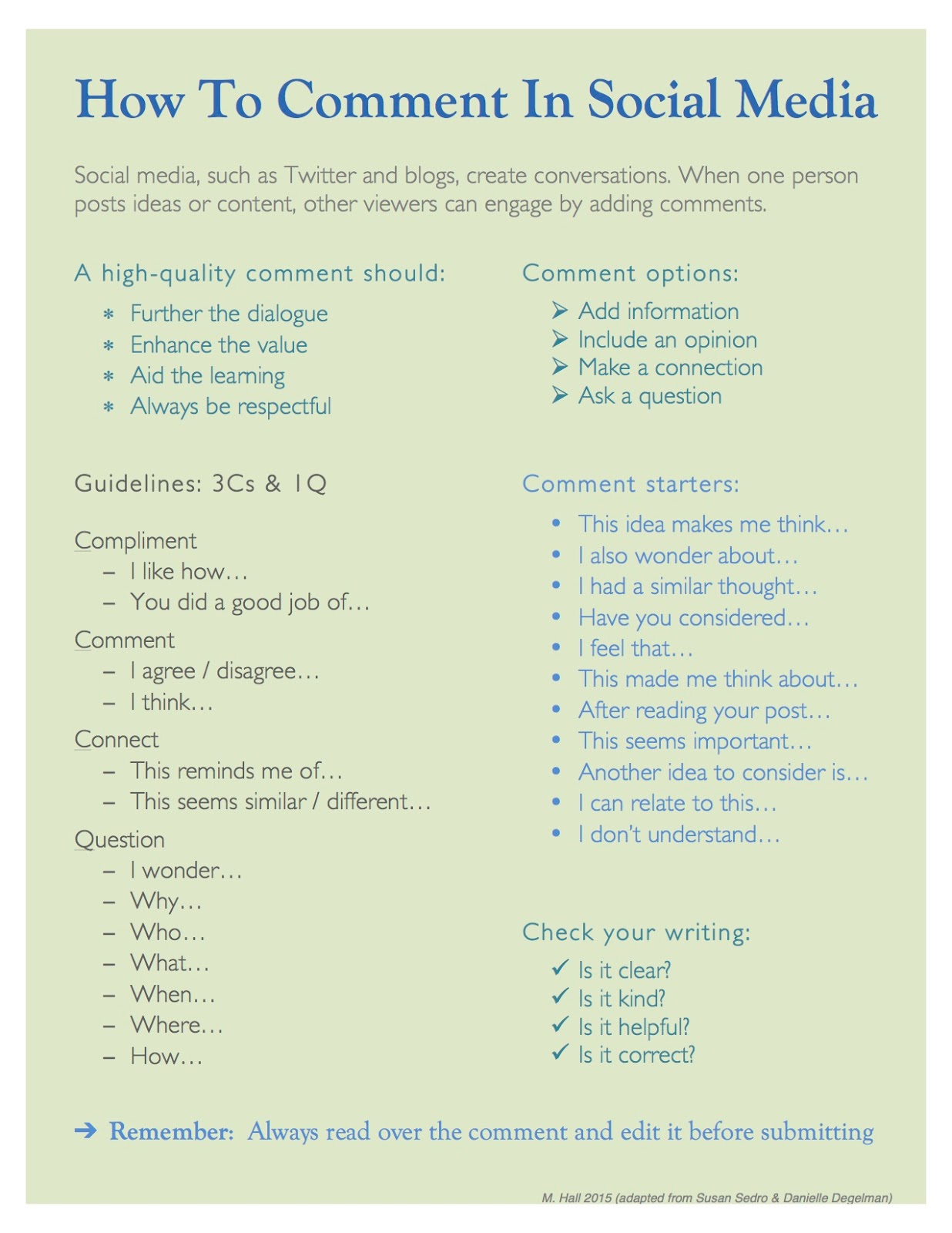
Instead, high quality comments on blogs and social media should create a dialogue that furthers the colloquy and deepens the learning. Replies on Twitter, for example, should offer suggestions or make interpersonal connections. Thoughtful comments in social media should add information, incorporate links, or most importantly, ask questions.

Susan Sedro offers a terrific post about “Teaching Children To Comment On Blogs” on her site, “Adventures In Educational Blogging.” She includes a presentation, a document, and a rubric to help teachers incorporate successful commenting into their lessons. Similarly, Danielle Degelman recently shared on Twitter (@deedegs) a photo of her whiteboard with excellent tips on helping students comment successfully.

We learned a lot from both Sedro’s and Degelman’s suggestions. For our own learners, we combined these two teachers’ ideas with a few of our own to make a handy one-sheet for our students. For example, our seventh-graders used it to exchange feedback via Twitter (#BCDSHist7) on their Thirteen Colonies research projects.

Here is the infographic we made to promote positive engagement through social media:

Student Video Projects In Vine: The Six-Second Constraint Encourages Creativity


Source: Vine

Poets have long considered the sonnet and the quatrain as the highest forms of poetry. The strict meters, the rigid rhyme schemes, and the unbreakable line limits force poets to create elegant verse within exacting structures. In other words, if writers can craft soaring language under such restrictive rules, then they have true talent.

Making Vine videos with students falls into a similar category. Vine is a social network owned by Twitter that allows users to record or upload clips no more than 6.5 seconds in length. With over 200 million users and 1.5 billion daily loops, Vine has created overnight celebrities and has changed the way kids watch, generate, and share content.


The ease of publishing makes Vine a terrific tool for the classroom. The strict time limit of the videos forces students to maximize the pithiness of their messages. In other words, the short videos demand:

  1. Efficiency of narration
  2. Effectiveness of visuals
  3. Concision of message

Students cannot be wasteful in language or vague in communication. They must get their points across succinctly and above all creatively. They are compelled to invent novel ways to pack a lot of meaning into a tight space.


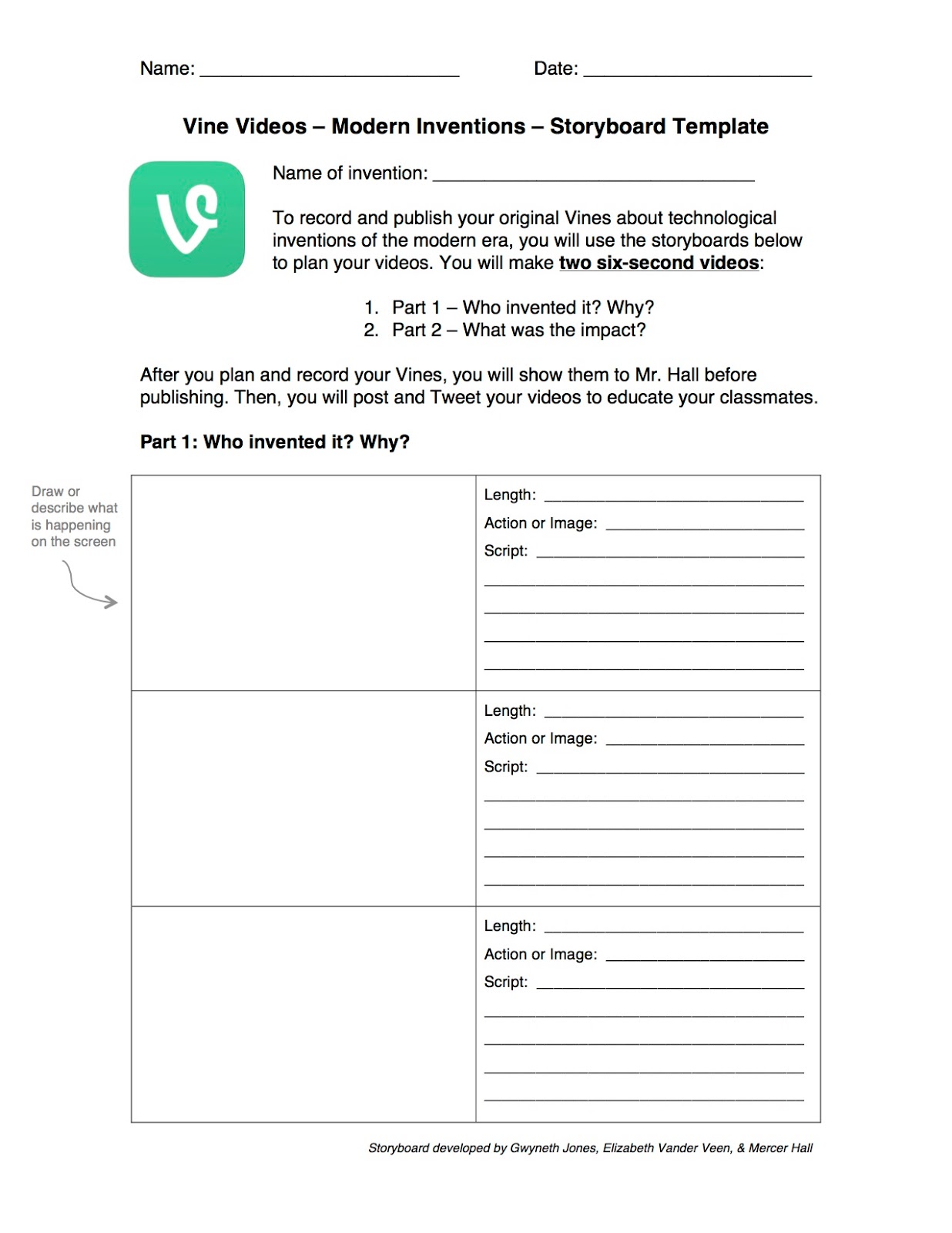
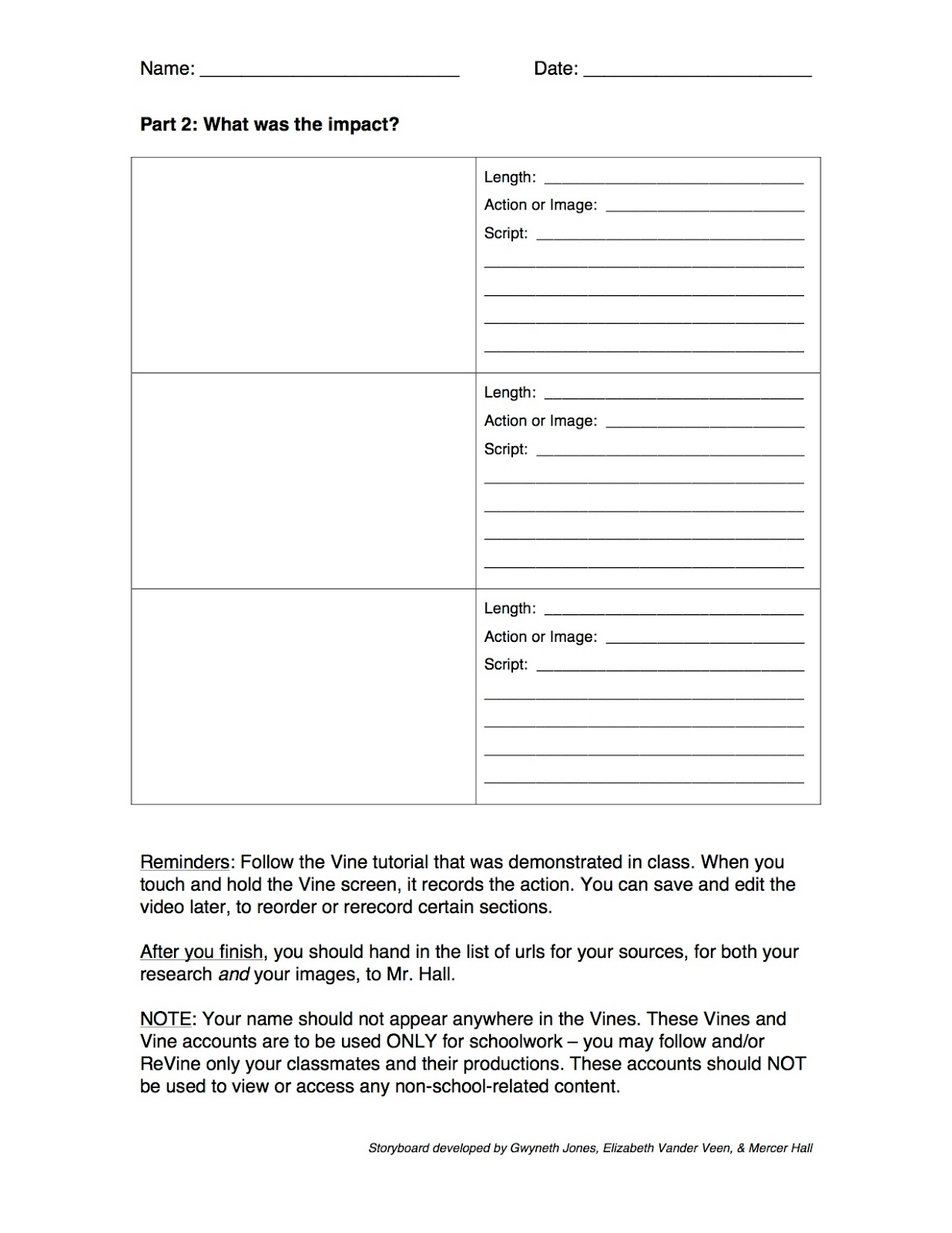
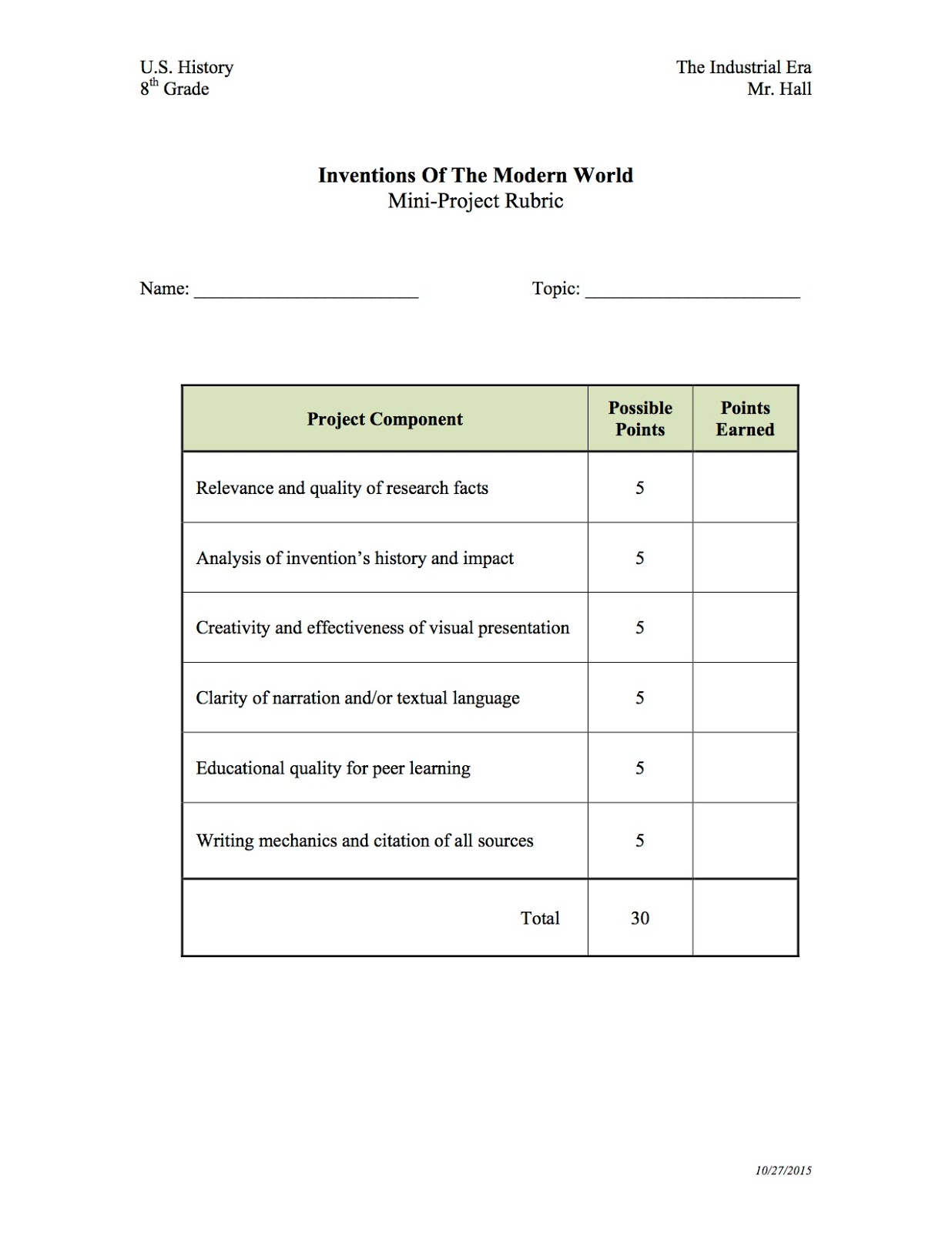
For example, our eighth-graders have been studying how technology and inventions transformed society in the late 1800s. We, therefore, invited them to conduct a mini-research project about modern inventions in the contemporary era that have similarly revolutionized daily life. Our instructions, storyboards, and rubrics are included in this post. We have also included several examples of the innovative approaches that students took to produce these brief films. For other ideas about incorporating Vine in the classroom, check out 20 Ways To Use Twitter’s Vine In Education.

As with all social media, there is plenty of content on Vine that would not be appropriate for all ages. That is why digital citizenship needs to be a crucial partner with digital publishing. As with all online activities, educators need to encourage students to be their own filters, to use their own good judgment in engaging with social media.

Social Media Is An Opportunity – Not A Problem In The Classroom

Source: ASIDE 2015


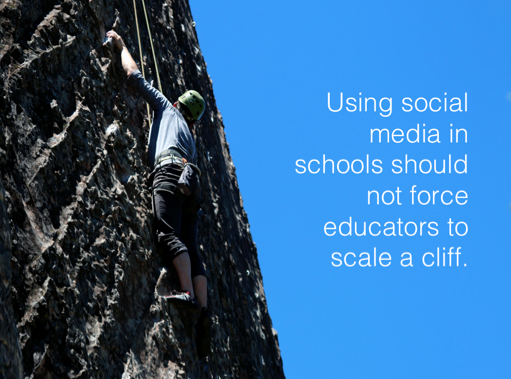
The resolute attitude of many schools to resist the “Social Age” by blocking websites within their walls strikes at the core of what it means to collectively share ideas. The system seems stuck in the notion that kids will do bad things if they have access to social media. Hello! They have access to it anyway, just not in school. We shake our heads every time we hear educators who want to share digital projects but can’t because of a school’s firewall. Some educators depend on the very students they teach to share when the leave the building in order to promote their work.

Source: ASIDE 2015

We value the opportunities at our disposal for creating digital portfolios with our students, running Tumblr pages for the humanitiesmaps, and classwork, using Twitter (@BCDS_History_56@BCDS_History_78>)and Kidblog, and sharing through Padlet to engage in the open practice of real-life skills.

Social media is not the culprit. In this day and age, digital environments are not separate from physical environments. If we want our students to understand the importance of building a healthy, digital footprint for prospective college applications and employment, then practice is imperative. It can’t be taught from a book.

Source: ASIDE 2015

Like other educators, we see the value in using social media. We are fortunate to work in a school that believes students learn by actively and responsibly participating in an online community of practice. We firmly believe that learning communities that allow students to use social media in their education build stronger digital citizens. They also encourage parents to be more proactive in the online behavior of their children by participating as digital partners.

We made a passionate plea to educators in our presentation, entitled “Tear Down This Firewall: Using Social Media To Engage Students And Parents,” at the annual NYSCATE conference. We showed multiple ways that we have incorporated social media in the elementary and middle school classrooms, as well as demonstrated how the skills learned from social media include context, framing, information, perspective, questioning, and problem-solving. We hope the solid foundation in instruction behind our students’ work will provide motivation for others to approach their administrations to unblock valuable web resources for learning. We included our SlideShare presentation here.

Tear Down This Firewall: Using Social Media To Engage Students & Parents from The American Society For Innovation Design In Education

The value of modeling, practicing, and incorporating social media into the curricula to better educate learners for a world that exists now is vital to their development. It builds the collectiveness of the community and a trusted bond between all participants, including administrators, faculty, students, and parents. Most importantly, it takes the fear out of the equation.

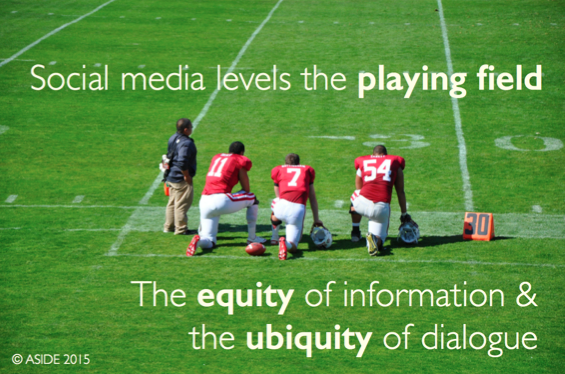
 In 2010, Rachel Botsam coined the term “collaborative consumption” in her critically acclaimed book, What’s Mine is Yours: How Collaborative Consumption is Changing the Way We Live. The theory of “collaborative consumption” is the reinvention of traditional market behaviors that are taking place at a rate not seen before as a result of technology. These changes affect more than just the economy; they influence and disrupt traditional learning environments as well. It shouldn’t be a “Them vs. Us” mentality; instead, it should build a collaborative network of makingsharing, and responding.

Source: ASIDE 2015

Yet despite this social revolution in an on-demand, real-time world, schools are still resistant to change, even though educators try desperately to show the value of collaborative work by using social networking.

As for the students, the firewalls may not be crumbling yet inside the bricks and mortar, but outside, learning takes on a life of its own, unfiltered without restrictions. They hunt and gather wherever they can, and technology has opened that door.

Students need to construct their social capital through shared networks, and schools need to participate in building it, not restricting it.

For other resources please see:

The 5 Best STEM Animations For 2016

Source: scenes.https://vimeo.com/126733859WWF Brazil – Marine Program


2015 was a banner year for animations to engage students. These dynamic explainer videos proved definitively that print textbooks cannot keep up with educational, up-to-date motion graphics, especially in the sciences.

The sphere of subjects that fall into STEM’s orbit keeps expanding. For better or for worse, K-12 courses are now binarly split into either “STEM” or “Humanities” categories. We would argue that this bifurcation is harmful, erasing the natural overlaps between the sciences and the liberal arts.

The effect, however, is that more and more designers and educators are creating brilliant interactive companions to traditional learning. Here are five favorite animations from the past year that will allow science and math teachers (as well as those in the Humanities) to kick off 2016 with a bang:

1. Math


This lively explainer video from Vox offers a primer in chart theory, as well as a caveat for undiscerning viewers of graphs. Entitled “Shut Up About The Y-Axis. It Shouldn’t Always Start At Zero,” the clip reminds math students that context is key in both reading and creating data graphics.

2. Environmental & Marine Science


B- Marine Program from scenes. on Vimeo.

This beautiful stop-motion animation offers a moving case study about the effects of urbanization on pollution. The “WWF Brazil – Marine Program” video, made in collaboration between scenes. and Wildgroeiers, highlights critical issues of conservation and biodiversity for any age group.

3. Astronomy


BC Earth has designed a clear and compelling motion graphic to emphasize the size of the universe and the speed of earth’s galactic travels. The 3D visualization employs time and scale to bring astrophysics to life.

4. Oceanography & Earth Science

Source: Cameron Beccario


Software engineer Cameron Beccario (@cambecc) has programmed a stunning representation of the earth’s weather conditions. With regularly updated ocean currents, waves, temperatures, and anomalies, this interactive globe allows students to zoom in and rotate a la Google Earth. The educational opportunities range from oceanographers analyzing climate change to historians studying ancient trade routes.

5. Medicine


Source: The Washington Post


The recent Ebola panic prompted The Washington Post to create this precise simulation that compares the disease’s spread to other historical pandemics. Although the original interactive graphic pre-dates 2015, the updates are important to medical students and social scientists who are trying to track contraction, infection, transmission, and vaccination.

Honorable Mention: Ecology & Forestry


This seemingly simple motion graphic by Nature Video brings into startling relief the rate of global deforestation. Researchers made 421,529 separate measurements around the world to produce an irrefutable data-driven image of the changing planet.

For more resources, take a look at last year’s five best animations, or some of our other posts about animations in the classroom: