
Teams are they more innovative and fun

Thank goodness for Leigh and his ability to keep us updated with the latest developments. The BBC interview where Peter Day talks to Professor Lynda Gratton of the London Business School was very interesting. Prof Gratton believes that good teamwork is what will make companies successful in the 21st century.

I like the ideas they were discussing e.g ignite teams with \”big questions\” to explore and solve – innovative teams are where there is a small core of people and \”volunteers\” come in because they are passionate about the project. Hence a team leader\’s role becomes not so much to direct and choose and but to inspire. The ability to cooperate is the most important characteristic for people to have in modern times so they can work collaboratively in teams. The focus is on the good of the team not on the individual\’s needs. Also the ability to be able to make connections with others, locally and globally. Graduates with these attributes are highly sought after in big companies.

People in a business if left to their own devices will sign up to project teams which excite and inspire them. eg. Google. Innovation is created when people who are very different share their ideas and they often do not agree with each other but they can cooperate.

So perhaps the idea of the teams and committees we have in the poly may not be the best for cohesion and for spreading the passion eg. the quality in teaching team was chosen – perhaps if people were invited to join and did so because of their passion about quality in teaching and learning, a very different mix would have been created, perhaps a more innovative (no offence meant here) combination may have been achieved. Having \”experts\” or higher levels of staff on a team is not necessarily more productive and effective – you need people to challenge because they have a different perspective.

Big teams can be very productive and everyone has the chance to shine. Gender and ethnicity mixed teams are much more productive. Some of the examples discussed were interesting such as Google, Nokia, BP and a Scottish bank. If they can do it surely we can as well.

One of the things which made my job in eLearning more exciting in the early days was the collaborative projects and networks I was involved in. Being able to have the freedom and autonomy to choose projects means I can be part of several teams, and I have learned so much from working collaboratively. The networked learning team is an excellent example of a collaborative association where ideas are discussed and shared, and people join because they are passionate about the area and want to develop resources to share with students and staff alike.

Now we have the Digital Information Literacy project and collaboration across Otago Polytechnic, Manukau Institute of Technology, University of Otago and Massey University. Watch this space for the project wiki page – it will be appearing soon.
Open educational resources

 The importance of our relationship with WikiEducator and the significance of open educational resources (OER) is really beginning to sink in. We are part of a vision and it rocks!

I attended a DEANZ web-conference (Elluminate) presentation by Wayne MacKintosh from the Commonwealth of Learning today – WikiEducator: DE reincarnated or new innovation? I realised after Wayne mentioned how Otago Polytechnic was a leader in OER in NZ, how far behind other organisations actually are in this area. The whole thing has taken on a life of its own since we started developing courses on WikiEd.

I agree with Wayne the structure of WikiEd does enhance asynchronous interaction. For one thing in the Designing for Flexible Learning course, participants can study self-paced using the course schedule as a guide, and they can leave each other messages in the Discussion (Talk) area. So far I haven\’t experienced many students using the wiki collaboratively though some participants in the Facilitating Online Communities did create pages for an assignment though I am not sure what will happen in the next iteration.

Wayne mentioned that social phenomenon of our time – Wikipedia – and how well it does in providing free access to the sum of our human knowledge – well it is the largest encyclopedia in the history of human kind. Well it is looking like WikiEd might be getting even bigger. Their strategy of access to free education for all countries by 2015 is phenomenal and worthy of our attention. He explained how community is pivotal – and involves content, capacity, connections;
sustainability is important for the OER project or they will fail.

Some stats
More than half of the registered users on WikiEd are over 50 yrs, and the majority are educators. Wayne\’s slide show has all the detail. A very interesting statistic – 12% of Wikied users are actively editing whereas in Wikipedia only 3% of the users are active editors – probably because more people access it than develop the articles. WikiEd is the first wiki platform to enable generation of pdf from wiki pages. There is also a facility to generate content cartridges of wiki pages for importation into LMS. And last but not least – Learning4content – is the largest wiki training initiative in the world.

WikiEd team
graphic designer
learning designer
critical reader
editor
subject matter expert

A return to tradition 
There are several levels of certification available following training:
wikiapprentice
wikibuddy
wikiartisan
wikitrainer
wikimaster

It is possible to get certification loaded on your user page after having done the training; maybe I will work harder on getting this. One thing I do need to do is create a decent profile page. Leigh has been nagging me for ages to do this.

In the future, WikiEd is looking at developing the extra capability of exporting an IMS package. It enables direct import of content to LMS without creation of a cartridge. Not sure why this is necessary but I guess it will satisfy people who are unwilling to share and feel cheated if others use their content.

A school initiative is racking up the action: http://wikieducator.org/Handouts4Teachers. Another school example – http://wikieducator.org/Biology_in_elementary_schools. There is a big opportunity for us to work with schools in helping them develop content on wikiEd. I wonder if the push is still there to do this? Not being on Academic Board any more I don\’t hear about these things and the info is not filtering to us.

Utah state is going to create an open school – an OER handbook is being developed to help educators create OERs. Perhaps they could use some of the stuff we have developed on digital information literacy on the WikiEd platform and which we are using in the Digital Information Literacy project also located on WikiEd. ….so much to do and so little time.

It was a good presentation and although discussion was slow and had that halted factor due to the \”push to talk\” feature of Elluminate, I was glad I made the time to attend. It has motivated, mortified and made me petrified….will I ever get my thesis written?

HERDSA conference – Rotorua

Traveling to Rotorua for the Herdsa 2008 conference was a smooth hop to Christchurch and Rotorua. The first day we spent in the eLearning Guidelines workshop sharing our project experiences with the other project leaders. I was pretty proud of the poster created by Sunshine – spot the one with the arrow below. The vertical brochures looked great as well. NorthTec\’s poster was pretty good as well – very little text, eye-catching and with a separate handout, an A4 brochure with all the info about the project. More on this later…

The highlights at HERDSA 2008 were the key note speakers – Dr Pita Sharples, Dr Barbara Holland, Judith Ramaley, Dr Stuart Middleton and Dr Etienne Wenger – and the Inquiry-based research workshop. I will concentrate on the key note presenters in this post and do another post around the IBL presentation.
  1. Dr Pita Sharples spoke at the Powhiri and shared his perspectives on Maori learners and participation – it is okay to take a long time to get your education – he did. His talk was enjoyable and set the scene for the conference about disadvantaged learners such as Maori, however, only the keynotes addressed this area with regard to engagement, and I only attended one presentation which dealt with this – Selena Chan (given by Nick) and the use of mobile technologies so that bakery students had access to resources. A lot of speakers spoke about engagement and communities of practice, but not about access and equity and diversity. Dr Sharples spoke about the importance of “language nests” for Maori children and also schools where they could carry on the learning. Taking children from Te Kohanga Reo and putting them in mainstream schools did not work. Te Wananga were another advance for improving the participation of Maori students.
  2. Dr Barbara Holland – spoke about communities of engagement. She mentioned how contemporary students crave active and experiential learning eg mobile learning and social networking – I was curious and want to investigate the research on this. She suggested a conference – International Service-Learning conference – Hong Kong 2009. There are different perspectives on what engagement with the community means. For example, an exchange of ideas and information is heading towards engagement, whereas Incubators, continuing education, internships and clinical work which are work-integrated and which promote networking are examples of community engagement. In other words engagement is connected learning and discovery. Dr Holland framed this as community-based learning which enables participants to explore their interests leading to greater self-esteem, motivation, engagement, empowerment. I liked the ideas Dr Holland put forward, as the theoretical basis of a practical framework which Judith Ramaley explained later on. However in vocational education community-based learning is not new. Certainly in nursing and other health professions there is a strong connection with professional communities which is linked to learning objectives and reflection. The development of academic/clinical positions in the School of Nursing at Otago Polytechnic has been dually beneficial. I wonder if they still exist?

  3. Judith Ramaley – was charming and funny as she spoke about how a framework of engagement in an organisation can lead to transformative change where “adaptive expertise” is foremost. That is proponents have the capacity to “learn on the job” and solve problems creatively as they arise. Anyone and everyone can lead change as people work together collaboratively using inquiry and emotional learning to form communities of practice. I particularly liked her analogy to social networking where “institutions become equivalent to a social network or open source model in which anyone may offer suggestions, contribute to advancing the institution and feel an integral part of the enterprise as a whole” – a “transformational change dynamic”. It is not a top down model and I believe OP has the beginnings of this capacity although our managers are immersed in a model of strategic change. The work we are doing with the Commonwealth of Learning through WikiEducator is an example of community-based learning and this is being led from the “coal-face”. It is disruptive, complex and collaborative and transformative for anyone who becomes involved and capacity is building around the nexus of open educational resources (Holland & Ramaley, 2008, p45). References: Holland B. & Ramaley, J. (2008). Creating a Supportive Environment for Community- University Engagement: Conceptual Frameworks. HERDSA Annual Conference 2008 Proceedings, p33-47.

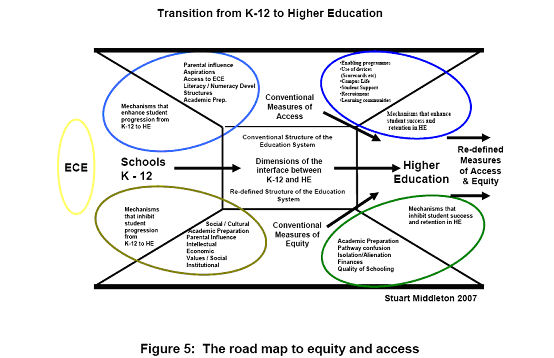
  4. Dr Stuart Middleton – was also funny and it was obvious he was not very impressed by politicians and the impact of government policies on access to education. We now have a situation where education has become more academic and has lost flexibility – the one size fits all approach means there is no longer a differentiated curriculum. The result is that disengagement is now occurring, and even though there is growth in education a large number of people turning are turning their backs on education and there are serious skills shortages. He likened the educational system to a nut which was resistant to change (the nut cracker), with disengagement showing up as one of the cracks as the arms of the nut cracker (changing demographics and economies) squeezed the nut. As Dr Middleton said, “Given the filters of failure that currently operate within education up to the point of entry into further and higher education, the group that presents itself for postsecondary education has become such a distorted reflection of the community that even the most carefully attentive and sensitive selection procedures would simply not achieve equity nor provide access for a majority of students.” We have a “leaky education system” with large numbers dropping out of secondary school, truant and leaving with no qualifications. Maori participation has increased thanks to the Te Wanangas, however, participation and completion rates in mainstream universities continue to be low. The diagram below depicts equity and access, and shows where some of the cracks lie in the transition from secondary to higher education. I will link to the paper once the proceedings are online. In the not too distant future, white Europeans will be in the minority so those groups of learners who have traditionally been under-represented are increasing, meaning HE needs to work differently. For example, the Pacific Island population is predicted to increase to make up 51% of the population in Auckland in the next five years. He also referred to examples in the literature around student retention and success stating, “Supporting students is critical to their success”.
Dr Middleton’s presentation was very powerful and I particularly liked the following quotes: “Simply by sailing in a new direction, you could change the world” (Curnow). “We have to be careful not to cross a crevasse in two steps” (Middleton), this was regarding the new funding regime – which he believes is a good move as we have moved away from the previous system but it is happening too quickly. For example, the Adult Community Education funding should never have been dismantled as 40% of people participating in Community Learning Centres in Auckland go on to HE. And the best quote, “Resources have to be distributed unevenly when the need is uneven” (Middleton).
5. Dr Etienne Wenger – rearranged the main venue and put us in circles facing each other. This was tricky for some who were unable to nod off, though believe it or not, they tried. Etienne tried to engage the audience in reflection on some of the presentations about Communities of Practice which worked a little but people had come to hear his wisdom and they were tired from the conference dinner and dancing so not particularly responsive and there was no real discussion. Personally I would have liked to hear more about his new theories and frameworks for COPs, but apparently this would have repeated his workshop. There were a couple of good diagrams about the social discipline of learning, an approach also
covered in his latest book, so I hope the diagrams will appear on the conference web site
soon. 
The conference was closed by Rotorua\’s Deputy Mayor and his closing speech and prayer sent us on our way after he led a rendition of pokare kare ana.

CCK08 – complexity theory we are everything and nothing

This week\’s topic in the connectivism course gave me permission to engage as it relates really closely to my Doctorate interests. Although I cannot test the theory I hope to include something about it in the discussion. here is the post I sent to the email forum.

people might be interested in Phelp\’s 2003 report of action research done on \”the development of one tertiary course in computer education for pre-service teachers\”. It is a great practical example of the importance of working with complexity rather than trying to put our students into boxes – and striving to meet pre-determined objectives.

It helps to illustrate an answer to George Siemen\’s (2008) questions – \”Consider learning outcomes created at the start of a course. Can we really ensure they are achieved? Can the complexity of learning be reduced to six or eight broad statements? Many educators feel that outcomes can be achieved. What is overlooked, however, is that much more than planned outcomes are experienced by learners.\”

Complexity of learning in my view cannot be reduced to \”six or eight broad statements\” and if students are given freedom, they will indeed learn more than they or the teacher ever imagined…..if they engage of course.

In Phelp\’s research, \”students were prompted to set themselves appropriate goals and were then challenged to engage with content most relevant to them\”. they engaged in self-directed and scaffolded learning which was authentic and relevant to each student. plus they took their learning to a metacognitive level. well worth a read. however it did happen over three years BUT like a good cheese, learning takes time…so pre-packaged, quick-fix, unit-standard-type courses probably don\’t cut it for real learning….well not in the long run. they serve a purpose perhaps to get black and white standards across eg. food safety, how to fly a plane etc. but if you do not really understand why it is important not to clean the cheese (yes the cheese theme is rife today) in dirty dish water, the complexity of life starts to confuse the unit-standard educated worker. We have to help teach people to think don\’t we?

However according to this Buddhist saying by Hsin Hsin Ming – thinking might not be so hot! I was interested in looking at something from the Buddhist tradition due to my husband\’s talk of Zen and the belief that we are both everything and nothing. also the post by Tech Ticker about Buddhism and complexity theory \” Everything, they say, is related and dependant. Nothing is independent.\” It is hard to be everything and nothing is it not?

To deny the reality of things is to miss their reality;
to assert the emptiness of things is to miss their reality.
The more you talk and think about it, the further astray you wander from the truth.
Stop talking and thinking and there is nothing you will not be able to know.
Hsin Hsin Ming

Online communities – what are they? Who makes them – A mouse or a (wo)man?

The topic of the next two weeks is one I am intrigued to follow as I want to see what everyone\’s take on an online community actually is. Two questions up front and you can read about how I reached them further on:

What do others think?

  • Can an online community thrive through commensurate (equal) facilitation and and symbiotic (feed off each other) relationships, or do you need one person or several people to take on leadership roles to make it work well?
  • How important is the platform chosen for the online community?

So how did I get to these questions? To start with on the email forum, I found that I agreed with Bronwyn Stuckey\’s example about learning.

\”For me a worrying area is when people call a class of learners a CoP and say that learning is the practice. That is really too large and amorphous to be one practice. A class of students learning accounting by engaging in scenarios as practitioners, possibly with real practitioners in the class as mentors is beginning to take on a CoP approach. According to what you state this course is not a community of practice of online facilitators. We\’re going there. \”

Already the email forum discussion has helped us to see the differences between online communities and CoPs and some belive there is not actually a difference.

I believe there is a difference. However surely an online community is \”what you make it\”. Certainly it can turn into a CoP if it is not already one. Sylvia Currie mentions, \”often communities evolve from interest — to learning — to practice. is it developmental\”. Perhaps it is but is it as simple as it seems?

The model of Virtual Community brought to us by Greg Barcelon via Violeta mentions that a Virtual Community exhibits – Responsibility, sharing, celebration – in other words members take the initiative, and they have enjoyment while sharing their ideas and knowledge. As Russ says, \”we need to understand the way the community functions\”. Plus a virtual community can be comprised of groups and is usually interwoven by networks (Bee). This is quite nice but is it too simplistic?

Isn\’t an online community not just about the participants in it, but also about the ways in which participants interact, and the platforms they use to interact?

For example, as many of you already know, and others will find out as you progress through the course there is a multitude of online community platforms – Second Life, FaceBook, MySpace, Google Groups, wikis, blogs, online games etc, etc, etc. Additionally, some platforms can kill a community as mentioned in Sheryl Nussbaum-Beach\’s blog post – The Art of Building Virtual Communities – if they are not right for the community.

Therefore if a platform is chosen which does not work for the community, then does this mean that the participants and/or facilitators do not have an adequate understanding of the community or that the platform is at fault? Sheryl also appears to make no distinction between online communities and CoPs.

There is some interesting stuff on Sheryl\’s post about Member Roles, What makes a healthy community and Derek Wenmouth\’s The 4 Cs of Participation in Online Communities for blogs. It is an extension and new take on Gilly Salmon\’s Five-step Model for e-moderation.

According to Greg Barcelon\’s take on virtual communities everyone is in it together and leadership is not important but is it? Is he just referring to active participation and not leadership? According to the writing by Sheryl Nussbaum-Beach, both her and Etienne Wenger believe that leadership is essential.

Bronwyn Stuckey in her post refers to opportunities for leadership as important:
\”the opportunity to step up and step into roles – that this event provided. And ..the shared sense of the value of being together – that evolved through the activity\” 
So maybe we need to do what the fellow in the pic is doing, and take charge of the situation and go for it if we are to create an online community around the subject of this course – online facilitation. I am looking forward to reading more people\’s opinions about online communities.

Pros and cons of assessing online discussions

It was a privilege to be able to run a 40 minute session as part of the Staff Development day at Otago Polytechnic on Thursday 5 February. The title of my presentation – Pros and cons of assessing online discussions – attracted 19 hardy souls, most of whom are already using online strategies for their teaching as well as some who are venturing into the area. It was excellent to hear what sort of online discussions people were using and how they were assessing; not all were and some were in the early stages of planning their approach.
I have uploaded audio with the presentation on Myplick – Pros and cons of assessing online discussions – so people can have another listen and review the session, and also so people who could not make the session, can get catch some of the debate around the area of assessing online discussions. Extra resources and references for the session can be found on the Flexible learning wiki page. Feel free to add other material you find on the topic which you would like to share.

In my next post, I will write about my beliefs and experiences, but firstly, people might like to take 20 minutes out to view the presentation to listen to some information about the different viewpoints and examples. There are lots of things to consider before going down the \’rocky road\’. It is important to make the right choice for your teaching context and to provide the best option for your students. Otherwise instead of ending up in a rolling green valley where you can lie around feeling happy, you may end up trying to scrabble out of a deep, dark cavern. Scared…no its not that bad, but in the best interests of your time and the implications on your workload and that of your students, it is best to get it pretty much right first time.

The last few weeks

Over the last few weeks I have been running close to the wind with my teaching and educational development work. The following things have been happening.
Evaluation of eLearning for Best Practice online course
The Evaluation of eLearning for Best Practice online course in its 5th week now has 18 participants, the majority of whom are pretty active bloggers so I am being kept pretty busy. 
Flexible learning course
On 18 March, Leigh and I ran the first workshop for the Flexible learning course and had really good attendance face-to-face. We also connected two participants on a web conference which did not work as well as it would have with a proper mic – next time. Jacinda spoke to the group about the library facilities and is going to run a session on the 9 April 1.30-2.30 in BG1 (back room ground floor) at the Bill Robertson library – to show people how to search effectively using the online databases and Google Scholar. The library now has a snappy piece of software (can\’t remember th name) which connects people directly from Google Scholar to the databases available at the Bill Robertson library.

I am organising a presentation for a week\’s time on preparing effective blog posts for this course. I will run an experiential session on how to write effectively for a blog in this course – 2 April 1-3pm in H311. This will also be offered in an online session – 8 April 7 – 8 pm. Some sites to look at before the session:

  • 10 tips on writing a blog post
  • My PLE is like my cooky baking (PLE = personal learning environment) – a good example of a post by Sarah Stewart.

Reflective practice lectures
I have given two lectures on reflective practice to two groups of undergraduate nurses – first year and third year. They have similarities, however, the presentation to first year nurses has more detail about reflection and reflective practice. The third years gave me applause so I must have done something right. Both groups in the main were pretty responsive to the Three-Step Reflective Framework and I have modified the template for use when writing about critical incidents in the health area.

Staff Development conference
The April Staff Development conference is shaping up with several submissions for presentations. The conference website has been incorporated with the EDC events blog. We now have four streams: sustainability, self-care, teaching and learning and effective use of technology. There are still some invited speakers to be confirmed. There will be one invited speaker per theme and each will be followed by a panel of speakers under the same stream. The next phase is to check the overviews and the Presenter Working Group is on to that job, and Catherine has set up a marvellous spreadsheet to collate all the information. This will be used to create a schedule.

Apart from this I am still advising staff regarding e-portfolios and online learning as well as the other projects I have on the go. Digital Information Literacy (DIL) research project and HIV/AIDS course development with Colette Blockley.

Technology in the Classroom: How to Assess Writing

If you’re like most teachers, teaching the craft of writing is a task that goes across multiple educational platforms: A history teacher for instance, must instruct on how to write a five-paragraph essay, synonyms, plan-revise-edit-rewrite, persuasive essays, letter writing, and more.
With this in mind, today on TeachHUB.com, frequent contributing writer Jacqui Murray, who is a seasoned technology teacher based in Northern California, takes a look at how to use technology in the classroom to assess writing.
Jacqui begins by calling out what writing brings about, including:
  • Conduct research based on focused questions that demonstrate understanding of the subject.
  • Gather relevant information, assess the credibility and accuracy of each source, and integrate the information while avoiding plagiarism.
  • Draw evidence from literary or informational texts to support analysis, reflection, and research.
  • Write routinely for a range of tasks, purposes, and audiences.
She also notes what shouldn’t be assessed when grading writing, including:
  • Ability to catch typos: Even excellent typists make typos. Don\’t let keyboarding errors affect a writing grade. You may assess keyboarding as a separate skill, deducting from the final grade for each mistake, but don\’t blend that into the writing grade. 
  • Skill with technology: If a writing project requires a student to create a digital timeline, trifold, or poster, don\’t assess how well they blend colors, use tools, or mash up apps. That\’s a separate skill. You want to only assess how well they communicate ideas.
Jacqui sums up her article like this: “By mentally removing the detractors that obfuscate good writing and providing students with the tools they require to communicate in the manner best suited to them, writing assessment becomes more authentic, granular, dynamic, and personalized.”

Curriculum Compacting Teaching Strategies

Although as teachers we often spend our time making sure that everyone can grasp what we’re teaching about, oftentimes we have kids in our classes who have already mastered the curriculum. So what teaching strategies do we use to reach those that already know what we’re instructing?
Today on TeachHUB.com, we examine those teaching strategies we can use to hopefully challenge the gifted kids who are at risk of becoming bored in our classes. Our centerpiece article, penned by frequent contributing writer Janelle Cox, looks at curriculum compacting, or a pace-based method that can engage kids who have already mastered what we’re teaching.
Janelle suggests we first identify kids who are already familiar with our upcoming subject matter. How do we do that? A potential student:
·       Finishes tasks quickly.
·       Appears bored during instruction.
·       Finishes assignments first.
·       Is performing high academically in more than one area.
Janelle offers up seven steps that you can use to compact a curriculum, including:
·       Identify students who should take the pre-assessment. Use your academic records and class performance to help you determine what student would benefit from this pre-test.
·       Use the pre-assessment test to determine mastery of the topic or subject.
Janelle sums up her article like this: “Teachers like using curriculum compacting because it’s an effective teaching strategy that can be used in any grade and in any school district. It’s also flexible enough that teachers find it easy to implement. Just remember that meeting the needs of all learners takes time and patience, so go at a slow pace.”
Have you used curriculum compacting as a means to differentiate instruction with your gifted learners? If so, do you find this an effective form of teaching strategies? Please share your thoughts in the comment section, we would love to hear what you have to day on this topic. 

Plan a Memorable Back to School Night

We’ve been covering all you teachers need to know for your inevitable return to the classroom, and today is no different. A staple of the back to school  schedule is now Back to school night, in which teachers and parents meet, with or without kids, to discuss and preview the school year. On the discussion docket are generally methodology, grading schemes and tactics, connecting parents, and more.
Today on TeachHUB.com, frequent contributing writer Jacqui Murray, who is a seasoned tech teacher based in Northern California, looks at how you can make back to school night memorable, informative, and fun.
Jacqui’s ideas include:
Make the Invite Engaging
Ask a Volunteer to Take Notes
Introduce the Class Page
And More!
Here’s how Jacqui suggests you create a class webpage, blog, or other electronic method of communication: “At some point during the evening (or in a form you display on one of the class computers), ask what parents would like to find here. Practice accessing it if there\’s time.  Have the page available on one of the class computers so parents can try it out before leaving for the evening.”

Jacqui sums up her article like this, in a paragraph entitled Provide a Parent-Child Questionnaire: Before you wrap up for the evening, have parents fill out a form (with Google Forms) that includes what motivates their child, his/her strengths, parent concerns, and anything else you should know about the child. This too can be available on one of the class computers. It should take only a few minutes to complete. You can also email the link to everyone on the class roster to be completed at their leisure.”
**
You never have a second chance to make a good first impression. This is as true today as when Will Rogers (was reputed to have) said it. Make parents your partner this school year. Their participation will make a huge difference in the child\’s success. Take advantage of that.

Classroom Management for Noncompliant Students

Noncompliant students can sink even the best-made lesson plans. Oftentimes these kids are disruptive, lack motivation, and as a result, perform poorly.
However, with a little planning and knowledge, you can use some classroom management techniques to overcome those noncompliant students and bring about a more positive learning environment.
Janelle Cox, a TeachHUB.com contributing writer who also has moonlighted as an elementary teacher in Upstate New York, looks at classroom management strategies you can use to overcome noncompliant students in today’s centerpiece website article.
Janelle’s ideas include:
  • Model Positive Behaviors
  • Be an Active Listener
  • Ask Questions
  • And More!

Janelle sums up her article thusly: “No one ever said that managing noncompliant students would be easy. You have to remember that like everything in life, it will take some time and patience. However, when you implement these teaching strategies (more than one at a time is recommended), then you can change a student’s unwanted behavior.”

11 Back-to-School Activities for the First Month

We’re all already knee-deep (well, maybe ankle deep) into the new school year. Some of us are immersed in chaos, others are already inspiring their legions of 2017-20187 students.
Regardless of how your class is coming along, you can probably use some helpful back to school activities to help you along. With that in mind, frequent TeachHUB.com contributing writer Jacqui Murray, who is a seasoned technology teacher based in Northern California, takes a look at some “Activities I\’ve collected from colleagues using transformative tools that optimize learning while making students active participants in expected learning outcomes.”
Jacqui’s ideas include:
  • Create a Timeline of Class Events
  • Class Rules
  • QR Codes
  • Virtual Collaborative Board


And More!

Jacqui sums up her article like this: “Whatever you do, make it a dynamic example of what is in store for students this school year. Leave them energized, excited, and ready to participate in a year\’s worth of learning.”

Fitness-Based Classroom Activities Can Boost Learning

Budget constraints and other concerns have forced some teachers to incorporate classroom activities that get kids (and the teaches themselves!) up and moving. Some incorporate brain breaks, as frequent contributing writer Janelle Cox points out in today’s centerpiece article on TeachHUB.com. Janelle’s brain break ideas include:
·       Have a five-minute dance party! Turn on your students’ favorite radio station and encourage them to let loose.
·       Try 30-second intervals of your students’ favorite exercise. 30 seconds of jumping jacks, 30 seconds jogging in place, 30 seconds of high knees.
·       Set a timer for five minutes and have students take turns playing follow the leader.
Instruct students to follow you in a few yoga poses like the standing mountain pose or tree pose
We also take a look at what educators can do in their personal lives outside the classroom to get and maintain health. Janelle sums up her article in this manner, with some bulletpoints on eating more healthfully:
·       Plan ahead. It’s all in the planning. If Sunday is your day to grocery shop, then take a little extra time to prepare healthy snacks and foods for the week. Chop up veggies and stick them in a baggie for an easy grab and go. Make a batch of hard-boiled eggs for a quick breakfast. Buy premade salads to take with you to work.
·       Invest in a crockpot. A slow cooker is a convenient and inexpensive way to make healthy meals. All you have to do is throw in a lean protein, some veggies and spices, and it will be ready for you when you get home from work.
·       Make extra. Whatever you plan on making, double or even triple the recipe. Leftovers are a busy person’s best friend.
·        If you’re going to eat out, choose wisely. Skip the sugary drinks and choose water. Cut your portion in half and take the other half home with you. Ask for salad dressing on the side, and order your food steamed or grilled instead of fried.

Classroom Management to Turn Parents into Partners

Many teachers believe that the key to the proverbial educational castle is parental involvement. In theory, teachers strive to include parents at every step of the educational process; but in reality, many “Don’t take the necessary classroom management steps to reach out to parents and make them partners in their children’s education,” says frequent TeachhUB.com contributing writer Jordan Catapano.
Jordan, who is a veteran high school English teacher based in the Chicago suburbs, today investigates someclassroom management methods to build partnerships with your students’ families.
Jordan’s ideas include:
  • Class Newsletters
  • Social Media
  • Invite Parents In
  • And More!

Jordan sums up his article like this: “Overall, schools and parents share the same goals. They have powerful common values that bring them together. Consider to what extent you and your school are partnering with families around these common values, and look for your next step to leveraging those relationships even further.”

Teaching Strategies to Become a “Listening” Educator

The best educators know that being a good listener is a key tenet of the teaching profession. Teaching strategies that include listening are key to the educational process.
So how do we develop good listening skills? Today on TeachHUB.com we examine how to foster good listening skills. Janelle Cox, a frequent contributing writer to both the website and TeachHUB Magazine, today examines helpful teaching strategies that can help put us on the way to becoming better listeners.
Janelle’s ideas include asking yourself:
  • What is an Active Listener?
  • How are Your Listening Skills?
  • And More!

Janelle also outlines a couple ways to become a better listener, including:
  • Focus on the student speaking and don’t let your mind wander or multitask. If you find that you are not focusing, then try and bring your attention back on the student and focus your attention to the students’ lips moving.
  • Check your body language to ensure that it isn’t sending out any wrong signals. Make sure your eyes are focused on the students’ face, your hands on not waving around or in a position of aggravation, and that you are showing the student that you are interested in what they have to say.

Janelle sums up her article like this: “Becoming a “Listening” teacher is a great way to build a meaningful relationship with your students. It will not only improve your teaching, but the way that your students learn as well.”