From \’Teacher Condemnation\’ to \’System Condemnation\’?

Years ago, it was felt that the root of all problems in education is the teacher. In fact, the MLLs (Minimum Levels of Learning, which served as the de fact national curriculum framework) in the late 80s and early 90s were designed to ensure \’teacher accountability\’ in terms of the minimum that would be achieved. A popular programme, Rishi Valley\’s multi-grade teaching  (adopted/adapted as \’activity based learning\’ in many states) actually originated from the desire to get children to be able to learn without needing the teacher (which is why there is so much of self learning in it).

People still continue to condemn the teacher and hold him responsible for all the ills in education. However, with the proliferation of so many \’reports\’ on education all around, there is now a great sense of intolerance towards the education system itself. The belief seems to be that not only government teachers and schools but the government education system itself is condemnable. Among NGOs, academics, commentators, researchers and intellectuals the general notion seems to be gathering steam that everything and everyone in the government system is the problem!

But what is a system if not the people in it, the way they work and the frame within which they work? From that point of view, I have to say that some of the finest people I\’ve come across are \’system\’ people. Every year I get the chance to work with thousands of teachers who I see putting in 12-14 hour days when others from outside the system (e.g. NGOs) fade away after only 8 hrs of input. This is not to say everything is OK with the system or the policies or the people – it\’s just point out that a black and white view doesn\’t help. And that just as it is not possible to change a teacher while condemning him, it is not likely to be possible to improve a system while condemning it!

Say Goodbye To Exam Phobia

Say Goodbye To Exam Phobia

Exams – Oh it\’s really annoying for many kids. Parents think it would be a strategy to evaluate their kid’s performance or to monitor their growth level. But under any circumstances, it should be nevertheless a burden to a kid. It’s okay for them to be lazy (but not all the time), As a parent, I would suggest you to handle your kids in a way they can share their feelings or they don\’t want to hide anything from you. While handling your kids don\’t be a parent all the time or don\’t be rude to them, you can eventually spend time with them while playing or while sharing your breakfast or dinner. I can hear your thoughts “I am already held up with my office work, then how should I need to take care of these things”. 
First have it in your mind whatever earnings or how many pence you earn is only for your kids not for anyone and the important thing is “You can\’t buy the Time” once the time is wasted then it can\’t be brought back, so as a parent it is your responsibility to allocate your time accordingly top your kids, this can leads a great way to avoid all the phobias they are getting during their exams.


Diet:
Having a proper diet before your exam or while preparing for your exam matters the most. Try to have more fruits and avoid the foods which don\’t suit you, since it might cause diarrhea, nausea, headaches and etc, makes you feel so sick. Please don\’t force them to have more food since it might cause them to feel sleepy during exams. Try to give them more protein-rich foods, ask them to munch on healthy snacks like dried fruits, cereals, and pulses. Avoid taking more oily foods.

More Liquids:
Keeping yourself hydrated is an important thing while preparing yourself for the exam. Try to have more water and liquids juices, this can help to maintain your diet level and make your feel light without dieting. Some may feel like nausea before their exam since they would have prepared a lot for their exam, they lack their sleep level, so in these cases, its better to avoid having heavy breakfast- fruit juice or a glass of milkshake would be very fine to have, without collapsing yourself.

Proper Sleep:
The day before or a few days before the exam creates a lot of pressure on all those who were facing that, it\’s quite common for everyone to face that stress. But getting proper sleep is the only way to handle that. Without proper sleep, you will be feeling restless all the time and this itself creates a kind of pressure for yourself. Even this plays a major role in your kid\’s digestion process, so ensure that they get a regular sleep in their exam times.

Play Hours:
Kindly monitor their playtimes, don\’t be very strict but try to engage them more with the indoor games, try to keep them away from video games & mobile phones. Try to schedule a time for their gadget usage. Most probably try to avoid the outdoor games, since there are more chances for them to get hurt or with the climatic changes they can even fall sick. So it\’s better to allocate the timings if you find the time you can too indulge in their activity.

Handling Stress:
Stress is very common for the kids, even if it is very stressful for their parents too. Kids just need encouragement & guidance from you. Understand! every kid is different, so setting up a target blindly sometimes creates more stress for you both. So don\’t trouble or put yourself in a problematic situation and be more stressed. Be cool, sit with them, help them in the place where they are struggling, motivate them.

Anxiety Level:
Don\’t be afraid of getting poor marks, you can try to give your best. Try to focus on the topics before the exam schedule, this can reduce your burden on the exam timings. Take a deep breath, this makes you feel relaxed.

No parents will be rude to their kids, but sometimes it’s nature to be strict with their kids for their activity, this is mainly because to ensure their obedience, their wellness and fixing up a good career path. The other main hurdle is, if you found out your baby is lying to you, then it is a call for you and you just need to take some diversion in your parenting activity. 


Unexpected and Unintended – Consequences of Curriculum and Material Development Processes

The following piece was difficult to write since it appears to make a tall claim. All I can say is that it is based on events that actually took place, and is true.
What started in Nagaland…
It was in the fourth workshop in Nagaland, in 2000, that participants stopped me and said they had something to share. All the education stuff they were learning was certainly very useful but what they valued far more was this: People from all the 16 tribes of the state were present in one room and, for the first time, they said, were not fighting! The process had somehow led all of them to feel like a family and they cherished this even more than the curriculum that was emerging from it.
How did this happen, I wondered. It was not being attempted (and in fact there was not even the awareness that something like this was required in the first place). So what went right? A little probing led to the realization that not being aware of who was from which tribe or occupied what social / professional position, the facilitation process could not distinguish between participants – no one was treated as being more ‘important’ or ‘different’.
A second feature was that much of the process revolved around generating a common set of experiences such as activities, school observations, classroom trialling, and intensive group discussions around key questions that had a larger canvas while also affecting state-specific decisions and implementation. The opportunity to evolve a common vision, agree upon the aims and objectives around which the curriculum would be built and developing consensus around the practical means to be adopted – all this led to ‘feeling like a family.’
Could this effect – that had happened ‘by mistake’ – actually be deliberately implemented? That is, could disparate groups who believed they had conflicting interests be brought together to ‘feel like a family’ through a consciously implemented version of this process?
It was not long before an opportunity to test this presented itself – in Afghanistan.
…Continued in Afghanistan
‘My brother from India,’ said a fearsome-looking senior member of the National Resource Group in Kabul, part of the Teacher Empowerment Programme, in 2003-04. It was the first effort to implement a country-wide in-service teacher training programme after the war. ‘My brother from India, do you know that we have in our group some people who are bandits! And we have to develop training with them!’
Before I could respond, another equally fierce gentleman thumped his desk, stood up and bellowed, ‘Our professor from India, when we were fighting the Russians in the mountains, some people were sitting in luxury in the USA!’ No one else seemed discomfited by this except me. How do you work with a group where members seemed intent on settling long-standing personal scores through you?
Once again it was really useful not to know who was exactly what. During the security briefing, I had been given a small chart depicting the various factions that had been at war with each other and now comprised the post-war nation. I had carefully put the chart away without looking at it. And had then thought about the kind of questions would work with this gathering of conflicting factions.
Therefore, as in many other places, the first question the participants got to work on was: ‘What games did you play as a child? And can you name at least 40 of them?’ In just a few moments the mood in the group had changed dramatically. People were gesturing, doing actions of the games they were describing, prodding each other to remember the names of the games they could recall, smiling more and more as their childhood seeped up and transported them into another time when they didn’t have this animosity. From then on, over the next several months, the process continued, with the fearsome gentlemen becoming less and less ferocious till they were actually good friends, and contributed greatly to the outcomes. Along with them, whatever factions that might have been there within the group also shed such reservations as they might have had about the ‘others’. By the end, in fact, it really was difficult to make out the groups that might have been there earlier….
And in a very different setting
Could there be a more difficult situation than Afghanistan? Actually, there could. During the thick of the LTTE-Sri Lankan Army war, I found myself in a workshop for writers, about half of whom were Tamil with the other half being Sinhala. Tamil writers arrived late to the venue, a few hours away from Colombo, as they had been held up again and again along the way by police and other security authorities – on the ground that they were Tamils moving around. One of the writers had just learnt that his brother had been arrested by the Sri Lankan police, on suspicion. Tamil and Sinhala writers were clearly unwilling to mix; in fact, there were many who did not know the other group’s language or English. It was the sensitivity displayed by the organizers and all others present that enabled the workshop to be held at all. However, a sense of awkwardness and whispered conversations pervaded the atmosphere and made it difficult to start.
Working through interpreters, one for each language, the challenge was to have a group that achieved some degree of comfort with each other and would relax sufficiently to enable a creative process to flow. Listening to lectures from the facilitator, however wonderful, was unlikely to achieve this. In this case the strategy of not knowing who was who was obviously not going to work…
What did work, however, was the use of ‘idea triggers’, which are ways to get people to think of things they otherwise would not. For example, take two completely unrelated words (such as ‘rocket’ and ‘goat’) and see if you can make a long and interesting sentence (at least 10 words long) that contains both the words. (Try this out a few times with the same two words and see what happens). Or, take an ordinary object – such as a spoon – and think of a place where it will usually never be found (e.g. on a branch high up on a tree) – and think of how it got there, what happened afterwards – and you will soon begin to get a story in your head.
As these ‘triggers’ began to be used, the ‘writer’ in the participants began to come to the fore. They bounced ideas off each other, laughing at the ridiculous and funny juxtapositions that were cropping up, teasing them into ideas for stories, applauding each others\’ creativity and slowly forgetting that that they were two peoples affected by being on the opposite sides of an ongoing war…

The REAL Reasons Why Change Is So Difficult In Education

If you\’re not in the government but are working to bring about change in education in India, you\’re likely to be using one or a mix of the following strategies:
1. Protest against whatever is going wrong
2. Provide data and evidence that things are not working (and occasionally, for what is working)
3. Intervene in policy and decision-making to the extent possible
4. Develop working models and ask the government or others to take them up
5. Actually take over or supplement the delivery function on behalf of the government
(As of now I can\’t locate any other strategy in use – but if you are using another one, do let me know so it can be part of this list.)
Here\’s a quick look at what each of these strategies involve and the kind of impact they seem to be having. (This is only a broad overview and not a nuanced analysis.)
Strategy 1: Protest against whatever is going wrong
From small village committees carrying their demands to block/districts officials, to state-wide forums of NGOs as well as the national RTE forum/s (there seem to be a few of these), various pressure groups have exerted themselves to protest against much that is not being done by the government.


The general notion seems to be that if you criticize the system or are able to make a serious protest – the system will somehow listen and start improving. As of now, there is no evidence that it really does. (It\’s very good in showing that it does, though! Look at all the advertisements issued by state governments where they list their achievements, including in education.) 
Results: Unsure impact. Getting a decent hearing is not easy, and even where there is a hearing, there is no guarantee that there will be an impact.
Strategy 2: Provide data and evidence that things are not working (and occasionally, for what is working)
The assumption is that if the system and decision-makers realize how wrong things are, or evidence is provided on what works and what doesn\’t, there will be appropriate changes and things will improve. Or that investment will be made on what is known to work. Partly based on this, a large number of think tanks have emerged (mainly comprising of western educated professionals) and produce a number of evidence-based documents every year. INGOs, donors and now VCs/similar funding agencies also take this view and back such efforts. The expansion of CSR and corporate supported initiatives all bring in this emphasis on \’in data we trust\’.
Unfortunately, there is not enough data to show that our education system ever pays serious attention to data on student learning, or classroom processes – and makes a difference accordingly. (That it should is another matter – the fact is that it doesn\’t.) Though a huge amount of data is collected, and the system itself does a great deal of the collecting, its impact on actual functioning is extremely limited. (For instance, which curricula or textbooks in any state have been influenced by such evidence-based approaches? Or by the NCERT\’s own data from country-wide surveys of learning levels, or even by ASER?) Where the data is used to some extent – as in the case of DISE – its actual reliability is in question. Attendance data, for example, is routinely manipulated to ensure that others can also get to \’eat\’.  
The system has a way of being blind to facts right before its nose. For instance, with a PTR norm of 30:1, in the foreseeable future (i.e. next 30 years), the \’typical\’ school in India will be the small school multi-grade (with 90-100 children in 5 classes, with 2-3 teachers) – implying that a majority of teachers will be teaching in multi-grade situations. Yet all curricula and training presently assume a mono-grade situation and believe that multi-grade will only be an exception. 
Result: Data flows off the system, usually like water off a duck\’s back. \”That\’s not how decisions are made\” – is a commonly heard statement in government offices, which indicates that there are other reasons why things are done the way they are done!


For those NGOs, donors, VCs and others hoping that \’evidence-based\’ and \’data-driven\’ strategies can actually persuade the system to bring about changes, especially those that make a real difference to the lives of the marginalized and the disempowered, there is a serious need to re-examine this strategy.
Strategy 3: Intervene in policy and decision-making to the extent possible
If you\’ve worked hard to reach a position where you can impact policy or decision-making, this is the strategy you would use. The late Vinod Raina is a good example of this, being part of CABE and involved in drafting of the RTE. Not everyone can achieve the status of being an \’eminent\’ invitee to important bodies and hence this is an option only a very few can access. (And even if invited, having an actual say is very difficult – in typical \’high-power\’ meetings, participants speak turn by turn, and the Chairman then winds up the meeting!) Most people/organizations trying this route reach only the point where they are part of certain committees or perhaps even the various groups related to the Planning Commission, such as the Steering Committee, etc.
Results: As the fate of some of the crucial RTE provisions shows, the more things change, the more they remain the same! I know this is not exactly true – sometimes, some of the things improve. And sometimes they worsen, as the total mis-communication on CCE indicates. Policies, decisions, projects and programmes all run the risk of being hijacked by mediocre implementation, corruption and deliberate diversion to benefit certain groups. Overall, this strategy definitely gives less than optimal results in today\’s context (everybody cannot be a Vinod Raina!). The primary reason is that it is governance itself which is the key issue, which often fails to get addressed here.
Strategy 4: Develop working models and ask the government or others to take them up
Eklavya, Digantar, Bodh, Srujanika and hundreds of other organizations and projects have implemented pilot projects, started schools, even initiated small interventions within the government system — with a view to generate models that will hopefully be \’replicated\’ or scaled up within the government set up. In fact, government programmes such as DPEP and SSA also incorporate an \’innovation\’ budget head that enables the setting up of such models that might eventually be expanded to the larger system.
Results: The history of upscaling shows that powerful models often lead to 
•   conflict (as was the case with the Hoshangabad Science Teacher Programme in MP, or the DPEP pedagogy upscaling in Kerala), or to 
•   a major reduction in quality of the original (as in ABL in TN, where only 22% children reached age-appropriate learning levels, as shown in a state-wide study facilitated by me when the programme was at its peak; or in the case of KGBV models that initially started well when run by NGOs)
The rest of the efforts don\’t really reach scalability, or if they do, they somehow fizzle out without leaving much impact. (Take Digantar\’s schools in Jaipur, Srujanika\’s effort in Odisha or the \’Active Schools\’ of Latur, Maharashtra, or the \’Kunjapuri\’ model in HP or indeed the various \’Model Schools\’ set up by the government itself in many states. This is really an endless list.)
Strategy 5: Actually take over the delivery function on behalf of the government
Several organizations are actually working on the ground with the government to improve the service delivery. They could be corporate houses who are taking over the management of schools (as is the case with the Bharti foundation running hundreds of schools for the Government of Haryana) to Azim Premji Foundation, which is creating its own channels (district schools up to the Education University). [As of now, I\’m keeping vendors – such as those IT companies implementing Computer Aided Learning on a Build-Own-Transfer model – out of this discussion, as they see themselves more as \’solution-providers\’ rather than change facilitators.]
Results: The jury is still out on the kind of strategy being implemented by the two organizations mentioned above. However, large-scale efforts of the kind where a group/programme actually took over the government\’s functions — such as Lok Jumbish (funded by SIDA initially) or Shiksha Karmi, or APPEP in AP (funded by the then ODA of UK), or Janshala (run by five UN agencies) in some 20+ districts in the country, or the Child-Friendly Schools project of Unicef in many parts of the country — all generated a great deal of energy in their time and people talk of them with much fondness even now, but those areas still struggle with quality of learning in government schools. 
Even in the NGO sector, many programmes / projects that appeared to have achieved a great deal, now do not show the expected dramatic improvement still surviving on the ground. Take the case of all the areas where Pratham ran its Read India project. If Pratham has stopped working in an area over three years ago, the levels of reading in that area are now likely to be of concern (even if they had improved earlier), and are a part of the \’declining levels of learning\’ being documented in ASER.
In the early days of DPEP, when it was seen as \’different\’ from government, states such as Haryana, Assam, Karnataka, UP made radically different textbooks and training (taking over the functions of the SCERTs and DIETs), actually implementing high-energy, high-quality training over 2-3 years across the state. Yet today many of these states are at the forefront of the quality crisis.
Bottom-line: you can bring about change as long as you are there, but things go back to what they used to be once you\’re not there!
So what is it that makes change in education so difficult? 
Perhaps we need to face up to what really lies behind things being bad in the first place. We tend to assume that there\’s an inability to make things better. But what if it has more to do with the ability to keep things as they are? This might a little more deliberate than the systemic \’inertia\’ we\’re used to talking about (though not necessarily as a conscious conspiracy). To begin \’appreciating\’ this, take a look who loses what if education, especially in the government system, actually improves.  
•   TEACHERS will find their income from private coaching reduced/lost altogether (this is starkly clear in secondary education, which is one reason why improving classroom processes in secondary schools is very difficult). 
•   PRINCIPALS and OFFICIALS will not have control over teachers/SMCs who teach well and have community support. (Wherever quality improvement efforts have succeeded, conflicts of this kind have increased. Eventually, the more powerful section \’wins\’. Several state governments – or rather the education ministers – have had VECs or SMCs reconstituted since they didn\’t find them \’convenient\’; another example: look at how the provision for SMCs to select books for their school libraries is being subverted through various means.)
•   OFFICIALS will also find academically strong teachers/HMs/SMCs and even students do not easily \’comply\’ – corruption will be difficult to practice. (When more teachers start teaching well, school inspectors always end up making less money. When anyone \’lower\’ in the hierarchy is empowered, those \’above\’ have a problem. And as everyone knows, whenever students ask questions, they\’re told: \’shut up and don\’t act over-smart!\’)
•   POLICY-MAKERS will have to create a whole lot of new jobs for the large numbers of the newly educated. (This is clearly not an easy thing to do – and one way to deal with this is to keep people in education for longer, as appears to be the case behind the recent shift to a FOUR YEAR graduation programme in Delhi University, despite various other claims being made for it.)
•   The POLITY will have to face voters who can think and ask questions of them. (In 2000, one political leader actually stopped a state curriculum from being implemented on the grounds that \’if this is what children learn, who will ever vote for us?\’)
•   Since the majority of people are in some way of the other \’under\’ someone, the questioning of authority will mean that all kinds of HIERARCHIES will be under threat if education really improves – age, seniority, caste, class, gender, ethnicity, religion! (When young girls refuse to get married, or children ask for reasons behind what they\’re being told to do, or groups raise voice against discrimination – you can be sure that someone powerful has a problem, and usually manages to find a \’solution\’. From rising wages for domestic labour to resenting the \’lower\’ classes accessing \’higher\’ levels of goods – such as mobile phones – the middle class too is not comfortable with the spread of education.)
All of which is sufficient to ensure the quality of education will not improve, isn\’t it? Sure, buildings will be built, as will handpumps and toilets, books will be printed and teachers appointed – since these are opportunities for \’side\’ income and asserting control over resources and people, or appearing to hand out largesse and thus earning \’gratitude\’. However, the actual change in the nature of teaching learning processes, a shift in the kind of relationships practiced, and the levels of learning outcomes attained, especially for the marginalized – does not take place at the same pace at which the provisioning grows. In fact, it is much, much slower, if not actually negative at times.
The \”system\’s\” strategies
And how is this ensured? Why does increased provisioning not lead to desired change? As anyone familiar with implementation at the field level will know, a number of powerful strategies are used to to ensure that the \’others\’ don\’t get what \’we\’ have today.  
•   neglect (take the case of DIETs, which continue to be ignored even after the new Teacher Education Scheme; or the case of hard to reach groups such as street children, working children, migrant groups, or those with disability; or how the north-east itself is missing from our history books; or how the knowledge of women is not reflected in the curriculum)
•   selective poor performance (the same government machinery that can do a fairly good job in conducting elections somehow fails at ordinary execution in education; an analysis of which files take the longest to move as against their expected time, will provide a good insight into this)
•   siphoning off inputs meant for the needy (from mid-day meals that kill children, buildings that need to be abandoned within ten years due to poor construction, textbooks on poor paper – name an input and you\’ll find that what reaches children is well below what should; this includes the teacher\’s time, which is the minimum the state should be able to guarantee, but is not able to due to the absenteeism that is allowed)
•   wasting time in doing things that appear to be important but are not (such as organizing \’functions\’ or \’attending\’ to a visiting officer or collecting data on a whole range of issues, which in turn is not used much either), 
•   rewarding the mediocre (as is common, officers \’attach\’ certain teachers for their administrative chores, thus relieving them from teaching; and of course everyone knows that the way \’up\’ the system hierarchy is not mainly through good work…)
•   demonizing and harassing the committed (anyone who works sincerely is usually called \’mad\’ by others; those who stand up for children and community are often hounded, as can be seen by the number of allegations that they face)
•   creating designs that ensure perpetuation of marginalization (e.g. expecting children to attend school every single day no matter how poor, deprived or ill they are; or using only \’state\’ language instead of mother-tongue) – and many other such \’devices\’. 

Supplementing all this is, of course, the common strategy of deliberate discrimination in the actual teaching learning process, something far too well-known for it to be elaborated upon…

In many ways, such strategies are used in the larger community and society as well, to ensure that that those who have been put in their place, remain in that place. As I was recently reminded by a Facebook comment, ‘If everyone gets educated who will till the fields and who will pick up your trash?’ As anyone above the age of 20 will recall, when mobile phones became cheap, many of the then chatterati were dismayed that ‘even plumbers, vegetable sellers and maids now have mobile phones’. And as can be seen in the middle class response to the admission of children from economically weaker sections in private schools under the RTE (‘they will spoil our children’s education’) – the word ‘system’ should perhaps include the larger society and its network of exploitative relationships in which everyone is complicit.

Thinking ahead
You already know all this very well, of course, and in repeating it here the intention is not to imply that nothing can be done or to mount a raving critique of how bad things are. Instead, in the interest of children, especially those from marginalized backgrounds, this is an appeal to recognize that the \’system\’ has far more powerful strategies than those seeking to do \’good\’ are able to put into practice – and the results are visible everywhere.
Should we stop using the five strategies mentioned earlier? No, but it would be better to take a longer, deeper view than we tend to take at present. Perhaps we need to stop underestimating the difficulty of the task and take into account that it is not the system\’s incompetence at making things better but its competence in keeping things the way they are that needs to be addressed.
What this calls for is a better understanding of the situation, of our own unwitting involvement in perpetuating it – and far, far smarter strategies.  

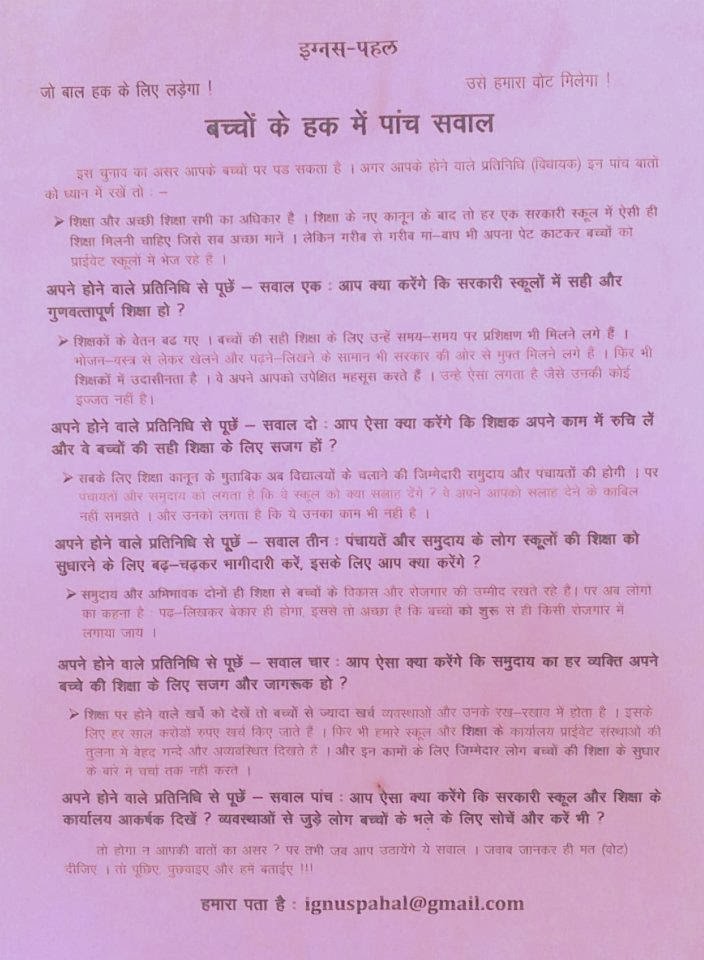
Five Questions To Ask Your Election Candidate!

With elections not so far away, here are five questions you can encourage people to ask of their prospective representatives. We used these in the last general elections, and had encouraging results. They were re-printed by others and spread over a fairly wide area in Varanasi and Lucknow regions. Many candidates and their party heads had to touch upon these issues. Unfortunately, we got the idea fairly late during the campaign season. This time though we need not be so late!
Inviting everyone to take a look and use what they find fit. Right now, these are in Hindi (and not a good reproduction of the original flyer) – will put up an English version as well.

Learn from history – Steel tariffs don\’t help

The US has been there before many times. And yet they do it again and again. Granted that logic and thoughtful action is not a feature of the current US administration. But still, you would have thought they would have read up what happened when they tried it last time.
I am referring to the announcement today that the US plans to impose a tariff of 25% on steel imports.
George W Bush tried the same tactics in 2002, with an eye on the same political prize – voters in Pennsylvania and West Virginia.  He imposed 8-30% tariffs on imported steel . At that time the target was European steel. Europe promptly took the US to the WTO and won sanctions of  some $2 billion. More tellingly, the politically astute European Union threatened retaliatory tariffs on oranges (goodbye Florida votes) and cars (ta ta Michigan votes).  Meanwhile steel prices in the US surged, screwing industries that buy steel. A later study concluded that 200,000 jobs were lost in the US as a result.  Bush retreated and called off the tariffs in 2003.
His father George HW Bush , and his predecessor Ronald Reagan tried various forms of it too. Reagan famously tried quotas on cars (at that time the target was Japan). The end result of that was that car prices went up by $1000 between 1982 and 1984 and the auto industry actually lost 60,000 jobs as a result of the quotas.
Obama indulged in steel tariffs too. His target was China. But that administration did it selectively – huge tariffs, selectively on products and against companies from China that were dumping.
It is not clear what the current administration is trying to achieve. Presumably their target is China , the current bogeyman and indisputably the cause of depressed world steel prices because of overcapacity. But China exports not much steel to the US possibly as a result of the Obama era actions. It is the 11th largest exporter to the US occupying a small portion of US imports – even India is above it in the rankings. The biggest exporter of steel to the US is Canada, followed by Brazil. Is the US trying to screw Canada ?
Why pick a trade war with Canada of all the countries. The US has a  deficit of $ 12 bn in goods and a surplus of $24 bn in services on a $ 700 bn two way trade. Overall the US has a surplus with Canada. And you want to provoke a war with them ? Yes, the current administration has launched a war on NAFTA, but even by that perverted logic, the target must be Mexico and not Canada.  Canadians are not fools . Selected tariffs from Canada  on Vehicles (bye Michigan) and Agricultural Produce ( adieu Ohio) and we are back to reliving the George Bush experience.
Albert Einstein is famously quoted to have said \” The definition of insanity is doing the same thing over and over again, but expecting different results.” But to avoid that, you have to read history to determine what has been done before. Well, in the current administration, reading history is too much to ask. They would make a \”yuuge\” improvement if they could just begin with reading !

Learn from history – Steel tariffs don\’t help

The US has been there before many times. And yet they do it again and again. Granted that logic and thoughtful action is not a feature of the current US administration. But still, you would have thought they would have read up what happened when they tried it last time.
I am referring to the announcement today that the US plans to impose a tariff of 25% on steel imports.
George W Bush tried the same tactics in 2002, with an eye on the same political prize – voters in Pennsylvania and West Virginia.  He imposed 8-30% tariffs on imported steel . At that time the target was European steel. Europe promptly took the US to the WTO and won sanctions of  some $2 billion. More tellingly, the politically astute European Union threatened retaliatory tariffs on oranges (goodbye Florida votes) and cars (ta ta Michigan votes).  Meanwhile steel prices in the US surged, screwing industries that buy steel. A later study concluded that 200,000 jobs were lost in the US as a result.  Bush retreated and called off the tariffs in 2003.
His father George HW Bush , and his predecessor Ronald Reagan tried various forms of it too. Reagan famously tried quotas on cars (at that time the target was Japan). The end result of that was that car prices went up by $1000 between 1982 and 1984 and the auto industry actually lost 60,000 jobs as a result of the quotas.
Obama indulged in steel tariffs too. His target was China. But that administration did it selectively – huge tariffs, selectively on products and against companies from China that were dumping.
It is not clear what the current administration is trying to achieve. Presumably their target is China , the current bogeyman and indisputably the cause of depressed world steel prices because of overcapacity. But China exports not much steel to the US possibly as a result of the Obama era actions. It is the 11th largest exporter to the US occupying a small portion of US imports – even India is above it in the rankings. The biggest exporter of steel to the US is Canada, followed by Brazil. Is the US trying to screw Canada ?
Why pick a trade war with Canada of all the countries. The US has a  deficit of $ 12 bn in goods and a surplus of $24 bn in services on a $ 700 bn two way trade. Overall the US has a surplus with Canada. And you want to provoke a war with them ? Yes, the current administration has launched a war on NAFTA, but even by that perverted logic, the target must be Mexico and not Canada.  Canadians are not fools . Selected tariffs from Canada  on Vehicles (bye Michigan) and Agricultural Produce ( adieu Ohio) and we are back to reliving the George Bush experience.
Albert Einstein is famously quoted to have said \” The definition of insanity is doing the same thing over and over again, but expecting different results.” But to avoid that, you have to read history to determine what has been done before. Well, in the current administration, reading history is too much to ask. They would make a \”yuuge\” improvement if they could just begin with reading !

Learn from history – Steel tariffs don\’t help

The US has been there before many times. And yet they do it again and again. Granted that logic and thoughtful action is not a feature of the current US administration. But still, you would have thought they would have read up what happened when they tried it last time.
I am referring to the announcement today that the US plans to impose a tariff of 25% on steel imports.
George W Bush tried the same tactics in 2002, with an eye on the same political prize – voters in Pennsylvania and West Virginia.  He imposed 8-30% tariffs on imported steel . At that time the target was European steel. Europe promptly took the US to the WTO and won sanctions of  some $2 billion. More tellingly, the politically astute European Union threatened retaliatory tariffs on oranges (goodbye Florida votes) and cars (ta ta Michigan votes).  Meanwhile steel prices in the US surged, screwing industries that buy steel. A later study concluded that 200,000 jobs were lost in the US as a result.  Bush retreated and called off the tariffs in 2003.
His father George HW Bush , and his predecessor Ronald Reagan tried various forms of it too. Reagan famously tried quotas on cars (at that time the target was Japan). The end result of that was that car prices went up by $1000 between 1982 and 1984 and the auto industry actually lost 60,000 jobs as a result of the quotas.
Obama indulged in steel tariffs too. His target was China. But that administration did it selectively – huge tariffs, selectively on products and against companies from China that were dumping.
It is not clear what the current administration is trying to achieve. Presumably their target is China , the current bogeyman and indisputably the cause of depressed world steel prices because of overcapacity. But China exports not much steel to the US possibly as a result of the Obama era actions. It is the 11th largest exporter to the US occupying a small portion of US imports – even India is above it in the rankings. The biggest exporter of steel to the US is Canada, followed by Brazil. Is the US trying to screw Canada ?
Why pick a trade war with Canada of all the countries. The US has a  deficit of $ 12 bn in goods and a surplus of $24 bn in services on a $ 700 bn two way trade. Overall the US has a surplus with Canada. And you want to provoke a war with them ? Yes, the current administration has launched a war on NAFTA, but even by that perverted logic, the target must be Mexico and not Canada.  Canadians are not fools . Selected tariffs from Canada  on Vehicles (bye Michigan) and Agricultural Produce ( adieu Ohio) and we are back to reliving the George Bush experience.
Albert Einstein is famously quoted to have said \” The definition of insanity is doing the same thing over and over again, but expecting different results.” But to avoid that, you have to read history to determine what has been done before. Well, in the current administration, reading history is too much to ask. They would make a \”yuuge\” improvement if they could just begin with reading !

Learn from history – Steel tariffs don\’t help

The US has been there before many times. And yet they do it again and again. Granted that logic and thoughtful action is not a feature of the current US administration. But still, you would have thought they would have read up what happened when they tried it last time.
I am referring to the announcement today that the US plans to impose a tariff of 25% on steel imports.
George W Bush tried the same tactics in 2002, with an eye on the same political prize – voters in Pennsylvania and West Virginia.  He imposed 8-30% tariffs on imported steel . At that time the target was European steel. Europe promptly took the US to the WTO and won sanctions of  some $2 billion. More tellingly, the politically astute European Union threatened retaliatory tariffs on oranges (goodbye Florida votes) and cars (ta ta Michigan votes).  Meanwhile steel prices in the US surged, screwing industries that buy steel. A later study concluded that 200,000 jobs were lost in the US as a result.  Bush retreated and called off the tariffs in 2003.
His father George HW Bush , and his predecessor Ronald Reagan tried various forms of it too. Reagan famously tried quotas on cars (at that time the target was Japan). The end result of that was that car prices went up by $1000 between 1982 and 1984 and the auto industry actually lost 60,000 jobs as a result of the quotas.
Obama indulged in steel tariffs too. His target was China. But that administration did it selectively – huge tariffs, selectively on products and against companies from China that were dumping.
It is not clear what the current administration is trying to achieve. Presumably their target is China , the current bogeyman and indisputably the cause of depressed world steel prices because of overcapacity. But China exports not much steel to the US possibly as a result of the Obama era actions. It is the 11th largest exporter to the US occupying a small portion of US imports – even India is above it in the rankings. The biggest exporter of steel to the US is Canada, followed by Brazil. Is the US trying to screw Canada ?
Why pick a trade war with Canada of all the countries. The US has a  deficit of $ 12 bn in goods and a surplus of $24 bn in services on a $ 700 bn two way trade. Overall the US has a surplus with Canada. And you want to provoke a war with them ? Yes, the current administration has launched a war on NAFTA, but even by that perverted logic, the target must be Mexico and not Canada.  Canadians are not fools . Selected tariffs from Canada  on Vehicles (bye Michigan) and Agricultural Produce ( adieu Ohio) and we are back to reliving the George Bush experience.
Albert Einstein is famously quoted to have said \” The definition of insanity is doing the same thing over and over again, but expecting different results.” But to avoid that, you have to read history to determine what has been done before. Well, in the current administration, reading history is too much to ask. They would make a \”yuuge\” improvement if they could just begin with reading !

Learn from history – Steel tariffs don\’t help

The US has been there before many times. And yet they do it again and again. Granted that logic and thoughtful action is not a feature of the current US administration. But still, you would have thought they would have read up what happened when they tried it last time.
I am referring to the announcement today that the US plans to impose a tariff of 25% on steel imports.
George W Bush tried the same tactics in 2002, with an eye on the same political prize – voters in Pennsylvania and West Virginia.  He imposed 8-30% tariffs on imported steel . At that time the target was European steel. Europe promptly took the US to the WTO and won sanctions of  some $2 billion. More tellingly, the politically astute European Union threatened retaliatory tariffs on oranges (goodbye Florida votes) and cars (ta ta Michigan votes).  Meanwhile steel prices in the US surged, screwing industries that buy steel. A later study concluded that 200,000 jobs were lost in the US as a result.  Bush retreated and called off the tariffs in 2003.
His father George HW Bush , and his predecessor Ronald Reagan tried various forms of it too. Reagan famously tried quotas on cars (at that time the target was Japan). The end result of that was that car prices went up by $1000 between 1982 and 1984 and the auto industry actually lost 60,000 jobs as a result of the quotas.
Obama indulged in steel tariffs too. His target was China. But that administration did it selectively – huge tariffs, selectively on products and against companies from China that were dumping.
It is not clear what the current administration is trying to achieve. Presumably their target is China , the current bogeyman and indisputably the cause of depressed world steel prices because of overcapacity. But China exports not much steel to the US possibly as a result of the Obama era actions. It is the 11th largest exporter to the US occupying a small portion of US imports – even India is above it in the rankings. The biggest exporter of steel to the US is Canada, followed by Brazil. Is the US trying to screw Canada ?
Why pick a trade war with Canada of all the countries. The US has a  deficit of $ 12 bn in goods and a surplus of $24 bn in services on a $ 700 bn two way trade. Overall the US has a surplus with Canada. And you want to provoke a war with them ? Yes, the current administration has launched a war on NAFTA, but even by that perverted logic, the target must be Mexico and not Canada.  Canadians are not fools . Selected tariffs from Canada  on Vehicles (bye Michigan) and Agricultural Produce ( adieu Ohio) and we are back to reliving the George Bush experience.
Albert Einstein is famously quoted to have said \” The definition of insanity is doing the same thing over and over again, but expecting different results.” But to avoid that, you have to read history to determine what has been done before. Well, in the current administration, reading history is too much to ask. They would make a \”yuuge\” improvement if they could just begin with reading !

Learn from history – Steel tariffs don\’t help

The US has been there before many times. And yet they do it again and again. Granted that logic and thoughtful action is not a feature of the current US administration. But still, you would have thought they would have read up what happened when they tried it last time.
I am referring to the announcement today that the US plans to impose a tariff of 25% on steel imports.
George W Bush tried the same tactics in 2002, with an eye on the same political prize – voters in Pennsylvania and West Virginia.  He imposed 8-30% tariffs on imported steel . At that time the target was European steel. Europe promptly took the US to the WTO and won sanctions of  some $2 billion. More tellingly, the politically astute European Union threatened retaliatory tariffs on oranges (goodbye Florida votes) and cars (ta ta Michigan votes).  Meanwhile steel prices in the US surged, screwing industries that buy steel. A later study concluded that 200,000 jobs were lost in the US as a result.  Bush retreated and called off the tariffs in 2003.
His father George HW Bush , and his predecessor Ronald Reagan tried various forms of it too. Reagan famously tried quotas on cars (at that time the target was Japan). The end result of that was that car prices went up by $1000 between 1982 and 1984 and the auto industry actually lost 60,000 jobs as a result of the quotas.
Obama indulged in steel tariffs too. His target was China. But that administration did it selectively – huge tariffs, selectively on products and against companies from China that were dumping.
It is not clear what the current administration is trying to achieve. Presumably their target is China , the current bogeyman and indisputably the cause of depressed world steel prices because of overcapacity. But China exports not much steel to the US possibly as a result of the Obama era actions. It is the 11th largest exporter to the US occupying a small portion of US imports – even India is above it in the rankings. The biggest exporter of steel to the US is Canada, followed by Brazil. Is the US trying to screw Canada ?
Why pick a trade war with Canada of all the countries. The US has a  deficit of $ 12 bn in goods and a surplus of $24 bn in services on a $ 700 bn two way trade. Overall the US has a surplus with Canada. And you want to provoke a war with them ? Yes, the current administration has launched a war on NAFTA, but even by that perverted logic, the target must be Mexico and not Canada.  Canadians are not fools . Selected tariffs from Canada  on Vehicles (bye Michigan) and Agricultural Produce ( adieu Ohio) and we are back to reliving the George Bush experience.
Albert Einstein is famously quoted to have said \” The definition of insanity is doing the same thing over and over again, but expecting different results.” But to avoid that, you have to read history to determine what has been done before. Well, in the current administration, reading history is too much to ask. They would make a \”yuuge\” improvement if they could just begin with reading !

The economics of Classical Music in India

 (carnaticdurbar.com)
This blogger is  a recently turned fan of Indian classical music. Being the weirdo he is, it is only to be expected that he would turn his attention to the economic side of this . Yes, I know it\’s weird with a capital W that instead of humming a tune, a blog post on economics is what comes out.
Classical music in India is economically a basket case. Every piece in the carnatic music supply chain is in doldrums moneywise.
Take the fan. A listener will only go to a concert if it is free. Will not buy a ticket even if it is just Rs 50. It is perfectly acceptable behaviour to go to a concert, find that there is a ticket and return back without going in ! The fan is a complete hypocrite. Music must be free. Musicians don\’t deserve money. But their own salaries (pensions) must be doubled.
Artistes, unless they are at the top of the profession earn an absolute pittance. I am  certain that what most upcoming musicians earn will not even be up to the minimum wage levels in India for casual labour. It is not unknown for lesser musicians to pay to perform rather than the other way around.
The musicians at the very top do earn for their concerts and the popular perception amongst the fans is that they demand too much money. This is nonsense. They may earn Rs 100,000 for a concert; something they have to share with the accompanying artistes. They can probably do 4 or 5 concerts a month on an average. That level of earnings is equivalent to what a middle manager in a company doing an irrelevant pedestrian job will make. And these are the top musicians in the land.
The organisations that hold these concerts are called sabhas – they are the equivalent of music clubs. Given the facts above, every one of them makes a loss and are barely solvent. How they survive is a mystery.
With these economics, it is hardly surprising that there are zero facilities for concerts. None of the cities have anything like the equivalent of an opera house. There is just one good concert hall in the cities of Chennai, Mumbai and Bangalore and they were all built at least 25 years ago. Not a single new concert hall of any size or quality has come up in decades – and just witness the number of malls, cinema multiplexes, resturants and the like that have sprung up. Concerts are held in ramshackle places where the word acoustics is foreign and as for facilities, what are they ?
There are two lifelines that has so far kept this genre going.
One is sponsorship from businesses. Sabha organisers harry, beg, plead, grovel for grants for businesses. You can always find a music fan in a company and they sometimes contribute for a concert. This can hardly be justified in any company for business reasons – this must just be written off as a handout with no benefit for the business.
For the artistes themselves, their main source of income is teaching music to Indian Americans on Skype. You see, the Indian parents in the US feel very guilty for disassociating their children from Indian culture. They are partial to therefore teaching them Indian classical music. Skype offers a perfect medium. Its a nice ego boost to be taught by the finest musician in the genre. This is how artistes put food on the table. The dollar goes a long way as you know.
Another option for artistes is to perform in  the US.  The huge Indian American community in the US wants to \”keep in touch\” with Indian music, even if they are pretty ignorant about it. For some strange reason Cleveland (of the \”bum state\” fame) is the headquarters of carnatic music.
All this makes for depressing reading. Musicians world over, in most genres, are millionaires. Classical music in  India is however economically gasping for breath. It is in decent health in terms of listener interest. But it can only thrive if a sensible economic model starts to emerge. For a start, listeners should start paying for a concert instead of demanding it for free. I\’ll buy a ticket for every concert I go to , or if its a free concert, at least drop the notional ticket price into the donation box.

Send them back

This blogger knows a thing or two about procuring visas , having had to endure this torture hundreds of times for nearly 30 years now. Indians, as is generally well known, are not welcome anywhere. The visa regimes of every country is designed to make it as difficult as possible for an Indian to visit. Note – the word is \”visit\” and not \”stay\”.
You sign all sorts of declarations and produce all sorts of proofs before you will even be considered for a visa. You have to produce a ton of documents (my favourite is the Australian visa for which I once had to produce 723 pages). You have to make all sorts of declarations (my favourite is a US declaration that says you have not kidnapped somebody below 18 years of age – there is no requirement to declare that you have not kidnapped somebody above 18 years of age). You solemnly swear to everything under the sun in the fine print.  My favourite is the UK requirement in the past (thankfully no longer there)  that if you are a lady going to get married to somebody in the UK, you swear that you are a virgin, which will subsequently be tested by somebody inserting her hand in to test whether your hymen is intact (I am not kidding). After all this you are subjected to the ignominy of a visa interview where you stand in a long and winding queue outside the embassy starting from 4.00 AM in the morning, then wind your way inside a virtual jail till you come into a prison like counter where you face a visa officer. He or she can , and does, reject your visa application simply because he/she/it does not like the look of your face . Period. That\’s it. No chance of even appealing.
All this is a long and elaborate preamble to illustrate how the very same countries completely flip 180 degrees if you are an economic offender who has fled your country.  You are now welcomed with open arms. Suddenly human rights of the alleged offender take precedence over everything else.  The very same United Kingdom of Great Britain and Northern Ireland (of the virginity test fame) will shield the alleged economic offender until its very last breath and allow him to stay indefinitely in the country. 
There is a long and illustrious list of alleged crooks who have fled India – Lalit Modi, Vijay Mallya, Jatin Mehta, Nirav Modi, Mehul Choksi et al. If you are interested, the exact number of such luminaries is 184. The modus operandi is usually the same. As soon as the heat starts to be felt and you feel that you are likely to get caught, flee the country. And then claim that you are being harassed , fear for your life, etc etc and stay put. Uncle Sam, Old Blighty and all the rest will freely protect you.
Sure, this lot has obtained permanent residency in these countries sometime in the past. So ? You  sign all the honest to god statements that you have to do for a mere visa to visit. Probably you swear to a few more things before you get permanent residency. This is not citizenship; just permanent residency. You still remain an Indian citizen , bound by the laws of India. If you have then violated them, why isn\’t permanent residency revoked ?
I can understand protecting those undergoing political persecution, those who are fleeing from war, and those who might be killed if returned. But these are economic offenders. If they are returned to India, they will be put through due legal process in a court of law. The Indian justice system may not be perfect, but it isn\’t arbitrary and without merit. Even with the greatest of ingenuity, the argument cannot be made that India is a lawless country. So what is the logic in not sending them straight back.
The long list of luminaries referred to earlier are Indian citizens. They are subject to the laws of India. The government of India has revoked their passports. Any foreign government, in whose jurisdiction they are staying,  are hypocrites in not returning them to India forthwith. 
I am not welcome to even transit through Heathrow, let alone visit the UK (the same visa process applies even if you are transiting and not entering the country). Mr Vijay Mallya is free to stay for as long as he wishes to and will be protected by Her Majesty. Shame on you, and every other country harbouring these 184 worthies.

Singapore is a threat to the national security of the US

Prime Minister Lee Hsien Loong should go on TV and broadcast to his countrymen that Singapore has \”arrived\”. The mighty US is scared of little Singapore. Perhaps a national holiday in Singapore will be declared to mark the event !
I am referring to the US government blocking the bid by Broadcom for the takeover of Qualcomm, on the grounds of national security. Broadcom is a Singaporean company (never mind that Broadcom had offered to move its headquarters to San Jose if the deal went through). Qualcomm is an American company. So Singapore is a threat to the national security of the US. Great !
The US government is giving a specious argument to justify national security. According to the government, Broadcom would cut R&D spending after it took Qualcomm over.  This would affect the development of 5G technology. Instead Huawei would become the leader in 5G. Huawei is a Chinese company. Therefore the US would be dependent on China for its mobile networks. That is the threat to national security.
That is an even more laughable argument. Qualcomm is an important player, but not the leader in the development of 5G in the first place. Have you forgotten Cisco ? Intel ? AT&T ? Samsung ? Ericsson ? And innovation is not the monopoly of anybody – even a rudimentary understanding of business should tell you that. Innovation comes from the strangest of places. If Qualcomm slashes R&D, does anybody seriously think other US companies will not succeed in 5G. If the US was solely dependant on Qualcomm, it was screwed long ago.
And why is 5G technology a matter for national security ? If this is truly the case with wireless technology, China\’s national security has long been compromised  because of US leadership thus far. Why is ownership of 5G technology and standards so  worrying ? Is the argument that Huawei will get a monopoly of technology and therefore all US companies will have to buy telecommunication equipment only from them and therefore China will have a backdoor entry and control over the entire US telecommunications infrastructure ? That stretches incredulity to the limit.
There\’s an interesting subplot to this. In the midst of the drama with Broadcom, Qualcomm  itself  is currently trying to take over NXP – another semiconductor company. That deal is awaiting clearance from Chinese regulators. Fat chance of that happening now. The people really screwed by these developments are Qualcomm shareholders – they don\’t get NXP and they don\’t get to be bought out by Broadcom at a stiff premium. And before you say you don\’t care about shareholders, let\’s just note for the record that US institutional investors , including mutual funds and pension funds, hold nearly 80% of Qualcomm stock.
No, this is not about national security at all. These days it appears you can claim national security for anything – even steel and aluminium tariffs. This is pure and simple economic nationalism. We don\’t want an American company to be taken over by \”Chinese looking people\”. That\’s it.
The current US administration is supposed to be a Republican one.  Standing for free trade and non interference of government into business. Has ideology, beliefs and policy ceased to matter at all ?

The Indian parliament is a waste of time

In democracies, the will of the people is supposed to be supreme. The forum for expression of the will of the people is the parliament. All laws and policies are enacted by the parliament and you need a majority of the elected representatives to pass any bill. Issues are debated and a majority vote determines the outcome. So goes the theory. Ha Ha .
India\’s parliament has become a joke. It has descended into a complete farce, where regular business is impossible to conduct because every party disrupts roceedings by protesting and shouting. Witness the current session of the Lok Sabha. The TDP is protesting against non grant of special status for their state. The AIADMK is protesting against the non formation of the Cauvery Board. The Congress, Trinamool, et al are protesting against the PNB scam. The Shiv Sena , which is actually a part of the government is agitating for, of all things,  inclusion of Marathi as a \”classical language\” . Each one has disrupted the Lok Sabha such that it has been stalled every day with nothing being discussed or transacted. This has been the way for at least 10 years now, but it has worsened over the last two years with not even one day of sane, sensible proceedings. Every party is guilty of this appalling behaviour. The ruling BJP did exactly the same thing when they were in opposition.
The trigger for this post is the Finance Bill. In India, economic policy is often manifested in the form of the annual Finance Bill (Budget, as it is called in common parlance). This is supposed to be debated and then passed in Parliament by a certain date, else the government will be shut down (similar to the position in the US).
But how do you discuss and pass anything when all the worthies are shouting and agitating. In true Ramamritham fashion, we have invented a process called the \”guillotine\”. When the deadline for passing the Finance Bill comes, it is just \”passed\” with no discussion or debate. Not even a minute of debate and discussion has happened on major fiscal, monetary and economic legislation. Its just considered adopted by parliament !! What a joke.
The passing of the Finance Bill is one of the most important, if not THE most important job of parliament every year.  Yet for many years now, there has been no debate and it just gets guillotined as a matter of routine. Begs the question, why do we need a parliament at all ? Have elections every five years and instead of actual representatives, put a wax dummy coloured with the party colours in a seat in a room. Each party represented in the parliament simply indicates which way it decides to vote . That can be tallied by a computer (actually even an abacus will do).  Much simpler. In any case, every member of parliament votes according to a party whip. Nobody even reads the damned bill. If you are an opposition party, vote against any bill saying it is the greatest blot on humankind. If you are in the government vote for saying that it is the long awaited final avatar of Lord Vishnu. So why bother with a parliament at all ?
Let this be the first instance where \”artificial intelligence\” replaces human beings entirely. Replacing our esteemed members of parliament is a simple task as they perform no function at all bar shouting . We don\’t even need artificial intelligence. Wax dummies are enough to be a major improvement – at least they will be silent.  
If that is considered way too extreme, then perhaps taping the mouths, tying the hands and gluing the seat of the pants (dhothi) to the chair can be resorted to.  For abundant caution, you can also shackle their legs. That would be an improvement over the current situation.