How Alternate Schools Are Right For Your Child

How Alternate Schools Are Right For Your Child

Is your child is going to attend an alternative school or are you searching for the best option for the child? Well, you do not have to look anymore as attending an alternative high school is the right choice for your kid. These schools are best for some of the schools and can be defined as a school with an unconventional curriculum and teaching methods. Such schools are popular for providing a wide range and definitive learning strategies. These schools are not only famous for their strategies of learning and beliefs but also for the small class sizes, close relation of pupil and teachers, and a sense of responsibility. These schools can be public as well as private. 

Here is how an alternative school is right for your child:
Flexible schedules:
 
There are various alternative schools which are offering their classes at night. It is very helpful for students who are also earning along with their studies. There are other schools as well where the students are introduced with flexible graduation requirements and give students more than enough choices that they can make. 
This can make the students get ready for their particular field of interest whether it is English, maths, science or other subjects. They can pursue it and make their career in it as well. 
Smaller and convenient class sizes:
 
Every parent wants their children to study in a less rushed environment. They want the best for their children and want them to be heard in the classroom. Smaller class sizes in Alternative schools have been known to provide the best education among the students.

The smaller classes allow the teachers to focus more on each and every child in the class. Smaller classrooms also make it easier to tailor lessons according to specific student needs. 

Various teaching methods:
Various teaching methods are being inspired by creativity as well as interaction. This can also help students who struggle and face the problem with taking notes all day.
Some students are inclined towards one teaching method and others might be grasping from others. These schools make sure that they are carrying out the teaching part properly and according to every student’s satisfaction. 
Social and mental needs of the students:
It is true that the teachers are there to address your academic needs. But in addition to these, there are other needs such as emotional, mental, and social. These schools help take care of the students in every way possible. Students sometimes need counseling which can help them and make them stand up for themselves.

There are other alternative schools that do not evaluate the students on the basis of grades but provide evaluations that are written.

If you are still doubtful of what alternative schools you want to send your children to, here is the list of some schools from which you can consider.

Azad Hind Fauj/Indian National Army and Freedom Movement of India

ESTABLISHMENT OF AZAD HIND FAUJ 

Indians remember this 21 October as Great Day and it is celebrated with full gaiety in many parts of the country as on this date in 1942, the Indian National Army (INA/ Azad Hind Fauj) was formed by two stalwarts and Indians Sri Rash Behari Bose and Sri Mohan Singh (in 1942) in Southeast Asia during World War II. Its main objective was to secure Indian independence from British rule. To attain the same Azad Hind Fauj/INA formed an alliance with the Empire of Japan in the latter’s campaign in the Southeast Asian theatre of WWII ( name given to the campaigns of the Pacific War in Burma, Ceylon, India, Thailand, the Philippines, Indochina, Malaya and Singapore). 
The first INA collapsed and was disbanded in December 1942 after differences between the INA leadership and the Japanese military over its role in Japan’s war in Asia. It is pertinent to mention that the Japanese Imperial General Headquarters in October, 1942 set up the Fujiwara Kikan, or the F-kikan, in Bangkok, headed by the Major Fujiwara Iwaichi, chief of intelligence of the 15th army. As INA member, Mohan Singh had good relation with the members of Fujiwara Kikan, but he was soon disillusioned with the Japanese Army’s behaviour. It is believed that they wanted to use the Indian National Army only as a part of Japanese army to fulfil their own objectives. In meantime, Netaji Subhas Chandra Bose arrived in Japan in 1943 and INA was invigorated. More than 60,000 soldiers of Indian origin were associated with Azad Hind Fauj/Indian National Army who were prisoners of war in those days and because of initiative of Sri Mohan Singh they joined in INA/Azad Hind Fauj to fight against the British. Out of them about 26,000 soldiers sacrificed their lives so their sacrifice must be saluted. 

SUCCESS STORY OF AZAD HIND FAUZ

The INA/Azad Hind Fauj first success was capturing of Moirang of Manipur. On 18 April 1944, the suicide squads led by Col. Shaukat Malik broke through the British defence and captured Moirang. After Moirang, INA penetrated the Kohima road, creating a threat to the British positions in both Silchar (presently in Assam) and Kohima (now capital of Nagaland state). Col. Gulzara Singh’s column had entered 250 miles into India. Anyway rest is history as Azad Hind Fauj/INA could not succeed to come up to Delhi. 
But the INA’s activities influenced the decision to leave India by the British is reflected by the views of Mr. Clement Richard Attlee, who was the Prime Minister of the United Kingdom from 1945 to 1951. Mr. Attlee cited several reasons, the most important of which were the INA activities of Subhas Chandra Bose, which weakened the very foundation of the British Empire in India, and the Royal Indian Navy Mutiny which made the British realise that the support of the Indian armed forces could no longer be relied upon. In the book written by Indian army scholar, General G D Bakshi, mentioned that in 1956, Mr. Clement Attlee had come to India and stayed in Kolkata (then Calcutta) as a guest of Sri P.B. Chakraborthy then Chief Justice of the Calcutta High Court and also serving as acting Governor of West Bengal. During the course of discussion, Sri Chakraborthy asked about the contribution of Mahatma Gandhi and Subhas Chandra in independence movement. This may be quoted from the book itself, ‘Bose An Indian Samurai: Netaji and the INA A Military Assessment’, “Toward the end of our discussion I (means Sri Chakraborthy) asked Mr. Attlee what was the extent of Gandhi’s influence upon the British decision to quit India. Hearing this question, Attlee’s lips became twisted in a sarcastic smile as he slowly chewed out the word, m-i-n-i-m-a-l!” Regarding the Royal Indian Navy Mutiny it may be mentioned that it took place in the context of the Indian National Army trials (INA trials), which are also known as the Red Fort trials, took place between November 1945 and May 1946. In the first trials, INA persons were Colonel Prem Sahgal, Colonel Gurbaksh Singh Dhillon, and Major General Shah Nawaz Khan. And in the second trials the INA officials were Abdul Rashid, Shinghara Singh, Fateh Khan and Captain Munawar Khan Awan. Most of the INA soldiers were set free after cashiering and forfeiture of pay and allowance. 
No Indians can forget Azad Hind Fauj/INA’s contribution in freedom movement. While I was in abroad even many Pakistanis and Bangladesh persons told about Subhas Chandra and INA/ Azad Hind Fauj.

Dr Shankar Chatterjee
Former Professor & Head (CPME),
NIRD & PR (Govt. of India), 
Hyderabad-500091 , India
Email <shankarjagu@gmail.com>


University Bound To Provide Answer Sheets Under RTI: Madras HC

In a remarkable decision, the Madras High Court very recently on October 14, 2019 in The Tamil Nadu Dr Ambedkar Law University, Represented by its Registrar vs 1. The Tamil Nadu State Information Commission Represented by its Assistant Registrar 2. Pavan Kumar Gandhi 3. Paras Jain 4. Kumar Shanu (R-3 & R-4 impleaded via order of Court dated 14.10.2019 made in WMP No. 29201 of 2019) in WP No. 16108 of 2019 and WMP No. 15866 of 2019 has very rightly and commendably held that evaluated answer sheets are ‘information’ under the Right to Information Act, 2005 and Universities are bound to provide them to the Respondent-students. This latest, landmark and extremely laudable judgment was pronounced in response to a writ petition filed under Article 226 of the Constitution of India praying for issuance of a Writ of Certiorari, calling for the records in proceedings No. SA4393/D/2018 dated 17.12.2018 passed by the first respondent and quash the same. This historic judgment was delivered by Justice SM Subramaniam while disposing of a petition filed by the Tamil Nadu Dr Ambedkar Law University (Petitioner), through Advocate VMG Ramakkannan, lambasting the order of the Tamil Nadu State Information Commission, whereby the Petitioner that is ‘The Tamil Nadu Dr Ambedkar Law University’ was directed to supply the copies of answer-sheets sought by the Respondent-students under the RTI Act. 

To start with, the ball is set rolling in para 1 of this noteworthy judgment wherein it is observed first and foremost that, “The writ on hand is to quash the order dated 17.12.2018 issued by the first respondent in proceedings No. SA4393/D/2018 dated 17.12.2018.” It is then pointed out in para 2 that, “The writ petitioner is the Tamil Nadu Dr Ambedkar Law University.”
What we then see being pointed out in para 3 is this: “The learned counsel appearing on behalf of the writ petitioner-University states that the second respondent is the student of the writ petitioner-Law University. The second respondent filed an application under the Right to Information Act, 2005, to furnish copies of the answer scripts, which were not furnished and consequently, the second respondent approached the Tamil Nadu State Information Commission, who in turn passed an order on 17.12.2018, directing the writ petitioner-Law University to supply the copies of the answer scripts sought for by the second respondent under the provisions of the Right to Information Act, 2005.”
While presenting the version of Law University, it is then pointed out in para 4 that, “Challenging the said order, the learned counsel for the writ petitioner states that the writ petitioner-Law University has got its own Rules and Regulations for the purpose of furnishing copies of the answer scripts. The writ petitioner-Law University has to follow the procedures and under these circumstances, they have rejected the claim of the second respondent for furnishing copies of the answer scripts sought for by him.”
While continuing in the same vein, it is then stated in para 5 that, “The learned counsel for the writ petitioner-Law University states that the writ petitioner-Law University is ready and willing to furnish copies of answer scripts on payment of charges prescribed under the Rules and Regulations of the Law University. The said reply was communicated to the second respondent also. Under these circumstances, it is contended that the writ petitioner-Law University has not refused to provide copies of the answer scripts, contrarily, they have insisted the second respondent that the procedures contemplated under the University Regulations are to be followed. Thus, the writ petitioner-Law University has not rejected the claim of the second respondent, but they have insisted him to follow the procedures prescribed under the Rules and Regulations of the University.”
On the contrary, para 6 then states that, “The second respondent, appearing in person, opposed the contentions of the learned counsel for the writ petitioner-Law University, by stating that he submitted an application under the Right to Information Act, 2005. However, the writ petitioner-Law University by reply dated 23.01.2018 states that, the University Regulations are to be followed and the answer scripts will not be supplied under the provisions of the Right to Information Act, 2005. However, the fact remains that the writ petitioner-Law University expressed their willingness to supply the answer scripts in the event of following the procedures contemplated under the Rules and Regulations of the University.”
Furthermore, it is then mentioned in para 7 that, “The first respondent Tamil Nadu State Information Commission, citing the judgment of the Supreme Court, passed an order directing the writ petitioner-Law University to furnish the copy of the answer scripts to the second respondent under the provisions of the Right to Information Act, 2005.”
To be sure, it is then conceded in para 8 that, “As far as the application submitted by the second respondent under the provisions of the Right to Information Act, 2005 to the writ petitioner-Law University is concerned, it is not in dispute that the Right to Information Act is applicable. Accordingly, the second respondent is entitled to get informations under the provisions of the Right to Information Act, 2005, unless such informations are prohibited specifically under Section 8 of the Right to Information Act, 2005.” 
To put things in perspective, it is then noted in para 9 that, “Shri Paras Jain and Shri Kumar Shanu filed an impleading petition in WMP No. 29201 of 2019 and Ms. V. Chethana, learned counsel appearing on behalf of the impleading petitioners, solicited the attention of this Court that the Supreme Court has settled the issue in respect of furnishing of the answer scripts to the students, who all are submitting their applications under the Right to Information Act, 2005.”
While citing the relevant case law, it is then illustrated in para 10 that, “In the Case of CENTRAL BOARD OF SECONDARY EDUCATION (CBSE) AND ANOTHER Vs. ADITYA BANDOPADHYAY & OTHERS [(2011) 8 SCC 497], the Apex Court held that “if CBSE was required to re-evaluate the answer-books or grant inspection of answer-books or grant certified copies thereof, it would interfere with its effective and efficient functioning, and will also require huge additional staff and infrastructure. It was submitted that the entire examination system and evaluation by CBSE is done in a scientific and systemic manner designed to ensure and safeguard the high academic standards and at each level utmost care was taken to achieve the object of excellence, keeping in view the interests of the students”.”
More pertinently, it is then rightly underscored in para 11 that, “In the judgment, cited supra, the Hon’ble Supreme Court further observed in paragraph-23 that “when a candidate participates in an examination and writes his answers in an answer book and submits it to the examining body for evaluation and declaration of the result, the answer-book is a document or record. When the answer-book is evaluated by an examiner appointed by the examining body, the evaluated answer-book becomes a record containing the ‘opinion’ of the examiner. Therefore, the evaluated answer-book is also an ‘information’ under the Right to Information Act”.”
What’s more, para 12 then further narrates that, “The Apex Court of India in an unequivocal terms held that “evaluated answer is an information under the Right to Information Act”. Thus, there is no option for the writ petitioner-Law University but to supply the evaluated answer scripts to the second respondent under the provisions of the Right to Information Act, 2005. When the evaluated answer books are construed as an information, the same cannot be denied and therefore, the second respondent is entitled to get the evaluated answer scripts as per the application submitted by him under the provisions of the Right to Information Act, 2005.”
Be it noted, para 13 then holds that, “It is relevant to extract paragraphs 26 and 27 of the judgment, cited supra, which are extracted as under:-
“26. The examining bodies (Universities, Examination Boards, CBSE, etc.) are neither intelligence nor security organisations and therefore the exemption under Section 24 will not apply to them. The disclosure of information with reference to answer books does not also involve infringement of any copyright and therefore Section 9 will not apply. Resultantly, unless the examining bodies are able to demonstrate that the evaluated answer books fall under any of the categories of exempted “information” enumerated in clauses (a) to (j) of sub-section (1) of Section 8, they will be bound to provide access to the information and any applicant can either inspect the document/record, take notes, extracts or obtain certified copies thereof.
27. The examining bodies contend that the evaluated answer books are exempted from disclosure under Section 8(1)(e) of the RTI Act, as they are “information” held in its fiduciary relationship. They fairly conceded that evaluated answer books will not fall under any other exemptions in sub-section (1) of Section 8. Every examinee will have the right to access, his evaluated answer books, by either inspecting them or take certified copies thereof, unless the evaluated answer books are found to be exempted under Section 8(1)(e) of the RTI Act.”” 
While citing a recent and relevant case law, it is then elucidated in para 14 that, “In the case of Institute of Companies Secretaries of India (ICSI) vs. Paras Jain [decided on 11.04.2019 in Civil appeal No. 5665 of 2014] (the impleaded respondent in the present writ petition), the Apex Court held that “the avenue for seeking certified copies as well as inspection is provided both in the Right to Information Act as well as the statutory guidelines of the appellant”.” 
As it turned out, para 24 then enumerates that, “Under these circumstances, the writ petitioner-Law University is bound to follow the Act as well as the Rules scrupulously, while dealing with the applications submitted under the provisions of the Right to Information Act and therefore, there is no infirmity, as such, in respect of the reasonings furnished in the order impugned by the first respondent. The order of the first respondent is in consonance with the spirit of the Act and therefore, the writ petitioner-Law University is bound to follow the procedures contemplated under the Act and the Rules at the time of dealing with the applications, if any, submitted under the Right to Information Act, by the information seekers.” 
Needless to say, it is then made absolutely clear in para 25 that, “The very object of the Right to Information Act, 2005, stipulates that democracy requires an informed citizenry and transparency of information which are vital to its functioning and also to contain corruption and to hold Governments and their instrumentalities accountable to the governed. Undoubtedly, the purpose and object of the Act, is noble and to achieve the constitutional philosophy and goals. The principles of equality can be achieved only if there is a transparency in public administration. The accountability in the public administration is of paramount importance, as ‘We, the People of our Great Nation’ are sandwiched between corrupt and non-corrupt. Identification of corrupt and non-corrupt may be difficult in the event of non-transparency in public administration.”
It goes without saying what is stated clearly, correctly and convincingly in para 26 that, “Irregularities in public administration cannot be sorted out if there is no transparency in the public administration. Thus, the Right to Information Act, is a Noble Legislation, which ensures transparency in the public administration, which would be undoubtedly helpful to the citizen of our Great Nation to make the public servants accountable and responsible regarding the administrative actions.”
As a corollary, it is then further very rightly held in para 27 that, “In this context, this Court would like to emphasise that the Law University, being a Public Institution, is bound to implement the provisions of the Right to Information Act, scrupulously in its letter and spirit. The moot question is that why should any public authority shy for providing public informations to the information seekers. Undoubtedly, confidential files are protected under the provisions of the Act itself and therefore, the officials should not shy about providing all informations to the public domain, enabling the citizen to understand the manner in which the Public Institutions are administered.”
It cannot be lost on us that it is then very rightly harped upon in para 28 that, “After all, ‘We, The People of India’ solemnly resolved to constitute India into a Sovereign Socialist Secular Democratic Republic and to secure to all its citizens Justice, Liberty, Equality and Fraternity. Therefore, ‘We, The People of India’ enacted the Right to Information Act, through its Parliament, then the instrumentality of the State or the Public Institutions cannot take a stand that they will adopt their own procedure for furnishing the informations under the Right to Information Act. When the Parliament enacted the law in order to develop transparency in public administration, undoubtedly, the other procedures or regulations formulated by any other institutions, cannot prevail over the Act of Parliament and those Rules and Regulations of such individual institutions can never override the purpose and object of the Right to Information Act, 2005.”
Of course, it is then pointed out in para 29 that, “The second respondent, in person, articulated his points by stating that large number of such applications are kept pending, by citing the pendency of the present writ petition. Further, the second respondent states that all such information seekers are waiting for the answer scripts and other informations sought for in their respective applications.”
To put it succinctly, it is then envisaged in para 30 that, “Under these circumstances, the writ petitioner-Law University has not established any acceptable ground for the purpose of assailing the order impugned. Per contra, the order impugned is well reasoned and candid. Thus, the second respondent is entitled to receive the answer scripts as sought for in his application under the Right to Information Act, 2005. All such similar applications are also to be disposed of by the writ petitioner-Law University, as expeditiously as possible, without causing any undue delay, as the students would be anxious in seeing their answer scripts and on account of the pendency of the writ petition, their applications are kept pending.”
Coming to the concluding paras, para 31 holds that, “This being the factum, the writ petitioner-Law University is directed to dispose of all the RTI applications filed under the Right to Information Act, 2005, as expeditiously as possible, by following the procedures contemplated under the RTI Act as well as the Rules in force. In respect of the application submitted by the second respondent, the answer script had already been furnished to him and no further directions are required in this regard.” Lastly, it is then held in the last para 32 that, “Accordingly, the writ petition stands dismissed. However, there shall be no order as to costs. Consequently, connected miscellaneous petition is also dismissed.”
In conclusion, it is very rightly held by the Madras High Court in this notable case that an evaluated answer sheet is an information as defined under the RTI Act and so a university cannot deny access to students. This is more so true because the information sought by students does not fall under the exempted category for national security or copyright infringement. We thus see that Justice SM Subramaniam of Madras High Court dismisses a plea made by the Tamil Nadu Dr Ambedkar Law University challenging the Tamil Nadu State Information Commissioner’s order allowing students to get copies of answer scripts through RTI. Justice Subramaniam directed the University to supply the answer scripts to students who wanted them and rejected the University’s contention that it is governed by its own rules and maintained that the RTI Act overrides the University’s statute. Very rightly so! This is a commendable judgment which will certainly address the genuine grievances of students and make them see for themselves whether justice has been done with them or not actually in evaluating the answer scripts!
Sanjeev Sirohi, Advocate,
s/o Col BPS Sirohi,
A 82, Defence Enclave,
Sardhana Road, Kankerkhera,
Meerut – 250001, Uttar Pradesh.


Whistle Blowing Protection Should Be Extended To Judges: UK Supreme Court

In a latest development with far reaching consequences not for India but for England, the Supreme Court of UK has gone all guns blazing by categorically and courageously pronouncing in Gilham (Appellant) v Ministry of Justice (Respondent) [2019] UKSC 44 on appeal from [2017] EWCA Civ 2220 and delivered on October 16, 2019 wherein it was explicitly held that the whistle-blowing protection envisaged under Employment Rights Act should be extended to the holders of judicial office. It was held that the exclusion of Judges from the whistle-blowing protection in Part IVA of the Employment Rights Act is in breach of their rights under Article 14 read with Article 10 of the European Convention on Human Rights. Very rightly so! 

To start with, this latest, landmark and extremely laudable and unanimous judgment delivered by Lady Hale who is President of UK Supreme Court for herself, Lord Kerr, Lord Carnwath, Lady Arden and Sir Declan Morgan sets the ball rolling in para 1 of this noteworthy judgment wherein it is observed that, “This case is about the employment status of district judges, but it could apply to the holder of any judicial office. The issue is whether a district judge qualifies as a “worker” or a “person in Crown employment” for the purpose of the protection given to whistle-blowers under Part IVA of the Employment Rights Act 1996 (“The 1996 Act”). If a district judge does not on the face of it qualify for whistle-blower protection, the further question is whether this is discrimination against her in the enjoyment of her right to freedom of expression under the European Convention on Human Rights. And if it is, what is the remedy?”
While defining worker, para 2 then states that, “In section 230(3) of the 1996 Act, a “worker” is defined as
“an individual who has entered into or works under (or where the employment has ceased, worked under) – (a) a contract of employment, or (b) any other contract, whether express or implied and (if it is express) whether oral or in writing, whereby the individual undertakes to do or perform personally any work or services for another party to the contract whose status is not by virtue of the contract that of a client or customer of any profession or business undertaking carried on by the individual.””
To be sure, para 3 then states that, “The appellant does not claim that a judge works under a contract of employment within limb (a) of that definition, but contends that she does fall within limb (b) of the definition.”
The history of the case
To recapitulate, it is then enumerated in para 4 that, “The appellant was appointed a district judge by the then Lord Chancellor, Lord Falconer of Thoroton, with effect from 6 February 2006. Under section 6 of the County Courts Act 1984, as it then stood, district judges were appointed by the Lord Chancellor. As it now stands, they are appointed by Her Majesty the Queen on the recommendation of the Lord Chancellor. In October 2005, the appellant had been sent a letter offering her appointment which talked in terms of her accepting that offer. The letter itself contained several stipulations as to the duration of her appointment, her salary, her pension on retirement, and other matters. Enclosed with the letter was a memorandum entitled “District Judges – Memorandum on conditions of employment and terms of service”. This was a detailed document, which included terms as to sitting days, sick pay, maternity, paternity and adoption leave, training, the prohibition of legal practice, relations with the press and media, outside activities and much more. The memorandum made it clear that the salary was taxed under Schedule E to the Income Tax Act and that the judge was an employed earner for the purpose of national insurance contributions. Although described as a “lifetime” appointment, a judge is required to vacate office on her 70th birthday (unless extended) and can resign before that date. The appellant’s Instrument of Appointment, signed by the Lord Chancellor on 27 January 2006, simply talked in terms of his approving her to sit at each of the country courts on the Wales and Chester circuit.”
Truth be told, para 5 then specifies that, “In fact, she first sat at the Crewe County Court and in 2009 transferred to the Warrington County Court. In 2010, the Cheshire courts were transferred to the Northern Circuit and major cost cutting reforms were announced. In 2011, the Runcorn County Court was closed and the business transferred to Warrington, as were some tribunal sittings. The appellant raised a number of concerns relating to the cuts, in particular about the lack of appropriate and secure court room accommodation, the severely increased workload placed upon the district judges, and administrative failures. She raised these with the local leadership judges and senior managers in Her Majesty’s Courts and Tribunals service and eventually in a formal grievance.”
To be sure, it is then disclosed in para 6 that, “She claims that her complaints fell within the definition of “qualifying disclosures” under section 43B of the 1996 Act, in particular as tending to show a failure to comply with legal obligations that miscarriages of justice were likely, or that the health and safety of any individual had been, is being or is likely to be endangered. The disclosures were made to an employer or other responsible person within the meaning of section 43C of the 1996 Act and thus they were “protected discloures” within the meaning of section 43A.”
As things stand, para 7 then lays bare that, “Under section 47B(1) of the 1996 Act, a worker has the right “not to be subjected to any detriment by any act or any deliberate failure to act, by his employer done on the ground that the worker has made a protected disclosure”. The appellant claims that she was subjected to a number of detriments as a result of her complaints a significant delay in investigating her grievance; being seriously bullied, ignored and undermined by her fellow judges and court staff, being informed that her workload and concerns were simply a “personal working style choice”; and inadequate steps to support her in returning to work; she also claims that a severe degradation in her health, resulting in psychiatric injury and a disability under the Equality Act 2010, was such a detriment. The appellant was signed off work due to stress from the end of January 2013 but has recently returned.”
Importantly, it is then pointed out in para 8 that, “In February 2015 the appellant made a two-part claim in the Employment Tribunal. Both parts of her claim depended, upon her being a “worker” within the meaning of section 230(3) of the 1996 Act (or having the same protection as such a worker). One part of her claim was for disability discrimination under the Equality Act 2010, as a result of failure to make reasonable adjustments to cater for her disability. This claim is derived from European Union Law. It is therefore accepted that, as a result of the decision of this Court in O’ Brien v Ministry of Justice (formerly Department for Constitutional Affairs) [2013] UKSC 6 [2013] 1 WLR 522, in the light of the guidance given by the Court of Justice of the European Union in ((Case C-393 10) [2012] ICR 955), a judge is a “worker” for the purpose of European Union law and national law has to be interpreted in conformity with that. That case concerned discrimination against part-time workers, but the same result was reached by the Court of Appeal for Northern Ireland in Perceval-Price v Development [2000] IRLR 380, that tribunal judges were “workers” for the purpose of discrimination on grounds of sex. Hence the disability discrimination claim will continue in any event.”
Furthermore, it is then pointed out in para 9 that, “The other part of her claim was under the “whistle-blowing” provisions in Part IVA of the 1996 Act, inserted by the Public Interest Disclosure Act 1998. These provisions are not derived from European Union law and accordingly the definition of “worker” does not have to be read so as to conform to the requirements of EU law. This means that a judge may have a different status in employment law depending upon whether or not the employment right in question is derived from EU law.”
More importantly, it is then explicitly and elegantly laid down in para 44 that, “Bearing in mind, therefore, the parallel seen in Ghaidan v Godin-Mendoza between section 3(1) and conforming interpretation in EU law, its strictures against attaching decisive importance to the precise adjustment needed to the language of the provisions, and the ease with which this court interpreted identical language to include judges as limb (b) workers in O’ Brien. I can reach no other conclusion than that the Employment Rights Act should be read and given effect so as to extend its whistle-blowing protection to the holders of judicial office.”
Most importantly, it is then held eloquently and effectively in para 45 that, “The relevant provisions of the Employment Rights Act extend to both England and Wales and Scotland (section 244) but not Northern Ireland. However, the equivalent provisions of the Employment Rights (Northern Ireland) Order 1996 (as amended by the Public Interest Disclosure (Northern Ireland) Order 1998) are to the same effect; article 3(3) defines “worker” in the same times as section 230(3); articles 67A, 67B, 67C define protected disclosures, qualifying disclosures and those to whom such disclosures may be made in the same way as in Part IVA of the 1996 Act and articles 70B and 71(1A) provide that a maker of a protected disclosure shall not be subjected to any detriment for doing so and for complaints to an employment tribunal. Those provisions too should be read and given effect so as to extend the protection given to whistle-blowers to the holders of judicial office.”
Lastly, it is then held in para 46 that, “I would therefore allow this appeal and remit the case to the Employment Tribunal on the basis that the appellant is entitled to claim the protection of Part IVA of the 1996 Act.”
On a concluding note, it may well be said that the UK Supreme Court has very rightly minced just no words in reaching the palpable conclusion that whistle blowing protection should be extended to Judges. It rightly deduced that, “To give the judiciary such protection might be thought to enhance their independence by reducing the risk that they might be tempted to “go public” with their concerns, because of the fear that there was no other avenue available to them, and thus unwillingly be drawn into what might be seen as a political debate.” No doubt, judiciary is the bedrock of democracy and Judges are the most important pillars of judiciary and so it has been very rightly held by the UK Supreme Court that whistle blowing protection should be extended to the holders of judicial office! 
Sanjeev Sirohi, Advocate,
s/o Col BPS Sirohi,
A 82, Defence Enclave,
Sardhana Road, Kankerkhera,
Meerut – 250001, Uttar Pradesh.

Nobel Peace Prize in 2019: My Experience in Eritrea

Nobel Peace Prize 2019 has been awarded to Ethiopian Prime Minister Mr. Abiy
Ahmed Ali for his effort to resolve 20-year-long border conflict between
Ethiopia and Eritrea. I congratulate the Norwegian Nobel Committee for
conferring the award to him.
  I was in Eritrea as senior
faculty from 2005 to 2007 and observed both Ethiopia and Eritrea had awful
relation as a sequel under United Nations Mission in Ethiopia and Eritrea
(UNMEE), Indian army was posted as peace –keeper. It is pertinent to mention
that fighting between Eritrea and Ethiopia erupted in May 1998, as a result of
border dispute. The Secretary-General of Security Council immediately contacted
the leaders of the countries, urging restraint and offering assistance in
resolving the conflict peacefully. Despite all efforts, the fighting between
Eritrea and Ethiopia erupted again on 12 May 2000.

      While I was in Eritrea many locals
(Eritreans) told against Ethiopian rulers but they highly appreciated our armed
personnel. Our army had great image in Eritrea.  I visited our army camp two times – one on
Republic Day and in another time I had the opportunity to visit for my ailment
(little injury in eye while playing volleyball).  During the time of my visit medical staff
after examining me gave some medicines – eye drops and tablets at free of cost;
in addition they offered me tea and snacks also. Within couple of days I was
cured. I was joyous to observe their hospitality.
After completion of my
assignment from Eritrea, I came back to my home town in Hyderabad but still
following news etc. about Eritrea and Ethiopia. Anyhow when Mr. Abiy Ahmed
became Prime Minister in Ethiopia in April 2018, he made it clear that he
wished to resume peace talks with Eritrea, so he was in close touch with Mr. Isaias
Afwerki, the President of Eritrea. Both Ethiopia and Eritrea are not
economically strong so the war had created huge economic loss to both the
countries in addition to death of thousands. According to,wikipedia.org/wiki/Eritrean%E2%80%93Ethiopian_War,
“Eritrea claimed that 19,000 Eritrean soldiers were killed during the conflict;
most reports put the total war casualties from both sides as being around
70,000. All these figures have been contested and other news reports simply
state that ‘tens of thousands’ or ‘as many as 100,000’ were killed in the war”.
Whatever the number of casualties but damage was severe, human lives were lost,
property was damaged, citizens of both the countries suffered.  Mr. Abiy Ahmed Ali immediately after becoming
President took some positive steps. The steps inter alia were a) in May, 2018 he ordered to free thousands of
political detainees, including opposition leader Andargachew Tsege b) in June,
2018 he lifted state of emergency two months early and in same month he agreed
to give disputed territory to Eritrea c) in 2018, July he along with the
Eritrean President declared ‘the end of war between the two countries’, d) also
in September itself, he arranged to reopen land border with Eritrea. Mr. Abiy
Ahmed’s another praiseworthy contribution was appointment of women members to
half of ministerial posts. I personally feel awarding Noble Peace Prize to such
peace activist of 43 years aged-person is a great step by the Noble Committee.
Hope peace will prevail in entire Africa and thus all the 54 countries will
economically flourish. All rational persons and all regions never endorse war, terrorism,
violence etc. I remember the statement of one of Saudi’s top Islamic clerics,
the Grand Mufti Sheikh Abdul Aziz al-Sheikh, who told “Islam does not allow
terrorism at any cost. Islam condemns all violence and terrorism plaguing the
world today. Muslims should demonstrate a love for peace and unity,”
I wish to conclude by
quoting Swami Vivekananda, “Lovers see this world as full of love, and haters
as full of hatred; fighters see nothing but strife, and the peaceful nothing
but peace.”
Dr. Shankar Chatterjee
Former Professor& Head (CPME)
NIRD &PR,
Hyderabad-500 030
Telangana, India

Jilting A Lover Is Not An Offence: Delhi HC Upholds Acquittal Of Rape Accused

It must be pointed out right at the outset that in a major and significant development, the Delhi High Court just recently on September 25, 2019 in State vs Sandeep CRI.I.P.532/2019 while upholding the acquittal of rape accused has clearly and categorically held that jilting a lover, however abhorrent that it may seem to some, is not an offence. Justice Vibhu Bakhru who authored this judgment held so while upholding the acquittal of a man accused of raping a woman on the pretext of promise to marry. It was observed that continuing with an intimate relationship, which also involves engaging in sexual activity, over a significant period of time, cannot be said to be induced and involuntary, merely on the assertion that the other party has expressed its intention to get married.

To start with, the ball is set rolling in para 3 which is the first relevant para which states that, “The State has filed the present petition against a judgment dated 15.07.2019 passed by the learned Additional Sessions Judge. The said proceedings had commenced pursuant to the FIR bearing no. 679/2016 under Section 376 of the Indian Penal Code, 1860 (IPC), registered with P.S. Narela, on 13.09.2016.”

To put things in perspective, it is then pointed out in para 4 that, “The said FIR was lodged pursuant to the complaint made by Ms P (name withheld to avoid any ignominy). She has stated that she had developed a friendship with the accused (respondent herein) in the year 2013. And, over a span of two years the same transformed into a love affair. She stated that she had been meeting the accused regularly and he had promised to marry her.”

Furthermore, it is then stated in para 5 that, “She stated that on occasion, three months prior to 08.09.2016, he had invited her to his house to meet his mother. On visiting his house, she had found that his mother was not present and had gone to the house of respondent’s maternal uncle. She alleged that respondent had bolted the door and raped her despite her resistance. However, he had also promised to marry her and had asked her not to disclose the said incident to any other person.” Also, it is then stipulated in para 6 that, “She further alleged that the respondent had taken her to a hotel on 08.09.2016 and had thereafter, raped her. Although he had promised to marry her, he had resiled from his promise and had declined to do so.”

As it turned out, it is then revealed in para 7 that, “She had approached the police station on 13.09.2016, where her statement was recorded. She was, thereafter, medically examined in SRHC Hospital. However, she had declined any internal medical examination.” Further, para 8 then discloses that, “Ms P had deposed as PW2. Her parents (Raj Kumari and Brahm Dev) deposed as PW3 and PW4 respectively. One Sh. Sohan Pal, a friend of the respondent, had deposed as a defence witness (DW-1). He had testified that he knew the accused, as well as Ms P, and both of them had a love affair. He claimed that the accused had introduced Ms P to him in 2015. At the material time, she was undergoing a beautician’s course in Narela. He had testified that the accused wanted to marry Ms P, but Ms P’s father was opposed to the said liaison and therefore, their marriage could not be solemnised.”

Needless to say, para 9 then holds that, “The fact that the respondent had established a physical relationship with Ms P cannot be disputed. Indisputably, Ms P had checked into a hotel with the respondent at about 10:00 pm on 08.09.2016 and had checked out of the said hotel on 09.09.2016 at 08:00 am. Clearly, the respondent and Ms P had done so for physical initimacy. The Trial Court had rightly observed that the only question to be considered was whether Ms P had consented for the physical relationship under a false promise of marriage.”

What then ensues is elaborated upon in para 10 which states that, “After evaluating the evidence, the Trial Court had concluded that Ms P had established the physical relationship with the accused on account of love and affection and not on being induced by a promise of marriage.”

While elaborating in detail, it is then pointed out in para 11 that, “It is relevant to examine Ms P’s (PW-2’s) testimony. She had deposed that she was friends with the accused and in the year 2013, she had visited his house to be treated for stomach ache by his mother. She also stated that the accused had proposed to her within two months of meeting her. Thus, admittedly, the accused had evinced his intention to marry her more than two years before the alleged incident of the accused establishing physical relationship with her (which according to Ms P was established three months prior to the accused taking her to the hotel on 08.09.2016). This clearly established that the inducement of marriage – if the action(s) of the accused could be termed as such – was made more than two years and six months prior to the alleged rape. Ms P’s testimony that she had objected to the accused touching her obscenely but had yielded on him promising marriage, is difficult to accept. This is so because Ms P had stated that the accused proposed marriage to her two months after he met her. Considering Ms P’s testimony that she had gone to the house of the accused in 2013 to be treated by his mother and had spent about two hours there it is apparent that, according to her, the accused had proposed to her two years and six months prior to the first incident of alleged rape.”

Be it noted, para 12 then states that, “It is important to note that Ms P had unequivocally accepted in her cross examination that she and the accused were in love with each other and wanted to get married.” Para 13 then reveals that, “Ms P’s father (PW4) had deposed that in the year 2015, his daughter had told him about the respondent and the proposal for them to get married. He further stated that he was not agreeable to marriage between Ms P and the accused. This is also consistent with the testimony of DW-1. In her cross-examination, Ms P had admitted that her father was opposed to their marriage. Her mother (PW3) had also deposed that she did not want her daughter to get married to the accused.”

To put it succinctly, it is then observed in para 14 that, “In view of the above, the Trial Court concluded that the “accused cannot be held guilty for not marrying the prosecutrix because he and his family members were ready for the marriage but the parents of the prosecutrix did not want that their daughter should marry the accused”. Given the testimony of the witnesses, the conclusion that the accused and Ms P did not marry on account of the opposition from the family of the prosecutrix is certainly a plausible view. The only reservation that this Court has to the above conclusion of the trial court is the implicit assumption that the accused was alleged to be guilty of not marrying Ms P. The accused was not on trial for not marrying Ms P, but on an allegation of committing the offence of rape.”

Truth be told, it is then pointed out in para 15 that, “There is also an inherent inconsistency in the testimony of PW-4. Whilst he deposed that Ms P had informed him about her friendship with the accused in the year 2015; in his cross examination, he stated that he became aware of their friendship at the police station.”

What’s more, it is then written in para 16 that, “The Trial Court reasoned that if the accused had established physical relationship on account of the promise of marriage, she would have disclosed the same to her parents. This Court finds no infirmity with the said reasoning as well. If the accused had induced Ms P to have physical relations on the false promise to marry, she or her mother, on becoming aware, would have disclosed the same to her father.”

More importantly, it is then rightly underscored in para 17 that, “It is important to bear in mind that two consenting adults establishing a physical relationship, is not a crime. Jilting a lover, however abhorrent that it may seem to some, is also not an offence punishable under the IPC.”

To be sure, it is then made clear in para 18 that, “In so far as consent to engage in a sexual act is concerned, the campaign ‘no means no’, that was initiated in the 1990’s embodies a universally accepted rule: a verbal ‘no’ is a definite indication of not giving consent to engage in a sexual act. There is now wide acceptance to more ahead from the rule of ‘no means no’ to ‘yes means yes’. Thus, unless there is an affirmative, conscious and voluntary consent to engage in sex; the same would constitute an offence.”

Simply put, para 19 then says that, “In the present case, the prosecutrix claims that her consent was not voluntary but was obtained by inducing her on the pretext of a promise to marry. Plainly, this is not established in this case.”

It cannot be lost sight of that it is then narrated in para 20 that, “The prosecutrix had, three months after the first alleged incident of rape, voluntarily checked into a hotel with the accused. They had checked into the hotel at about 10:00 p.m. on 08.09.2016 and had checked out of the same, the next day at around 08:00 a.m. Clearly, this was a voluntary act. There is no merit in the contention that this act was induced by a promise of marriage.”

Most importantly, it is then most rightly pointed out in para 21 that, “Inducement to have a physical relationship by promising marriage must have a clear nexus with the moment promise of marriage cannot be held out as an inducement for engaging in sex over a protracted and indefinite period of time. In certain cases, a promise to marry may induce a party to agree to establish sexual relations, even though such party does not desire to consent to the same. Such inducement in a given moment may elicit consent, even though the concerned party may want to say no. Such false inducement given with the intention to exploit the other party would constitute an offence. However, it is difficult to accept that continuing with an intimate relationship, which also involves engaging in sexual activity, over a significant period of time, is induced and involuntary, merely on the assertion that the other party has expressed its intention to get married.”

As things stand, it is then held in para 22 that, “In the present case, the prosecutrix appears to have used the allegation of inducement of physical relationship on the promise of marriage, to not only justify her physical relationship with the accused in the past, but also her conduct after the FIR was filed. The prosecutrix had refused an internal medical examination. In her testimony, she had done so because the accused had contacted her and again reiterated his promise to get married to her.”

Now coming to the concluding paras. It is held in para 23 that, “The Trial Court had evaluated the evidence on record. It had also found serious inconsistencies in the testimony of PW-4. In view of the above, the Trial Court had acquitted the accused.” Last but not the least, para 24 then holds that, “This Court finds no infirmity with the impugned decision. The petition is, accordingly, dismissed.”

All said and done, this notable judgment makes it absolutely clear that a woman cannot justify continuing with an intimate relationship, which also involves engaging in sexual activity, over a significant period of time only on the pretext of the man’s promising to marry him. There have been many such cases where we see a woman indulging in sex with a men for a long period of time with consent and later blaming men squarely for heinous offence of rape by just saying that he had promised to marry her. It is high time and our rape laws must be amended in this direction to check the growing abuse of law on this score and if this is not done then the Apex Court must intervene just like the adultery law was amended after the landmark judgment delivered by the Apex Court in 2018 in Joseph Shine vs Union of India! A woman who with consent indulges in sex with a men for a long period of time should not later be allowed to scream “rape”. This is precisely what the Delhi High Court also has very rightly reiterated in this noteworthy case also!

Sanjeev Sirohi, Advocate,

s/o Col BPS Sirohi,

A 82, Defence Enclave,

Sardhana Road, Kankerkhera,

Meerut – 250001, Uttar Pradesh.

High Court Of England And Wales Rejects Pak’s Claim

In a major legal setback to Pakistan, the High Court of England and Wales has given an extremely landmark and laudable judgment on October 2, 2019 after a long drawn out legal battle that dates back to 1948 rejecting rightly Pakistan’s frivolous claims and ruling explicitly that the VII Nizam of Hyderabad’s descendants and India can collect 35 million pounds from London’s National Westminster Bank. Thus the decades old legal battle has now finally culminated in India’s favour! Very rightly so!
Needless to say, this historic verdict has left Pakistan red faced and has left India with a big smile on its face! Justice Marcus Smith of the High Court of England and Wales who authored this extremely wonderful judgment has rightly ruled that the 35 million pounds that is about Rs 306 crore deposited in the London Bank rightfully belonged to the Nizam’s family and India and threw out the frivolous claims made by Pakistan through its High Commissioner in London. It also made it clear in its noteworthy judgment that the funds worth 1 million pounds (now 35 million pounds) were sent by the erstwhile Nizam Asaf Jah to Pakistan for “trust for safekeeping” and that their ownership vested in the Nizam himself. 
It may be recalled that at the time of partition in 1947, the then Nizam Asaf Jah had sent the said funds to the then Pakistan High Commissioner for London for safekeeping of independent princely state of Hyderabad, in case of invasion from India. Subsequently, however, the Nizam claimed that he had not authorized the transfer and sought the return of the amount. Nevertheless, the request came to be denied by the NatWest Bank at UK, where the funds were kept, which said that the fund could be released only on an express agreement of Pakistan which held the legal title to the funds. 
As it turned out, we saw how consequently the Nizam whose legal claims were fully backed by the Indian government took legal recourse and issued proceedings against the bank which ultimately failed due to Pakistan’s sovereign immunity. However, what went later in India’s and Nizam’s favour was that this obstacle was finally removed in 2013 when Pakistan claimed ownership of the fund and submitted a claim, thereby waiving its sovereign immunity. The matter was thus then placed before the High Court of Justice Business and Property Courts of England and Wales which finally culminated in this extremely laudable and landmark judgment!
Truth be told, Justice Marcus Smith in his landmark judgment explicitly held that, “Nizam VII was beneficially entitled to the Fund and those claiming in right of Nizam VII – the Princes and India – are entitled to have the sum paid out to their order. I will leave it to the parties to frame an appropriate form of order for my approval.” The Ministry of External Affairs (MEA) while hailing the noteworthy verdict that upheld India’s claim and which also rejected Pakistan’s contention that the Nizam had transferred the funds as a gift or as payment for a shipment of arms. The MEA statement also said that, “The Court has issued a wide-ranging judgment today after analyzing documentation going back more than 70 years and embracing the law of constructive and resulting trusts, unjust enrichment, foreign act of state, illegality and limitation of actions,” adding further that the court “rejected arguments advanced by Pakistan that the dispute was non-justiciable, either in whole or in part; that the doctrine of illegality somehow barred recovery; or that the claims of other parties were time barred.”
To recapitulate, this historic case pertains to the transfer of 1,007,940 pounds (now worth 35 pound million) and nine shillings by the Nizam’s envoy and Foreign Minister in London – Moin Nawaz Jung, on September 16, 1948 to Pakistan when the Indian Army’s tanks were closing in on Hyderabad from all directions. Moin Nawaz Jung transferred the money to the account of Habib Ibrahim Rahimtoola, the High Commissioner of Pakistan in London, which the bank processed on September 1948. However, Hyderabad’s armed forces had already surrendered to General JN Chowdhury on September 17, 1948 after a military operation known as “Operation Polo”.
What then unfolded was that within days of surrender, the Nizam sent a message to the National Westminster Bank demanding the money to be transferred back to his account. Pakistan also claimed the money with its tall claims. The case has seen many twists and turns over the years before it finally ended in India’s favour! In 1965, the Nizam assigned to the President of India, his claim to the fund and joined forces with India to fight for his claim on the money. It is unclear however as to how the fund will be divided.
Not surprising that Pakistan while fulminating said that the judgment had not taken into account the “historical context” that led to the Nizam transferring the money to Pakistan’s high commissioner in London, in order to protect his state from “Indian invasion”. The Pakistan’s Ministry of Foreign Affairs said that, “Pakistan is closely examining all aspects of the detailed judgment and will take further action in light of legal advice received.” This present case was first instituted by Pakistan in 2013 against the bank to transfer the money to Pakistan. 
What’s more, Pakistan’s claim rested squarely on the premise that the money was transferred for the weapons supplied by the country to the Nizam. The court relied on the testimony of Prince Muffakam Jah who was the brother of the seventh Nizam, documentary evidence as well as public documents produced by India and Pakistan. Paul Hewitt who was partner in Withers LLP, who has acted for the VIII Nizam since Pakistan issued proceedings in 2013 was quoted as saying that, “Our client was still a child when the dispute first arose and is now in his 80s. It is a great relief to see this dispute finally resolved in his lifetime.”
Let us now briefly have a cursory look at the summary of the judgment. The salient points here are worth mentioning. It is held that, “I conclude that Pakistan’s illegality arguments fails for the following reasons:-
1. First, India is indeed correct in her assertion that the question of illegality is “analytically irrelevant” to the claim to the Fund advanced by India. 
2. Secondly, even if the question of illegality were relevant to India’s claims, the Settlement between the Princes and India has rendered the issue irrelevant because the rival claims to the Fund of the Princes and India have validly been compromised, such that the question of illegality is no longer before the Court.
3. Thirdly, there is no illegality alleged that is sufficient to cause this Court to prevent the Princes and India – specifically India – from asserting her claim to the Fund.”
Conclusions and Disposition
Finally and most importantly, this elegant and excellent judgment authored by Justice Marcus Smith in his conclusions and disposition sums up by saying that, “I conclude that:
(1) The Fund was held by Pakistan through her High Commissioner in the United Kingdom on trust for Nizam VII and his successors in title. The Fund was not held by Rahimtoola personally, nor did either Pakistan or Rahimtoola have any beneficial interest in the Fund.
(2) The trust was either a constructive trust in favour of Nizam VII or a resulting trust in favour of Nizam VII. It was not, as I have found, an express trust because I find that Nizam VII did not communicate to Moin any authority to effect the Transfer and create a trust. However, Moin’s conduct was consistent with the unexpressed wishes of Nizam VII. Both Moin and Rahimtoola intended that an express trust should arise and – had there been a communication of authority by Nizam VII to Moin – an express trust would have arisen.
(3) There is nothing in the involvement of Pakistan, India, Hyderabad or Nizam VII as sovereign states or rulers of sovereign states to prevent a trust (whether express, constructive or resulting) from arising.
(4) It is unnecessary, given the Settlement reached as between the Princes and India, for me to determine whether it is the Princes or India that is Nizam VII’s successor in title, whether by virtue of the 1963 Settlement and 1965 Appointment (in the case of the Princes) or the 1965 Assignment (in the case of India). However, it is appropriate to record that the Nizam’s successor in title can be no-one other than the Princes or India. The administrator of Nizam VII’s estate (Mr Lintott) was a party to these proceedings and was given every opportunity to bring a rival claim to those of the Princes and India; he did not do and is bound by the outcome of these proceedings. It is also appropriate to record that during the course of these proceedings, I have seen no hint of the possibility of any further claimant to the Fund beyond the Princes and India.
(5) The Princes’ and India’s alternative claims in restitution succeed against (i) Pakistan and (ii) in the alternative, the Bank. I find that Pakistan’s assertion of a defence of limitation is an abuse of the process of the court and order that the paragraphs in Pakistan’s statements of case asserting this defence be struck out. The Bank never pleaded a defence of limitation, and I find that a claim in restitution is properly maintainable against the Bank.
(6) Pakistan’s contention of non-justiciability by reason of the foreign act of state doctrine and non-enforceability on grounds of illegality both fail.”
It is then also rightly held in para 341 that, “In these circumstances, Nizam VII was beneficially entitled to the Fund and those claiming in right of Nizam VII – the Princes and India – are entitled to have the sum paid out to their order. I will leave it to the parties to frame an appropriate form of order for my approval.” 
No doubt, it is a very well written, well drafted and superb 140-page extremely landmark and laudable judgment which rightly rules in favour of the Nizam VII and India and rejects strongly all the frivolous claims made by Pakistan! Pakistan must be gracious enough to accept this extremely landmark and historic verdict by the High Court of England and Wales but that it can never be! In spite of knowing fully well that its tall claims hold no legal basis still it chose to knock the door of the High Court of England and Wales. The result it got is now before all of us to see for ourselves! Pakistan has every reason on earth to sulk as its tall claims of ‘arms-for-money’ argument and ‘safeguarding-the-money’ argument got rejected as it did not cut much ice with the Judge and India and Nizam of Hyderabad have every reason to celebrate as their logical stand got the full backing of the court and it was ruled that the money must go to the Nizam’s descendants and India! India had earlier tried to settle the lingering dispute amicably but Pakistan never cooperated and so no mutually agreed solution could be arrived at! 
Sanjeev Sirohi, Advocate,
s/o Col BPS Sirohi,
A 82, Defence Enclave,
Sardhana Road, Kankerkhera,
Meerut – 250001, Uttar Pradesh.

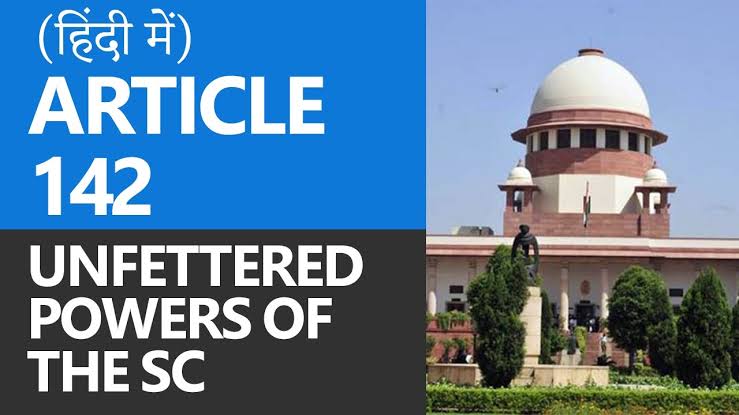
Inherent Powers Under Article 142 Can Be Invoked To Dissolve Marriage Which Has Broken Down Irretrievably: SC

In a latest and interesting development, we have seen just how recently on October 4, 2019, the two Judge Bench of Apex Court comprising of Justice Sanjay Kishan Kaul and Justice MR Shah in a laudable and landmark judgment titled R Srinivas Kumar v. R Shametha in Civil Appeal No. 4696 of 2013 has once again reiterated explicitly and elegantly that it can exercise its inherent powers under Article 142 of the Constitution of India for dissolution of a marriage where it finds that the marriage is totally unworkable, emotionally dead, beyond salvage and has broken down irretrievably, even if the facts of the case do not provide a ground in law on which the divorce could be granted. This has been observed earlier also many times by the Apex Court in its various judgments where it had invoked this Article 142 of the Constitution to dissolve the marriage! Earlier in this case the High Court had rejected the plea of a husband who sought a decree of divorce on the ground of irretrievable breakdown of marriage. 
To start with, this noteworthy judgment authored by Justice MR Shah for himself and Justice Sanjay Kishan Kaul sets the ball rolling in para 1 wherein it is pointed out that, “Feeling aggrieved and dissatisfied with the impugned judgment and order dated 06.02.2012 passed in C.M.A. No. 4142 of 2003 by the High Court of Judicature Andhra Pradesh at Hyderabad, by which the High Court has dismissed the said appeal preferred by the appellant-husband and has confirmed the judgment and order passed by the learned Family Court refusing to pass a decree of divorce against the respondent-wife, the appellant-husband has preferred the present appeal.”
To recapitulate, it is then pointed out in para 2 that, “That the marriage of the appellant and the respondent took place on 09.05.1993. That out of the said wedlock, the respondent gave birth to a male child on 29.08.1995. It appears that there were differences of opinion between the parties and according to the appellant-husband, cruelty was meted out to him. Up to 1997, many a times, the respondent-wife stayed at her parental house. The appellant-husband filed a divorce petition in the year 1999 being O.P. No. 157 of 1999 before the Family Court at Hyderabad. That the said petition was filed for a decree of divorce against the respondent-wife under Section 13(1)(a) and (b) of the Hindu Marriage Act, 1955. That the learned Family Court dismissed the said divorce petition by observing and holding that the appellant-husband has failed to prove the cruelty by the respondent-wife. The Family Court also referred to pass a decree of divorce on the ground of irretrievable breakdown of marriage.”
Furthermore, it is then pointed out in para 2.1 that, “Feeling aggrieved and dissatisfied with the judgment and order passed by the Family Court at Hyderabad dated 04.09.2003 in O.P. No. 157 of 1999 dismissing the divorce petition, the appellant-husband preferred an appeal before the High Court. Before the High Court also, the appellant-husband sought a decree of divorce on the ground of irretrievable breakdown of marriage. By the impugned judgment and order, the High Court has dismissed the said appeal. Hence, the appellant-husband is before this Court by way of the present appeal.”
After hearing the learned counsel for the respective parties at length, it is then held in para 5.1 that, “At the outset, it is required to be noted and does not seem to be in dispute that since last 22 years both the appellant-husband and the respondent-wife are residing separately. It also appears that all efforts to continue the marriage have failed and there is no possibility of re-union because of the strained relations between the parties. Thus it appears that marriage between the appellant-husband and the respondent-wife has irretrievably broken down. In the case of Hitesh Bhatnagar (supra), it is noted by this Court that Courts can dissolve a marriage as irretrievably broken down only when it is impossible to save the marriage and all efforts are made in that regard and when the Court is convinced beyond any doubt that there is actually no chance of the marriage surviving and it is broken beyond repair.” 
More crucially, it is then rightly held in para 6 that, “Now so far as submission on behalf of the respondent-wife that unless there is a consent by both the parties, even in exercise of powers under Article 142 of the Constitution of India the marriage cannot be dissolved on the ground of irretrievable breakdown of marriage is concerned, the aforesaid has no substance. If both the parties to the marriage agree for separation permanently and/or consent for divorce. In that case, certainly both the parties can move the competent court for a decree of divorce by mutual consent. Only in a case where one of the parties do not agree and give consent, only then the powers under Article 142 of the Constitution of India are required to be invoked to do the substantial Justice between the parties, considering the facts and circumstances of the case. However, at the same time, the interest of the wife is also required to be protected financially so that she may not have to suffer financially in future and she may not have to depend upon others.” 
What’s more, it is then enunciated in para 7 that, “This Court, in a series of judgments, has exercised its inherent powers under Article 142 of the Constitution of India for dissolution of a marriage where the Court finds that the marriage is totally unworkable, emotionally dead, beyond salvage and has broken down irretrievably, even if the facts of the case do not provide a ground in law on which the divorce could be granted. In the present case, admittedly, the appellant-husband and the respondent-wife have been living separately for more than 22 years and it will not be possible for the parties to live together. Therefore, we are of the opinion that while protecting the interest of the respondent-wife to compensate her by way of lump sum permanent alimony, this is a fit case to exercise the powers under Article 142 of the Constitution of India and to dissolve the marriage between the parties.”
Most importantly, it is then held in para 8 that, “In view of the above and for the reasons stated above, the application for divorce filed by the appellant-husband for dissolution of marriage is hereby allowed. The marriage between the appellant-husband and the respondent-wife is ordered to be dissolved in exercise of powers under Article 142 of the Constitution of India on the condition and as agreed by the learned Senior Advocate appearing on behalf of the appellant-husband that the appellant-husband shall pay to the respondent-wife a lump sum permanent alimony, quantified at Rs 20,00,000/- (Rupees Twenty Lakhs) to be paid directly to the respondent-wife by way of demand draft within a period of eight weeks from today. Till the permanent alimony as above is paid to the respondent-wife, the appellant-husband to continue to pay the maintenance as being paid to her.” Lastly, it is then held in para 9 that, “The appeal is allowed in the aforesaid terms. No costs.”
In summary, it may well be said that the Apex Court has once again reiterated that the inherent powers under Article 142 of the Constitution can be invoked to dissolve marriage which has broken down irretrievably. There is no point in continuing a marriage which has broken down irretrievably. The best option in such cases is to allow the parties to separate from each other and this is what has been allowed by the top court in this leading case also even though the facts of the case do not provide a ground in law on which the divorce could be granted! No denying it!
Sanjeev Sirohi, Advocate,
s/o Col BPS Sirohi,
A 82, Defence Enclave,
Sardhana Road, Kankerkhera,
Meerut – 250001, Uttar Pradesh.

Courts Can Interfere With Administrative Actions Only If It Suffers From Vice Of Illegality, Irrationality Or Procedural Impropriety: SC

It must be mentioned right at the outset that in a latest, landmark and extremely laudable judgment titled Municipal Council Neemuch vs Mahadeo Real Estate And Ors in Civil Appeal No. 7319-7320 of 2019 (Arising out of S.L.P.(C) Nos. 172-173 of 2019) which was delivered on September 17, 2019 by a three Judge Bench of Supreme Court comprising of Justice BR Gavai who authored the judgment for himself, Justice Arun Mishra and Justice MR Shah has sought to send a very loud, clear and categorical message to all the High Courts that an interference by the High Court would be warranted only when the decision impugned is vitiated by an apparent error of law. It was reiterated that while exercising its powers of judicial review of administrative action, Courts could not interfere with the administrative decision unless it suffers from the vice of illegality, irrationality or procedural impropriety. This observation was made by the three Judge Bench of Apex Court while setting aside a Madhya Pradesh High Court judgment that had interfered with an order passed by Revenue Commissioner of Ujjain in a matter of issuing tenders for allotment of land on lease, for a period of 30 years. 

To start with, the ball is set rolling in para 2 after leave is granted under para 1 wherein it is observed that, “The present appeals challenge the Judgment and Order passed by the Division Bench of the Madhya Pradesh High Court Bench at Indore dated 31.08.2017 thereby allowing the writ petition filed by respondent No. 1 herein and the subsequent Order dated 05.07.2018 thereby rejecting the Review Petition filed by the appellant.”

For the sake of brevity, para 3 then states that, “The factual background, in brief, giving rise to the present appeals is as under. The appellant, which is a Municipal Council, duly constituted under the Madhya Pradesh Municipality Act, 1961 (hereinafter referred to as the “said Act”) had invited tenders for allotment of land on lease, for a period of 30 years. The land was ad-measuring 163176 sq. ft. situated in Scheme No. 1A (Commercial-cum Residential Use), Neemuch. The Notice Inviting Tenders (“NIT” for short) was published in the daily newspapers, viz., Nai Duniya, Dainik Bhaskar, Free Press and Dashpur Express. Respondent No. 1, which is a registered partnership firm along with other bidders had submitted the tender thereby giving an offer of Rs. 5,81,00,106/-. It had also deposited the earnest money amounting to Rs. 47,00,000/-. The bids of the participants were opened in presence of the representatives of all the bidders. The bid of respondent No. 1 herein was found to be highest.”

To be sure, it is then mentioned in para 4 that, “The appellant issued a letter dated 27.09.2008 thereby informing respondent No. 1 that its bid was accepted. Respondent No. 1 was directed to deposit an amount of Rs. 1,45,25,050/-, i.e., 25% of the bid amount within a period of seven days. Respondent no. 1 in accordance therewith deposited the aforesaid amount on 01.10.2008.”

Truth be told, it is then unfolded in para 5 that, “It appears that an objection was raised by two members of the Municipal Council under the provisions of Section 323 of the said Act before the Collector with regard to the said tender process. It further appears, that the Collector vide Order dated 18.07.2008 had stayed further proceedings of the tender process. Vide Order dated 23.12.2008, the Collector disposed of the proceeding observing therein, that the proposal be sent for approval of the State Government in the Urban Administrative and Development Department, respondent No. 2 herein, under the provisions of Section 109 of the said Act.”

While continuing in the same vein, it is then pointed out in para 6 that, “Thereafter, it appears that, there was certain correspondence between the Urban Administrative and Development Department, on one hand, and the Divisional Revenue Commissioner of Ujjain, respondent No. 3 herein, on the other hand. Finally, respondent No. 3 passed an order dated 03.07.2010 observing therein that, the tenders invited in connection with transfer of the said land were not competitive. He further observed in the said Order, that the NIT was published only in Indore edition of two Hindi Newspapers at Indore and as such there was no wide circulation. As such, he rejected the proposal of the Municipal Council and returned the same with the direction to invite the tenders again by publishing the NIT in at least one National level English newspaper and one State level reputed Hindi newspaper. Being aggrieved thereby, respondent No. 1 herein approached the Madhya Pradesh High Court in Writ Petition No. 12204 of 2010. The Division Bench vide Order dated 31.08.2017 allowed the writ petition thereby quashing and setting aside the Order dated 03.07.2010 passed by respondent No. 3 and further directing him to grant approval on behalf of the State Government for allotment of the land on lease in favour of respondent no. 1. The appellant, thereafter, preferred Review Petition No. 1072 of 2017. The same was rejected. Hence the present appeals challenging both the Orders dated 31.08.2017 and 05.07.2018.”

In the context of Rule 3 of the Municipal Corporation (Transfer of Immovable Property) Rules 1994 (referred to as the “said Rules”), it would be apposite to note that para 11 envisages that, “A perusal of the aforesaid Rule 3 of the said Rules would reveal that no immovable property which yields or is capable of yielding an income shall be transferred by sale, or otherwise conveyed, except to the highest bidder at a public auction or by inviting offers in a sealed cover. The proviso thereof provides that if the Corporation is of the opinion that it is not desirable to hold a public auction or to invite offers in sealed covers, the Corporation may, with the previous sanction of the State Government, effect such transfers without public auction or inviting offers in sealed covers. The second proviso also provides that the Corporation may, with the previous sanction of the State Government and for the reasons to be recorded in writing, transfer any immovable property to a bidder other than the highest bidder.”

What is truly a no brainer is then elaborated upon in para 12 which states clearly that, “It is thus amply clear that, no land, exceeding fifty thousand rupees in the value shall be sold or otherwise conveyed without the previous sanction of the State Government. The perusal of the aforesaid Rule further makes it clear that the immovable property which yields or is capable of yielding an income shall not be transferred by sale or otherwise conveyed, except to the highest bidder at the public auction or by inviting offers in a sealed cover. No doubt, with the previous sanction of the State Government such a transfer could be effected without public auction or inviting offers in a sealed cover. The second proviso further provides that, the Corporation may, with the previous sanction of the State Government and for the reasons to be recorded in writing, transfer any immovable property to a bidder other than the highest bidder.”

What is also a no brainer is further elucidated in para 13 that, “It is thus amply clear that, whenever any land which is having a value exceeding fifty thousand rupees is to be sold the same cannot be done without the previous sanction of the State Government.”

More importantly, while discussing about the scope of judicial review, it is then rightly underscored in para 15 that, “It could thus be seen that the scope of judicial review of an administrative action is very limited. Unless the Court comes to a conclusion, that the decision maker has not understood the law correctly that regulates his decision-making power or when it is found that the decision of the decision maker is vitiated by irrationality and that too on the principle of “Wednesbury Unreasonableness” or unless it is found that there has been a procedural impropriety in the decision-making process, it would not be permissible for the High Court to interfere in the decision making process. It is also equally well settled, that it is not permissible for the Court to examine the validity of the decision but this Court can examine only the correctness of the decision making process.”

What’s more, para 17 then illustrates that, “It could thus be seen that an interference by the High Court would be warranted only when the decision impugned is vitiated by an apparent error of law, i.e. when the error is apparent on the face of the record and is self evident. The High Court would be empowered to exercise the powers when it finds that the decision impugned is so arbitrary and capricious that no reasonable person would have ever arrived at. It has been reiterated that the test is not what the court considers reasonable or unreasonable but a decision which the court thinks that no reasonable person could have taken. Not only this but such a decision must have led to manifest injustice.”

To put things in perspective, para 22 then lays bare stating that, “The situation that emerges is this. Initially the Municipal Council, Neemuch, invited tenders for allotment of the said land on lease for 30 years. This was done without taking prior approval of the State Government as is required under Section 109 of the said Act. Two municipal counselors raised objections before the Collector under the provisions of Section 323 of the said Act. The Collector, who initially granted stay on 18.07.2008, vide order dated 23.12.2008 directed the Municipal Council to seek approval of the State Government to the said proposal. Vide communication dated 21.12.2009, the State Government directed respondent No. 3-Revenue Commissioner to hand over the possession of the land to respondent No. 1. While doing so, the State Government directed the Commissioner to inspect as to whether the land was being put for use as per the development plan. On receipt of the communication the Divisional Commissioner addressed a communication to the State Government on 03.03.2010 thereby, specifically pointing out that no proper publicity was given to the NIT and that the rates were not competitive as per the market value. It was specifically observed that there was a cartel among the tenderers and therefore, sought clear orders of the State Government in view of Section 109 of the said Act. He also proposed to reject the proposal with further direction to invite fresh tenders by giving adequate publicity. In response to the said communication, the State Government re-examined the issue and by communication dated 18.05.2010 authorised the Commissioner for transferring the land in question. It is further clear from the said communication that, the State Government authorised the Commissioner to take necessary decision with regard to grant of sanction under the provisions of Section 109 of the said Act and Rule 7 of the said Rules. It specifically observed that if the Commissioner does not agree with the proposal of the Municipal Council he may while invalidating the proposal of the Municipal Council give orders for initiation of proceedings afresh. It is in view of this authorisation that the Divisional Commissioner has passed the orders which were impugned before the Madhya Pradesh High Court.”

While pooh-poohing the manner in which the Division Bench of Madhya Pradesh High Court based its decisions, the Bench then observes in para 23 that, “We are at pains to say, that the Division Bench of the High Court by only referring to the communication dated 21.12.2009 came to the conclusion that the sanction contemplated under Section 109 of the said Act was granted by the State Government. However, the Division Bench has totally ignored the subsequent correspondence between the State Government and the Commissioner. Perusal of the subsequent communication reveals that the Commissioner had pointed out the infirmities in the proposal of the Municipal Council and advised the State Government to reject the said proposal with a direction to the Municipal Council to invite fresh tenders. On the objection of the Commissioner, the State Government reexamined and reconsidered the issue and authorized the Commissioner to exercise powers under Section 109 of the said Act to take appropriate decision including rejecting the proposal and directing the process of re-tendering.”

It cannot be lost on us that it is then held in para 24 that, “It could thus be clearly seen that, the Commissioner, instead of blindly accepting the directions contained in the communication dated 21.12.2009 has acted in larger public interest so that the Municipal Council earns a higher revenue. Not only this, but the State Government, after the Commissioner pointing out anomalies to its notice, has reexamined and reconsidered the issue and authorised the Commissioner to pass appropriate orders including invalidating the tender process and directing initiation of fresh tender process. In the background of this factual situation, the finding of the Division Bench of the High Court that the action of the Commissioner is arbitrary and illegal, in our view, is neither legally or factually correct. As discussed hereinabove, the High Court, while exercising its powers of judicial review of administrative action, could not have interfered with the decision unless the decision suffers from the vice of illegality, irrationality or procedural impropriety.”

Most importantly, it is then observed in para 25 that, “In the present case, we find that the Commissioner had acted rightly as a custodian of the public property by pointing out the anomalies in the proposal of the Municipal Council to the State Government and the State Government has also responded in the right perspective by authorizing the Commissioner to take an appropriate decision. We are of the considered view that, both, the Commissioner as well as the State Government, have acted in the larger public interest. We are unable to appreciate as to how the High Court, in the present matter, could have come to a conclusion that it was empowered to exercise the power of judicial review to prevent arbitrariness or favouritism on the part of the State authorities, as has been observed by it in paragraph 13. We are also unable to appreciate the finding of the High Court in para 17 wherein it has observed that the impugned decision of the authorities are found not to be in the public interest. We ask the question to us as to whether directing re-tendering by inviting fresh tenders after giving wide publicity at the National level so as to obtain the best price for the public property, would be in the public interest or as to whether awarding contract to a bidder in the tender process where it is found that there was no adequate publicity and also a possibility of there being a cartel of bidders, would be in the public interest. We are of the considered view that the decision of the Commissioner which is set aside by the High Court is undoubtedly in larger public interest, which would ensure that the Municipal Council earns a higher revenue by enlarging the scope of the competition. By no stretch of imagination, the decision of the State Government or the Commissioner could be termed as illegal, improper, unreasonable or irrational which parameters only could have permitted the High Court to interfere. Interference by the High Court when none of such parameters exist, in our view, was totally improper. On the contrary, we find that it is the High Court, which has failed to take into consideration relevant material.”

Broadly speaking, as a corollary of what has been mentioned above, we then finally see that it is held in para 26 that, “In the result, the impugned Orders are not sustainable in law. The appeals are, accordingly, allowed and the impugned orders dated 31.08.2017 and 05.07.2018 are quashed and set aside. The petition of respondent No. 1 stands dismissed.” However, it is also then added in para 27 that, “However, the Municipal Council is directed to refund the amount deposited by respondent No. 1 herein along with interest at the rate of 6% per annum forthwith.” Lastly, it is then held in the last para 28 that, “In the facts and circumstances of the case, there shall be no order as to costs.”

In a nutshell, this decisive and laudable judgment minces just no words whatsoever to send a loud and unmistakable message that, “Courts can interfere with administrative actions only if it suffers from the vice of illegality, irrationality or procedural impropriety”. The Apex Court in this noteworthy judgment also generously cites the relevant cases like Tata Cellular Vs Union of India (1994) 6 SCC 651 and West Bengal Central School Services Commission vs Abdul Halim 2019 SCC Online SC 902 wherein it is pointed out in detail when the Court can intervene. It is pointed out that the scope of judicial review of an administrative action is very limited. Also, it is enunciated that unless the Court comes to a conclusion that the decision maker has not understood the law correctly that regulates his decision-making power or when it is found that the decision of the decision maker is vitiated by irrationality and that too on the principle of “Wednesbury Unreasonableness” or unless it is found that there has been a procedural impropriety in the decision-making process, it would not be permissible for the High Court to interfere in the decision making process. It is also equally well settled that it is not permissible for the Court to examine the validity of the decision but this Court can examine only the correctness of the decision-making process.

By the way, it is also explicitly stated that an interference by the High Court would be warranted only when the decision impugned is vitiated by an apparent error of law, i.e. when the error is apparent on the face of the record and is self evident. The High Court would be empowered to exercise the powers when it finds that the decision impugned is so arbitrary and capricious that no reasonable person would have ever arrived at.

It has also been very rightly reiterated that the test is not what the court considers reasonable or unreasonable but a decision which the court thinks that no reasonable person could have taken. Not only this but such a decision must have led to manifest injustice. Very rightly so!

It needs no Albert Einstein to conclude that all the High Courts in our country must always unflinchingly abide by what the 3 Judge Bench of the Apex Court has held so clearly, categorically and convincingly in this latest, landmark and extremely laudable judgment in similar such cases. If they do so, it will very rightly save them from getting a rap on the knuckles as we see in this notable case the High Court Bench of Madhya Pradesh got much to their own relief! This is exactly what makes this judgment so significant and crucial that no High Court Judge can ever afford to miss it out some how! .

Sanjeev Sirohi, Advocate,

s/o Col BPS Sirohi,

A 82, Defence Enclave,

Sardhana Road, Kankerkhera,

Meerut – 250001, Uttar Pradesh.

Right To Access Internet Is Part Of Right To Privacy And Right To Education: Kerala HC

Right To Access Internet Is Part Of Right To Privacy And Right To Education: Kerala HC
It is highly remarkable that the Kerala High Court has just recently on September 19, 2019 in a latest, landmark and extremely laudable judgment titled Faheema Shirin RK Vs State of Kerala and others in WP (C) No. 19716 of 2019 (L) has taken a giant step forward by declaring clearly, categorically and convincingly that right to access internet is a fundamental right forming part of right to privacy under Article 21 of the Constitution of India. This commendable judgment was delivered by a single Bench of Justice PV Asha while allowing a petition filed by a student named Faheema Shirin challenging the unwarranted restrictions on the usage of mobile phones in a girls hostel. The Kerala High Court also added that it also forms part of the right to education. Very rightly so!

To start with, the ball is set rolling in para 1 of this commendable judgment which briefly states the background of the case by saying that, “A 3rd semester B.A. student of Sree Narayanaguru College, Chelannur, Kozhikode, has filed this Writ Petition aggrieved by her expulsion from the hostel. It is stated that she has been staying in hostel run by the college which is an aided college affiliated to University of Calicut. It is stated that the inmates of the hostel were not allowed to use their mobile phone from 10 p.m. to 6 a.m. within the hostel and that undergraduate students were not allowed to use laptop also in the hostel. While so from 24.06.2019 onwards the duration of the restriction in using the mobile phones was changed as 6 p.m. to 10 p.m. The petitioner claims that though she, along with other inmates of the hostel, met the Deputy Warden – the 5th respondent, requested to convene a meeting of the inmates, explaining the inconveniences caused to them on account of the restrictions, the Deputy Warden or the matron did not respond. It is also stated that though a meeting was convened within a week thereafter, no discussion was made regarding the restriction of the electronic devices. It is stated that the 5th respondent sent a Whatsapp message informing that those who do not abide by the rules would have to vacate the hostel. The petitioner claims that she thereupon approached the Principal on 03.07.2019 and submitted Ext.P2 letter requesting to relax the restrictions. Thereupon, Ext.P3 letter was obtained from her in writing to the effect that she was not willing to abide by the new rule restricting usage of phone between 6 p.m. to 10 p.m. Thereupon her parents were asked to meet the Principal on 05.07.2019; the 4th respondent informed them that the petitioner has to vacate the hostel as she refused to abide by the rules; Ext.P4 memo dated 05.07.2019 was issued to her directing her to vacate the hostel immediately; respondents 4 to 6 convened a meeting of the hostel inmates on 08.07.2019 when the students were informed about the action taken against the petitioner based on her request to relax the rules and that the inmates were asked to give in writing their willingness to abide by the restrictions when all the hostel inmates except the petitioner submitted such willingness; on 11.07.2019, Ext.P5 notice was issued to the petitioner directing her to vacate the hostel within 12 hours; on 15.07.2019, the petitioner submitted Ext.P6 leave letter for the period from 12.7.2019 on 15.7.2019, as it was not possible for her to attend the classes since she had to travel nearly 150 km every day; when the petitioner reached the hostel on 15.7.2019 to vacate her room, it was seen locked and the hostel authorities did not allow her to take her belongings.”

Before proceeding ahead, it would be useful to mention the names of all the 7 respondents. They are as follows: –

1. State of Kerala represented by the Secretary;

2. University of Calicut represented by its Registrar;

3. University Grants Commission represented by its Secretary;

4. Principal Sree Narayanaguru College, Chelannoor, Balussery, P.O. Kozhikkode;

5. Deputy Warden, Women’s Hostel, Sree Narayanaguru College;

6. Matron, Women’s Hostel, Sree Narayanaguru College; and

7. SFLC.IN represented by its Executive Director, New Delhi.

No doubt, it is rightly pointed out in para 8 that, “The question to be considered is whether the restrictions imposed by the hostel authorities on use of mobile phones while enforcing discipline has infringed the fundamental rights of the petitioner, even assuming that such modification was brought about at the request from the parents.”

Going forward, it would be useful to have a quick look at the relevant part of para 9 which states that, “However in this case the question to be examined is whether such enforcement of discipline by restricting the use of mobile phones would result in curtailing the right of the students to acquire knowledge by different means. Using of mobile phones by itself would not cause any harm to anyone. If a restriction is unreasonable and arbitrary and infringes the fundamental right of an inmate, it cannot be said that the student has to abide by such restriction, especially when the inmate is an adult.”

Furthermore, while examining the impact of using mobile phone in hostel, it is then enunciated in para 10 that, “It is therefore necessary to examine whether usage of mobile phone during 6 pm to 10 pm would amount to indiscipline and whether the refusal to abide by the instruction in using it should result in expulsion from the hostel. It is stated that the object behind introducing such a restriction is to see that the students are utilizing their study time for study purposes alone. The respondents have not stated whether usage of mobile phone by the petitioner or by any inmate caused any disturbance to other inmates. Therefore, indiscipline comes only to the extent of disobedience of an instruction. Then the question is whether an instruction or restriction can stand in the way of acquiring knowledge by the inmates. It is also necessary to examine whether they can utilise the study time for study purposes using the mobile phones also, in this advanced world of technology. The college authorities as well as parents should be conscious of the fact that the students in a college hostel are adults who are capable of taking decisions as to how and when they have to study. It is a fact that there is large scale misuse of mobile phones; but that misuse can happen with the laptops also; it can be even before 6 pm and 10 pm, before and after the study time.”

While underscoring the growing indispensable importance and necessity of mobile phones in routine life, it is then rightly pointed out in para 11 that, “The mobile phones which were unheard of once and later a luxury has now become part and parcel of the day to day life and even to a stage that it is unavoidable to survive with dignity and freedom. Though initially it was a mere replacement of land phone enabling one to connect another and talk, on the advent of internet the connectivity became so wide. On availability of more and more facilities, since the year 1998, the number of users gradually increased and as at present India stands 2nd in the world in the usage of internet. The facilities to access internet, which was initially possible only through desktop computers, later in laptop, is now available in mobile phones which are handy and portable; with more and more applications, connectivity became feasible for everyone everywhere even among the common man. Apart from the facilities to read E-newspapers, e-books, etc. one can undergo online courses also sitting at home or hostel and it is pointed out that there are courses under SWAYAM recognized by the UGC, which students can undergo even when they are undergoing regular studies in colleges. Though the respondent college has stated that there is no restriction for the inmates to use laptops, all the students would not be ordinarily able to afford to have a laptop in addition to mobile phone. Assuming that the purpose is to prevent misuse of mobile phones during study time, such misuse is quite possible with laptops also. Thus the purpose of such restriction would not be achieved. It would not be proper for the college authorities to impose such restrictions on students of the college going age even if it is at the request of parents, in their anxiety to see that their children are studying and not being misdirected through mobile phones. It is a well known fact that these phones as well as the modern technologies are prone to misuse. At the same time, the college authorities as well as the parents cannot be permitted to shut their eyes on the innumerable advantages out of internet on various aspects of learning with world wide connectivity, on its proper usage. Apart from facilities for interaction, exchange of ideas or group discussions, there are several methods by which the devices can be usefully utilised by its proper use by downloading of data or e-books or undergoing other courses, simultaneously utilising the facilities under the Swayam program of UGC, etc; knowledge can be gathered by adopting the method which one chooses. When one student may be interested in garnering knowledge by reference of books in libraries, one may be interested in referring to e-books or downloading data.”

While batting for more freedom for students above 18 years, it is then rightly articulated in para 12 that, “By compelling one that she should utilise the books in the library during the study time or that she should not access the technological means during a particular time or study time may not always yield positive results. A student above the age of 18 years shall be given the freedom to choose the mode for her studies provided it does not cause any disturbance to others. The schools in Kerala promotes digitalisation with smart class rooms and the modern technology has taken its place in all the fields even from primary section. Thus the usage of mobile phones in order to enable the students to have access to internet will only enhance the opportunities of students to acquire knowledge from all available sources based on which they can achieve excellence and enhance quality and standard of education.”

While quoting liberally from the landmark cases, it is then pointed out in para 15 that, “As found by the Apex Court in Charu Khurana v. Union of India (2015) 1 SCC 192, women still face all kinds of discrimination and prejudice and the days when women were treated as fragile, feeble, dependent and subordinate to men, should be a matter of history.” Similarly, it is then held in para 16 that, “In the judgment in Puttaswamy’s case (supra) the Apex Court held that right to privacy is held to be an intrinsic part of the right to life, personal liberty and dignity and hence a fundamental right under part III of the Constitution.”

Be it noted, para 18 then envisages that, “Though it is true that the Principal of the college is the supreme authority to enforce discipline as held by this Court in Manu Wilson’s case, Sojan Francis’ case, Indulekha Joseph’s case (supra) and that there cannot be any dispute that rules and regulations lawfully framed are to be obeyed by the students and that teachers are like foster parents who are required to look after, cultivate and guide the students in their pursuit of education for maintaining excellence of education, the rules should be modified in tune with the modernisation of the technology so as to enable the students to acquire knowledge from all available sources. It would be open to the authorities in the hostel to supervise whether any distraction or disturbance is caused to other students on account of usage of mobile phone or take action when any such complaint is received. The total restriction on its use and the direction to surrender it during the study hours is absolutely unwarranted. When the Human Rights Council of the United Nations have found that right to access to Internet is a fundamental freedom and a tool to ensure right to education, a rule or instruction which impairs the said right of the students cannot be permitted to stand in the eye of law.”

What’s more, it is then eruditely pointed out in para 19 that, “It is pertinent to note that the learned counsel for the college vehemently argued that in the absence of any challenge to the rules and regulations, the petitioner cannot be heard to challenge the action taken in accordance with the rules. The learned counsel for the college also argued that in the light of the judgment of the Full Bench of this Court in Pavitran VKM V. State of Kerala & others 2009(4) KLT 20: 2009(4) KHC 4, the rules and regulations of the hostel will stand as long as it is not set aside. But in this case the rule was that the mobile phones shall not be used in the hostel. Therefore, what remains is only the decision/instruction restricting/banning the use of mobile phone from 6 pm to 10 pm and the direction to surrender the mobile phone to the warden. When it is already found that such an action infringes the fundamental freedom as well as privacy and will adversely affect the future and career of students who want to acquire knowledge and compete with their peers, such instruction or restriction cannot be permitted to be enforced.”

To put it succinctly, para 20 then states unambiguously that, “While enforcing discipline it is necessary to see the positive aspects of the mobile phone also. As held by this Court in the judgment in Anjitha K. Jose’ case (supra), the restriction should have connection with the discipline and when there is nothing to show that there was any act of indiscipline on account of the usage of mobile phone by the petitioner, that cannot stand. The fact that no other student objected to the restriction or that all others obeyed the instructions will not make a restriction legal if it is otherwise illegal. No student shall be compelled either to use mobile phone or not to use mobile phone. It is for each of the students to decide with self confidence and self determination that she would not misuse it and that she would use it only for improving her quality of education.”

While adding a word of advice for parents, hostel authorities and students, para 21 then states that, “The parents as well as the authorities of the hostel have to consider the fact that almost all the undergraduate students staying in the hostel have attained majority. They have joined the course after passing one or two public examinations. The students in that age group are expected to be conscious of their duty to study properly in exercise of their right to education. The manner in which as well as the time during which each person can study well, vary from person to person.”

More importantly, Justice PV Asha who delivered this landmark judgment then categorically observes in para 22 that, “I am of the view that what is required is a counseling for the students, as well as parents in the colleges. The students in the hostels should be given counseling in order to inculcate in them self restraint in the usage of mobile phones, to make them capable of choosing the right path, to make them aware of the consequences of misuse as well as advantage of its proper use. It should be left to the students to choose the time for using mobile phone. The only restriction that can be imposed is that they should not cause any disturbance to other students. While acting in exercise of right to privacy, persons like the petitioner shall also see that such exercise does not invade the right to privacy of another student residing in the hostel especially in her room.”

While spelling out the boundaries for enforcement of rules and discipline, it is then observed in para 24 that, “Regarding the contention of the respondent that any inmate is bound to abide by the rules and regulations or else she is free to leave the hostel, it is pertinent to note that rules and regulations require reforms to cope up with the advancement of technology and the importance of modern technology in day to day life. As per the University Regulations as well as the UGC Regulations, the college is bound to run a hostel to enable the students to reside near the college in order to enable them to have sufficient time to concentrate in their studies. Therefore, the hostel authorities are expected to enforce only those rules and regulations for enforcing discipline. Enforcement of discipline shall not be by blocking the ways and means of the students to acquire knowledge.”

Finally, it is then held in the last para 25 that, “In view of the aforesaid reasons, I am of the view that imposing of such restrictions is unreasonable and therefore the respondent shall re-admit the petitioner in the hostel without any further delay. It is made clear that the petitioner or her parent shall not do any act in a manner humiliating any of the respondents or any other teacher or warden or Matron in the hostel/college. The petitioner or any other inmate shall also see that no disturbance is caused to others by usage of mobile phone in the hostel. The Writ Petition is allowed to the above extent.”

In the ultimate analysis, what can be easily inferred from the above foregoing discussion is that the Kerala High Court has laid down in no uncertain terms that right to access internet is part of the right to privacy under Article 21 of the Constitution of India and also the right to education. We all know fully well how crucial internet is to acquire invaluable information about anything which cannot be acquired from other sources so easily which makes it all the more important!

It also cannot be denied that even the UN General Assembly had declared right to internet to be a human right in 2014. Even the Kerala Finance Minister Dr Thomas Issac in 2017 in his budget speech had recognized right to internet as a human right and had disclosed that efforts were being made to make internet accessible to all. The only restriction that can be imposed is that the students using mobile phones should not cause disturbance to other students! This was made clear by the Kerala High Court also in this commendable judgments and all students must adhere to it!

Sanjeev Sirohi, Advocate,

s/o Col BPS Sirohi,

A 82, Defence Enclave,

Sardhana Road, Kankerkhera,

Meerut – 250001, Uttar Pradesh.

Ishwar Chandra Vidyasagar: A Legendry Personality

On this date i.e. on 26 September in 1820 Ishwar Chandra Vidyasagar (Ishwar Chandra Bandyopadhyay/ at present many persons with same surname write
Banerjee instead of Bandyopadhyay) was
born in then Bengal, present West Bengal. Because of his vast knowledge later
on of his life, he is known as
Vidyasagar means knowledge of ocean. He was also
known as ‘Dayar Sagar’ or ‘Karunar Sagar’
(meaning ocean of kindness) because of his charitable nature and generosity.
His enormous contribution for the development of the society is gratefully
remembered by all not only in India but also in Bangladesh. 
Ishwar Chandra Vidyasagar: A Legendry Personality

He reconstructed the
Bengali alphabets and simplified Bengali typography into an alphabets.
He was a social reformer
and advocated widow remarriage and worked against polygamy.
Because of his initiative,
the Widow Remarriage Act was passed in 1856 making the widow marriage legal.
   Vidyasagar worked endlessly to provide equal
education to all men and women irrespective of their caste, religion and
gender.
He
was protagonist of women education. According to him with education only women
can live in the society with dignity and respect. He lobbied hard for girls’ school
and for this; he went door to door requesting heads of families to allow their
daughters to admit in the schools. And it is believed that he could open 35
schools for girls throughout then Bengal where around 1300 students were
enrolled. It is pertinent to mention that because of his arduous labour and
support received from John Elliot Drinkwater Bethune, the first girls’ school
in India, the Bethune School was established on 7 May, 1849 in Calcutta.
He worked as a Sanskrit
professor in Sanskrit College, Calcutta. While he was principal of the college undertook
some reforms and one of them was admission of students belonging to  marginalised group (present SC/ST) as earlier
they were not allowed admission. Further, when he was Professor in Sanskrit
College successfully included English and Bengali as medium of learning, in
addition to Sanskrit. He introduced courses of European History, Philosophy and
Science along with Vedic scriptures. During his lifetime, Vidyasagar wrote many
books and thus enriched education system.
In present days, he is
remembered in many ways, inter alia
of which are:
a)     
Vidyasagar Setu, which
connects Howrah and Kolkata, is a bridge over the Hooghly River in West Bengal.
b)     
A
fair/mela named Vidyasagar Mela (dedicated
to spreading education and increasing social awareness) is held annually in
West Bengal since 1994.
c)     
Vidyasagar
College in Kolkata is named after him, as well as Vidyasagar University in Paschim Midnapore, West Bengal.
d)     
A
street in then Calcutta now Kolkata has been named after him
e)     
The
West Bengal Government has established a stadium named after him at Barasat, North 24 Parganas, district.
f)      
For
his immense and selfless service for the marginalised people of then Bihar
present Jharkhand, a railway station has been named as Vidyasagar Station in Jamtara district of Jharkhand.
g)     
Indian
Post issued stamps featuring Vidyasagar in 1970 and 1998.
       In addition to above, I have observed
many persons in the states of South India keep their son’s name Ishwar Chandra
Vidyasagar/
Vidyasagar
(prefix as family name). When I visited Bangladesh amazed to observe his
popularity among the people of Bangladesh.
Vidyasagar although has
passed away on 29 July, 1891 but he is still remembered by all Indians. After
his death Rabindranath Tagore wrote, “One wonders how God, in the process
of producing forty million Bengalis, produced a man!”

Dr Shankar Chatterjee
Former Professor & Head (CPME),NIRD & PR ( Govt. of India), Hyderabad,  India

Former Associate Professor, Eritrea

Former Assistant Prof, Govt. Degree College, Tripura, India
Former Senior Planning Officer, Govt of Assam, India 
PRESENT ADDRESS
Prof. Shankar Chatterjee 
Lidom Villa, No.13
Peranchuru, Bandlaguda(Jagir), Hyderabad-5000091

We have responsibility to save the environment

 SAVE NATURE – PLEASE  TAKE PRINTOUT WHENEVER NECESSARY

Journalism

Journalism alludes to the generation
and circulation of reports on late occasions. The word news-casting
applies to the occupation, just as native writers utilizing strategies
for social affair data and utilizing abstract methods. Journalistic
media incorporate print, TV, radio, Internet, and, previously,
newsreels.
Ideas of the suitable
role for journalism shift between nations. In certain countries, the
news media are constrained by government mediation and are not
completely independent. In others, the news media are free of the
legislature yet rather work as private industry propelled by benefit.
Notwithstanding the changing idea of how media associations are run and
financed, nations may have varying executions of laws taking care of the
right to speak freely and criticism cases.
The coming of the Internet and cell phones has conveyed critical
changes to the media scene as of late. This has made a move in the
utilization of print media stations, as individuals progressively devour
news through tablets, cell phones, and other individual electronic
gadgets, instead of the more customary arrangements of papers,
magazines, or TV news channels.

Mass Media

Mass media are apparatuses for the exchange of data, ideas, and thoughts
to both general and explicit groups of onlookers. They are critical
instruments in propelling general wellbeing objectives. Conveying about
wellbeing through broad communications is unpredictable, in any case,
and difficulties experts in assorted orders. Utilizing mass media can be
counterproductive if the channels utilized are not gathering of people
fitting, or if the message being conveyed is excessively enthusiastic,
dread exciting, or disputable.
 Bothersome reactions more often than not
can be kept away from through appropriate developmental research,
information of the gathering of people, involvement in connecting media
channels to groups of onlookers, and message testing. Each mass medium
has its own substance types, innovative specialists, professionals, and
plans of action. For instance, the Internet incorporates web journals,
digital recordings, sites, and different advances worked on the general
conveyance arrange. Some contend that computer games have formed into an
unmistakable mass type of media.

Journalism and Mass Communication

Mass communication is the investigation
of spreading data to a substantial gathering of people through the
different methods for communication. Journalism is the action of
expounding on ongoing advancements for papers, magazines and so forth.
It has encompassed detailing done through radio and TV.
Along these lines, there is a contrast between the two projects. Mass
Communication is a more extensive field while Journalism is a restricted
field. Mass Communication manages the technique of passing on or
transmitting a message to the all-inclusive community through media like
radio, papers, magazines, TV, web, etc.
 

Digital Journalism

Digital Journalism is a contemporary type of journalism where article
content is disseminated by means of the Internet, instead of
distributing by means of print or communicates. Digital journalism is
debated by researchers; in any case, the essential result of
news-casting, which is news and highlights on flow issues, is displayed
exclusively or in blend as content, sound, video, or some intuitive
structures like news games, and spread through computerized media
technology. Less boundaries to passage, brought down dissemination
costs, and assorted PC organizing advances have prompted the across the
board routine with regards to computerized journalism. It has
democratized the progression of data that was recently constrained by
customary media including papers, magazines, radio, and television. 

The
digital viewpoint might be fundamental to the journalistic message and
stays, to some degree, inside the innovative control of the essayist,
manager, as well as publisher. The desires for society for moment data
was critical for the development of digital journalism.