Inbound marketing versus digital marketing
Digital marketing and inbound marketing are easily confused, and for good reason. Digital marketing uses many of the same tools as inbound marketing—email and online content, to name a few. Both exist to capture the attention of prospects through the buyer’s journey and turn them into customers. But the 2 approaches take different views of the relationship between the tool and the goal.
Digital marketing considers how each individual tool can convert prospects. A brand’s digital marketing strategy may use multiple platforms or focus all of its efforts on 1 platform.
Inbound marketing is a holistic concept. It considers the goal first, then looks at the available tools to determine which will effectively reach target customers, and then at which stage of the sales funnel that should happen.
The most important thing to remember about digital marketing and inbound marketing is that as a marketing professional, you don’t have to choose between the 2. In fact, they work best together. Inbound marketing provides structure and purpose for effective digital marketing to digital marketing efforts, making sure that each digital marketing channel works toward a goal.
Types of digital marketing
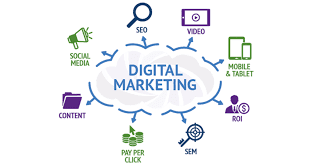
There are as many specializations within digital marketing as there are ways of interacting using digital media. Here are a few key examples.
Search engine optimization
Search engine optimization, or SEO, is technically a marketing tool rather than a form of marketing in itself. The Balance defines it as “the art and science of making web pages attractive to search engines.”
The “art and science” part of SEO is what’s most important. SEO is a science because it requires you to research and weigh different contributing factors to achieve the highest possible ranking. Today, the most important elements to consider when optimizing a web page include:
- Quality of content
- Level of user engagement
- Mobile-friendliness
- Number and quality of inbound links
The strategic use of these factors makes SEO a science, but the unpredictability involved makes it an art.
In SEO, there’s no quantifiable rubric or consistent rule for ranking highly. Google changes its algorithm almost constantly, so it’s impossible to make exact predictions. What you can do is closely monitor your page’s performance and make adjustments accordingly.
Content marketing
SEO is a major factor in content marketing, a strategy based on the distribution of relevant and valuable content to a target audience.
As in any marketing strategy, the goal of content marketing is to attract leads that ultimately convert into customers. But it does so differently than traditional advertising. Instead of enticing prospects with potential value from a product or service, it offers value for free in the form of written material.
Content marketing matters, and there are plenty of stats to prove it:
- 84% of consumers expect companies to produce entertaining and helpful content experiences
- 62% of companies that have at least 5,000 employees produce content daily
- 92% of marketers believe that their company values content as an important asset
As effective as content marketing is, it can be tricky. Content marketing writers need to be able to rank highly in search engine results while also engaging people who will read the material, share it, and interact further with the brand. When the content is relevant, it can establish strong relationships throughout the pipeline.
Social media marketing means driving traffic and brand awareness by engaging people in discussion online. The most popular platforms for social media marketing are Facebook, Twitter, and Instagram, with LinkedIn and YouTube not far behind.
Because social media marketing involves active audience participation, it has become a popular way of getting attention. It’s the most popular content medium for B2C marketers at 96%, and it’s gaining ground in the B2B sphere as well. According to the Content Marketing Institute, 61% of B2B content marketers increased their use of social media this year.
Social media marketing offers built-in engagement metrics, which are extremely useful in helping you to understand how well you’re reaching your audience. You get to decide which types of interactions mean the most to you, whether that means the number of shares, comments, or total clicks to your website.
Direct purchase may not even be a goal of your social media marketing strategy. Many brands use social media marketing to start dialogues with audiences rather than encourage them to spend money right away. This is especially common in brands that target older audiences or offer products and services not appropriate for impulse buys. It all depends on your company’s goals.
To learn more about how Mailchimp can help with your social media strategy, check out the comparison of our free social media management tools versus others.
Pay-per-click marketing
Pay-per-click, or PPC, is posting an ad on a platform and paying every time someone clicks on it.
How and when people see your ad is a bit more complicated. When a spot is available on a search engine results page, also known as a SERP, the engine fills the spot with what is essentially an instant auction. An algorithm prioritizes each available ad based on a number of factors, including:
- Ad quality
- Keyword relevance
- Landing page quality
- Bid amount
Each PPC campaign has 1 or more target actions that viewers are meant to complete after clicking an ad. These actions are known as conversions, and they can be transactional or non-transactional. Making a purchase is a conversion, but so is a newsletter signup or a call made to your home office.
Whatever you choose as your target conversions, you can track them via your chosen platform to see how your campaign is doing.
Affiliate marketing
Affiliate marketing lets someone make money by promoting another person’s business. You could be either the promoter or the business who works with the promoter, but the process is the same in either case.
It works using a revenue sharing model. If you’re the affiliate, you get a commission every time someone purchases the item that you promote. If you’re the merchant, you pay the affiliate for every sale they help you make.
Some affiliate marketers choose to review the products of just 1 company, perhaps on a blog or other third-party site. Others have relationships with multiple merchants.
Whether you want to be an affiliate or find one, the first step is to make a connection with the other party. You can use a platform designed to connect affiliates with retailers, or you can start or join a single-retailer program.
If you’re a retailer and you choose to work directly with affiliates, there are many things you can do to make your program appealing to potential promoters. You’ll need to provide those affiliates with the tools that they need to succeed. That includes incentives for great results as well as marketing support and pre-made materials.
Native advertising
Native advertising is marketing in disguise. Its goal is to blend in with its surrounding content so that it’s less blatantly obvious as advertising.
Native advertising was created in reaction to the cynicism of today’s consumers toward ads. Knowing that the creator of an ad pays to run it, many consumers will conclude that the ad is biased and consequently ignore it.
A native ad gets around this bias by offering information or entertainment before it gets to anything promotional, downplaying the “ad” aspect.
It’s important to always label your native ads clearly. Use words like “promoted” or “sponsored.” If those indicators are concealed, readers might end up spending significant time engaging with the content before they realize that it’s advertising.
When your consumers know exactly what they’re getting, they’ll feel better about your content and your brand. Native ads are meant to be less obtrusive than traditional ads, but they’re not meant to be deceptive.
Marketing automation
Marketing automation uses software to power digital marketing campaigns, improving the efficiency and relevance of advertising.
According to statistics:
- 90% of US consumers find personalization either “very” or “somewhat” appealing
- 81% of consumers would like the brands they engage with to understand them better
- 77% of companies believe in the value of real-time personalization, yet 60% struggle with it
Marketing automation lets companies keep up with the expectation of personalization. It allows brands to:
- Collect and analyze consumer information
- Design targeted marketing campaigns
- Send and post marketing messages at the right times to the right audiences
Many marketing automation tools use prospect engagement (or lack thereof) with a particular message to determine when and how to reach out next. This level of real-time customization means that you can effectively create an individualized marketing strategy for each customer without any additional time investment.
Email marketing
The concept of email marketing is simple—you send a promotional message and hope that your prospect clicks on it. However, the execution is much more complex. First of all, you have to make sure that your emails are wanted. This means having an opt-in list that does the following:
- Individualizes the content, both in the body and in the subject line
- States clearly what kind of emails the subscriber will get
- Offers a clear unsubscribe option
- Integrates both transactional and promotional emails
You want your prospects to see your campaign as a valued service, not just as a promotional tool.
Email marketing is a proven, effective technique all on its own: 89% of surveyed professionals named it as their most effective lead generator.
It can be even better if you incorporate other techniques such as marketing automation, which lets you segment and schedule your emails so that they meet your customer’s needs more effectively.






 Eduindex
You must be logged in to post a comment.