EMI: HOW TO CALCULATE EMI

An Equated Monthly Installment (EMI) is a fixed payment amount made by a borrower to a lender at a specified date each calendar month. EMI depends upon the tenure for which a loan is taken. EMI is high for a tenure of short period of time as compared to long period.

Equated monthly Installments are used to pay off both interest and Principal each month so that over a specified number of years, the loan is paid off in full. If a person pays only the interest component each month, then it is not the EMI amount as the Principal amount stands unpaid.

EMI Moratorium: Opting for it now means paying more later

Want to understand using a hypothetical situation?

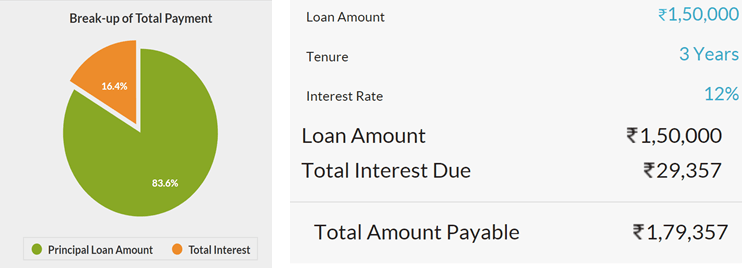
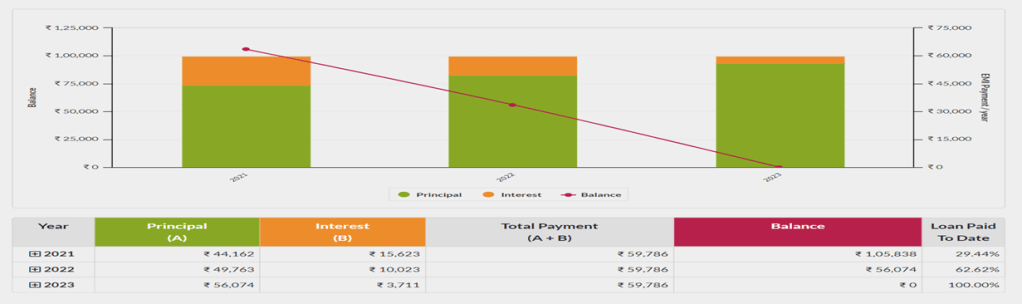
A person was planning to buy a new motorcycle and has managed to save Rupees 75,000 for the cause and decides to take a loan for the balance amount. He approached a showroom and decides to buy a latest motorcycle worth Rupees 2,50,000. He visits a bank on the next day and was able to fetch a motor loan of  Rupees 1,50,000 only. He agreed to pay back the amount with an interest of 12% within a tenure of 3 years. He worked overtime and was able to manage the balance of rupees 25,000 rupees.

The person on taking a loan of Rupees 1,50,000 has to pay a sum of Rupees 1,79,357 including an interest of Rupees 29,357 i.e. 16.4% of total payable amount  within a tenure of 3 years at an interest rate of 12% Per Annum
In first year, he needs to clear a debt of 29.44% of total debt of rupees 1,79,357 i.e. 59,786 including a Principal Amount of Rupees 44,162 and an Interest of Rupees 15,623

In Second year, he needs to pays rupees 59,786 clearing 62.62% of the total debt including a Principal Amount of Rupees 49,763 and an Interest of Rupees 10,023

In third year he needs to make a final installment of rupees 59,786 to clear all his debts. The installment includes a Principal Amount of Rupees 56,074 and an Interest of Rupees 3,711.
LOAN: TYPES OF LOAN

Loan

A loan is a form of debt incurred by an individual or other entity.

The lender, usually a corporation, financial institution, or government advances a sum of money to the borrower.

In return, the borrower agrees to a certain set of terms including any finance charges, interest, repayment date, and other conditions.

How to Avail Tax Benefits On a Personal Loan (3 Possible Ways)

Types of Loan

i) Collateral Loans

These are  secured loans as the commodity kept as a security can be sold by bank to recover the debt, if the borrower fails to pay back the loan.

A guarantor can also act as a Collateral for a loan if he/she promises to pay the loan with interest if the borrower fails to do so.

ii) Non- Collateral Loans

These loans are not secured as nothing is kept as a security that can be sold by the bank to recover the debt, if the borrower fails to pay back the loan.

Wireless Energy Transfer-Tesla’s Dream

WPT- Wireless Power Transmission
Wireless Power Transfer holds the promise of freeing us from the tyranny of power cords. This technology is being incorporated into all kinds of devices and systems.

Wireless Power Transfer holds the promise of freeing us from the tyranny of power cords. This technology is being incorporated into all kinds of devices and systems. Let’s take a look!
The Wired Way
The majority of today’s residences and commercial buildings are powered by alternating current (AC) from the power grid. Electrical stations generate AC electricity that is delivered to homes and businesses via high-voltage transmission lines and step-down transformers.
Electricity enters at the breaker box, and then electrical wiring delivers current to the AC equipment and devices that we use every day—lights, kitchen appliances, chargers, and so forth.
All components are standardized and in agreement with the electrical code. Any device rated for standard current and voltage will work in any of the millions of outlets throughout the country. While standards differ between countries and continents, within a given electrical system, any appropriately rated device will work.
Here a cord, there a cord. . . . Most of our electrical devices have AC power cords.


Wireless Power Technology
Wireless Power Transfer (WPT) makes it possible to supply power through an air gap, without the need for current-carrying wires. WPT can provide power from an AC source to compatible batteries or devices without physical connectors or wires. WPT can recharge mobile phones and tablets, drones, cars, even transportation equipment. It may even be possible to wirelessly transmit power gathered by solar-panel arrays in space.
WPT has been an exciting development in consumer electronics, replacing wired chargers. The 2017 Consumer Electronics Show will have many devices offering WPT.
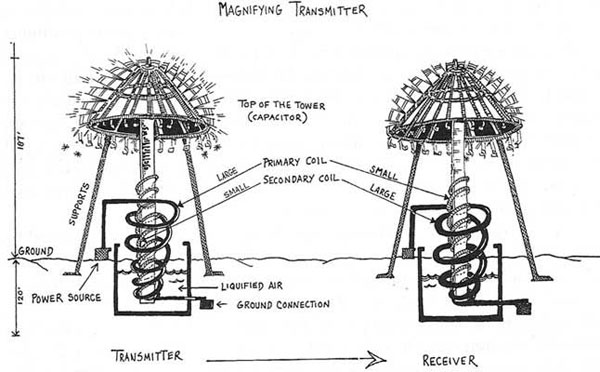
The concept of transferring power without wires, however, has been around since the late 1890s. Nikola Tesla was able to light electric bulbs wirelessly at his Colorado Springs Lab using electrodynamic induction (aka resonant inductive coupling).
 

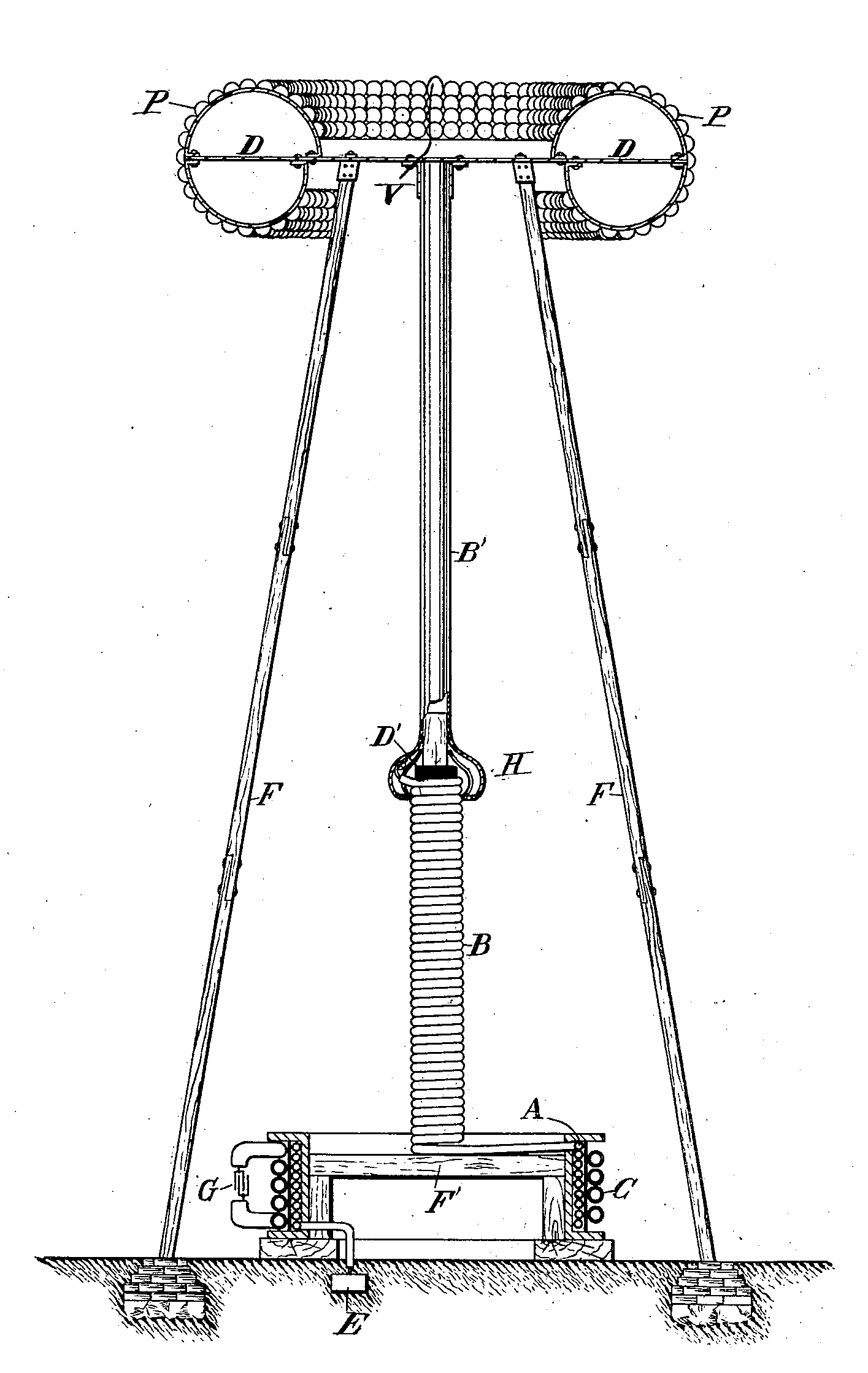
An image from Tesla’s patent for an “apparatus for transmitting electrical energy,” 1907.
 
Three light bulbs placed 60 feet (18m) from the power source were lit, and the demonstration was documented. Tesla had big plans and hoped that his Long Island-based Wardenclyffe Tower would transmit electrical energy wirelessly across the Atlantic Ocean. That never happened owing to various difficulties, including funding and timing.
WPT uses fields created by charged particles to carry energy between transmitters and receivers over an air gap. The air gap is bridged by converting the energy into a form that can travel through the air. The energy is converted to an oscillating field, transmitted over the air, and then converted into usable electrical current by a receiver. Depending on the power and distance, energy can be effectively transferred via an electric field, a magnetic field, or electromagnetic (EM) waves such as radio waves, microwaves, or even light.

 
Qi Charging, an Open Standard for Wireless Charging
While some of the companies promising WPT are still working to deliver products, Qi (pronounced “chee”) charging is standardized, and devices are currently available. The Wireless Power Consortium (WPC), established in 2008, developed the Qi standard for battery charging. The standard supports both inductive and resonant charging technologies.
Inductive charging has the energy passing between a transmitter and receiver coil at close range. Inductive systems require the coils to be in close proximity and in alignment with each other; usually the devices are in direct contact with the charging pad. Resonant charging does not require careful alignment, and chargers can detect and charge a device at distances up to 45mm; thus, resonant chargers can be embedded in furniture or mounted in shelving.
 

The Qi logo displayed on the Qimini wireless charging plate. Image courtesy of Tektos.
 
The presence of a Qi logo means the device is registered and certified by the Wireless Power Consortium.
When first introduced, Qi charging was low power, about 5W. The first smartphones using Qi charging were introduced in 2011. In 2015, Qi was expanded to include 15W, which allows for quick charging.
Only devices listed in the Qi Registration Database are guaranteed to provide Qi compatibility. There are currently over 700 products listed. It is important to recognize that products with the Qi logo have been tested and certified; the magnetic fields they use will not cause problems for sensitive devices such as mobile phones or electronic passports. Registered devices are guaranteed to work with all registered chargers.  
For more information on Qi wireless charging, check out this article, and for an introduction to and technical evaluation of Qi-compatible transmitter/receiver WPT evaluation boards, click here and here.
 
The Physics of WPT
WPT for consumer devices is an emerging technology, but the underlying principles and components are not new. Maxwell’s Equations still rule wherever electricity and magnetism are involved, and transmitters send energy to receivers just as in other forms of wireless communication. WPT is different, though, in that the primary goal is transferring the energy itself, rather than information encoded in the energy.


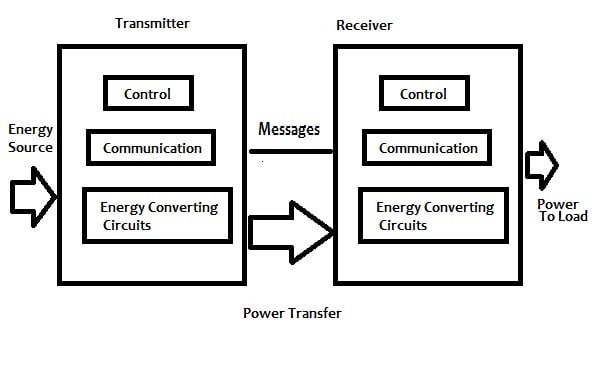
WPT transmitter/receiver block diagram.
The electromagnetic fields involved in WPT can be quite strong, and human safety has to be taken into account. Exposure to electromagnetic radiation can be a concern, and there is also the possibility that the fields generated by WPT transmitters could interfere with wearable or implanted medical devices.
The transmitters and receivers are embedded within WPT devices, as are the batteries to be charged. The actual conversion circuitry will depend on the technology used. In addition to the actual transfer of energy, the WPT system must allow the transmitter and receiver to communicate. This ensures that a receiver can notify the charging device when a battery is fully charged. Communication also allows a transmitter to detect and identify a receiver, to adjust the amount of power transmitted to the load, and to monitor conditions such as battery temperature.
The concept of near-field vs. far-field radiation is relevant to WPT. Transmission techniques, the amount of power that can be transferred, and proximity requirements are influenced by whether the system is utilizing near-field or far-field radiation.
Locations for which the distance from the antenna is much less than one wavelength are in the near field. The energy in the near field is nonradiative, and the oscillating magnetic and electric fields are independent of each other. Capacitive (electric) and inductive (magnetic) coupling can be used to transfer power to a receiver located in the transmitter’s near field.
Locations for which the distance from the antenna is greater than approximately two wavelengths are in the far field. (A transition region exists between the near field and far field.) Energy in the far field is in the form of typical electromagnetic radiation. Far-field power transfer is also referred to as power beaming. Examples of far-field transfer are systems that use high-power lasers or microwave radiation to transfer energy over long distances.
 
Where WPT Works
All WPT technologies are currently under active research, much of it focused on maximizing power transfer efficiency (PDF) and investigating techniques for magnetic resonant coupling (PDF). In addition to the idea of walking into a room equipped for WPT and having your devices charge automatically, much more ambitious projects are in place.
Across the globe, electric buses are becoming the norm; London’s iconic double-decker buses are planning for wireless charging, as are bus systems in South KoreaUtah, and Germany.
Using WiTricity, invented by MIT scientists, electric cars can be charged wirelessly, and those cars can wirelessly charge your mobiles! (Using Qi charging, of course!) This wireless technology is convenient, to be sure, but it may also charge cars faster than plug-in charging can.
 

Graphic of a wireless parking charge setup built into a parking space. Image courtesy of Toyota.
 
An experimental system for wirelessly powering drones has already been demonstrated. And as mentioned above, ongoing research and development is focused on the prospect of supplying some of Earth’s energy needs using WPT in conjunction with space-based solar panels.
WPT works everywhere!
 
Conclusion
While Tesla’s dream of having power delivered wirelessly for everyone’s use is still far from feasible, many devices and systems are using some form of wireless power transfer right now. From toothbrushes to mobile phones, from cars to public transportation, there are many applications for wireless power transfer.