

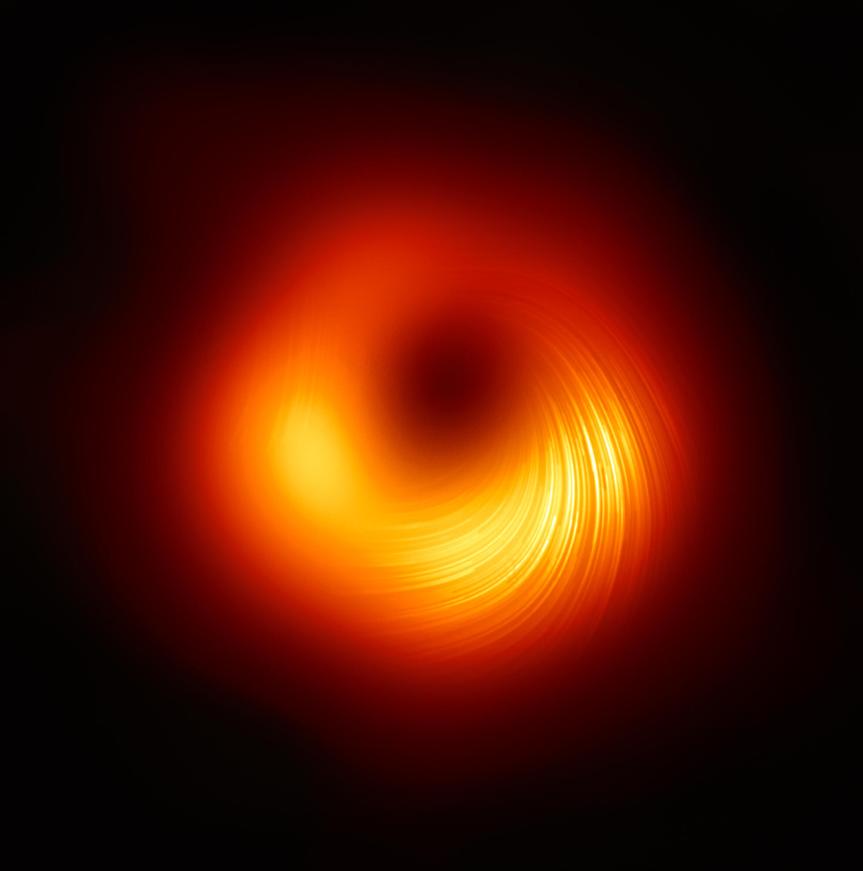
A black hole is not really an empty hole or space. Black holes are points in space that are so dense they create deep gravity sinks.
It is formed by a death of a massive star. A black hole takes up zero space but does have mass, that used to be a star. And black holes get more massive as they consume matter near them.
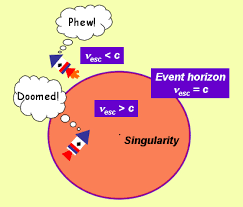
There’s a boundary at the edge of a black hole called the event horizon, which is the point of no return — any light or matter that crosses that boundary is sucked into the black hole. It would need to travel faster than the speed of light to escape, which is impossible.
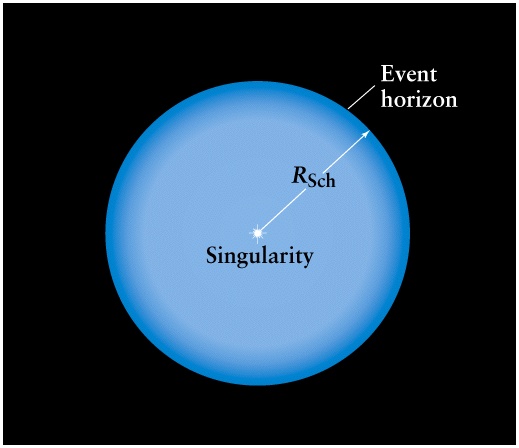
When a massive star (more than 8 times bigger than Sun) runs out of nuclear fuel in its core hen it’s gravity causes the core to collapse upon itself. This huge weight of its constituent matter falling in compresses the dying star to a point of zero volume and infinite density– called the singularity.
A black hole cannot be observed but only detected by the effects of its enormous gravitational fields on nearby matter.
In April 2019, the scientists at the Event Horizon Telescope project released the first-ever image of a black hole.
Supermassive black holes are found at the centre of most galaxies, including our own Milky Way. The one in our galaxy is called Sagittarius A*.
Interesting Facts-
If our Sun were suddenly replaced by a black hole with Mass equal to that of sun, the orbits of the planets wouldn’t change.
If you travelled close to the black hole, you could escape, as long as you don’t enter the event horizon.
If you entered the black hole, you could still see everything outside, since light can enter a black hole.
You wouldn’t notice anything special about the event horizon, since it isn’t a solid surface.
Once you enter the event horizon, you will pulled into the singularity.
 Eduindex
You must be logged in to post a comment.