

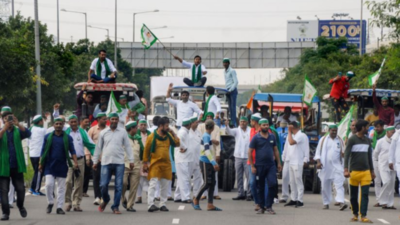
A Bharat bandh has been called by the Samyukt Kisan Morcha (SKM) on 27th of September from 6 am to 4 pm. The prime reason behind the protests is pressurizing the government in repealing the three farmer laws passed in the September (monsoon session of the Parliament) of last year.
The ruling Congress in Punjab however, has shown its support to the cause of the Farmer’s Union. The national highways, link roads and railway tracks have been blocked and vehicular movement has been prohibited within the bandh’s time frame in Punjab.
In Noida, Barricades were broken by the protestors who reached the Noida Authority Office in sector-6. The farmers were protesting over their demands and the compensation for their lands which was acquired by the Noida Authority.
In Punjab, farmers have protested in 350 places and in Haryana 25 places have been blocked in the Jind district itself.
The protests led to the vehicular disruption in Jharkhand where the supporters blocked the highways.
Similar demonstrations have been witnessed in Jammu demanding the laws to be repealed. The protest was led by CPI(M) leader MY Tarigami who sat on a dharma and took out a rally. Thereby, blocking the road.
Chaos was witnessed in many parts. In Jalandhar for example, Army vehicles were stopped by the protestors and said that the jawans should support them in their protest. In Bengaluru, on the other hand, a protestor ran his car over the DCP(Deputy Commisioner of Police)and was arrested.
However, states like Arunachal Pradesh and Maharashtra remained unaffected
The BKU leader Rajesh Tikait spoke about how Yogi Adityanath had promised in the manifesto to increase the price of the of sugarcane to Rs 375-450 but ended up being increased by mere Rs 25 and therefore asked for the accountability of the losses faced. However, he also mentioned the Bandh to be successful and the main reason for the protest to talk with the government which is not happening.
Let’s Rewind
What were the farm laws of 2020?
•The Farmers’ Produce Trade and Commerce (Promotion and Facilitation) Bill, 2020
•The Farmers (Empowerment and Protection) Agreement of Price Assurance
• Farm Services Bill, 2020, and The Essential Commodities (Amendment) Bill, 2020
Why were they resented?
The provisions of the new farm law intends to help the marginalized farmers who lack the means to bargain or invest in technology for their farms.
The provision of the act of Agri Market is one of the key reasons for the current protests. It mentions that the farmers can sell their produce to whoever they want, outside than the APMC mandi but however it may lead the commission agents to be deprived of their mandi fees. Better prices were also promised through cost cutting on transportation and competition.
The law on contract farming seeks to help the marginal farmers by the provision which states that the farmers can enter into contract with agri business firms on pre agreed prices of their produce. This will shift the market unpredictability from the farmer to the sponsor.
Why are the farmers resenting the laws?
Firstly, they fear that the companies may change the terms of the agreement and they will have to suffer loses for the crops. The primary fear is the dismantling of the Minimum Support Price (MSP) system.
Secondly, the farmers fear that selling the produce to WHOEVER they want might not provide them with an assured price. The disbanding of the mandi system and the losses of the arthiyas(commission agent who provides farmers with loans) is indeed a fact to be feared of.
What are the farmers demanding?
The farmers are demanding the withdrawal of the three laws which is putting a question on the further existence of the MSP system. The farmer unions are also ready to accept if the MSP is legally assured to stay prevalent.
What is the root of the protest?
It is the system of Minimum Support Price which is prevalent in India. MSP is the minimum price provided by the government to the farmers on buying on their produce. The MSP is decided by the the state-run Commission for Agricultural Costs and Prices (CACP) which consists of 23 commodities which it procures.
The Food Corporation of India on the other hand largely procures only wheat and paddy which it sells to the poor at a subsidized price.



 Eduindex
You must be logged in to post a comment.