
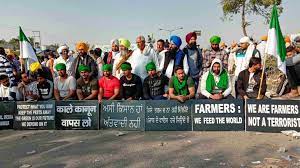
6 months to Farmers protest

Various farmer’s unions and opposition parties are observing ‘Black day’ on May 26th Wednesday marking 6 months of the farmers’ protest that started on 9 August 2020. A nationwide protest day has been organized with the support of various political parties.   

 The protest started against three ordinances that were passed by the parliament and signed by the President. They are (i) The Farmers Produce Trade & Commerce (Promotion & Facilitation) ordinance 2020 (ii)The farmers (Empowerment & Protection) Agreement on Price Assurance & Farm services ordinance 2020 (iii) The Essential Commodities( Amendment) ordinance 2020.The current provisions of law restrict farmers from selling their produce outside their notified APMC markets where the government set MSP will be given. Also, farmers are supposed to sell their produce only to registered licencees of the state government. The APMCs are maintained by the state government and they charge a percentage as tax. The new law relaxes these restrictions and allows farmers to sell their produce outside mandis and to all traders(including those without licenses) like corporates on a contract basis.  

The protest arises mainly on four aspects of the new laws; Trade area, trader, market fee, and dispute resolution. The majority of the Indian farmers are less educated and not well versed in the legalities of contracts. Farmers can be easily manipulated and tricked into contracts with corporates as most  farmers cannot afford legal advisors. Secondly farmers fear the system of Minimum Support Price (MSP) may end eventually as APMCs may decline. The corporates can provide high prices in the initial years diverting the whole market to themselves till a stage where APMCs decline and later they will be the sole body deciding prices in the market.  

The protest grew over the months with support from different parts of the country. Farmers from Punjab and Haryana marched to Delhi where they were blocked at the check posts. Many organizations came forward to help them. And several leaders have sent letters to the government asking them to repeal the laws. Amidst the strong protest, the government stayed the implementation of the laws for 18 months. But the farmers stayed adamant on their need and asked for a complete repeal of the laws.   

Peaceful protests in Hisar that led to the release of arrested farmers have further fuelled the protest and black flags were hoisted at various protesting sites as a symbol of their dissent. Due to COVID restrictions, the protest is now carried out at a slow pace. Almost 12 political parties have extended their support to the cause. They are Congress, TMC,NCP,DMK,Shiv Sena,Samajwadi Party,JMM,RJD,CPI,CPM and others.The farmers are determined to protest until they achieve their goal.

 

WHEN THE ‘TOOLKIT’ BECOMES THE TOOL

In light of the recent ‘Farmer’s protest toolkit controversy’, a 22-year-old environmental activist from Bengaluru, Disha Ravi has been arrested by the Delhi police on Sunday 14th February 2021. She is now under five-day police custody as the Delhi Magistrate decided to remand her following the arrest. She has been booked under Indian Penal Code Sections 124(a) for sedition, 153(a) for promoting enmity between different sections of the society and 120(b) for criminal conspiracy. She is accused of involvement in the composition of the “toolkit”, an online document shared by the International environmental activist Greta Thunberg, which consists of action plans to protest against the farm bill. Police claimed that the toolkit had the violence on 26th January as one of its “action plans” to protest against the farm bill, in addition to the pro-Khalistani elements.

Since last October, thousands of farmers have been camping on the national capital borders, protesting against the three newly passed farm laws introduced by the NDA government. On the republic day, the tractor rally conducted by the protesting farmers has resulted in great commotion as the farmers attempted to enter the national capital region, storming the Red Fort complex and clashing with the police and security forces. The police allege that plans for such actions were formulated in the online document, described as a “toolkit” that Ravi created and shared with Thunberg. “The main aim of the toolkit was to create misinformation and disaffection against the lawfully enacted government,” said a police official. “The toolkit sought to artificially amplify the fake news through various tweets which they have created in the form of a tweet bank. The document that they drafted had secessionist and pro-Khalistani content embedded into it through links and texts” he added. 

The arrest of Disha has instigated furious criticism against the fascist actions of the government regarding the farmers protest. The efforts made by the government to silence and oppress the voice of the farmers and the people supporting them is more of a provocative manner than a call for peace.

FARMERS’ PROTEST: GOVERNMENT’S PLANS TO OPPRESS THE MOVEMENT TAKES A HIT WITH INTERNATIONAL ATTENTION POURING IN

Iron nails, rods, barbed wire, boulders, makeshift walls….. These are not the visuals from a war front. This is how the largest democratic government in the world is preparing the country capital to face its farmers. The Farmers’ Produce Trade and Commerce (Promotion and Facilitation) Bill, 2020 was passed by the parliament followed by the approval of the President in September 2020. Since then, the farmers mainly from regions of Haryana and Punjab are protesting in the outskirts of New Delhi against the bill. Several rounds of discussions between the farmers and the government representatives have taken place but none of them was fruitful. The government had earlier offered to suspend the farmers’ bill as part of negotiations to end the protest but the farmers were loath as they demanded a complete abrogation. 

The protestors took hold of the major highways at Singhu, Ghazipur and Tikri, thereby isolating the national capital. It is in the third month that the protest took a violent turn when protesters and police clashed after thousands of farmers entered Delhi as part of a massive tractor rally, on January 26th. Several injuries were reported and a protester lost his life during the commotion. The police used tear gas and water cannons along with brutal lathi-charge to oppress the rally. Media personals who reported the incidents in favour of the farmers were also arrested with sedition charges. The government has disconnected the fuel, power and water supplies to the protestors as part of oppressing the movement. The shutting down of the internet and the mobile networks by the government in and  around the protest sites in order to “ensure public safety” have further fueled up the rage among the farmers. 

To prevent the protestors from entering the city again, the government has deployed force at the capital borders with Haryana and Uttar Pradesh and have begun blocking the area around the protests by placing large concrete slabs , spools of razor wire, heavy metal barricades , layers of stone boulders and embedding huge iron nails across the breadth of the roads leading to the protest sites. Only few selected vehicles are permitted to go beyond the barricading with media vehicles being strictly prohibited. With the movement gaining international attention and support as many notable faces from across the world vouched support for the farmers, it won’t be easy for the government to oppress the farmers agitation anymore.