
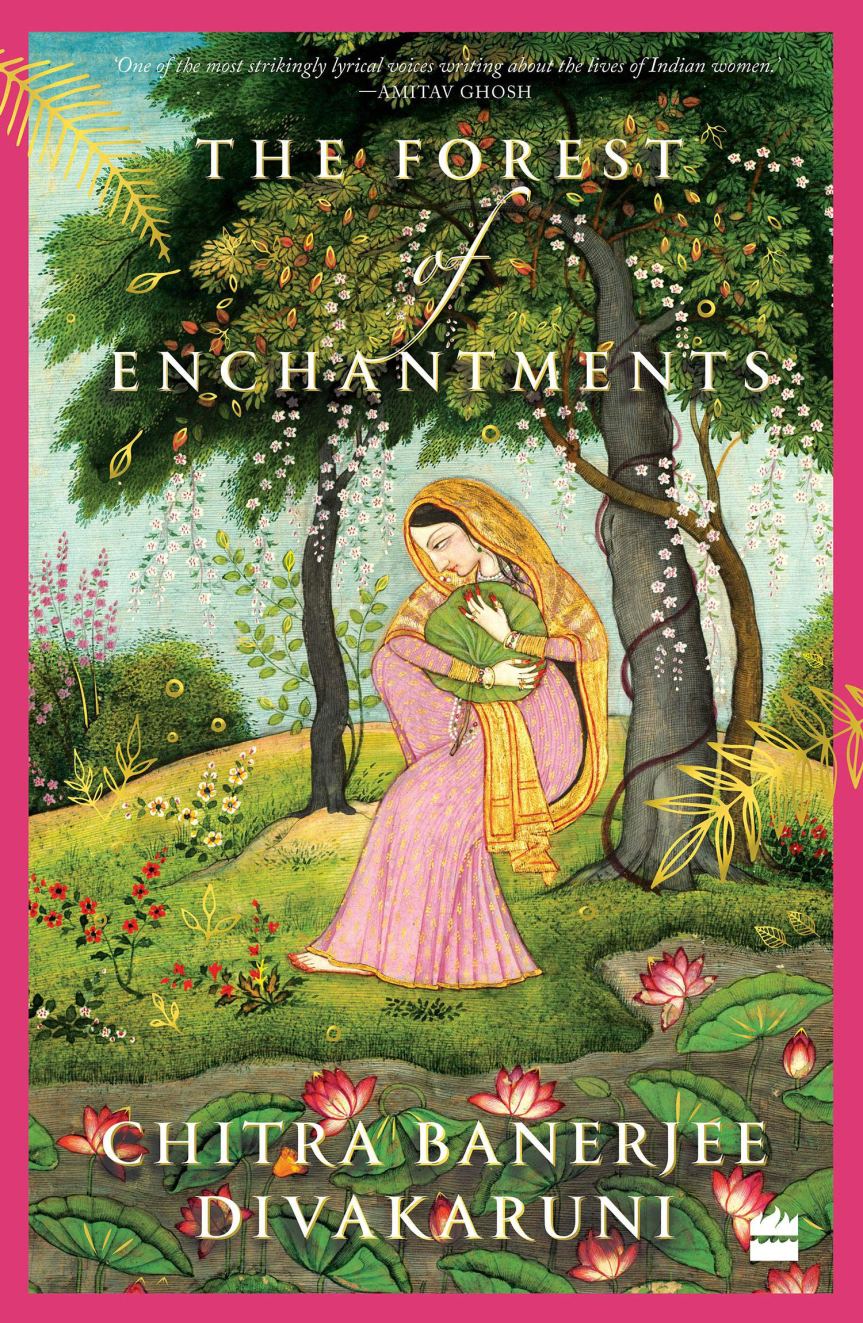
‘The Forest of Enchantments’ – A Sitayan

“Sita’s story haunted me. Because it was one of the first stories I was told, and because I sensed there was a disconnect between the truth of Sita and the way Indian popular culture thought of her. I sensed that Sita was more than what we took her to be. But who she was I didn’t yet know.”

   Chitra Banerjee Divakaruni has made a well-written Author’s note right before the prologue to the novel begins. She tells us one big truth which is to a great extent a commonality among three-fourth of the world’s population who is familiar with the great epic ‘Ramayana’ – who real Sita is, is untold.

      Despite Sita being considered as the incarnation of Goddess Lakshmi herself, she is often regarded as a meek woman who is an epitome of sacrifice and unending love, with no temper or hatred. The ‘ideal-woman concept’ idolizes Sita for she is considered the perfect wife with silent stoicism and the ability to long endure without whimpering. This is of course a prominent reason why many name their daughters ‘Sita’ and asks them to look up to the goddess to learn subservience, sacrifice and ‘perfection’. Sita is indeed to be idolized but not in a way most people perceive.

                     ‘The Forest of Enchantments’ is brilliantly feministic in writing. It retells Ramayana through Sita’s eyes, making us analyse the story through a gynocentric perspective. Thus, it indubitably makes Ramayan a ‘Sitayan’.  The author sets to bring out the version of Sita nobody knows, a Sita who is much more than a mere daughter, a loyal wife and a loving mother, a Sita who is a woman, an equal to Ram, one who refuses to give her dignity away even for love. Chitra Banarjee also tries to sympathize with some of the other female characters of Ramayana, who we consider evil, flawed or obnoxious, through Sita. We see Sita musing about whether Shurpanaka had deserved to get mutilated by Ram just for declaring her love for him. Similarly Sita chats with Ahalya asking her a question that most of us would’ve asked if gotten an opportunity to meet Ahalya in real- ‘why did she forgive Gautam?’. Sita is left answerless by Ahalya but it is quiet clear from her countenance that it is what women are supposed to do, forgive and endure.  Sita herself had to go through a similar situation, when Ram refused to accept her, doubting her chastity after Ravan abducted her, she performed the agni-pareeksha and the gods itself declared her innocence. Sita got the answer as to why Ahalya forgave her husband when she found herself forgiving Ram inspite of how cruel he had been to her. The author draws a picture of how women are taught to endure and forgive when men are never blamed for their actions. She also points out how love can be blinding. Ram’s consecutive injustices to Sita like abandoning her while she’s pregnant and making her do fire test is often celebrated by people as the spirit of kingship and the duty of a husband but ‘The Forest of Enchantments’ questions Ram on how he’s going to pay for his actions. The epilogue to the novel is heart-wrenching, especially for the female audience, for it shows how extreme a woman can get insulted, how her dignity is at stake and her indecisiveness whether to choose love or self-respect. Sita lets go the love of her life and chooses to be dignified and decides not to settle for anything less.

             Chitra Banerjee’s ‘Sita’ is what every woman should be. Loving, caring yet resilient and dignified. The author walks us through every little detail on ‘How to be a Sita’, not the stoic one but the strong one. The book is indeed a must-read if you are ever asked to be like Sita.

Books Written By Women For Women

Women are capable of accomplishing anything. Create great ideas, build businesses, and make a great difference in the world. Nonetheless, we don’t see enough of this message in mainstream media. However, the realm of literature has provided us with many incredible stories of women’s perseverance, knowledge, wit, boldness, and drive.As such, here are some excellent novels written by women authors for women.

I Know Why the Caged Bird Sings by Maya Angelou

The caged bird attempting to escape has long been a symbol of resistance to injustice. Maya Angelou employs this sign to express her desire to leave a life of strife, racism, and misogyny. I Know Why the Caged Bird Sings is an autobiographical novel about Angelou’s childhood in the 1930s. 

We encounter prejudice, rape, and rejection from her community, even from her own mother, as we follow this impoverished, disenfranchised black girl. Maya Angelou discovers as an adult how her own strong spirit, compassion, and generosity to others is the greatest way to be free. The book is a strong and beautiful storey of courage and breaking free from one’s captivity.

We Should All Be Feminists by Chimamanda Ngozi Adichie

We Should All Be Feminists is an interesting piece on women’s rights and equality. This book-length article discusses how the term “feminism” is sometimes connected with misunderstandings and prejudices like brainwashing.

To counterbalance this, Chimamanda Ngozi Aidchie provides the reader with a simplistic yet compelling description of feminism: equality for women in social, political, and economic terms. She confronts common feminist misconceptions front on. Even after her own friends called her a terrorist supporter, Aidchie continued to clarify that the term “feminist” has little to do with hostile, resentful, and men-hating women. The central theme of this novel is a narrative of a life-long battle to achieve equality between the sexes. 

According to the author, feminism is important since it helps to tackle women’s silence and exploitation.By how successive generations educate their children, the concepts of gender equality and feminism continue to struggle with all these terms.

The Terrible by Yrsa Daley-Ward

The Terrible is a novel about a lady attempting to manage her life on her own. Yrsa Daley-Ward recounts personal aspects of her childhood without her father and the terrible facts she had to discover in this stunning piece of painfully honest prose.

These realities are referred to as “the terrible.” As a young lady, the writer couldn’t comprehend the mental strain of having encountered tremendous pessimism and tribulations so early on in life. Having grown up as the only kid of colour in a white area, she was educated by a family of radical Christians, and witnessed her mother being devastated by several bad relationships.

Later in the book, the book relates Daley-Ward’s life as an adult, when she, too, had to deal with “the terrible.” She discovered it was continually expanding and having a much more huge psychological strain on her as she became hooked to narcotics and experienced repeated mental breakdowns.

The author reaches the climax and confronts “the terrible” after suffering all of the negative stuff that has occurred to her. She can only break free and recover if she recognises the consequences of her trauma and embraces her self-sustaining positivity.

The Girl with the Louding Voice by Abi Daré

The title of this novel hints at the main character. The tale of Adunni, a young Nigerian girl who aspires to acquire an education but ends up in an arranged marriage, is told in “The Girl with the Loud Voice.” As she escapes her violent husband and her native town, her resolve to attend school, which her mother encouraged Adunni to accomplish, triumphs.

The plot follows Adunni on her trip, which is packed with perilous, life-changing, and remarkable experiences. On her journey, she gains access to literature such as English dictionaries when she finds herself working as a maid in Lagos. Eventually, she comes upon an opportunity to learn. Her irrepressible attitude and perseverance drive her on the path to the “louding voice,” making this book a fantastic piece of how battling for your ambitions will be rewarded.

Notwithstanding the many difficulties in her journey, she never quits on her aim of escaping poverty. The end result reminds readers of the author’s message: pursue your goals, and you might just bring about change.

Wow, No Thank you: Essays by Samantha Irby

Wow, No Thank You is an essay collection in which Samanth Irby describes her life as a married woman in her forties. She compiles a fantastic series of stories in which she finds herself in situations that many people can relate to. All throughout the novel, humour is a recurring motif, as Irby makes amusing comments on her own behaviour and life choices.

The author’s inner voice, however, is at the heart of the book, pushing us to be more sensitive to things. That discourse also enables us to notice these things that no one else notices, which frequently results in pretty funny circumstances. Irby demonstrates how her internal thoughts influences her clothing and footwear, food preferences, cleansing items, and so much more.