ORIGIN OF CASTE SYSTEM

Caste system is an integral part of the Indian social system. It is the arrangement of people in a hierarchy of status where there is negligible mobility up and down the social ladder.

Origin of the caste system:

Caste system is very complex and complicated that is why a number of theories have been given explaining the origin of the caste system. Some of the theories are: 

Racial theory- One very old and important theory about the origin of the caste system is the racial theory. Herbert Risley and D N Majumdar are supporters of this theory. According to Risley before Aryans came to India they were divided into 4 classes which came to be regarded as from different races after their settlement. Majumdar believes that after the Aryans established themselves as superior in India they became a separate race and  called the defeated as the dasas and thus the Aryans the Dasas  became two separate races. This was the beginning of the caste system and once this distinction started it became difficult to narrow down the gap and it still continues.

Political Theory- Some of the thinkers believe that not race but the political convenience and manipulation by those who wanted to retain authority is the basis of the caste system in India. It is said that the Brahmin who wanted to hold authority devised this system. In the words of Dr.Ghurye, “Caste is a brahmanic child of Indo-Aryan culture, cradled In the land of Ganges and hence transferred to other parts of India by brahmanic prospectors.” How the Brahmins, however manipulated is not very clear. Thus, according to the supporters of this theory it has nothing to do with religion, it is a man-made institution and creation of few for the perpetuation of authority. 

Occupational theory-  Nesfield is of the view that occupation is the basis of the caste system. In his view “function and function alone is responsible for the origin of caste structure in India”. Thus, he and his supporters also do not believe that the system has any religious background. According to them occupation was the basis of the caste system. In the beginning when there was no rigidity each individual was free to have occupation of his choice. But gradually with the rigidity in the system changing of occupation became difficult and caste began to come into existence on the basis of his occupation. Those who were doing noble occupations like those of educating the people, fighting on the battlefield, or traders became noble and began to be considered superior caste people and others began to be treated as those belonging to the inferior caste ,example the shudras. The former then began to enjoy social respect which was denied to the latter. The system was continued because that suited the former.

Traditional theory- Exponents of this theory believe that the caste system is not of human but of divine origin. They argue that the main four castes were created by god Brahma whereas the sub-castes came into existence subsequently as a result of inter-caste marriages, etc. Since the purpose of creation of each caste, according to them, is to perform a specific function as such because of human will these castes cannot be changed. They also believe that any change in the system could be brought about only at the cost of winning the displeasure of God. 

What are Folkways ?

What are social norms ?

Social norms refer to the group shared standards of behaviour .It is a pattern setting limits on individual behaviour .
Norms are said to be ” blueprints ” for behaviour .
They determine , guide , and control human behaviour .
Norms are not systematically classified by Sociologists . But they are grouped into –
” Folkways “, “mores ” , “fashions “, “rites “, “ceremonies “, “customs ” etc. .


What are folkways ?

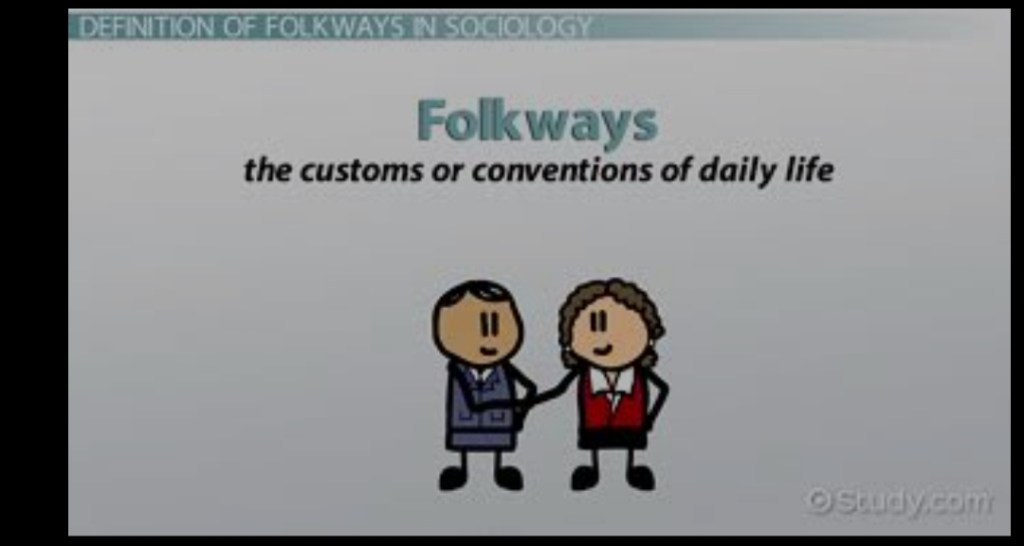
In general , folkways means “ the ways of folk “.
The term ‘folk’ represents people and ‘ways’ represent their behavioural habits .
Folkways are the customary, normal and habitual ways of the group to meet certain needs or solving day-to-day problems.


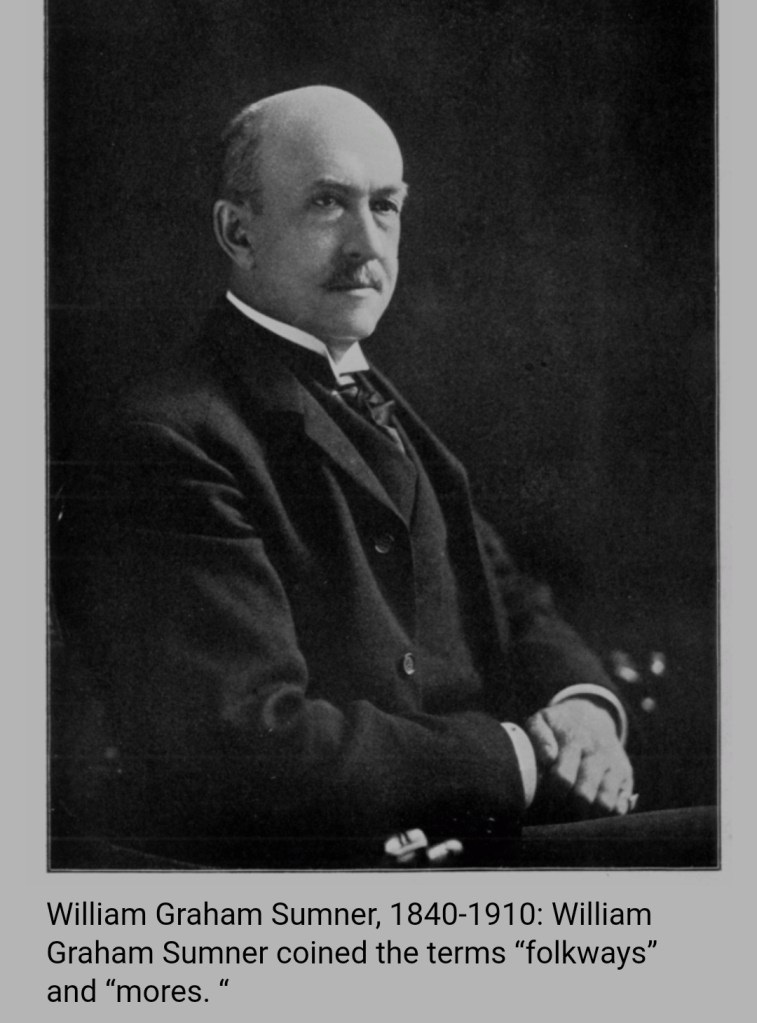
The term folkways was introduced into Sociology literature by W.G .Summer in a book with the title , ” Folkways: A Study of the Sociological Importance of Usages, Manners, Customs, Mores, and Morals ” published in 1906.


Folkways are accepted ways of behaviour.
According to Summer ,
” folkways represent man’s unique means of adapting himself to the environment .


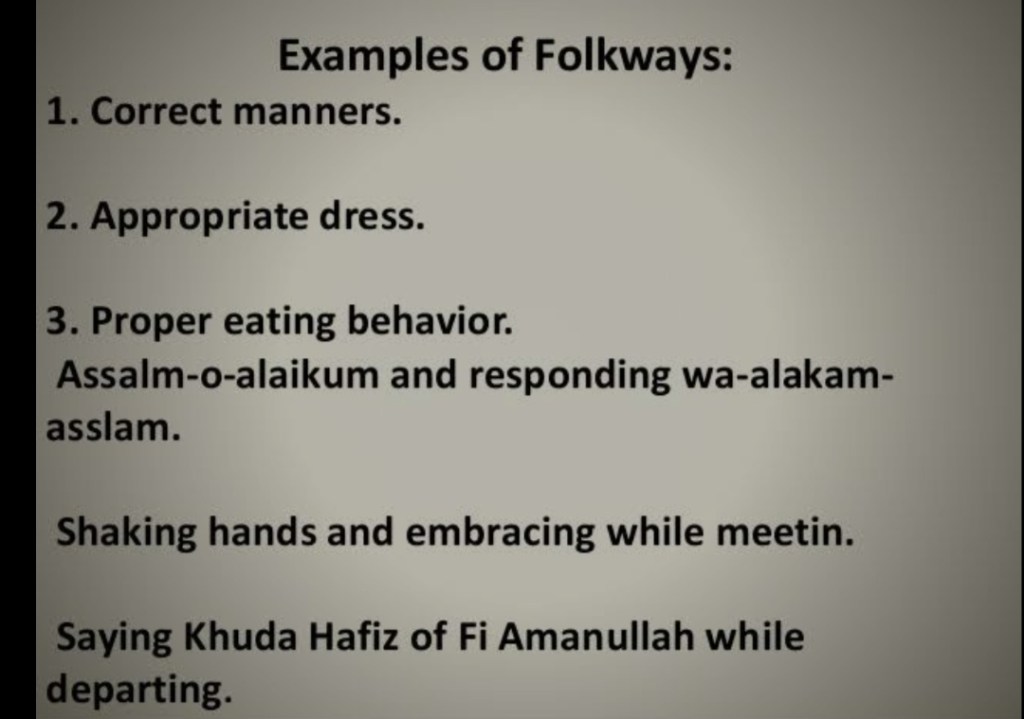
Examples of Folkways :-

The ways of eating , talking , dressing , playing , walking , working , greeting , conversing ,etc. represent folkways .

The daily activities become an individual’s habits ,but folkways are termed as habits of a group though Not all (group) habits become general. They differ from individual to individual and place to place.

Folkways are a learned process of socialisation. They become the second nature of the individual.

Habits are socially approved habits which are followed by a number of persons in a society are referred as folkways,

Habits of exchanging greetings and courtesies like bidding ‘Namaste’ with joined palms is an.examples of Indian folkways .

Walking on right side if the road , taking three meals a day , Wearing different clothes at different occasions, showing respects to elders , love and affection to younger ones ,
Wearing a cap, hat or turban,.shaking hands, eating with forks and knives, driving on the left or right hand side of the street, attending classes in paints and skirts rather than gowns or bathing suits etc..are some folkways followed by difficult individuals.


Definitions :-


Folkways are behavioural patterns of e everyday life which generally arise unconsciously in s group .”
-.Gillin and Gillin

According to Reuter and Hart (1933),
“The folkways are simple habits of action common to the members of the group; they are the ways of the folks that are somewhat standardised and have some degree of traditional sanction for their persistence”.

Maclver and Page (1949) defined it as:
“Folkways are the recognized or accepted ways of behaving in society.”

A.W. Green opines ,
Those ways of acting that are common to a society or a group and that are handed down from one generation to the next are known as folkways .

Lundberg stated ,
“. Folkways are the typical or habitual beliefs , attitudes and styles of conduct observed within a group or community .”

In simple words , folkways are “repetitive petty acts of the people .”
___________________________________________

Characteristics of Folkways

• Social in Nature :- Folkways are the products of man’s group life . They are created by the groups for their sustenance and maintenance . Individuals get social recognition by comforting the folkways .

Repetitive in Character:– A social practice becomes a folkway when the majority of people observe it constantly and regularly . The often repeated practices of the majority normally become the folkways . These practices become standardized practices by constant repetitions .

Unplanned Origin :– The origins of Folkways are very obscure . Summer believed that they arise automatically and unconsciously . They are not the result of any advance planning . Someone in the group starts a new way and in course of time it becomes popular and a good number of people may start following it but by the time it becomes folkways the origin trace fades away.

Informal Enforcement :– Folkways constitute one of the types of informal means of social control . Folkways are not as compulsive and obligatory as that of laws or morals . Conformity to the folkways is neither required by law nor enforced by any special agency of society. They are not absolutely obligatory though they are considered as necessary .

Folkways Differ a Lot :- Folkways Differ from group to group and society to society . They may also undergo changes in course of time within the same group or society .
For example , table meals are common in the West whereas the majority of Indians used to squat on the floor and take their meals with their hands .

Folkways vary with age and sex in almost all places . They even vary according to social status , religion , ethnic groups , racial groups etc .

Folkways are Numerous :- It is not possible for anyone to enlist all the folkways . There are so diverse and numerous folkways . They range from most trivial acts and behaviour patterns to the most serious ones .

Folkways are subject to Change :- Just like everything folkways are also subject to change . Folkways change according to changes in social conditions .
Summer is referred to as ” fashion ” .
Fashion related to dress , hairstyle , architecture designs , etc. undergo rapid changes .
___________________________________________

Social importance of Folkways

The folkways are the foundation of every culture . They give us a better understanding about a particular culture.
When fully assimilated they become personal habits .

Summer believed , ” the life of society consists in making folkways and applying in them . The science of society must be construed as the study of them .

Folkways have become a universal characteristic of human societies. No society does or could exist without them . Hence they constitute an important part of the social structure . They are most powerful and control the behaviour of individuals in society even more than the state action.

They become a part and parcel of the personality of the infant through the process of socialisation. An individual learns different folkways at different stages of socialisation . They become a form of unstated premises of our mental life .

Folkways play a major part in social control in society, as folkways are informal means of social control.

Hence , folkways are not compulsory or obligatory but constitute an important part of social structure as they become personal habits that contribute stability and order in social relations .