

Food security means availability, accessibility and affordability of food to all people at all times. It has been a major concern in India. Food is as essential for living as air is for breathing. The poor households living in the rural areas are more vulnerable to food security. Food security has following dimensions-
1- Availability of food- It means that enough food is produced within the country, it must be available in every part of the country and there should be no deficit.
2- Accessibility of food- It means food is within reach of every person, there is no barrier on access to food.
3- Affordability of food- It means that an individual has enough money to buy sufficient and nutritious food to meet one’s basic needs.
India ranks 71 out of 113 major countries in terms of food security index 2020.
WHY FOOD SECURITY?
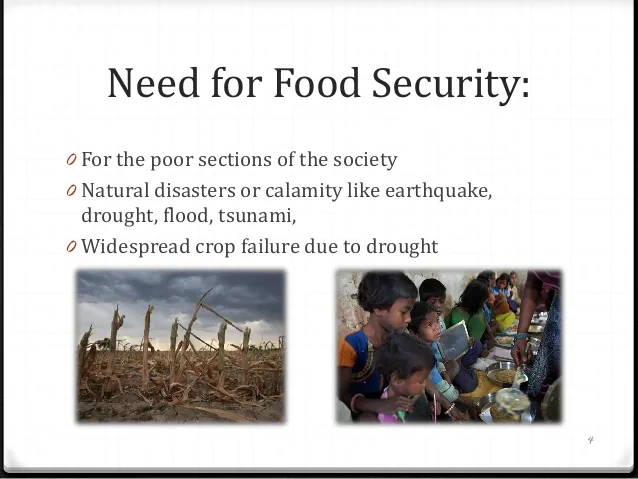
The poorest section of the society might be food insecure while even persons above the poverty line might also be food insecure when the country faces a disaster or calamity like earthquake, flood, drought, failure of crops causing famine. A famine means the widespread deaths due to starvation and epidemics caused by forced use of contaminated water or decaying food and loss of body resistance due to weakening from starvation. There are places like Kalahandi and Kashipur in Orissa where famine-like conditions have been existing for many years and some starvation deaths have also been reported. The most devastating famine that occurred in India was the FAMINE OF BENGAL in 1943. This famine killed 30 lakh people in the province of Bengal. So food security is needed in a country to ensure food at all times.
HOW IS FOOD SECURITY AFFECTED DURING A CALAMITY?
Due to a natural calamity, total production of foodgrains decreases. It creates a shortage of food in the affected areas. Due to shortage of food, the prices goes up. At high prices, some people cannot afford to buy food. If such calamity happens for a longer time period, it may cause a situation of starvation.
WHO ARE FOOD- INSECURE?
Although a large section of people suffer from food insecurity in India, the worst affected groups are landless people with little or no land to depend upon, traditional artisans, petty self-employed workers and beggars. In the urban areas, the food insecure families are those whose working members are generally employed in ill-paid occupations and casual labour market. These workers are paid very low wages that just ensure bare survival. The SCs, STs and some section of the OBCs who have either poor land-base or very low land productivity are prone to food insecurity. The people affected by natural disasters are also among the most food insecure people. The food insecure people are large in economically backward states with high incidence of poverty, tribal and remote areas, regions more prone to natural disasters etc. In fact, the states of Uttar Pradesh Jharkhand, Orissa, Chhattisgarh account for largest number of food insecure people in the country.
HUNGER-
Hunger is another aspect indicating food insecurity. It brings about poverty. The attainment of food security therefore involves eliminating current hunger and reducing the risks of future hunger. Hunger has chronic and seasonal dimensions. Chronic hunger is a consequence of diets inadequate in terms of quantity or quality. Seasonal hunger is related to cycles of food growing and harvesting. This type of hunger exists when a person is unable to get work for the entire year.
India is aiming at Self-sufficiency in Food grains since Independence. After Independence, Indian policy-makers adopted all measures to achieve self-sufficiency in food grains. India adopted anew strategy in agriculture which resulted in ‘Green Revolution’, especially in the production of wheat and rice.
Since the advent of the Green Revolution in the early 1970s, the country has avoided famine even during adverse weather conditions. India has become self-sufficient in foodgrains during the last 30 years because of a variety of crops grown all over the country. The availability of foodgrains at the country level has been ensured with a carefully designed food security system by the government. This system has two components- 1. Buffer Stock 2. Public Distribution System
Buffer Stock is the stock of foodgrains, namely wheat and rice, procured by the government through the Food Corporation of India TH(FCI). The FCI purchases wheat and rice from the farmers of the state where there is surplus production and the farmers are paid a pre-announced price for their crops. This price is called Minimum Support Price.
The food procured by the FCI is distributed through government regulated ration shops among the poorer section of the society. This is called the Public Distribution System (PDS). The PDS has proved to be the most effective instrument of government policy over the years in stabilising prices and making food available to consumers at affordable prices.
ROLE OF COOPERATIVES IN FOOD SECURITY-
The cooperatives are also playing an important role in food security in India especially in the southern and western parts of the country. The cooperative societies set up shops to sell low priced goods to poor people. For example, out of all fair price shops running in Tamil Nadu, around 94% are being run by the cooperatives. In Delhi, Mother Dairy is helping in provision of milk and vegetables to the consumers. Amul is another success story of cooperatives in mil and mil products from Gujarat. It has brought about the White Revolution in the country. Thus cooperatives are playing a major role in ensuring food security in India.
 Eduindex
You must be logged in to post a comment.