SUBHASH CHANDRA BOSE

INTRODUCTION

Subhash Chandra Bose
SUBHASH CHANDRA BOSE

Subhash Chandra Bose is fondly remembered as one of the greatest freedom fighters of India, and popularly known by the name of ‘Netaji’ (Respected Leader). He was strongly influenced by Swami Vivekananda’s teachings, and also believed that the Bhagavad Gita was a great source of inspiration for the struggle against the British. Bose was an Indian nationalist, and a prominent figure of the Indian independence movement. He was superior head for Indian National Army during World War II. He always pitched for complete and unconditional independence of India from the British Rule.

CHILDHOOD

Subhash Chandra Bose was born to Prabhavati Devi and Janakinath Bose on January 23 in 1897 in Odisha. He took admission into the Protestant European School which was run by the Baptist Mission. He did B A in Philosophy from the Presidency College in Calcutta, and was later expelled for assaulting Professor for the latter’s anti-India remarks. After the incident, Bose was considered as one of the rebel-Indians.During his college days, he gradually developed nationalistic temperament, and became socially and politically aware. 

POLITICAL LIFE

18 Subhash Chandra Bose Books Which Prove Massively Impactful
THE GREAT FREEDOM FIGHTER

After a few years, Bose returned to India as he resigned from his civil service job in April 1921, and later joined the Indian National Congress to fight for the independence of India. Subhash Chandra Bose started the newspaper known as ‘Swaraj’, and took charge of publicity for the Bengal Provincial Congress Committee. In 1923, Bose was elected as the President of All India Youth Congress and as the Secretary of Bengal State Congress. He was also editor of the newspaper called ‘Forward’, founded by his mentor Chittaranjan Das, and he served as the CEO of the Calcutta Municipal Corporation. By December 1927, Bose was appointed as the General Secretary of the INC.

In November 1934, he wrote the first part of his book ‘The Indian Struggle’, which was about nationalism and India’s independence movement during 1920–1934, but the British government banned the book. By 1938, he agreed to accept nomination as the Congress President, and presided over the Haripur session. However, due to his strong differences with Mahatma Gandhi and Jawaharlal Nehru, he resigned in 1939.

ROLE IN INDIAN INDEPENDENCE
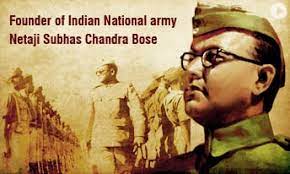
S C Bose was always in favour of armed revolution in order to expel the Britishers from India. During the time when the Second World War took place, Bose form the Indian National Army (INA) with the help of the Imperial Japanese Army, and also founded an Indian Radio Station called ‘Azad Hind Radio’.

A few years later, he travelled to Japan, where more soldiers and civilians joined the INA. Even when faced with military reverses, Bose was able to maintain support for the Azad Hind movement. In Europe, S C Bose sought help from Adolf Hitler and Benito Mussolini for the liberation of India. Bose had struck an alliance with Japan and Germany as he felt that his presence in the East would help India in the freedom struggle against the British.

MEMORIAL
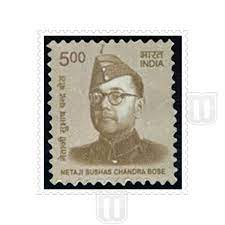
Bose was featured on the stamps in India from 1964, 1993, 1997, 2001, 2016 and 2018.Bose was also featured in ₹2 coin in 1996 and 1997, ₹ 75 coin in 2018and ₹125 coin in 2021. Netaji Subhash Chandra Bose international Airport at Kolkata, Netaji Subhash Chandra Bose Island, formerly Ross Island and many other institutions in India are named after him. On 23 August 2007,Japanese Prime minister visited the Subhas Chandra Bose memorial hall in Kolkata. Abe said to Bose’s family “The Japanese are deeply moved by Bose’s strong will to have led the Indian Independence Movement from British rule. Netaji is a much respected name in Japan.

In 2021, the Government of India declared 23 January as Parakram Divas to commemorate the birth anniversary of Subhas Chandra Bose. Political party, Trinamool Congress and the All India Forward Bloc demanded that the day should be observed as DESHPREM Divas.

*****MY HERO IS SUBHAS CHANDRA BOSE THIS ARTICLE IS DEDICATED TO YOU*****

JAI HIND” this slogan is said by Subhas Chandra Bose .
Gandhi Jayanti

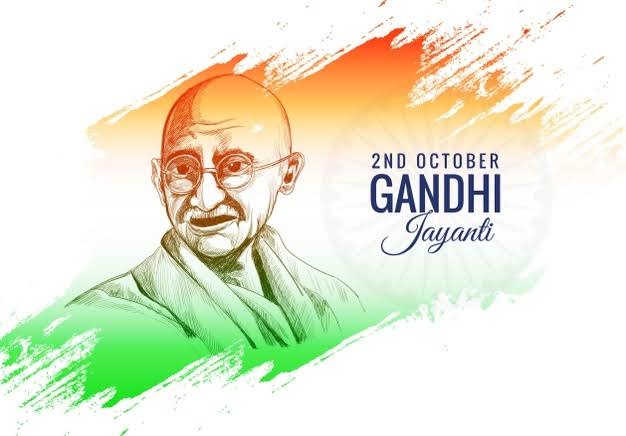
2nd October, Gandhi Jayanti ,a date which needs no introduction. Father of our nation Mohandas Karamchand Gandhi was born on this day. He was one of the strongest pillar for India during in struggle for freedom from British era.

He was very different from other freedom fighters. He believed in the concept of nonviolence and self sufficiency. His personality has impressed many leaders around the world like Martin Luther King Jr, Nelson Mandela, Einstein and even the Britishers one of those.

He was a gentleman who gained law degree in London and came back to the India and I was so touched by the living conditions of the people here that he decided to be one of them. He wore a dhoti and thin cloth on upper body.

He was a man of principle, in his aashram he did all of his work on his own and teach the same lesson to his followers. He was a tiny man but having a great speed. He walked miles on his foot that too with great speed, matching his speed was not easy.

He always live for his countrymen and tried to solve their problems and dedicated whole of his life for the country. He fought the fight of freedom with never compromising his principles. That’s the reason he was given the title of ‘Father of India’.

V. O. Chidambaram Pillai (V.O.C.): A Great Figure in Freedom Movement

Freedom movement against the British Raj in those days was not only confined to few states but spread over across undivided India because the British came thousands and thousands kilometres away to exploit our resources including human resources. Different websites of Wikipedia reveal that during World War I, more than one million Indian soldiers forced to serve overseas, of whom 74,187 soldiers perished and little more than 67,000 were injured. Also in the World War II, more than 2.5 million Indian troops forced to join and fight on behalf of the British force around the world. I feel if we were not under the British Raj probably our persons would not have joined in both the World Wars.

        Anyway, in those days in the Madras Presidency division, also many sacrificed their lives or imprisoned for participating in freedom movement or raising voice against the British Raj.  It is pertinent to mention that the Madras Presidency was an administrative subdivision (presidency) of British India. The Presidency included most of southern India, including the whole of Andhra Pradesh, and parts of Tamil Nadu, Kerala, Karnataka, Telangana, Odisha and the union territory of Lakshadweep. The city of Madras was the winter capital of the Presidency and Ootacamund or Ooty was the summer capital (wikipedia.org/wiki/Madras_Presidency).

     In this article, a great human being who was in freedom movement also an entrepreneur is presented from then the Madras Presidency.

Vallinayagan Ulaganathan Chidambaram (5 September 1872 – 18 November 1936), popularly known by his initials, V.O.C., also known as Kappalottiya Tamizhan meaning ‘The Tamil Helmsman’, was a freedom fighter and leader of Indian National Congress. He was the founder of Swadeshi Steam Navigation Company, first indigenous Indian shipping service moving between Tuticorin and Colombo with the Swadeshi Steam Navigation Company, competing against British ships. With dynamism, courage and integrity VOC/ Chidambaram raised the people against the mighty British Raj. He was at young age motivated by Shri Ramakrishnanathar, a saint and ardent follower of Swami Vivekananda’s philosophy. The Saint advised him to do something for the country. During this period, VOC/ Chidambaram met the Tamil poet Bharathiyaar who shared his political ideology and thus both had close relationship. VOC was also great admirer of Bal Gangadhar Tilak and considered him mentor in politics.

     In 1908, VOC’s political involvement drew attention to the British. He, Subramaniya Siva and Padmanabha Iyengar along with others celebrated the release of freedom fighter from Bengal Bipin Chandra Pal, and then Tirunelveli Collector Wynch called VOC and others asked to give assurances that they would not participate in any political revolt but they refused, so all three were arrested on 12 March 1908.  Their arrests led to widespread protest. In Tirunelveli shops, schools and colleges were closed in protest and riot broke out also the municipal office, post office, police stations and municipal court were attacked, unfortunately four persons were killed by the police. VOC was charged with sedition, and the court sentenced him to two life imprisonments for charges of sedition. An appeal to the Madras High Court reduced the sentence to 6 years in prison and 4 years in transportation both to run concurrently. He was not treated as a political prisoner, nor was it simple imprisonment. V.O.C and Siva had to undergo rigorous imprisonment. V.O.C health suffered a great deal. They were  released in December 1912. During his arrest in March 1908, Sri Aurobindo lauded him in his editorial “Srijut Chidambaram Pillai has shown throughout the Tuticorin affair a loftiness of character, a practical energy united with high moral idealism which shows that he is a true Nationalist. His refusal to accept release on bail if his fellow-workers were left behind is one more count in the reckoning. Nationalism is or ought to be not merely a political creed but a religious aspiration and a moral attitude. Its business is to build up Indian character by educating it to heroic self-sacrifice and magnificent ambitions, to restore the tone of nobility which it has lost and bring back the ideals of the ancient Aryan gentleman. The qualities of courage, frankness, love and justice are the stuff of which a Nationalist should be made. All honour to Chidambaram Pillai for having shown us the first complete example of an Aryan reborn, and all honour to Madras which has produced such a man” (Aravindan Neelakandan, in Swarajya,   5/9/2017)

After his release his law license was taken away and he moved to Chennai then Madras city with his wife and two young sons where he ran a grocery store and a kerosene shop.

  VOC was a dynamic and enterprising person which is reflected by his activities as he set up many institutions and some of which are Yuvanesh Prachar Sabha, Dharmasanga Nesavu Salai, National Godown, Madras Agro-Industrial Society Ltd and Desabimana Sangam. He was a great human being also as in 1908, 23 February VOC  supported the workers at Coral Mill (now part of Madura Coats) to protest against their low wages and harsh working conditions.  The workers at the British-owned mill were unfairly treated and 59 percent of the workers were aged 14 – 16.   He was also a prolific writer in Tamil. Some of his works are – Meyyaram, Meyyarivu, Autobiography, commentary on the Thirukkural, compiled works of Tolkappiyam, etc.

In 1920, VOC withdrew from the Indian National Congress, citing ideological differences with Gandhiji and concentrated his activity on establishing labour unions in Madras so that the labourers were not awfully exploited.

     For VOC’s great sacrifice in the freedom movement, the Tuticorin Port Trust was named after him and now known as V. O. Chidambaranar Port Trust. It may be mentioned here that   Thoothukudi (Tuticorin) district was formed by reorganising Tirunelveli district in the year 1986.  In his honour and for remembering him, the Indian Posts & Telegraphs Department issued a special postage stamp on 5 September 1972, on the occasion of his birth centenary. VOC/Chidambaram although passed away on 18 November 1936 (aged 64) but he will remain forever in our hearts and memories.

Also for reference consulted:

  1. https://byjus.com/free-ias-prep/this-day-in-history-nov18
  2.  https://swarajyamag.com/culture/v-o-chidambaram-pillai-the-forgotten-patriot

Dr. Shankar Chatterjee

Former Professor& Head (CPME), NIRD &PR (Govt. of India),

Hyderabad-500 030

Telangana, India

Email <shankarjagu@gmail.com>