

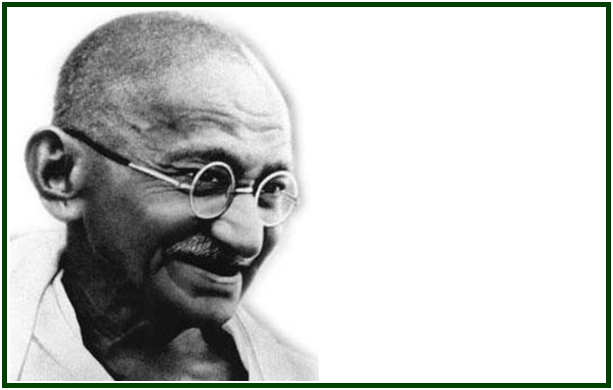
Gandhism derives its name from most prominent leader of India’s freedom movement Mohandas Karamchand Gandhi, commonly referred to as Mahatma Gandhi. He was a lawyer by profession. He was also a social and moral philosopher. His social and political thoughts are collectively known as Gandhism. His thoughts are not in a single book it is scattered in many notes, his autobiography “My Experiments with Truth”. He himself rejected the existence of anything such as Gandhism but with due course of time it is seen that Gandhian thoughts have worldwide application. The features of Gandhian ideology are as follows: –
Politics and Ethics
Gandhi thinks that ethics and morality should be the guiding principles of politics. He emphasizes the use of spiritualization in politics. He believed in purity of means to achieve pure ends. He lifelong criticise the use of unfair means even if gives the best possible result. His morals were based on all religions, but he paid special attention to Sanatana Dharma. In his views the essence of all religion is same. No religion is superior or inferior to any other religion. He thinks that politics without religion is nothing short of a death trap, which kills the soul. He sat for hunger strike to force Indian Government to pay ₹ 55 crore to newly formed to Pakistan.
Truth and Non-violence
One of the major philosophies of Gandhism is the search for truth. Finding truth is as tough as to find God itself. He believed that truth can be found through devotion to its creations specially the oppressed. Non-violence is also a part to pursue truth. It means preventing the use of violence in one’s behaviour towards other living beings which include both physically and mentally. He says, “It is non-violence only when we love someone those that hates us.” He holds that harming nature is also a form of violence. His firm belief in non-violence can be seen in his ways of struggle against the British. He uses non-violence ways such as Satyagraha, Dandi March etc. It is not the way of weak but the power of strong. Non-violence has the power to defeat physical force by the use of spiritual force.
Vision of Classless Society
Gandhi was the flag bearer of a classless society. People have a mindset that physical labour is inferior to another type of labour such as mental labour. He made ‘bread labour’ compulsory for all. The concept of ‘bread labour’ expected everyone to do physical labour to compensate or produce his/her consumption. Here bread is symbolical for various items of one’s consumption. This will create a sense of dignity of labour among societies. He rejected discrimination on the basis of race, caste, religion etc. He strived to create a classless society by transforming the attitude of peoples towards discrimination.
 Eduindex
You must be logged in to post a comment.