
MARADONA: THE ARGENTINE BORN NEAPOLITAN

The world was in absolute shock and the Neapolitans couldn’t believe their senses when the world’s most expensive player moved to one of the world’s poorest cities and led the team which have never won a Serie A title to two Scudetti and a UEFA cup. The signing of Maradona itself was a huge reason for the people of Naples to celebrate but when he won them the titles they could’ve never imagined of, that’s the moment when the Argentine boy Diego Maradona became Santo Diego for them. With the streets of Naples painted in blue with flags and ribbons and chants hailing Diego pulsating everywhere, it took months for Neapolitans to fall back to their senses and accept that they have become the champions of Italy. And for one last time, Neapolitans were out on 25th November 2020, wearing the blue colour, carrying Diego’s photos and chanting his name through the streets of Naples, as their Saint, the greatest of all-time bid adieu to the mortal world.

Debates on Maradona’s might as a player and a person shall go on forever but for the city of Naples and its people, Maradona is so much more than just the greatest football player of all time. He will remain a godly figure, a ray of hope, an emotion that led them through their darkest times. He had the courage, conscience, and resilience to take football beyond the pitch and elevate it to a political act embarking millions of hearts with a sense of hope and feeling of redemption. 

From the slums of Buenos Aires to attaining the stature of a demigod for millions of Argentines and Neapolitans, Maradona was all a footballer could ever imagine of becoming. He has etched his name in golden scripts in the history of world football and the people of Naples, Argentina and football lovers across the globe through his charisma, leadership qualities and love for the game. Maradona might be flawed as a person but as a player, no one can ever reach the greatness he has achieved with a ball at his feet. He had qualities which no other footballing personalities can never boast about. He wasn’t a player but a politician who rebelled against the atrocities against the people. Football was just a medium for him. Diego’s might is beyond football and the politics of nations. Wherever he’s played, no one could ever own the player in Maradona. He was never a player for a particular club or country but the people, he represented them as one among them. That is the sole reason why the people of Napoli still celebrates Diego, decades after his departure, not as a person or a player but as Santo Diego, the Saint send by God to save them from all the atrocities. For Neapolitans, Maradona stays eternal, he’s the patron saint of Naples and champion of the people. And they celebrate him now and forever by singing,

‘OH, MAMMA, MAMMA, MAMMA, DO YOU KNOW WHY MY HEART BEATS?

‘I’VE SEEN MARADONA, I’VE SEEN MARADONA, AND MAMMA, I’M IN LOVE.’
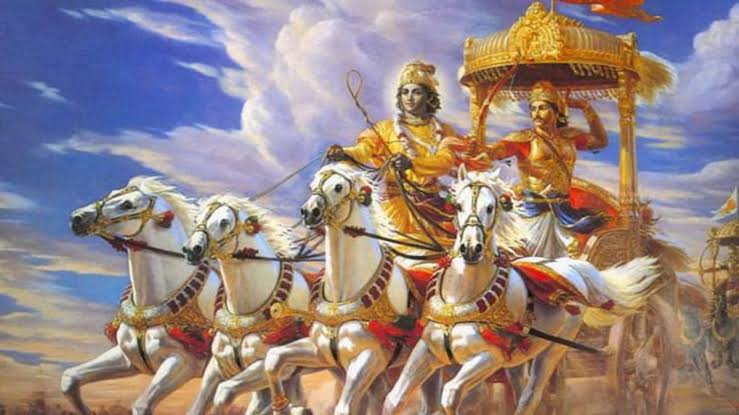
Mahabharata: A Myth or Reality

Some stories are at the heart of Indian history.  The mythological stories of Mahabharata are one of these.  This epic of Maharishi Ved Vyasa was written by Lord Shri Ganesh.

 The characters in these amazing stories of the epic have many amazing powers.  Even Narayana himself, through his wisdom, diplomacy and deceit, had led the right Pandavas to victory in this great war of Mahabharata.

Mahabharata war has a great aspect of the number 18.  There are 18 chapters in this epic.  Lord Krishna gave the knowledge of Gita to Arjuna for a total of 18 days.  The Mahabharata war lasted for 18 days.  The Gita also has 18 chapters. Army of  the Kauravas and the Pandavas  had a total number of 18 Akshohini army of which 11 belongs to Kauravas and 7 to Pandavas were Akshohini army. The main initiators of this war was also 18. Also only a number of 18 warriors survived in this war.

 Some such skeletons were found in Mohenjo daro which had the effect of radiation. In Mahabharata, the results of Brahmastra were given from the chapter number 13 to 15 of the Saptik festival.  Historians believe that the Brahmastra left 5561 BC was the atomic bomb.

 There were no zodiac signs during Mahabharata.  Astrology at that time was totally based on 27 constellations, not on 12 zodiac signs.  In the constellations,not Ashwini but Rohini was the first place.  Various civilizations experimented in astrology and created zodiac signs based on the moon and the sun and began to predict the future of the people, while in the Vedas and the Mahabharata there is no mention of such learning to show that the planetary constellation would make a person’s life  They affect.

The Mahabharata is written by Ved Vyasa.  Actually, Ved Vyas was not a name, but a title, which was given to people with knowledge of Vedas. There were a number of 27 Ved Vyas before Krishnadvapayana and he was himself the 28 Ved Vyas.  He was named Krishnadvapayan because he was born as a dynasty and was born on an island.

 Ghatotkacha, son of Bhima and Nagakanya Ahilavati had a son named ‘Barbarika’.  At some places, it is also said that he was born from the stomach of Murmant’s daughter ‘Kamakantakata’.  When the war of Mahabharata was decided, Barbarik also expressed his desire to join the war and promised his mother to support the loser.  Barbarik rode his blue horse with three arrows and a bow to the battlefield of Kurukshetra.

 Three arrows were enough for Barbarik, on whose strength he could destroy the entire army of Kauravas and Pandavas.  Knowing this, Lord Krishna appeared in front of him in the form of a Brahmin and asked him to trick Barbareek into charity.

 Barbarik prayed to Krishna that he wanted to see war till the end, then Krishna accepted his statement.  He donated his head to the Dwadashi of Falgun Mas.  Lord Krishna watered that head with nectar and placed it on a hill near the battlefield, from where Barbarik could see the entire Mahabharata war.