What a filibuster is.

Traditionally, the Senate filibuster was reserved for only the most controversial issues, but its use has escalated in recent years, often slowing business in the chamber to a halt. Some lawmakers acknowledge that the filibuster, which has effectively set a 60-vote super­majority requirement for passing legis­la­tion in the Senate, could doom many of the propos­als they have cham­pioned, including meaningful reforms on issues ranging from health care to climate change to gun control. Behind this dysfunc­tion, the filibuster also has a troubling legacy: it has often been used to block civil rights legislation intended to combat racial discrimination.

As advocates push for pro-democracy legislation, calls for eliminating the filibuster have grown louder. In his remarks at the funeral of civil rights hero and congressman John Lewis in July 2020, former President Barack Obama called the filibuster a “Jim Crow relic,” arguing that the procedure should be eliminated if it is used to block voting reforms. Others note that certain types of legislation are already exempt from the fili­buster’s super­majority require­ment and argue that a similar exemp­tion should be made for voting rights.The stakes were raised in March 2021, when the For the People Act — a comprehensive democracy reform bill — was passed by the House of Representatives and introduced in the Senate, where the filibuster may determine its fate. Whether through elimination or reform, the filibuster cannot be allowed to impede the expansion of Ameican democracy or the rights of all eligible voters.

What is the filibuster?

The filibuster is a 19th-century procedural rule in the Senate that allows any one senator to block or delay action on a bill or other matter by extending debate. While a final vote in the Senate requires a simple majority of 51 votes, a supermajority, or 60 votes, is needed to start or end debate on legislation so it can proceed to a final vote. Therefore, even if a party has a slim majority in the Senate, it still needs a supermajority to even move forward with legislation a tall task for a hyper-partisan Washington. The House of Representatives does not use the filibuster. Instead, a simple majority can end debate.

How can the filibuster rule be changed?

Senators have carved out exceptions to the filibuster rule before.One option to do so is called “going nuclear” — when senators override an existing rule, such as the number of votes needed to end debate. This is usually done by lowering the threshold needed to end a filibuster to 50 votes.In 2017, then-Senate Majority Leader Mitch McConnell, R-Ky., eliminated the filibuster for Supreme Court nominees, clearing the way for then-President Donald Trump’s first nominee to be confirmed.

Why a call for change now?

In the last 50 years, the filibuster has been used more and more to kill major legislation. And with Biden’s agenda stalled, Democrats are calling for a carve out to pass voting rights legislation. In the last year, at least 19 states passed 34 laws restricting access to voting, according to the Brennan Center for Justice. If the threshold to end debate on a bill is lowered to 50 votes, for instance, Democrats could end debate on their voting reform bill and eventually move to a final vote, with Vice President Kamala Harris serving as a tie-breaking vote in the 50-50 Senate to pass the legislation. Incidentally, Harris, as president of the Senate, would play a key role in any potential rules change. She would be expected to occupy the chair and preside over any rule change action.

What’s the differ­ence between “talking” and “silent” fili­busters?

Filibusters traditionally involved long speeches in which a senator attempted to block a vote from proceeding by refusing to yield the floor. To stage such a “talking” fili­buster, a senator would hold the floor by stand­ing and talking for as long as they could, sometimes overnight. This was popularized in the 1939 film Mr. Smith Goes to Wash­ing­ton. The longest filibuster ever recor­ded, by South Caro­lina Sen. Strom Thur­mond in opposition to the Civil Rights Act of 1957, lasted for more than 24 hours. But since the early 1970s, senators have been able to use a “silent” filibuster. Anytime a group of 41 or more senators simply threatens a filibuster, the Senate majority leader can refuse to call a vote.

How has the fili­buster changed over time?

The use of the filibuster, once reserved for only the most controversial issues, has increased dramat­ic­ally in recent years along­side grow­ing polar­iz­a­tion in Wash­ing­ton. There have been more than 2,000 fili­busters since 1917; about half have been in just the last 12 years. Crit­ics argue that this increased use has slowed busi­ness in the Senate to a halt, often entangling the cham­ber in proced­ural maneuv­er­ing instead of substant­ive debate and, ulti­mately, lawmak­ing.

Government vs Twitter

Chris pirillo said that “twitter is a great place to tell the world what you are thinking before you have had a chance to think about it”. However, the government wants to control it. 

India’s Covid-19 rise had eclipsed all superlatives only a few months ago. Hundreds of thousands of people have died because of India’s worst public-health catastrophe in history, which has highlighted the country’s deteriorating healthcare infrastructure. In the midst of the tragedy, while armies of medical personnel and volunteers focused their energies on battling the virus, the administration looked to be concentrating on a different issue. And that issue is TWITTER.

 The initial root of the situation was a tweet sent by BJP spokesperson Sambit Patra on May 18. Patra displayed a paper he referred to as a “toolkit” in this tweet, which appears to be an internal Congress document outlining the processes for undermining the BJP’s reaction to the epidemic and increasing publicity of the party’s activities. Days later, the Delhi Police, which reports to the Union government but is not a full-fledged state, paid a visit to Twitter’s headquarters in Delhi and Gurugram, ostensibly to find out why the company opted to put the warning label on Patra’s post. According to local sources, authorities in Uttar Pradesh recently blamed Twitter, along with journalists and opposition party officials, for posting a video that sparked communal strife. The video, which alleged to depict majority Hindus beating a minority Muslim guy, prompted another complaint against Twitter India CEO Manish Maheshwari, according to Delhi police. However, The problematic footage has subsequently been deleted, with no more comment from the firm other than a remark about following local regulations. 

The government has opted to focus on digital image management many times during the epidemic, including the most recent occurrences. Following government demands, Twitter and Facebook pulled down about 100 postings in April. The government’s approach to the epidemic was criticized in several of these tweets.Following the agricultural demonstrations, Twitter agreed to the BJP’s demands to temporarily and permanently restrict 500 accounts, including those of opposition leaders and journalists. The government also forced Twitter to remove several well-known personalities who expressed support for the protestors, like Punjabi musician JazzyB, whose account has 1.2 million followers but can’t be viewed from India, though the firm hasn’t followed through on all of its demands.

Therefore, they not only silence the critical voices but also exposes the corporation to much more pressure to stifle government critics in India and elsewhere. Twitter, a relative newcomer with 17.5 million members, has India as one of its fastest-growing markets. However, its limited reach makes it vulnerable in a country that demonstrated its willingness to outlaw popular foreign services a year ago when it banned TikTok — which had 200 million users in the country — WeChat, and hundreds of other Chinese-made apps following a violent clash on the disputed border. It is critical to political debate in India, and Modi himself is a frequent user with a following of over 69 million people, demonstrating its global reach. While politicians have been outspoken in their criticism of Twitter, none have publicly threatened to abolish it. 

E-COMMERCE IN PANDEMIC WORLD

Covid-19 worldwide pandemic was one of the 2020’s defining events and it still is. It has changed everything even the e-commerce world. The internet and e-commerce industries have grown amid the COVID-19 issue and experienced extraordinary and unexpected development. 

Many restaurants, pubs, movie theatres, and gyms are closing in major cities. Meanwhile, many office workers are encountering new problems as they transition to full-time remote employment. However, People are adjusting to the reality of our interconnected society and the difficulty of briefly separating oneself from others. It would be an understatement to suggest that we are living in extraordinary times. In these times, lockdowns became the latest trend therefore, companies and customers progressively “went digital,” and started delivering and purchasing more products and services over the internet which in turn boosted e-share commerce’s of global retail trade from 14% in 2019 to almost 17% in 2020 as per the statistics. The epidemic has sped up the transition from physical to digital purchasing by around five years.

Customers are avoiding public locations, and non-essential enterprises are being forced to close in these trying times due to covid-19 situation where cities are going under lockdowns. Shopping for only the bare necessities is becoming the new normal. So, To satisfy shifting requirements, brands are adapting and becoming adaptable by consumers. 

Millions of individuals turned to e-commerce platforms this year, not only in metropolitan area  but also in tier III and beyond, due to the need for social distance and prioritizing safety during the epidemic, according to companies like Amazon and Flipkart as well as industry analysts. It is expected that the coronavirus pandemic influence will increase e-commerce business by 84% to $111 billion by 2024. Mobile shopping will fuel India’s e-commerce sector, which is expected to increase at a rate of 21% annually over the next four years. The most common payment methods online in 2020 were digital wallets, credit cards, and debit cards. As well all know that Physical retail has merged with the digital world and e commerce capacity is no longer restricted to traditional websites. Consumers are becoming habitual with this e-commerce world and  want the same hassle-free and convenient shopping experience whether they purchase via an app, through their social feeds, or in person in near future. 

However, despite several governments’ attempts during the COVID-19 crisis to promote e-commerce, persisting digital inequalities mean that not everyone has been able to participate. Furthermore, in the event of growing universal sales models or novel modes of delivery, rules that are not suited to e-commerce might create hurdles for businesses. While many of these issues existed before to COVID-19, the present crisis, as well as the growing role of e-commerce for consumers and businesses, has increased the need for governmental intervention.

Systemic issues in connection, financial inclusion, skills, and trust (for instance- digital security, privacy, and consumer protection) have been brought to the forefront for consumers. To solve this issue, governments may provide rural and underdeveloped areas with inexpensive and high-quality internet, improve financial inclusion, and encourage trust and the development of skills needed to participate in e-commerce.

Governments must also maintain fair system in the context of online platforms. It’s also critical to provide enough competition in the retail sector and a well-functioning enabling environment for e-commerce, which includes communication services, logistics, and trade.

Nationalization of Banks

Despite the provisions, control and regulations of the Reserve Bank of India (RBI) , banks in India except the State Bank of India (SBI), remain owned and operated by private persons. By the 1960s, the banking industry had become an important tool to facilitate the development of the Indian economy. At the same time, it had emerged as a large employer, and a debate had ensued about the nationalization of the banking industry. The then Prime Minister of India, Indira Gandhi, expressed the intention of the Government of India in the annual conference of the All India Congress Meeting in a paper entitled Stray thoughts on Bank Nationalization.

The decision came at the end of a troubled decade. India was buffeted by economic as well as political shocks. There were two wars—with China in 1962 and Pakistan in 1965—that put immense pressure on public finances. Two successive years of drought had not only led to food shortages, but also compromised national security because of the dependence on American food shipments to keep hunger at bay. Fiscal retrenchment through a three-year plan holiday had hurt aggregate demand as public investment was cut.

Thereafter, the Government of India issued the Banking Companies (Acquisition and Transfer of Undertakings) Ordinance, 1969 and nationalized the 14 largest commercial banks with effect from the midnight of 19 July 1969. These 14 banks included: Allahabad Bank (now Indian Bank), Bank of Baroda, Bank of India, Bank of Maharashtra, Central Bank of India, Canara Bank, Dena Bank (now Bank of Baroda), Indian Bank, Indian Overseas Bank, Punjab National Bank, Syndicate Bank (now Canara Bank), UCO Bank, Union Bank of India United Bank of India (now Punjab National Bank). These banks contained 85 percent of bank deposits in the country. Within two weeks of the issue of the ordinance, the Parliament passed the Banking Companies (Acquisition and Transfer of Undertaking) Bill, and it received presidential approval on 9 August 1969.

As a result of this nationalization, it led to an impressive growth of financial intermediation. The share of bank deposits to GDP rose from 13% (1969) to 38% (1991), the gross saving rate rose from 12.8% (1969) to 21.7% (1991). Gross Domestic Savings almost doubled as a percentage of national income in the 1970s. The reach of the banking system also increased and banks were no longer confined to the metropolitans and reached remote areas of the country, thus promoting rapid growth in agriculture, small scale industries and development of these remote and backward areas. The nationalization furthered India’s growth process, particularly during the Green revolution.

There were also some harmful effects of the nationalization. The primary purpose for which the nationalization was done i.e. extending bank facilities to rural areas was also unfulfilled and many areas of the country including Uttar Pradesh, Chhattisgarh and the North Eastern part remain unbanked. It failed to eradicate poverty and scaling down of wealth inequalities. Financial inclusion was only increased post the implementation of the Jan Dhan Yojana. Moreover, multiple public sector banks also suffered due to political interference. Banking was no longer done on professional and ethical grounds. It resulted in lower efficiency and poor profitability. The performance of these banks on the basis of branch expansion and number of deposits never surpassed the numbers shown by private banks.

Bank nationalization was the beginning of a broader political economy strategy in the 1970s- a decade where economic growth barely outpaced population growth. This nationalization did succeed in certain areas such as financial deepening cause of the rapid spread of branches but eventually, it did more harm than good. As of 2021, there are a total of 12 nationalized banks in India.

UNDERSTANDING GOOD GOVERNANCE

GOOD GOVERNANCE SHOULD BE LIKE AIR. IT’S EXISTENCE NEED NOT BE DISCUSSED BUT IT’S ABSENCE WOULD MAKE A HUGE DIFFERENCE”

Nowadays the terms “Governance” and “Good Governance” are being used widely. Major reforms, actions, changes and even donations and institutional activities are basing all their rules and regulations which will help achieve “good governance”.

WHAT IS GOVERNANCE ?

Governance is the process or system by which entities are administered or directed and controlled. It is the process of decision making and the process of deciding the actors who will be involved in the decision making process and implementation of decisions.

The concept of “governance” has been used from past many years and can be used in several contexts such as international or national governance, corporate governance, local governance etc. One of the major actor of governance is “government” and other actors involved in the process of governance are NGOs, private bodies, landlords, research institutes, religious leaders, political parties, military etc.

GOOD GOVERNANCE

The term “Good Governance” originated from the report entitled ” Governance and Development” which was published by World Bank in year 1992. The World Bank defined Good Governance as “the manner in which power is exercised in the management of a country’s economic and social resources for development”.

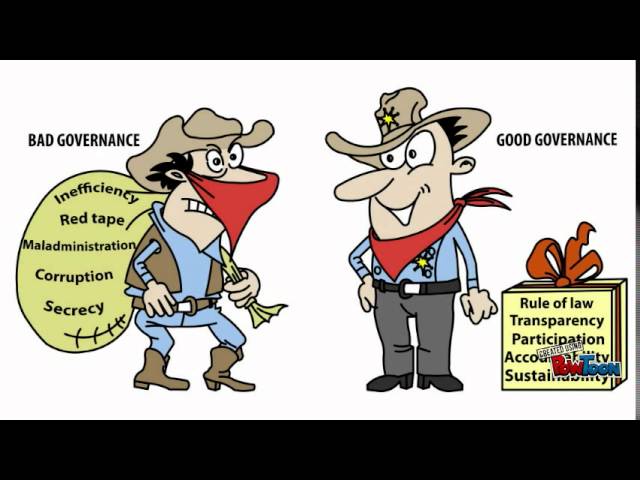
Thus, good governance is an approach which aims in creating a system which finds justice and peace and ensures the protection of individual’s human rights and liberties. Good Governance is measured by 8 characteristics : Participation, Rule of Law, Transparency, Responsiveness, Consensus Oriented, Equity and Inclusiveness, Effectiveness and Efficiency, and Accountability.

Good Governance is a process of governance that considers the views of minorities and vulnerable groups of society and minimizes corruption while taking decisions thereby boosting the economy.

REFERENCES OF GOOD GOVERNANCE

  1. The importance of Governance is clearly highlighted and explained in Indian Constitution which is based on – Sovereign, Socialist, Secular and Democratic Republic for attaining democracy, rule of law and welfare of people.
  2. The Sustainable Development Goal q6 also describes the linkage between improvement of governance, inclusivity, participation, rights and security.
  3. The Bhagavad Gita also provides numerous indications of good governance, leadership, dutifulness and self realization.
  4. According to former United Nations Secretary-General Kofi Annan, “Good governance is ensuring respect for human rights and the rule of law; strengthening democracy; promoting transparency and capacity in public administration.” He also said that “Good Governance is perhaps the single most important factor in eradicating poverty and promoting development”.

PRINCIPLES OF GOOD GOVERNANCE

Principles of Good Governance
  1. Participation: Participation by each section of the society irrespective of their gender, social class, caste, income etc. The participation of the individuals can be through direct or indirect (through other institutions or representatives) mediums. Participation is an crucial part of governance because it brings forward the major concerns of the society, the issues as well as in identification of potentials of the area.
  2. Rule of Law: It ensures fair and legal frameworks and methods being used in the governance and enforces impartially. This requires full protection of human rights, especially of the weaker sections and vulnerable groups of the society. For this the law needs to be impartial, uncorrupted and judicial.
  3. Transparency : Transparency in a process or system or governance ensures that all the decisions, actions and enforcements are taken only after considering the governing rules or laws or regulations. It signifies the availability of information’s to all the stakeholders and the people who will be affected by the actions or enforcements.
  4. Responsiveness: Good Governance requires timely actions and processes and tries to serve all the stakeholders within a reasonable time frame or specified time frame.
  5. Consensus Oriented: Good Governance requires different interests to sum up into a broad consensus to show the best interest for the community and society. It is necessary for developing sustainable human development and the only way by which cultural, social and historical diversity can be preserved.
  6. Equity and Inclusiveness: Equity and Inclusivity ensures that all the members of the community or society are feeling free to put forward their concern and idea. Nobody should feel excluded. Equity and Inclusivity is highly important for minor or vulnerable groups because it is very important to give them the opportunities to express their issues and ideas for improving and maintaining their well being.
  7. Effectiveness and Efficiency: The results or outcomes of the processes should satisfy the needs of the society and should make the best use of available resources, without exploiting them. It is necessary to identify the potentials and weaknesses of the society or community or area before coming up or implementing any solution. All the outcomes and results should within desirable time frame and should be the best decisions for the welfare of the society.
  8. Accountability: It is one of the most vital requirements of good governance as it ensures that all the stakeholders (government bodies or private institutions or civil organizations or NGOs etc) are accountable to the public. Who is accountable to whom depends on the actions or decisions which are taken in the organization.
What makes Good Governance different from Bad Governance

CONCLUSION

From the above discussion it is clear that “Good Governance” is the most ideal form of governance but it requires transperancy, accountability and intelligent form of governance which makes it more difficult to achieve. For achieving good governance, a system much be uncorrupted, bias free and free from prejudices.

Thus, there is a need to reform and reformulate strategies for restoring good governance. The government should focus on the principle of : “Sabka Saath, Sabka Vikas and Sabka Vishwas” which will guide the way to achieve inclusive and sustainable development.

National Democratic Alliance (NDA)

What NDA or National Democratic Alliance is?

NDA is the abbreviation for the National Democratic Alliance. The NDA is the alliance of the centre-right and right-wing Indian political parties, which is led by the Bharatiya Janata Party (BJP). The alliance includes 17 parties. The NDA government was founded in 1998 by late Prime Minister Lal Krishna Advani and Atal Bihari Vajpayee.

BJP is the only national party in the NDA alliance. Other than that, the alliance includes 25 members as of May 2020:

Janata Dal (United) (JD (U))

Lok Janshakti Party (LJP)

Apna Dal (Sonelal) (AD (S))

Shiromani Akali Dal (SAD)

Jannayak Janata Party (JJP)

All India Anna Dravida Munetra Kazhagam (AIADMK)

All Jharkhand Students Union (AJSU)

National Democratic Progressive Party (NDPP)

Rashtriya Loktantrik Party (RLP)

Pattali Makal Katchi (PMK)

Kerala Congress (J)

Asom Gana Parishad (AGP)

Bodoland People’s Front (BPF)

Desiya Murpokku Dravida Kazhagam (DMDK)

Tamil Maanila Congress (M) (TMC (M))

Bharat Dharma Jana Sena (BDJS)

Al India N.R Congress (AINRC)

Mahrashtrawadi Gomantak Paksha (MGP)

Maharashtra Navnirman Sena (MNS)

Jana Sena Party (JSP)

Gorkha Janmukti Morcha (GJM)

National Peoples Party

Mizo National Front

Sikkim Krantikari Morcha

History of National Democratic Alliance (NDA)

The National Democratic Alliance (NDA) was formed to contest general elections as a coalition government in 1988. It was led by the Bharatiya Janata Party (BJP). Several regional parties were included in the NDA coalition, including the Samta Party, All India. Anna Dravida Munetra Kazhagam (AIADMK), and also the Shiv Sena which is the only member of NDA to share the Hindutva ideology of the BJP. In 1988, the NDA won the majority number of seats and with it won the elections, and Atal Bihari Vajpayee again came into power as the Prime Minister. The win was possible because of the outside support that the Telugu Desam Party (TDP). However, the government collapsed because of the withdrawal of the All India Anna Dravida Munetra Kazhagam (AIADMK). Later, few more regional parties joined the NDA, after which it again won the elections of 1999 and for the first time came into power for a full term of five years. Earlier the NDA came into power with Atal Bihari Vajpayee serving as the Prime Minister but for 13 days in 1996, then for 13 months from 1998-1999, and finally for a full term of five years from 1999 – 2004.

Formation of Bharatiya Janata Party (BJP)

Bharatiya Janata Party (BJP) is one of the two major national political parties of India. One is the Indian National Congress (INC) and the other is the Bharatiya Janata Party (BJP) among the two major parties. In 1951, Shyama Prasad Mukherjee formed the Bharatiya Janata Sangh, from where the BJP originated. In 1977, the State of Emergency emerged, and to form the Janata Party the Jana Sangh emerged with several other parties and defeated the Congress Party in the general elections of 1977. The Janata Party dissolved in 1980 after being in power for three years, and the former members of the Jana Sangh came together to form the Bharatiya Janata Party (BJP). The BJP then officially was formed in 1980. Initially, in the 1984 elections, it only won 2 seats but later it followed victories in state and national elections and 1996 became the largest party in the parliament. However, it lasted for only 13 days due to the lack of a majority in the lower house of parliament (Lok Sabha). In 1998, after the general elections the coalition government of the National Democratic Alliance (NDA), led by the BJP came into power lasted for 13 months and then in 1999 for a full term of five years. However, in 2004 the NDA government faced defeat and Congress Party stayed in power for the next 10 years. In 2014, the BJP led NDA government finally regained its power and served for a full term of five years under Narendra Modi serving as the Prime Minister of India.