'Sahkar se Samriddhi' program in Gandhinagar, Gujarat

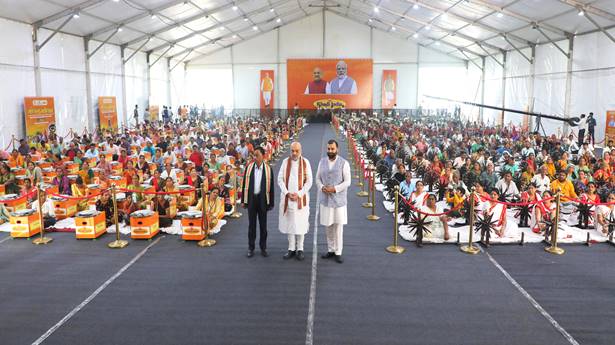
 Union Home Minister and Minister of Cooperation Shri Amit Shah addressed the ‘Sahkar se Samriddhi’ (Prosperity through Cooperation) program organized on the occasion of 102nd International Day of Cooperatives in Gandhinagar, Gujarat today. Many dignitaries including Gujarat Chief Minister Shri Bhupendra Patel, and Secretary, Ministry of Cooperation were present on the occasion.
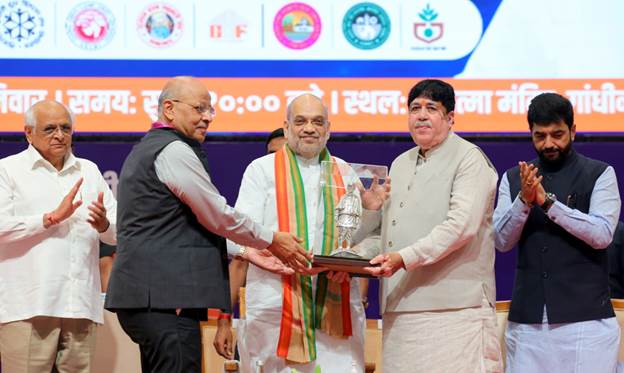
In his address, Shri Amit Shah said that today is the birth anniversary of Dr. Shyama Prasad Mukherjee and we owe to him for making Bengal and Kashmir integral parts of India today. He said that it was Dr. Mukherjee who led the movement against having two legislations, two heads at the top and two flags in one country and sacrificed his life fighting for this cause. Shri Shah said that today under the leadership of Prime Minister Shri Narendra Modi the duality of having two legislations (Vidhan), two heads at the top (Pradhan) and two flags (Nishaan) has ended in Kashmir and the tricolour is flying there high with great pride. He said that today is also the death anniversary of Babu Jagjivan Ram ji, who initiated and took forward many development programs for the Dalits of the country and laid the foundation of social harmony and opposed religious conversion.


The Union Minister of Cooperation said that today is a very important day in many ways for all the people and workers associated with the cooperative sector. He said that on this day, Prime Minister Shri Narendra Modi had established an independent Ministry of Cooperation. He said that previous governments never paid heed to the demand of a separate Cooperation Ministry. He said that Shri Narendra Modi, who comes from the land of Gujarat, after becoming the Prime Minister, established an independent Ministry of Cooperation by understanding the need for cooperation in today’s time.
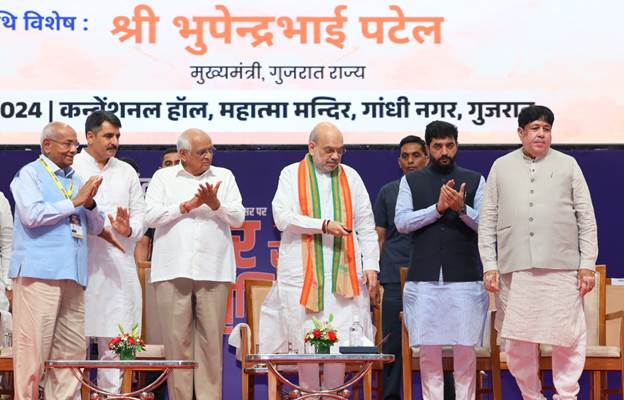


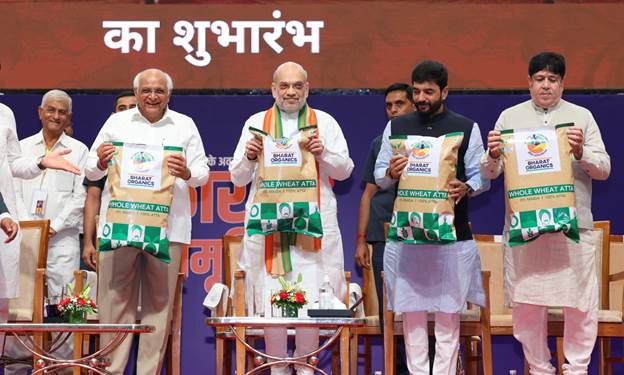
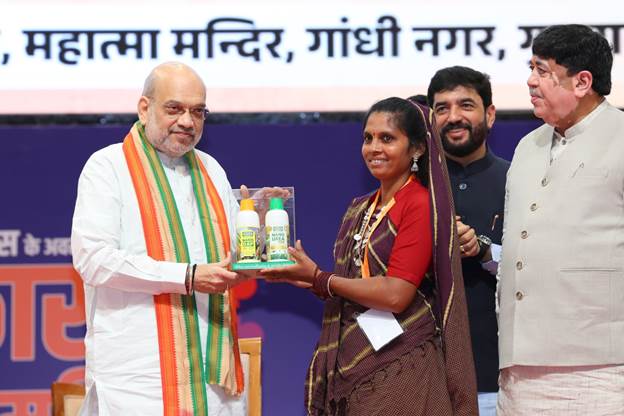
Shri Amit Shah said that today the Government of Gujarat has taken a very important decision and announced a subsidy of 50 percent on Nano-Urea and Nano-DAP. He thanked the Gujarat government for the decision and said that farmers need to spray Nano-Urea only once and that there is no need to add Urea to the fields later during the crop’s growth. Shri Shah said that spraying Nano-Urea and Nano-DAP in the field is sufficient for increased production and will also save the soil. He said that the Modi government has made them cheaper and farmers should use them. He said that the Government of India has established National Cooperative Organic Limited (NCOL) to promote organic products and ensure fair price for their produce to farmers practising organic farming. Shri Shah said that today Bharat Organic Atta has also been launched by NCOL. Shri Shah said that Amul has also launched a shop of Organic products in Delhi. He said that both Bharat Organic and Amul are reliable and 100 percent organic brands. Shri Shah said that the Bharat brand stamp is put on organic products only after testing them using the world’s most modern technology.


Union Home Minister and Minister of Cooperation said that cooperation is not a new idea in India and our forefathers had adopted this 125 years old idea. He said that many great personalities like Sardar Patel, Mahatma Gandhi, Gadgil ji, Vaikunthbhai Mehta and Tribhuvandas Patel started it. He said that a time came when this idea started weakening gradually. Shri Shah said that Prime Minister Modi established a new and independent Ministry of Cooperation recognizing the relevance of cooperation. He said that today we are at an important juncture and the 125 years old cooperative movement is making a big contribution in various areas of the country. He said that the cooperative sector is contributing 20 percent in the distribution of agricultural loans, 35 percent in the distribution of fertilizers and 21 percent in production, 31 percent in sugar production, 13 percent in the purchase of wheat and 20 percent in the purchase of paddy. He said that the cooperative sector is making a very important contribution in the rural and agricultural economy. He said that we have to lay such a strong foundation of cooperation in the next 5 years so that cooperation can reach every village and household for the next 125 years.


Shri Amit Shah said that the Modi government has come up with two new schemes through cooperatives. He said that the government has taken important steps to promote Ethanol and for the prosperity of the farmers producing Maize. He said that the government have made arrangements that two big cooperative institutions of the government will buy Maize produced by the farmers online at the minimum support price (MSP) and Ethanol will be made from it. He said that this will not only make the farmers prosperous but will also help in increasing the country’s foreign exchange reserves by reducing the import of Petrol. Shri Shah said that similarly, now National Agricultural Cooperative Marketing Federation of India (NAFED) and Consumer cooperative institutions will also procure 4 types of Pulses at 100 per cent MSP. He said that we should promote ‘Cooperation among Cooperative’ institutions. He said that if we do all the economic transactions of the cooperative sector within the cooperative sector itself, then we will not need to bring a single penny from outside the cooperative sector. The Minister of Cooperation urged National Bank for Agriculture and Rural Development (NABARD) and all the State Cooperative Banks across the country that every Primary Agriculture Credit Society (PACS) and other cooperative institutions should open their account in the District Cooperative Bank or State Cooperative Bank, which will not only strengthen the cooperative sector but will also increase capital and confidence.


Union Home Minister and Minister of Cooperation said that Prime Minister Shri Narendra Modi has given the slogan of ‘Sahkar se Samriddhi’ to the cooperative sector of the country. He said that in the last 10 years, Prime Minister Modi emancipated 30 crore people from poverty and freed them of their worries of daily needs. He said that PM Modi has provided facilities like house, electricity, toilet, drinking water, 5 kg free food grains and gas cylinder to crores of poor people of the country. Shri Shah said that now these crores of poor people want to contribute to the development of the country but they do not have capital. He said that the only way to contribute to the development of the country and to develop oneself without capital is cooperation. Shri Shah said that the only objective behind the mantra of ‘Sahkar se Samriddhi’ given by Prime Minister Shri Narendra Modi is to bring confidence, happiness and prosperity in the lives of these 30-crore people who are backward even after 75 years of independence.


Shri Amit Shah said that the Union Ministry of Cooperation has taken many important steps for the cooperative sector. He said that the government has set a target that there should not be any state or district in the country where there is not a viable district cooperative bank and a viable district milk producer union. He said that only by doing this we will be able to expand the cooperative sector and make every rural and poor person prosperous. Shri Shah said that for this we have envisioned a Cooperative Panchayat. He said that even today there are 2 lakh panchayats in the country where there is not a single cooperative institution. He said that we have set a target that in the next 5 years we will work to create multipurpose PACS in these two lakh panchayats. Shri Shah said that the government has also made model bylaws for PACS and despite PACS being a state subject, every state from Kashmir to Kanyakumari and Assam to Dwarka has accepted these model bylaws. Shri Shah said that the Government has also worked towards making PACS multi-purpose and today, out of 65,000 functional PACS in the country, 48,000 have taken initiatives towards becoming viable by adding some new activity to themselves.


Union Minister of Cooperation said that the central government has also formed three multi-state cooperative institutions – Organic Committee, Export Committee and Seed Committee – through which the path has been paved to enrich the lives of farmers. He said that the government will soon bring a National Cooperative Policy. Shri Shah said that 1100 new Farmer Producer Organisations (FPOs) have been formed in the country, more than 1 lakh PACS have accepted the new bylaws and now with the issuance of bonds worth Rs 2000 crore to National Cooperative Development Corporation (NCDC), this institution will be able to work for the welfare of more cooperative institutions. Along with this, the urban cooperative banks have got the target of opening new branches, the limit of personal housing loan given by cooperative banks has been doubled, both the income tax benefits and the limit of cash withdrawal have been increased and Prime Minister Shri Narendra Modi, by enacting a law, has done the work of cancelling the income tax liability of Rs 15000 crore of sugar cooperative mills. The IT liability was pending for many years.
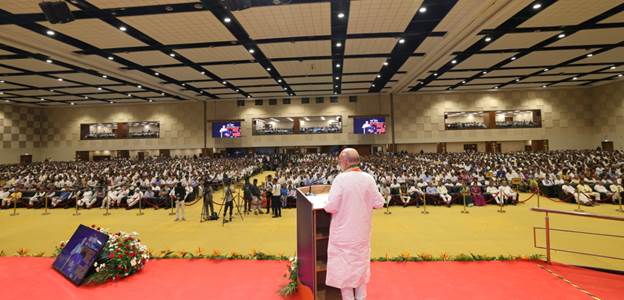


Shri Amit Shah called upon the workers of the cooperative sector across the country and asked them to make cooperatives a strong pillar of the country’s economy. He said that we not only have to make cooperatives a strong pillar but also work to instil facilities, prosperity and self-confidence in the lives of crores of poor people of the country through this sector. Shri Shah expressed confidence that on the day when International Day of Cooperatives will be celebrated in 2029, there will not be a single Panchayat in the country where there will not be a PACS. He said that we all have to come together to make Prime Minister Shri Narendra Modi’s dream come true and take cooperatives forward to serve the poor.

*****
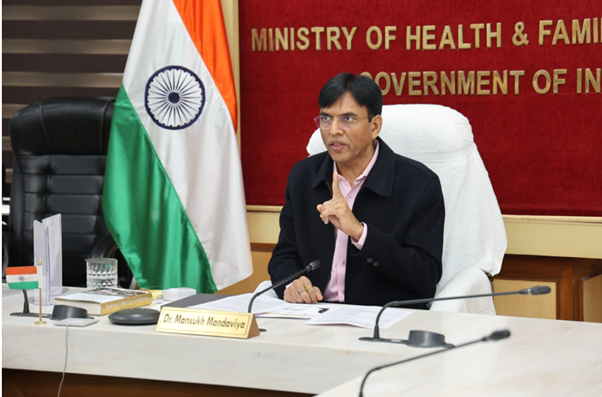
Vibrant Gujarat Pre-Summit on ‘Biotechnology: The Path of Innovation & Wellness for Viksit Bharat’

 “India’s ‘Bio Economy’ has grown eight times in the last eight years from $10 billion to $80 billion. In the coming times, biotechnology will become the biggest foundation for health treatment.” This was stated by Dr. Mansukh Mandaviya, Union Minister for Health & Family Welfare as he virtually addressed the pre-event summit “Biotechnology: The Path of Innovation & Wellness for Viksit Bharat” in the presence of Shri. Bhupendra Patel, Chief Minister, Gujarat at Vigyan Bhavan, Science City, Ahmedabad, Gujarat today. The summit is a preliminary event leading up to the 10th Vibrant Gujarat Global Summit that will take place on January 2024 at the Mahatma Gandhi Mandir, Gandhinagar under the theme of ‘Gateway to the Future’

Dr. Mandaviya noted that Indian Biotech Industry aiming to grow to $150 Billion by 2025 and $300 Billion by 2030, and India is currently among the top 12 destinations for Biotechnology in the world with approximately 3% share in the Global Biotechnology Industry. He stated “This industry will become a medium for finding solutions for complex problems in various spheres such as agriculture, environment, industrial production and many more. In light of this, in the future, the economy will become biotechnology based.” Quoting the Prime Minister, Shri Narendra Modi, Dr. Mandaviya stated “in the global biotechnology ecosystem, India will soon feature as one of the top ten nations.” Reiterating the Prime Minister’s vision of India achieving the status of a developed nation by 2047, Dr. Mandaviya cited that “this sector’s contribution will be instrumental in making India a developed nation.” 

Highlighting the growth and prowess of the industry, Dr. Mandaviya stated that the vaccination produced by India during the pandemic showcased India’s power in the field of biotechnology to the world. Underscoring the importance of this sector, the Union Minister stated “the National Biotechnology Development Strategy 2020-25 provides the government a platform to strengthen skill development, resource and innovation converging into one strong ecosystem for knowledge sharing.” He stated it further facilitates commercialization and market linkages by encouraging private-public partnership models in these sectors. 

Commending the progress of the nation and industry in this sphere, the Dr. Mandaviya praised the participation of startups, industries and industry associations, researchers and academicians across the nation for contributing to the development of this sector. The Union Health Minister lauded the efforts and contribution of Gujarat in their dedicated focus on biotechnology over two decades and its strong contribution in making India a healthcare and innovation ready country. The Union Health Minister reflected that Gujarat was the first state in the country to establish Biotech Mission 15-20 years ago. Dr. Mandaviya recalled that when Prime Minister Narendra Modi was the Chief Minister of Gujarat, he had established Biotech Mission and Biotech Park in the state. 

Acknowledging the crucial contribution of the Biotechnology sector will provide to the nation and economy Shri. Bhupendra Patel stated “aligning with the theme of ‘Gateway to the Future’ we will provide additional focus to futuristic sectors of which Biotechnology features as most important.” He further cited that “Biotechnology sector is known as the sector of hope. With its rapid growth, it will provide significant contributions to the world.” The Gujarat Chief Minister also inaugurated the ‘Start-Up Product Launch’.


The event was attended by Shri Raj Kumar, Chief Secretary, Gujarat, Ms. Mona Khandhar, Principal Secretary, Department of Science & Technology, Government of Gujarat, Dr. Rajesh Gokhale, Secretary, Department of Science & Technology, Ministry of Science and Technology, senior government officials, mission directors, as well as eminent dignitaries. 

****

'Smriti Parv' programme organized on the birth centenary of Shri Divyakant Nanavati Ji in Junagadh, Gujarat

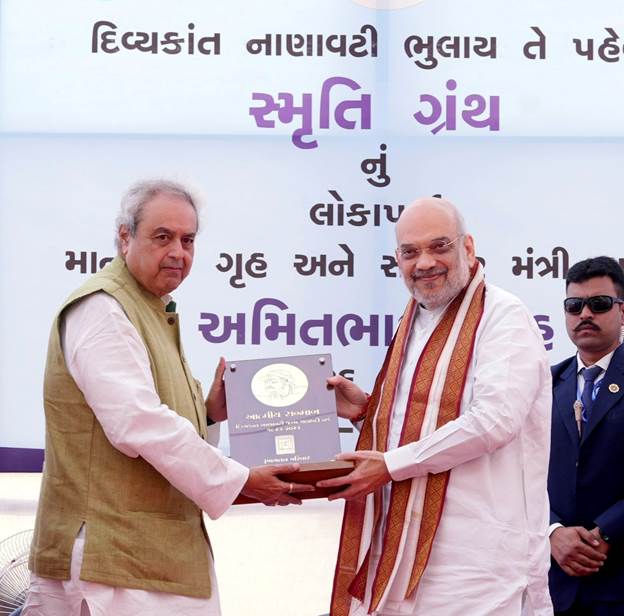
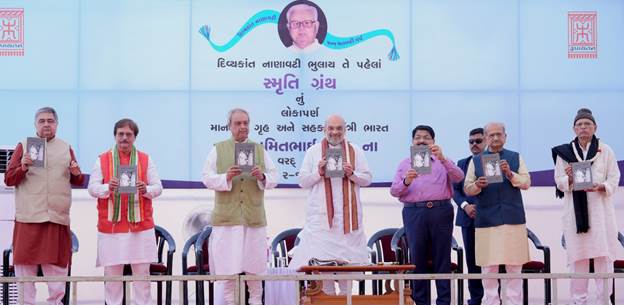
 Union Home Minister and Minister of Cooperation, Shri Amit Shah addressed the ‘Smriti Parv’ programme organized on the birth centenary of Shri Divyakant Nanavati in Junagadh, Gujarat today.

In his address, Shri Amit Shah said that Shri Divyakant Nanavati was one of those people who lived for the society and the people. He said that Rupayatan Sanstha has published such a book today which will definitely prove to be a guide for the leaders of the new generation. Shri Shah said that if someone remembers a person even after 100 years, it means that person’s life has been truly meaningful. Shri Divyakant ji was MLA for two consecutive terms and was also the Law and Justice Minister in the Government of Gujarat and he made numerous contributions not only to Junagadh but also to the public life of Gujarat.

The greatest personality of Bhakti Sahitya, Shri Narsingh Mehta Ji dedicated his entire life to literature and it is impossible to find an excellent litterateur like him. He said that Shri Mehta presented all the secrets of Vedas and Upanishads in front of the people in a concise manner and lucid language. He said that only Shri Narsingh Mehta Ji could have the courage to oppose untouchability at that time. Shri Shah said that if we want to know about social justice then we will have to understand Shri Narsingh Mehta Ji. He said that on this sacred land of Shri Narsingh Mehta Ji, Rupayatan Sanstha has published a book in the memory of son of the soil Shri Divyakant ji. It will definitely become an inspiration for the people working in public life of Junagadh and Gujarat.

Shri Amit Shah said that Rupayatan Sanstha is also doing very good work on various dimensions of social life for the last 75 years. He said that Shri Bhikhudan ji has done the work of transmitting the art of Gujarat and Saurashtra from the older generation to the new generation. He said that Shri Bhikhudan Gadhvi was a bridge between the generation of Shri Kaag Bapu and today’s litterateurs and he has made immense contribution to the literature of Gujarat. Shri Shah said that when Shri Narendra Modi became the Prime Minister, he recognized the contribution of Shri Bhikhudan ji and honored him with Padma Shri award. He said that Prime Minister Shri Narendra Modi has made complete arrangements so that the deserving person of the country can be honored with Padma Award.

*****

‘Mati Kala Mahotsav’ in Ahmedabad, Gujarat

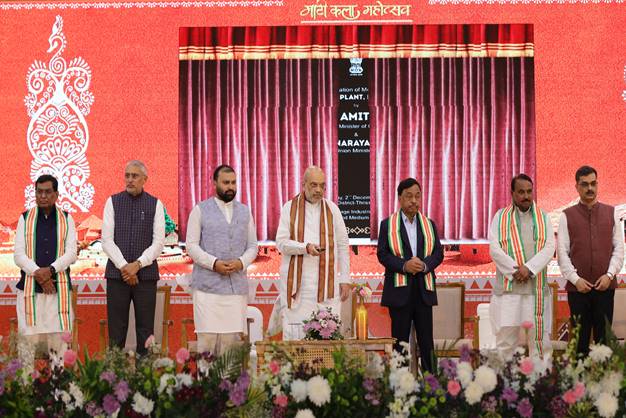
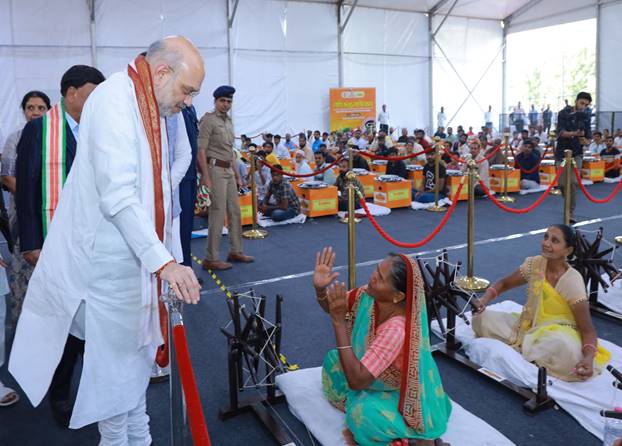
 Union Home Minister and Minister of Cooperation, Shri Amit Shah addressed the Mati Kala Mahotsav in Ahmedabad, Gujarat, today. Many dignitaries including Union Minister Shri Narayan Rane and Shri Bhanupratap Singh Verma were present on this occasion.

In his address, Shri Amit Shah said that Khadi Mati Kala Mahotsav is a multidimensional idea which has been taken forward by Prime Minister Shri Narendra Modi. He said that the idea of Khadi was first put forward by Mahatma Gandhi in front of everyone by linking it with the freedom movement and through this, Bapu worked to connect all the people living in poverty with employment. Along with this, Gandhi Ji worked towards reducing the demand for foreign clothes and spread the spirit of Swadeshi and Swaraj to every village. Shri Shah said that even today the idea of Khadi is multi-dimensional and multi-purpose. He said that Prime Minister Modi has not only revived the idea of Khadi but also worked to popularize Khadi by taking it forward and to the common people.

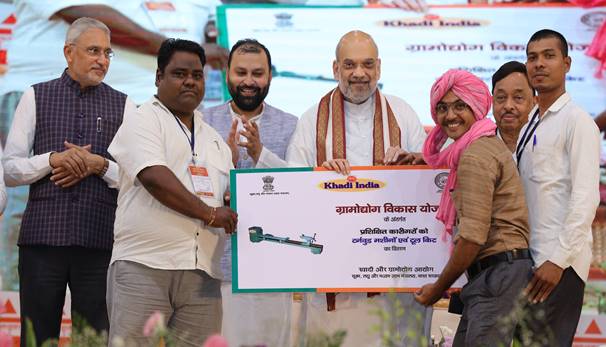
The Union Home Minister and Minister of Cooperation said that Prime Minister Shri Narendra Modi has done the work of linking Swadeshi and employment in the call of “Vocal for Local”. He said that it is because of the vision of Shri Modi that the dying Khadi movement is touching new dimensions today. Under the leadership of Shri Modi, India has become the fastest growing economy in the world. Shri Shah added that under the leadership of Shri Modi the economic development of the country is taking place and along with this, Prime Minister Modi has also taken many steps to make the economy all-inclusive. He said that increasing the turnover of Khadi to three times means providing employment to crores of people and when these people become self-reliant then the increasing GDP figure becomes humane. This also brings confidence, self-reliance and happiness in the lives of crores of people. He said that today in this Khadi Mati Kala Mahotsav, 300 electric potter wheels, 40 agro-based food processing industry tool kits, 40 incense stick making machines to women, 20 plumbing kits and more than 200 traditional charkhas have been given.

Shri Amit Shah said that today a Central Silver Plant (CSP) has been inaugurated which is very important for the production of Khadi. He said that this CSP which was built 30 years ago, has been modernized at a cost of Rs 10 crore, due to which production will increase, quality will improve and all the material of the people spinning Khadi will be utilized. Shri Shah said that today 8 newly constructed post offices have also been inaugurated virtually where many facilities like mail, parcel booking, Aadhaar services, banking postal services, life insurance, rural postal life insurance and digital certificates for pensioners will be available. He said that now all the people of Gandhinagar area do not need to go anywhere to get a passport, now they can get the application processed from their nearest post office. He added that these same post offices had sent 53,000 national flags under the Har Ghar Tiranga Abhiyan in Gandhinagar area. Shri Shah said that when Prime Minister Modi had conceived this campaign, no one had anticipated that this campaign would become such a huge success for awakening the spirit of patriotism. He said that from Kashmir to Kanyakumari and Dwarka to Kamakhya, there was no building left without our Tricolour being hoisted and this campaign revived the spirit of patriotism.


The Union Home Minister said that today, under PMEGP, online payment of margin money of about Rs 200 crore has been made to 5000 beneficiaries across India including Gujarat, which will enable them to get a loan of Rs 600 crore. He said that Khadi Village Industries has made a lot of progress in the last 9 years. Shri Shah said that Shri Modi gave priority to Khadi and as a result the total turnover of Khadi has crossed Rs 1,35,000 crore in 2022-23. At least 1 lakh people have contributed to this turnover of Rs 1,35,000 crore. Today lakhs of people have achieved their livelihood through this turnover of Rs 1,35,000 crore and they are living with dignity.

The Union Home Minister requested the people of Gujarat and the country that every family should promote Khadi by purchasing Rs 5,000 worth Khadi or products of Khadi Village Industries in a year. He said that if every family in the country buys Khadi worth Rs 5000, the number of unemployed people in the country will decrease by more than half.

****

THE ROLE OF COMMUNAL HARMONY FOR SUSTAINABLE DEVELOPMENT OF THE INDIAN SOCIETY

BY DAKSHITA NAITHANI

India is a huge country with the second largest population on earth. It is a hub of various religious and the very nature of culture is diversified and composite. We gained independence in 1947 and keeping the diverse nature of our country, our fore fathers prepared our constitution and dreamed of a secular country where every religion will be respected and given equal weightage. They realised very early that unless we had ’unity in diversity’ there will be no development for the Indian society. India is a emerging economy where the small businesses and agriculture are the two main providers to the job industry. Unfortunately during communal violence the shopkeepers and various other small scale industry entrepreneurs and daily wagers are the ones who are the most hit and are prone to loss and damages. Violence usually resulting in loss of income and property are not recovered in any sorts of insurances and people are left to face the economic burdens afterwards.

In most of the typical Indian homes where the male is the sole earner for the family and females are designated to the household chores are amongst the worst sufferers which leads to disintegration of homes as well as community as a whole. Many children as a result of these broken homes usually end up missing a good education and a hope of good growth in life which in turn nullifies their future contribution to the society and economic growth of the country.

Communal violence leads to generations of suffering and spoiling the economic prospect of a country

The very famous Godhra riots which is also known as 2002 Gujarat riots was a three-day period of inter-communal violence in the western Indian state of Gujarat. Following the initial incident, there were further outbreaks of violence in Ahmedabad for three months; statewide, there were further outbreaks of violence against the minority Muslim population for the next year. The burning of a train in Godhra on 27 February 2002, which caused the deaths of 58 Hindu pilgrims karsevaks returning from Ayodhya, is cited as having instigated the violence.

According to official figures, the riots ended with 1,044 dead, 223 missing, and 2,500 injured. Of the dead, 790 were Muslim and 254 Hindu. The Concerned Citizens Tribunal Report, estimated that as many as 1,926 may have been killed. Other sources estimated death tolls in excess of 2,000. Many brutal killings and rapes were reported on as well as widespread looting and destruction of property. There was widespread destruction of property. 273 dargahs, 241 mosques, 19 temples, and 3 churches were either destroyed or damaged. It is estimated that Muslim property losses were “100,000 houses, 1,100 hotels, 15,000 businesses, 3,000 handcarts and 5,000 vehicles.” Overall, 27,780 people were arrested. Of them, 11,167 were arrested for criminal behavior (3,269 Muslim, 7,896 Hindu) and 16,615 were arrested as a preventive measure (2,811 Muslim, 13,804 Hindu). Thus destroying many lives and causing fear amongst people from one another On 23 May 2008, the Union Government announced a 3.2 billion rupee (US$80 million) relief package for the victims of the riots. In contrast, Amnesty International’s annual report on India in 2003 claimed the “Gujarat government did not actively fulfill its duty to provide appropriate relief and rehabilitation to the survivors”. The Gujarat government initially offered compensation payments of 200,000 rupees to the families of those who died in the Godhra train fire and 100,000 rupees to the families of those who died in the subsequent riots, which local Muslims took to be discriminatory.  Thus creating more hate between the two community

The recent riots in Delhi’s Chand Bagh Bhajanpiura and surrounding areas were one such example the violence led to huge losses both emotional as well economic . Around 42 people lost their lives. About 92 houses, 57 shops, 500 vehicles, 6 godowns , 2 schools,4factories and 4 religious places were burnt and taken down . The riots led to property and business losses of over 1000 cr. However long term economic loss, production loss, employment losses as well emotional losses cannot be quantified. These riots led to large scale migration of people to other states thus uprooting people who have been flourishing there for decades successful businesses were destroyed and demolished overnight dreams were shattered and the already stressed farm and agriculture was further stressed to support and feed the additional mouths.

The Delhi government was forced to announce compensation and financial support to the people who were affected running into crores of rupees. The precious funds which could have been used for development of schools, hospitals, betterment of the NCT and upliftment of the poor and needy were exhausted to support the riot victims. The immeasurable loss to the image of country and subsequent losses in share markets due to foreign funds pulling out their funds were a huge blow to India’s economic progress leaving it behind others. India is now being looked upon as an unsafe destination for Investments and travel. The travel tourism industry of India which provides employment to over 42 million people in India suffered huge losses in cancelled bookings. The Industry which was projected to grow at the rate of 4 per cent in 2020 is now looking at a bleak future.

India is a developing country and the vision of our leaders to make India a developed nation and an economic powerhouse cannot materialize unless the internal security of the nation, particularly communal harmony is intact. Maintenance of communal peace and tranquillity occupies a lot of government energy and valuable resources which could be used in nation building.

In case peace prevails, an ambience of trust will develop between various communities, leading the nation on the path of development and economic advancements.

WORLD’S LARGEST SHIP BREAKING YARD: ALANG, GUJARAT

Alang is the biggest ship breaking yard in the world and is situated in Gujarat, India. Hundreds of ships get scrapped here every year. With the increasing popularity of the yard, the number of ships getting scrapped here is also increasing steeply. With this the number of threats on the health of the workers working there and the marine environment is also increasing. There is a steep increase in threats on them. Unlike other countries, India had lacks strict policies and regulations for protecting and preserving the marine environment. This leads to irreversible harm on the surrounding flora and fauna as well as the health of the laborer’s. Indian coasts have coral reefs and due to the unregulated practice of ship breaking activity, the coral reef of the coast has vanished and destroyed completely. It is having serious impacts on the marine life. Alang has now become the storage of toxic wastes, radioactive elements, poisonous gases and waste, unusable oil which have now entered into the marine food chain and and are also affecting the health of the workers working there. The laborer’s work in dilapidated condition with least safety measures and poor health care facilities.

Ship Breaking Yard at Alang, Gujarat

EXISTING SHIP RECYCLING CAPACITY OF ALANG

Currently the ship breaking yard has 153 plots or ship breaking yards on 10 kilometer long coast in Bhavnagar District of the state. Out of these 131 plots practice ship breaking activities and just 80 plots have ships for breaking. So, 48 per cent of the ship breaking capacity is laying idle in the site. In the year 2011 -12, 415 ships with a total 3.85 million Light Displacement Tonnage (LDT or weight of a vessel without fuel, cargo, etc.) came to the site and the capacity of the site was almost full. And after that there was a decrease in the number of ships coming. In 2021, only 199 ships came to the site.

In this entire process of ship breaking, there are numerous factors and aspects which are not being considered and are neglected. The protection of health, safety and sanitation of the workers is not considered, the negative impacts of the practice on the marine ecosystem and the surrounding environment is not being considered properly and the potential threats on the flora and fauna are not considered properly. Some of the regulations and rights of the workers which are being violated are:

  1. Violation of Legal Frameworks for Adequate Health Facilities: One of the major problems in the ship breaking site is the absence of proper health care facilities for the workers. The region as 2 hospitals only which are under staffed and don’t possess necessary health care infrastructure for treating fatal emergencies. There is no ambulance facility in the area as well. Regulations Violated: the International Labor Organization (ILO) guideline of 2003, which outlined detailed provisions for the safety and health of workers in ship-breaking industries etc.
  2. Violation of Regulations provided for secured employment of laborer’s: The ship breaking yard of Alang is labor intensive and does not use modern technologies like China and Japan. Thousands of people migrants migrate from different parts of the state (especially Odisha, Uttar Pradesh, Bihar etc.) to Alang Sosiya for getting employment but there is no employment security here. A number of workers are Alang Sosiya Ship Breaking YARD (ASSBY) have also said that there is a always a delay in payment of wages and they do not receive any financial benefits as laid down by different labor laws of India. The workers are not even paid for extra work on Sundays and when they are on leave. Regulations Violated: The Workmen’s Compensation Act 1923; the Payment of Wages Act 1936; the Factories Act 1948; the Employees’ State Insurance (ESI) Act 1948; The Minimum Wages Act 1948; the Employees’ Provident Funds Act 1952; the Payment of Bonus Act 1965 etc.
  3. Absence of database providing details of migrant workers: The District Authority does not maintain any database regarding the number of migrant workers working in the ship – breaking yard. Regulations Violated: Chapter II of the Inter-State Migrant Workmen (Regulation of Employment and Conditions of Service) Act, 1979, specifies that the state government shall appoint a registering officer for the purpose of registering interstate migrant workmen. Ship-breaking industries continue to recruit migrant workers without registering under this Inter-State Migrant Workmen Act.