

The Union Cabinet, chaired by the Hon’ble Prime Minister Shri Narendra Modi, today approved Metro Connectivity from HUDA City Centre to Cyber City with Spur to Dwarka Expressway, Gurugram covering the distance of 28.50 km having 27 stations on the route.
The total completion cost of the project will be Rs.5,452 crore. This will be a standard gauge line of 1435 mm (5 ft 8.5 inches). The entire project will be elevated. The spur from Basai village has been provided for connectivity to depot.
The project is proposed to be completed in four years from the date of sanction of the Project and is to be implemented by Harayana Mass Rapid Transport Corporation Limited (HMRTC) which will be set up as a 50:50 Special Purpose Vehicle (SPV) of the Government of India and Government of Haryana after sanction order is issued.
|
Name of corridor |
Length (in KM) |
No. of Station |
Elevated/ Under Ground |
|
Huda City Centre to Cyber City – Main corridor |
26.65 |
26 |
Elevated |
|
Basai Village to Dwarka Expressway – Spur |
1.85 |
01 |
Elevated |
|
Total |
28.50 |
27 |
|
Benefits:
As on date there is no metro line in Old Gurugram. The main feature of this line is to connect New Gurugram with Old Gurugram. This network will connect with Indian Railway station. In next phase, it will provide connectivity to IGI airport. This will also provide overall economic development in the artea.
The detail of the approved corridor is as follows:
|
Particulars |
HUDA City Centre to Cyber City, Gurugram |
|
|
Length |
28.50 Km |
|
|
No of Stations |
27 stations (All Elevated) |
|
|
Alignment New Gurugram area Old Gurugram area
|
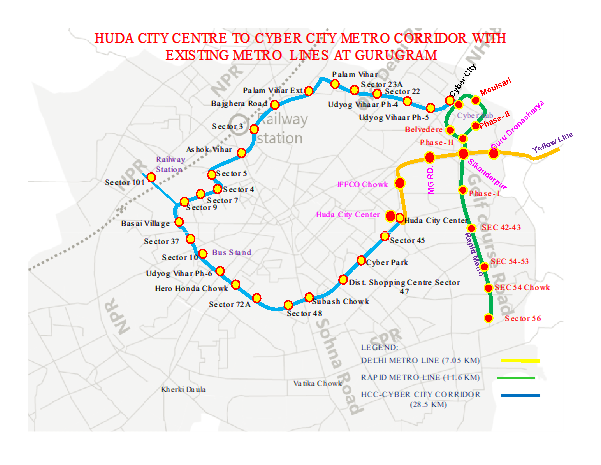
HUDA City Centre – Sector 45 – Cyber Park – Sector 47 – Subhash Chowk – Sector 48 – Sector 72A – Hero Honda Chowk – Udyog Vihar Phase 6 – Sector 10 – Sector 37 – Basai Village – Sector 9 – Sector 7 – Sector 4 – Sector 5 – Ashok Vihar – Sector 3 – Bajghera Road – Palam Vihar Extension – Palam Vihar – Sector 23A – Sector 22 – Udyog Vihar Phase 4 – Udyog Vihar Phase 5 – Cyber City Spur to Dwarka Expressway (Sector 101) |
|
|
Design Speed |
80 Kmph |
|
|
Average Speed |
34 Kmph |
|
|
Proposed Completion Cost |
Rs. 5,452.72 crore |
|
|
GoI share |
Rs. 896.19 cr |
|
|
GoH share |
Rs. 1,432.49 cr |
|
|
Local Bodies Contribution (HUDA) |
Rs. 300 cr |
|
|
PTA (Pass through Assistance- Loan component) |
Rs. 2,688.57 cr |
|
|
PPP (Lift & Escalator) |
Rs. 135.47 cr |
|
|
Completion Time |
4 Years from the date of Sanction of the project |
|
|
Implementing Agency |
Haryana Mass Rapid Transport Corporation Ltd. (HMRTC) |
|
|
Financial Internal Rate of Return (FIRR) |
14.07% |
|
|
Economic Internal Rate of Return (EIRR) |
21.79% |
|
|
Gurugram estimated Population |
Around 25 lakh |
|
|
Estimated Daily Ridership |
5.34 Lakhs – Year 2026 7.26 Lakhs – Year 2031 8.81 Lakhs – Year 2041 10.70 Lakhs – Year 2051 |
|
Route map of proposed corridor is as per Annexure-1.
Loan is being tied up with European Investment Board (EIB) and World Bank (WB).
Background:
Other Metro Lines in Gurugram:
a) Yellow Line of DMRC (Line-2)- shown as yellow in Annexure-1
i) Route length- 49.019 km (Samaypur Badli- HUDA City Centre; 37 Stations)
ii) Delhi portion- 41.969 km (Samaypur Badli- Arjangarh; 32 Stations)
iii) Haryana portion- 7.05 km (Guru Dronacharya – HUDA City Centre; 5 Stations)
iv) Daily ridership- 12.56 lakhs
v) Connectivity of proposed line with Line-2 at HUDA City Centre
vi) Date of commencement of operation at different stretches
|
Vishvidyalaya to Kashmere Gate |
Dec 2004 |
|
Kashmere Gate to Central Secretariat |
July 2005 |
|
Vishvavidyalaya to Jehangirpuri |
Feb 2009 |
|
Qutab Minar to Huda City |
Jun 2010 |
|
Qutub Minar to Central Secretariat |
Sept 2010 |
|
Jehangirpuri to Samaypur Badli |
Nov 2015 |
This line is broad gauge 1676 mm (5 feet 6 inches gauge).
b) Rapid Metro Gurugram (Shown as Green in Annexure-1)
i) Route length-11.6 km
ii) Standard Gauge- 1435 mm (4 ft 8.5 inches)
ii) Line constructed in two phases.
- First phase is loop between Sikandarpur to Cyber Hub with total route length 5.1 km, initially constructed by consortium of DLF and two companies of IL&FS group i.e. IERS (IL&FS Enso Rail system) and ITNL (IL&FS Transport Network Limited). The first phase was run by SPV named Rapid Metro Gurgaon Limited wef 14.11.2013.
- Second phase is between Sikandarpur to Sector-56 with route length of 6.5 km, initially constructed by consortium of two companies of IL&FS i.e. ITNL (IL&FS Transport Network Limited) and IRL (IL&FS Rail Limited). This phase was run by SPV namely Rapid Metro Gurgaon South Limited since 31.03.2017
- The operation was taken over by Haryana Mass Rapid Transit Company (HMRTC) since 22.10.2019 in terms of High Court order when concessionaire backed out to run this system
- The operation of this line has been entrusted to DMRC by HMRTC. Prior to this DMRC continued to run rapid metro line wef 16.09.2019.
- Average ridership of Rapid Metro Gurugram is about 30,000. In weekdays total daily ridership is about 48,000
- Connectivity of proposed line with Rapid Metro Line is at Cyber Hub
Multi Modal Connectivity:
- With Railway Station near Sector-5- 900 m
- With RRTS at Sector-22
- With yellow line station at HUDA City Centre
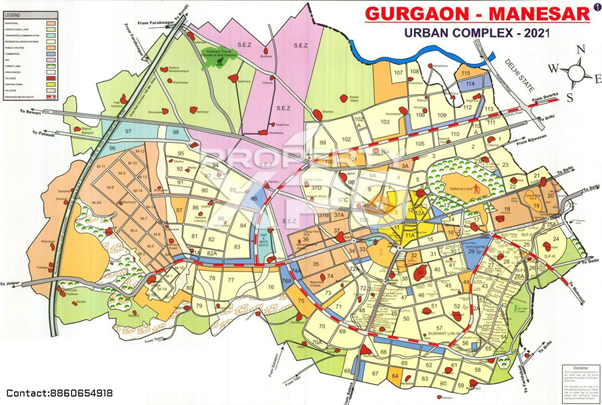
Sector wise map of Gurugram is enclosed as Annexure-2.
Project preparedness:
- 90% land is Govt land and 10% private
- Shifting of utilities started
- World Bank and European Investment Bank approached
- GC tendering under process
Annexure-1
Annexure-2
*****
 Eduindex
You must be logged in to post a comment.