

As millennials or members of Gen Z, most of us have been exposed to some form of social media from quite a young age. Our parents’ generation saw social media begin its growth, we grew up with it, and the coming generation is not going to know a life without it. So, where did it all start, and how did we reach here?
Precursors:
In simple terms, social media refers to computer-based platforms that can be used to share thoughts, ideas, and information through the internet. It gives users quick electronic communication of content, such as personal information, documents, videos, and photos.
But before the internet, there was the Morse Code as a precursor to the social media we know of today. Morse code used a series of dots and dashes which were tapped out by hand on a telegraph machine to communicate some information. The first message using Morse code was sent on 24 May 1844 from Baltimore to Washington D.C.


The emergence of ARPANET (Advanced Research Projects Agency Network) in 1969 by the United States Department of Defense and NSFNET (National Science Foundation Network) in 1987 by the National Science Foundation was crucial for laying the technical foundation of the Internet.
The Timeline:
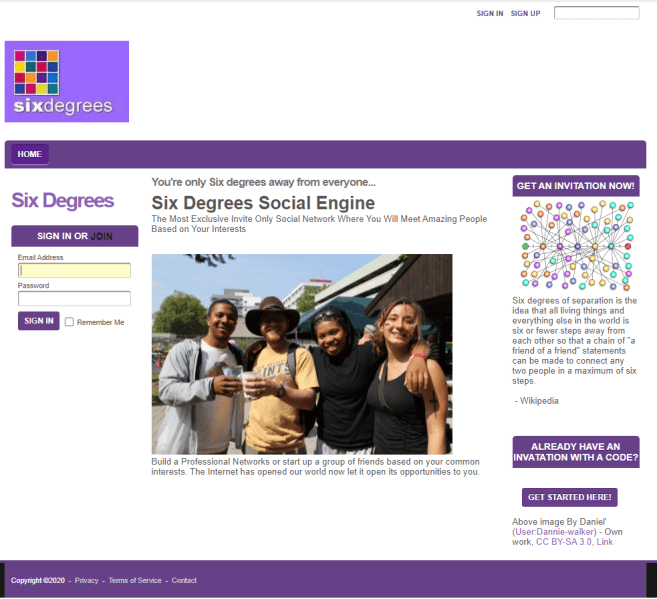
With the advent of the Internet, there were a lot of communication services coming up in the U.S such as CompuServe, America Online, and Prodigy. They provided users digital communication services through email, bulletin board messaging, and real-time online chatting. But the first online social media is considered to be Six Degrees which was the first platform that made it possible for users to have a profile. A profile is like a virtual character that resembles the user’s identity. Six Degrees was developed by Andrew Weinreich in 1997 and the name was derived from the “six degrees of separation” theory according to which “everyone in the world is connected to everyone else by no more than six degrees of separation”. This platform was shut down in 2000 but is now active again and you can find it with a simple Google search!
A lot of instant messaging applications came up between 1997 and 1999, like AOL Instant Messenger, Yahoo Messenger, and Microsoft’s MSN Messenger. Brad Fitzpatrick founded LiveJournal which caused a large number of people to get into blogging.
Friendster was another platform that was launched in March 2003. It allowed users to contact other members, maintain those contacts, and share online content and media with those contacts. Users could share videos, photos, messages, and comments with other members via profiles and networks. it was redesigned as a social gaming platform in June 2011.
Both LinkedIn and MySpace were launched in 2003. LinkedIn was founded as a networking site for career-minded professionals and still remains the social media site of choice for job-seeking people as well as employers looking for qualified professionals. MySpace allowed users to share new music on their profile pages and was the most visited website on the planet by 2006. It was beaten in popularity by Facebook in 2008, which has now grown into a huge networking service that literally everybody knows about.
Modern Social Media:
Facebook was founded in 2004 by Mark Zuckerberg and his Harvard collegemates and gained popularity over other social media sites because it provided frequently updated content in their News Feed. “The Wall” feature also enabled its users to post publicly. The “Like” button was introduced in 2009 and “The Wall” was replaced by the “Timeline” feature which organized the user’s posts chronologically. Over the years, Facebook has also been the subject of various controversies, including issues related to user privacy, mass surveillance, and political manipulation. The platform has 2.8 billion active monthly users, as of 2020.
Steve Huffman launched Reddit in 2005 as a web-content rating and discussion website where users can vote content up or down. In 2006, Jack Dorsey launched Twitter as a microblogging site where users can post and interact with messages known as “tweets”. As of 2020, Twitter has 186 million active users.
Instagram is another big social media site that was launched in 2010 by Kevin Systrom. It was launched as a photo-sharing website but has now included sharing of media content that can be edited using filters and featuring hashtags. Viewers can like, browse other users’ posts, and view trending content. Instagram was purchased by Facebook in 2012. It has since then come up with several features like messaging, ‘stories’ and live-stream features, and ‘reels’ which allows users to post quick 15, 30, or 60-second video clips. It is said to have 1.386 billion active users as of 2022.
Pinterest was launched in 2010 by Ben Silbermann as an image sharing and social media service site. Users can save and find information using images, GIFs and animated videos. Snapchat is another popular site that was launched in 2011 by Evan Spiegel. Instagram developed its ‘stories’ feature because of the competition from Snapchat which allows users to post pictures and messages that are available only for a short time.
Other popular social media platforms include TikTok, which was founded in 2016 by a Chinese company called ByteDance. Users can post very short videos on the site and it has rapidly grown to be hugely popular among teens and young adults across the world. As of 2021, it has about 1 billion users, even though it has been banned in various countries due to issues with content and security.
Over the years, social media has grown from being a place for people to connect with friends and family, to also being a major platform for businesses and corporations. Sponsored advertisements have been a part of all the modern social media sites like Facebook, Twitter, and Instagram. Companies use organic social media marketing to increase brand awareness, develop and nurture relationships with customers, generate leads and increase conversions, and learn from competitors. Social media sites like Facebook, Instagram and Twitter also regularly come under fire for spreading fake news, and causing psychological effects like addiction, and self-esteem issues in teenagers and young adults.
The landscape of social media is rapidly changing and we can only wait and watch how this industry grows and changes in the future.

 Eduindex
You must be logged in to post a comment.