Section 377

In the past, homosexuality was regarded as an offence of criminal nature. However, few years back in 2018, a remarkable judgement was laid, decriminalizing Section 377 of the Indian Penal Code making private homosexual relations legal. This judgement was assumed to be bring benefitable changes in the life of the homosexuals and was believed to contribute in their fight for their right to be a part of the society. Nonetheless, the increasing cases of suicide of homosexuals recently has turned upside down the above believe and the fact of decriminalizing the Section 377 has not brought fruitful effects that was expected as such.

In 1864 initially, Section 377 was introduced by the ruler of British colonial. Section 377 of the IPC states that any homogenous intercourse or sex activities between individuals of same sex are prohibited and illegal under the law. Our Indian government followed this act for a very long time but it was opposed by a great number of people. Many NGOs and foundations also stood in support of the homosexuals and many rallies and campaigns were started to create awareness about gay sex and normalize it in the society.

Prior to the revilement of the Act, the people were afraid to express their real feelings. They considered the fact that they are gay should remain hidden because they thought that if the people come to know about this fact, the society would avoid them making them feel unmotivated, uncomfortable and unaccepted. Such was the reality back then. However, when the ban was raised, many homosexuals came forward and expressed their true feelings. The upliftment made gay sex legal and such people started living a happy confident life and it also encouraged them to make confident choices.

Taking into account the present scenario, many people still consider homosexual intercourse and sex as a taboo. There is a false belief that performing such actions is excessively repulsive and vicious for the society or human race. Although, it has been proven scientifically that its all about changes in the hormones and it’s utterly normal to have affection and love between individuals belonging to same sex. There should be no sense of uneasiness among the people, rather they should support the homosexuals as they are also humans as them and they also have the same emotions and feelings. Love and support are the mere needs of homosexuals to feel accepted by others in the society.

The ban upliftment was the result of the help and support of a number of foundations and NGOs. One such foundation was Naz foundation that focused on putting this act at public notice and tried to make it a significant topic to be noticeable by the court. Many NGOs and foundations came together and joined hands in implementing campaigns to make people familiar about the concept of same sex relationship.

The ban was uplifted by a five-judge bench of constitution headed by chief justice Dipak Mishra. Prior to the revilement of the act, if an individual was caught in this act then he/she was liable to be in atleast a 10 year imprisonment along with fine. It was the outcome of the support of many people and determination of the NGOs and foundations that the ban was raised by a long 185 years period. This encouraged the people to come out of the shadows and live their life confidently and happily. Today, not only in India but in many other countries, the government is open for gay relationships and one can marry an individual of same sex and can even adopt a baby. These things are now no more regarded as taboo because of their constitutional flexibility which is made only for the betterment of the people.


Call Me By Your Name: The Book Review

Call Me By Your Name, Cinematic Adaptation

Introduction

Call Me By Your Name is a book that throbs with desire. André Aciman’s 2007 novel (and the basis for the film of the same franchise in 2017) is a portrait of adolescent love and lust, experienced for the first time with an intensity that’s almost frightening in how all-consuming it feels. And Aciman devotes himself to chronicling every fleeting fantasy, every caress, with a fervour that matches what his characters are feeling.

About The Author

André Aciman is an Italian-American writer. Born and raised in Alexandria,Egypt, he is currently distinguished professor at the Graduate Center of City University of NewYork, where he teaches the history of literary theory  and the works of Marcel  Proust.

He is the author of several novels, including Call Me By Your Name and a 1995 memoir, Out of Egypt, which won a Whiting Award.  Although best known for Call Me by Your Name, Aciman stated in an interview in 2019 that his best book is the novel Eight White Nights.

André Aciman

Storyline of The Novel

It tells the story of a blooming romance between 17-year-old Elio Perlman, and 24-year-old visiting scholar Oliver, who comes to the summer home of Elio’s parents in Italy, 1983.

The story is told in retrospect, with grown-up Elio recalling the events of that fateful summer. He always resented his parents’ tradition of taking a doctorate student into their home for six weeks each year, forcing him to vacate his bedroom (that sacred space of a teenage boy) to make room for their guest. That all changed when Oliver, a Harvard graduate student comes to stay with the academic expat family in the Italian Riviera, where he will oversee the translation of his dissertation on Heraclitus. As he wins the family over with his breezy charm and preppy insouciance, Oliver also inspires the adoration of the professor’s teenage son, Elio, who relays to us each stage of his infatuation.

Elio catalogues every aspect of Oliver—his gazes, his phrases—and even augurs meaning from his clothing: “He had, it took me a while to realize, four personalities depending on which bathing suit he was wearing.” Elio, in turn, dazzles Oliver with his precocity—he’s a virtuoso on piano and on an enviously easy footing with literature from Ovid to Celan. But he is unsure and untested in carnal matters. His desire for Oliver literally false-starts when he accidentally (and discreetly) ejaculates in his presence (the scene recalls Marcel’s embarrassing tussle with Gilberte). But when Oliver starts sleeping with a local girl, it seems that Elio’s fantasies of consummation will never be realized. He muses about killing, or at least crippling, Oliver: “If he were in a wheelchair, I would always know where he was, and he’d be easy to find.”

But then, just as Elio has given up hope, it happens: He slips into Oliver’s room one night and so begins their five-week love affair. They have adventurous, almost incessant sex, during which, at Oliver’s prompting, they call each other by the other’s name. As a strategy for subsuming the other’s self, this verbal masquerade is strikingly successful. At first shameful for Elio, their passion quickly becomes all-consuming. The lovers revel in their sameness—they are both young Jews, “brothers in the desert”; they experience the same sexual pains and pleasures; their minds travel along the same currents to catch the right literary references.

Timotheé Chalamet as Elio Perlman and Armie Hammer as Oliver, in Call Me By Your Name (2017)

Analysis of The Story

Call Me by Your Name is the story of a sudden and powerful romance that blossoms between an adolescent boy and a summer guest at his parents’ cliff-side mansion on the Italian Riviera. Unprepared for the consequences of their attraction, at first each feigns indifference. But during the restless summer weeks that follow, unrelenting buried currents of obsession and fear, fascination and desire, intensify their passion as they test the charged ground between them. What grows from the depths of their spirits is a romance of scarcely six weeks’ duration and an experience that marks them for a lifetime. For what the two discover on the Riviera and during a sultry evening in Rome is the one thing both already fear they may never truly find again: total intimacy.

The psychological manoeuvres that accompany attraction have seldom been more shrewdly captured than in André Aciman’s frank, unsentimental, heartrending elegy to human passion. Call Me by Your Name is clear-eyed, bare-knuckled, and ultimately unforgettable.

Timotheé Chalamet as Elio Perlman

Criticism of The Story

Despite the fact that it’s a coming-of-age story, Call Me By Your Name is hardly a young adult book. For one, it’s quite erotic, albeit in a highly literary way. All of the sexual encounters (including one truly smutty incident with a peach) are depicted in detail, but not to titillate. It feels more like Aciman is simply demonstrating the depth and desperation of Elio and Oliver’s desire.

Call Me by Your Name ends with a series of unsatisfactory but still charged meetings between Elio and Oliver later in life. They have a rendezvous in New England, where Elio is traveling and where Oliver teaches and lives with his family. The novel, despite its melancholy send-off, ultimately holds out an extremely un-Proustian, optimistic promise: Love and understanding can endure hand in hand. Elio can still say of Oliver, “This was my favourite Oliver: the one who thought exactly like me.” Twenty years later, when they return to one of their cherished spots in Italy, Elio asks only to be called once more by the name Oliver—as if to imply that nothing has changed. For Proust, such naming is inevitably fraught with failure (Marcel at one point wishes he could give a different name to each of the Albertines he knows). The notion that the past could ever obey such a summons, that anyone could ever be so static, suggests that Elio has breached, but finally resisted, Proustian knowledge. This shying away leaves us with something less than we might have expected from Aciman’s previous reckonings with time.

Scene from the Movie Call Me By Your Name

Conclusion

Even with all the critical analysis, the storyline wins millions of hearts with the sweet message of love, that can happen to anyone under any circumstance. The story broke some stereotypes about how the meaning of Love is mostly depicted in society. It normalizes the simplicity, the beauty and the agony of love between two men, in a never seen before way. And that makes the book an ultimate winner for its modern day readers.

Same Sex Marriages

Sex is a biological term that differentiates between two biologically different human beings; the Male and the Female. When we talk about same sex marriages, we are intending to a sacred union of two people belonging to the same sex. This union can be seen when two females get married to each other or when two males get married to each other. It is not the sex or gender that binds two souls together but love and care for each other.

As we all know, love comes in all form. So, it be wrong to say a person cannot marry someone just because they are not from the opposite sex. The world is evolving more than ever and we need to keep up with times. We should not shun the concept of same sex marriage anymore.

In other words, gone are the days when people had to ashamed because of their sexuality. In today’s accepting world, we must make way for every human being irrespective of their gender. One needs to realise that there are more than two genders. The society needs to be more inclusive of the people. It will make the world a happier place when everyone feels that they are accepted and appreciated.

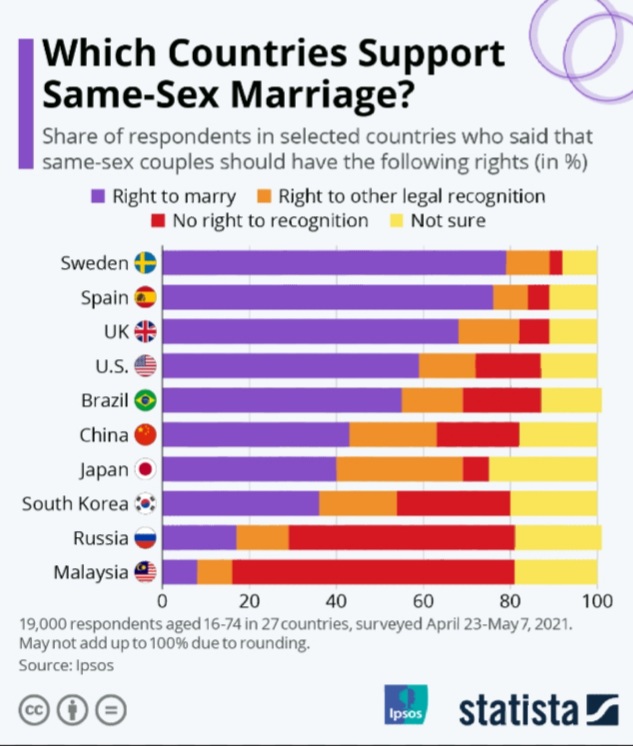
Same sex marriages are not a trend or western influence that is adapted by the society. Same sex attraction has existed from ancient times. It was not openly a d vividly talked about due to tha lack of knowledge and understandings. It is still a taboo in most of the world. With the struggle for these activities, it has now become possible for the same sex couples to be free and enjoy equal rights in some countries. It is our responsibility to educate ourselves and the world so that the same sex couples do not face discrimination.

Same sex marriages are ridiculed at most parts of the world by society. These type of marriages need to welcomed with joy, and the same sex couples must not be subjected to discrimination. Marrying anyone is basic fundamental right, thus, not allowing the same sex couples to get married is deciding them of their basic human right. We, as society, must take care that the LGBTQ+ community are not devoid of their fundamental rights and are treated with respect with everybody else.

Same sex marriages in India especially are not encouraged. There are ma y countries which have stringent laws against it yet the people are open-minded. In India, neither are the laws lenient but the people are also very narrow-minded.

Most importantly, they never give them a chance to prove themselves. Indian society does not like to change. It is not as adaptable as western countries. India still needs time to be okay with the concept of same sex marriage.

However, not knowing about the concept is a different thing and completely opposing is different. Not only in India, but in other countries, people do not support same sex marriage because they think it is against their religion.

Thus, this creates a lot of problems for them. People do not want the LGBTQ+ community to get the right to marry their lovers. This takes away their very basic human rights. The LGBTQ+ community has fought for a long time for their rights. We must not be against of any form of love, be it same sex marriage or anything else.

In India, same sex marriages are yet to be legalised. On 6th September 2018, the Supreme Court of India discrimalised gay sex marking a historic judgement in the Indian judiciary. The court also defined love to be without boundaries. This historic judgement is a result of prolonged protests and sufferings. It was welcomed and celebrated by the country with joy.

Section 377

Section 377 of Indian penal code criminalizes homosexuality and says whoever voluntarily has carnal intercourse against the order of nation with any man; woman or animal shall be punished with imprisonment for life. However, the Supreme Court on 6 September, 2018, decriminalized the section 377 of IPC. The sc said that it is natural and people have no control over it. Being homosexual is not a disease but people in India still don’t accept. Before moving further we need to know what homosexuality is.

It is basically same sex attraction and attraction can physical, emotional or psychological of the same sex.LGBT means lesbian, gay, bisexual, transgender. The LGBT community is harassed now also they still are not respected in our society even after law has accepted. Their human rights are violated. These people suffer a lot they even can’t approach to police station if there is any case of sexual assault and rape on them. HIV AIDS are mostly found in same sex but they are neither provided with proper heath facilities nor aware about these diseases transmission. There are separate schools for them that are discriminatory. They are prevented from seeking legal protection from violence just because they are attracted to same sex people. A culture of silence in society is created about homosexuality that results to their denial and rejection at home as well as discrimination in workplaces and public places. They are people like us so why to treat them like this. They are called by different names like chakka, hijra and many others. They too have the same right to live in society with all dignity and respect. We all must respect them as they faced a lot in this society.

‘Made in Heaven’ one of the popular series that indicate to very serious problem LGBT where a person can’t even open to his family about his homosexuality. After knowing the truth his mother tortures her son and their landlords file a case against him. Even a married person can’t stand up for himself. It is our society who makes people so weak that they couldn’t speak up for themselves. We all should encourage such people instead of making their jokes and calling with different names and treating them with discrimination. Our law has decriminalized this section 377 but society didn’t accept this. We must give time to each other for this acceptance.

Current developments in section 377

1.       To decriminalize sexual intercourse in private between consenting adults

2.       The age of consent should be 18 or above

3.       The phrase ‘against the order of nature’ should be removed because it is not against nature, it is a natural process.

One has to understand that fight cannot be achieved only through legal amendments but you should ask yourself if you are able to accept this orientation in which one female is attracted to another female or vice versa. So it should be accompanied by awareness campaigns to educate parents, children. To adopt a healthy and supportive attitude towards homosexuals and to have broader approach to gay lifestyle or lesbian lifestyle or any other lifestyle should be considered normal.