
India vs China, Economic Differences Yet India Liveable

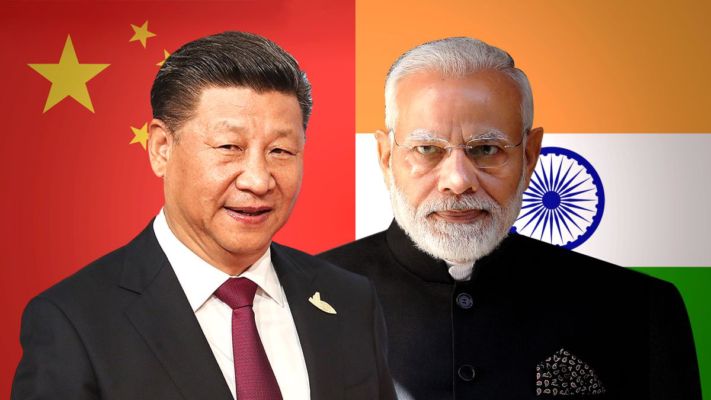
The President of China (Left) and The Prime Minister of India (Right)

China and India are the two fastest growing Asian economies. Respective governments have left no stones unturned to project the two nations as ideal investment destination on global platform, inviting industrialists with the lure of a business-friendly atmosphere. The two countries have always been at loggerheads for political reasons, making their bilateral relationship really rocky. The leaders at the helm of power of these two neighbours are known for their reformative approach and the similarities between Indian Prime Minister Narendra Modi and Chinese President XI Jinping are conspicuous. Both of them are known to rub shoulders with ten-figure friends to draw investments. While China has wowed the world with its bullet trains, India is pacing ahead in its space mission, launching valuable communication satellites.

Here’s a list of four fronts in which India is ahead of China in terms of growth:

India Being one of the Greatest Economy Balancer

An important metric where India beats China is financial market development. India ranks 38, while China ranks 56. Though the two nations introduced separate sets of reforms at different points of time, China started moving towards the pro-market economy in 1978 and India did the same in 1991. But India is 15 years ahead of China with regard to reforms in economic and financial markets. Experts are of the opinion that India has performed better than China in the financial sector. Indian bond market is known as one of the most liquid in Asia, which is well regulated by the RBI and is fully electronic. India is known as one of the best countries in the world in the way the financial sector is managed. As far as equity markets are concerned, reporting standards in India maintain global standards.

Tight Competition Among India and China in Space Technology

Though China is doing really good in space missions, India is not much behind with its successive launching of communication satellites. Recently, India has sent its heaviest communication satellite with its own GSLV MK III. India reportedly aims to win a bigger share of the $300-billion global space industry. It has successfully launched record 104 satellites, earning praise even from its northern neighbour. China started its space missions in the late 1950s while India entered the space in 1962 and is racing fast.

India being a Top Pharmaceutical Manufacturer and Exporter

India regards pharmaceutical production and exports as one of its biggest strengths. It has consistently beaten China in exports of pharmaceutical products to Latin America in the past five years. In 2016, India exported products worth $651 million to Latin America, as compared to China’s $404 million-worth exports, stated the IBEF report. Fortunately, India has never suffered regulation bottlenecks in the sector, ensuring the ease of doing business for Indian manufacturers and vendors.

What makes our country’s growth in this sector more interesting is the fact that it imports the bulk of its raw materials from China. This sector is not really the focus area of Beijing. A study by Assocham forecasted in june 2016 that India’s pharma exports could reach $20 billion by 2020. It has already crossed this mark and in fact the impact of covid-19 in 2020 has led to major medicinal demands from India than any time before. Demands of hydroxychloroquine from India have surged to a point where many countries like US, Australia, UK & other European countries are all lined up for getting these and many other medical drugs.
Saying No To China, Could It Be A Tough Road For India?

What happened at Galwan valley of Indian Ladakh had raised tensions between India and China to all time high. The clash between Indian and Chinese forces led to nationwide outburst against China.

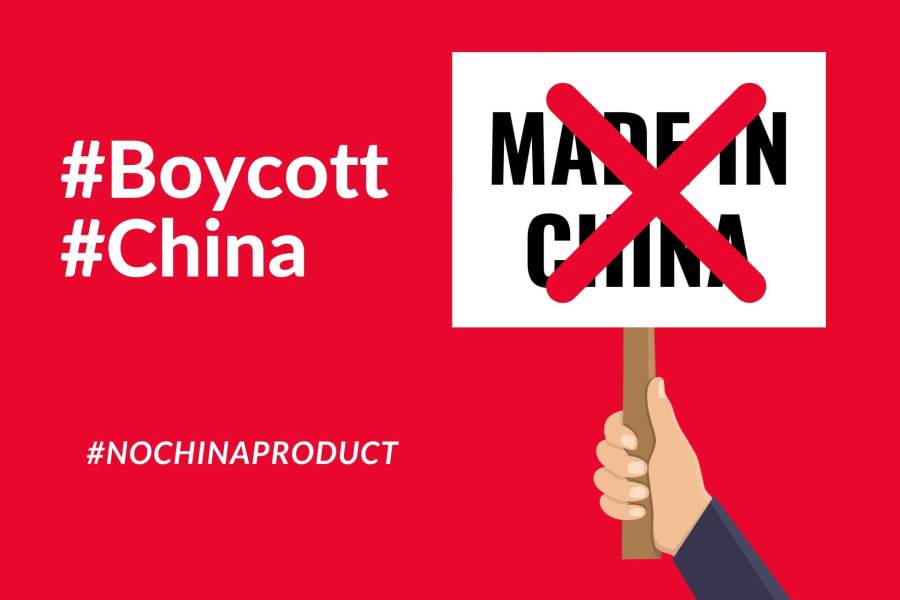
Fuelling this, there had been a sudden disagreement for buying any Chinese product or services. This is to make sure that Chinese economy doesn’t receive a single penny from India and its citizens, making it obvious after China bearing malice towards its neighbours, specifically India. The initiative has greatly boosted with GOI’s (Government of India) decision of banning 59 Chinese applications in India and by increasing the import taxes on Chinese goods or services. The Indian armed forces had already been deployed at disputed regions of border and are ready for any surprise from counter side.

With Governments and Armed forces holding tight on attempts to self-reliant India, the dice of responsibility falls our side too. By us I mean, all the common or less common citizens of India whose decision of just boycotting Chinese products could shatter its trade. Already many huge economies of the world have turned against China, amid Corona virus outbreak and deaths of 600,000 (still rising) innocent people.

Boycotting Chinese items won’t be that easy as it sounds, one has to spend a little more of their money while switching to non-chinese brands, as the only PSP (product selling protocol) of Chinese products is its cheap pricing. This pricing gets balanced with its poor quality and doesn’t last any longer. Yet, Chinese products have kept its dominance in certain sectors of Indian market.

The mobile phone sector

India had imported mobile phones worth $11.3 billion from China in 2016-17, and that was about 68 per cent of all mobile phones (both push-button feature phones and smart devices) imports into the nation that year. In 2017-18, even as the duties were imposed, the value of mobile phone imports from China climbed to $15.6 billion, or 71 per cent of the mobile phones imported. As the tax measure began to hurt and local manufacturing of mobile phones gathered momentum, imports of these devices from China halved to $7.4 billion and about 41 per cent of all mobile phone imports in 2018-19. Imports of phones, by value, from China declined further in 2019-20 but not the share, which remains at 40 per cent. If we just speak of alternatives, we have few options of some Korean, Taiwanese, American and just few Indian tech companies. These options are:

  • LG
  • Samsung
  • Nokia
  • Apple
  • Asus

The drop in electronic imports gradually implemented by the GOI in recent years but this won’t be enough and buyers need to push their expenses to continue supporting the campaign of #boycottchina.

Other imports from China include toys, gift items, fabrics and garments, and thousands of small value items that are popular with consumers. CAIT (Confederation of All India Traders) estimates that there are some 3,000 items that can be easily substituted with India-made products in the first phase of the boycott of Chinese goods campaign. The list of China-made items popular with consumers includes fairy lights with tiny LED bulbs that are used to decorate homes during festivals, idols of deities, home decors, kite strings and even incense sticks (agarbattis). It is estimated that about 80 per cent of the incense sticks sold in India are imported from China.

For all of it to happen, for this campaign to succeed we all should hold our horses and should maintain an adequate transition of market into indigenous domain. This would be the only secure and once for all time solution to problems India facing with the dragon as war could never be a solution. It would just tear up economies at both ends and loss of Brave Indian soldiers shouldn’t happen any further.