
PUBG MOBILE APP BANNED BY GOVERNMENT

PUBG MOBILE, a wildly popular online multiplayer shooting game, is among 118 Chinese apps blocked by the government Wednesday amid tension over fresh Chinese provocation in Ladakh. Ministry of Electronics and Information Technology (MeitY) has banned 118 more Chinese apps including one of the most popular mobile games PUBG Mobile. The official press release stated that all of these apps have been “banned under section 69A of the Information Technology Act”. The government said that it has “decided to block 118 mobile apps since in view of the information available they are engaged in activities which is prejudicial to sovereignty and integrity of India, defence of India, security of the state and public order.”

The apps have been banned in the country on Wednesday. The apps are still available on the Google Play store and Apple App store. It takes some time for such orders to get enforced and hence both PUBG Mobile and PUBG Mobile Lite are still available on the app stores. Users can still be able to download the game before it’s gone from the app store. If PUBG MOBILE does not turn off server access to the region, users will still be able to play the game on their smartphone.

In a measure of PUBG’s huge popularity in India, Prime Minister Narendra Modi, during an event on exam stress last year, had remarked to a mother complaining about her teen: “Yeh PUBG-wala hai kya (Is he a PUBG player?)”. 

In June, the government banned 59 mobile apps including Bytedance’s TikTok, Alibaba’s UC Browser and Tencent’s WeChat, also citing security concerns.After the PUBG Mobile ban, many people are worried about their money, which they had invested in the game for buying skins, Royale Pass and more. PUBG Mobile has not provided any statement regarding this. But, most possibly players will have to raise a dispute regarding this on the respective app stores to get their money back.

GDP: Why India’s growth rate is shrinking rapidly?

India’s economy posted the biggest contraction among major economies last quarter, with a recent surge in coronavirus infections weighing on the outlook for any recovery.

Gross domestic product shrank 23.9% in the three months to June from a year earlier, the Statistics Ministry said in a report Monday. That’s the sharpest decline since the nation started publishing quarterly figures in 1996, and was worse than any of the world’s biggest economies tracked by Bloomberg. The median estimate in a survey of economists was for an 18% contraction.

Once the world’s fastest-growing major economy, India is now on track for its first full-year contraction in more than four decades. While there are early signs that activity began picking up this quarter as lockdown restrictions were eased, the recovery is uncertain as India is quickly becoming the global epicenter for virus infections.

Economists had anticipated the economy shrinking anywhere between 15-25% while an ET Now Poll projected Q1FY21 GDP at -19% YoY.

As largely expected, agriculture was the only silver lining among all sectors as it grew by 3.4% in the April-June quarter.  

Manufacturing, construction and trade (hotels, transport, communication & services related to broadcasting) shrank by 39.3%, 50.3% and 47% during the quarter. Interestingly, governmetn expenditure during the quarter also contracted by 10.3% as per NSO figures.   

Let us find the reasons in this article that what are the reasons behind the decline in the Indian GDP

1. Sharp decline in overall demand:

Increment in the employment opportunities leads to further demand of the other products in the economy. Since last few months Indian economy is facing the problem of lower demand which ultimately trapped the whole economy.

2. Sharp fall in consumption

Consumption has accounted for 55-58% of GDP. Remember consumption is at the core of domestic demand in India. Indian economy experienced a sharp decline in private final consumption expenditure from 7.2% in the March quarter to 3.1% in the June.

3. Decline in investment

The value of declared investments in the same quarter is Rs 71,337 crore, which is also the lowest since September 2004. This is a big indication that industries are not yet confident in India’s economic future.

4. Poor condition of banking sector

The recent announcement of the mergers of the banks may further create the atmosphere of anarchy in the mind of the investors and depositors.

India’s New Education Policy of 2020

India’s union Cabinet on Wednesday approved the National Education Policy 2020, engraving a way for transforming reforms in school and higher education sector in the country. Union cabinet also renamed the HRD Ministry as Education Ministry. Making the announcement, Union Ministers Prakash Javadekar and Ramesh Pokhriyal Nishank said there would be a single regulator for all higher education institutions and MPhil would be discontinued.

“I congratulate Government of India for giving the country an education policy that will nurture a child’s creative and unique abilities rather than only judging them on their exam scores”, said famous film actor Anil Kapoor in reaction to new education policy.

The National Education Policy was framed in 1986 and modified in 1992. More than three decades have passed since previous Policy. During this period significant changes have taken place in our country, society economy, and the world at large. It is in this context that the education sector needs to gear itself towards the demands of the 21st Century and the needs of the people and the country. Quality, innovation and research will be the pillars on which India will become a knowledge super power. Clearly, a new Education Policy is needed.

The Government had initiated the process of formulating a New Education Policy through the consultation process for an inclusive, participatory and holistic approach, which takes into consideration expert opinions, field experiences, empirical research, stakeholder feedback, as well as lessons learned from best practices.

The Committee for preparation of the draft National Education Policy submitted its report to the Ministry on 31.05.2019. The Draft National Education Policy 2019 (DNEP 2019) was uploaded on MHRD’s website and also at MyGov Innovate portal eliciting views/suggestions/comments of stakeholders, including public. The draft NEP is based on the foundational pillars access, affordability, equity, quality and accountability.

Post submission of Draft Report States/UTs Governments and Government of India Ministries were invited to give their views and comments on Draft National Education Policy 2019. A brief summary of the Draft National Education Policy 2019 was circulated among various stakeholders, which was also translated in 22 languages and uploaded on the Ministry’s website. Meetings with State Education Secretaries of School Education and with State Secretaries of Higher & Technical Education were held.An Education Dialogue with Hon’ble MPs of Andhra Pradesh, Telangana, Tamil Nadu, Puducherry, Kerala, Karnataka and Odisha.

A special meeting of CABE on National Education Policy was held. In the meeting, 26 Education Ministers of various States and UTs, representatives of States and Union Territories, Members of CABE, Heads of Autonomous Organisations, Vice Chancellors of Universities, attended the meeting along with senior officials of the Central and State Governments. Around 2 lakh suggestions on the Draft National Education Policy received from various stakeholders. A meeting on Draft NEP 2019 of Parliamentary Standing Committee on Human Resource Development was held on 07.11.2019.

Indian Government also said that “Efforts will be made to incentivize the merit of students belonging to SC, ST, OBC, and other SEDGs. The National Scholarship Portal will be expanded to support, foster, and track the progress of students receiving scholarships. Private HEIs (Higher Education Institutes) will be encouraged to offer larger numbers of free ships and scholarships to their students.”

A development in the Indian education system and policies were need of the time, demand of the 21st century. It took almost 34 years for India to make changes into its schooling, Higher Education processes.

India’s Booming Population, Boon or Bane?

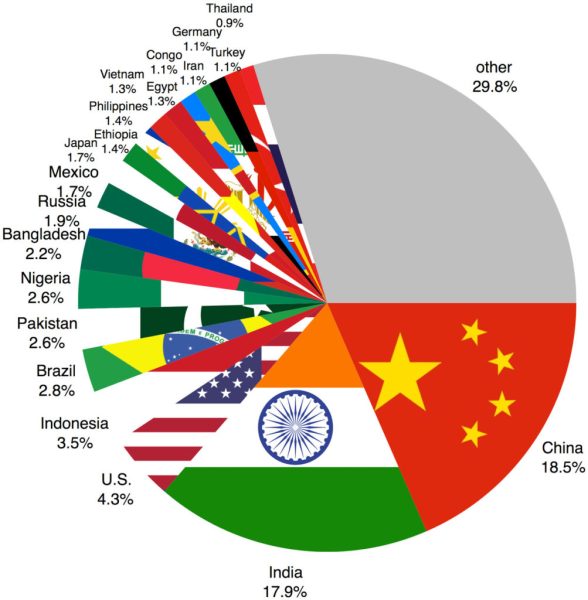
A pie chart showing major countries and their population percentage with the world

India with a population count of almost 1.35 Billion stands second in the entire planet after China. There are certain nations with similar ‘people per sq. Km’ ratios, one such example is of Japan and it has done remarkably great in terms of its wonderfully boosted economy. Can India do the same? Well, so far it has come up good with rising potential. The only question arises, could it come up to those expectations, because a lot has to done if India seeks to turn its massive population into its favour. If India looks to change its economy towards higher standards alike Japan, Indian citizens need to follow those strict discipline like the Japanese. More indigenous business setups has to be established to make India self-reliant and for this its humongous population with majority of youth (60 Cr. Plus) has to work much more seriously. A combined effort of its huge population would do wonders for India, it’s just that India needs to realise this before it’s too late to recover.

The main impact the growing population has is on the economic growth as a modest increase in national income under economic development is being eaten up by the increase in population. As a result, the per capita income of the country does not grow which in turn results in a poor standard of living. So, the overall development of the country and rise in per capita income are directly linked to population.

There is a similar scare mongering about too high a population density of Indian cities. According to them, cities are better with a lesser number of people so that they have less crowded roads, large expansive houses and lesser number of riders on commuter trains. But aren’t the advocates of sparsely populated cities arguing against their own economic well-being. Cities are vast and teeming with people not because city-dwellers like it that way but because economy and business demands it.

The rate of population growth depends on the difference between the birth rate and the death rate. Thus, the population growth experienced in India can largely be explained by variations in birth and death rates.

In 1900, India’s population count was roughly 24 Cr. In 1950-51, India’s population was 36 Cr. In 2001 it jumped to 100 Cr. This population begun soaring in the 1950s and saw the highest decadal growth of 24.8 per cent in the 1960s and 24.7 per cent in the 1970s. Since the 1980s, decadal growth has been falling and the 1990s saw a significant fall. In fact, India’s total fertility rate – a measure of the number of children born to a woman during her lifetime – was down from 5.9 in 1951 to 2.3 in 2011. The fertility rate due to the population policies and other measures has been falling but even then it is much higher compared to other countries. This means that the birth rate has been falling, but with rapid progress in medical sciences, the death rate has fallen which has ensured that the population grows.

Other reasons that have contributed to high birth rates are early marriages, lack of awareness, poverty and illiteracy, and illegal migration.

A recent report by the UN predicts that India’s population could surpass that of China by around 2024. And this is despite the fact that the country has one of the oldest family planning programmes in the world, dating back to 1951.

In the year 2017, the government of India launched Mission Parivar Vikas as a part of its national family planning initiative. It marks the first attempt at the government level to deal with family planning as a social issue rather than just a health issue, to be dealt with at a health centre. The initiative incorporates a component called ‘Saas Bahu Sammelans’ aimed at improving communication between mothers-in-law and daughters-in-law. It would not be right to say that the programs initiated by the government to rein in population growth have not been successful. A fertility rate of about 2.1 is a benchmark figure for ensuring a broadly stable population.

The growth should be stabilised by raising awareness among all the citizens on India, specifically in the rural regions of India because this isn’t just the government’s task from planning committee. This concerns each individual of India and to the world as well. Where we have reached so far could not be undone, this is obvious but what we could definitely do is make good use of it. Let’s engage, educate and expand the minds of Indians, specifically the Youth.