
Fracking

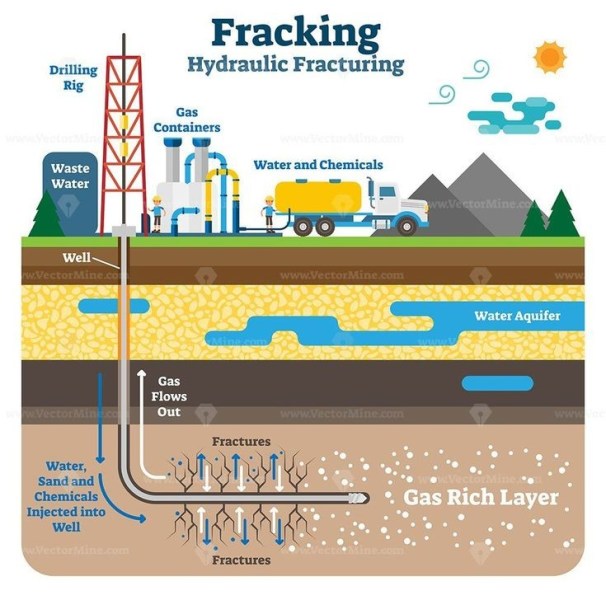
Fracking is short for “hydraulic fracturing”, which is the process of creating fractures in rocks and rock formations by injecting specialized fluid into cracks to force them to open further. The larger fissures allow more oil and gas to flow out of the formations and into the wellbore. It is easier to extract oil and gas there.Fracking has resulted in many oil and gas wells attaining a state of economic viability due to the level of extraction that can be reached. It has also allowed drilling firms access to previously difficult-to-reach sources of oil and gas.Fracking is an extraction technique for oil and gas wells in which rocks are fractured artificially using pressurized liquid. The process involves drilling down into the earth and injecting a highly pressurized mixture of water, sand, and thickening agent, also called “fracking fluid,” into a wellbore to create cracks in rock formations. Once the hydraulic pressure is removed from the well, the remnants of the fracking fluid hold the fractures open, making it easy to extract the oil and gas inside. Fractures can also exist naturally in formations, and both natural and human-made fractures can be widened by fracking. As a result, it is possible to extract more oil and gas from a given area of land.
Fracking increases the rate at which water, petroleum, or natural gas can be recovered from subterranean wells. It has also allowed the extraction of unconventional oil and gas resources from low permeability sites where traditional extraction technologies fail. Fracking as a method for oil and gas extraction is also more economically viable than conventional or horizontal drilling. In the United States, domestic oil production has grown significantly with the introduction of fracking. The process has driven down gas prices and offered gas security to both the United States and Canada for about 100 years.

Most of the opposition to fracking revolves around its potential negative impact on the environment. Fracking typically produces methane emissions, which reduce air quality. Furthermore, methane gas contributes significantly to global warming.Fracking requires forcing large volumes of water and chemicals into the ground, which can seep and contaminate local soil and water resources. Moreover, due to the high pressures involved, fracking is also associated with increased seismic activity. It also releases large quantities of methane gad and other air pollutants that can cause health problems and contribute to climate change.Fracking has allowed for the cost-effective extraction of harder-to-reach deposits of oil and gas, which has increased the supply of available fossil fuels. In general, greater supply leads to lower prices; however, several other factors also impact the price of oil and gas.
Mahabharata: A Myth or Reality

Some stories are at the heart of Indian history.  The mythological stories of Mahabharata are one of these.  This epic of Maharishi Ved Vyasa was written by Lord Shri Ganesh.

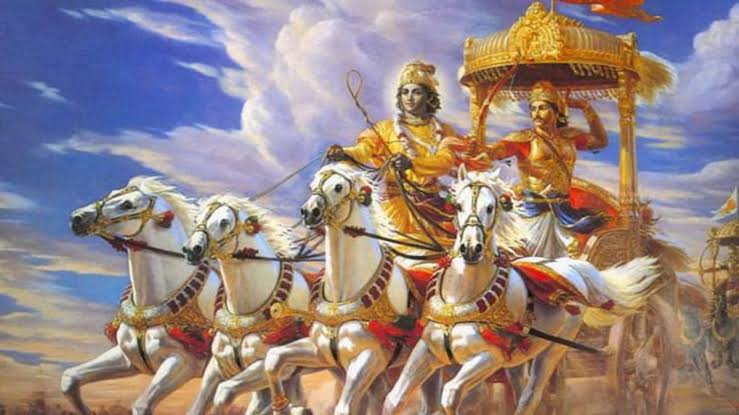
 The characters in these amazing stories of the epic have many amazing powers.  Even Narayana himself, through his wisdom, diplomacy and deceit, had led the right Pandavas to victory in this great war of Mahabharata.

Mahabharata war has a great aspect of the number 18.  There are 18 chapters in this epic.  Lord Krishna gave the knowledge of Gita to Arjuna for a total of 18 days.  The Mahabharata war lasted for 18 days.  The Gita also has 18 chapters. Army of  the Kauravas and the Pandavas  had a total number of 18 Akshohini army of which 11 belongs to Kauravas and 7 to Pandavas were Akshohini army. The main initiators of this war was also 18. Also only a number of 18 warriors survived in this war.

 Some such skeletons were found in Mohenjo daro which had the effect of radiation. In Mahabharata, the results of Brahmastra were given from the chapter number 13 to 15 of the Saptik festival.  Historians believe that the Brahmastra left 5561 BC was the atomic bomb.

 There were no zodiac signs during Mahabharata.  Astrology at that time was totally based on 27 constellations, not on 12 zodiac signs.  In the constellations,not Ashwini but Rohini was the first place.  Various civilizations experimented in astrology and created zodiac signs based on the moon and the sun and began to predict the future of the people, while in the Vedas and the Mahabharata there is no mention of such learning to show that the planetary constellation would make a person’s life  They affect.

The Mahabharata is written by Ved Vyasa.  Actually, Ved Vyas was not a name, but a title, which was given to people with knowledge of Vedas. There were a number of 27 Ved Vyas before Krishnadvapayana and he was himself the 28 Ved Vyas.  He was named Krishnadvapayan because he was born as a dynasty and was born on an island.

 Ghatotkacha, son of Bhima and Nagakanya Ahilavati had a son named ‘Barbarika’.  At some places, it is also said that he was born from the stomach of Murmant’s daughter ‘Kamakantakata’.  When the war of Mahabharata was decided, Barbarik also expressed his desire to join the war and promised his mother to support the loser.  Barbarik rode his blue horse with three arrows and a bow to the battlefield of Kurukshetra.

 Three arrows were enough for Barbarik, on whose strength he could destroy the entire army of Kauravas and Pandavas.  Knowing this, Lord Krishna appeared in front of him in the form of a Brahmin and asked him to trick Barbareek into charity.

 Barbarik prayed to Krishna that he wanted to see war till the end, then Krishna accepted his statement.  He donated his head to the Dwadashi of Falgun Mas.  Lord Krishna watered that head with nectar and placed it on a hill near the battlefield, from where Barbarik could see the entire Mahabharata war.