
History of Kashmir


The large Indian subcontinent was very different from what it is today. From colonial rule to gaining independence and consolidation of states, India had to go through many challenges and changes. One major change which broke not only the country but also millions of hearts was the Partition.

During the British rule, India was divided into provinces, areas of the country which were directly under the administration of the British, and Princely states, territories which were ruled by kings or princes who accepted the supremacy of the British and agreed to rule according to them.

Jammu and Kashmir was a princely state during the colonial rule. This area of 2,22,441 square kilometres is now Jammu and Kashmir and Ladakh (parts of India), Azad Jammu and Kashmir and Gilgit-Baltistan (under the control of Pakistan), and Xinjiang and Tibet (administered by China). 

Religious History 

Jammu and Kashmir is rich in terms of its religious history. It is associated with Buddhism, Shaivism (now a part of Hinduism) and Islam, three of the majorly followed religions in the world. At first, Hinduism was popularly followed in this area. However, when Ashoka assumed the throne of this kingdom, Buddhism was introduced here. Under his reign, grand stupas as well as temples dedicated to Lord Shiva were built, which shows harmonious existence of the two religions. It was through Kashmiri Buddhist missionaries that Buddhism became widely followed in Tibet and known in China. The corruption, heavy taxation and constant fighting under the Lohara dynasty gave way to foreign invasions. A Tibetan Buddhist took the throne from a Turkish-Mongol chief and, due to political reasons, converted into Islam.

Eventually, Islam replaced Hinduism as the dominant religion in Kashmir. Rulers of Jammu and Kashmir treated all of their subjects equally, irrespective of the religion they followed, with the exception of a few who imposed taxes on the non-Muslims and favoured the ones who followed Islam. 

After Mughal rule in Kashmir, Sikhs took over. Initially, their rule was oppressive and they introduced many anti-Muslim measures but later, the Sikh rulers became more considerate towards farmers. The status of Muslim subjects did not change. 

Today, it is a home of multiple religions with Buddhism, Islam, Sikhism and Hinduism still dominating the area. 

British Raj and Independence 

The Sikh ruler of Jammu and Kashmir, Gulab Singh, won the trust of British and sided with them. The loyalty of the Sikhs proved favourable for the British, especially during the revolt of 1857. However, the Princely state never became a true state because its residents did not connect with each other or the rulers. When the colonial rule ended, the British left the decision of whether the Princely States should unite with India or Pakistan, or become independent states with the rulers of these states. This threatened the existence of the already-partitioned country. 

Maharaja Hari Singh, the monarch of J&K at the time, was yet to make a decision regarding accession of Jammu and Kashmir. When invaded by Pakistan, J&K needed the help of the Indian army to defend themselves. The Maharaja had to sign the Instrument of Accession to get assistance from India with special conditions. These conditions were translated into Article 370 which gave special status to the state. 

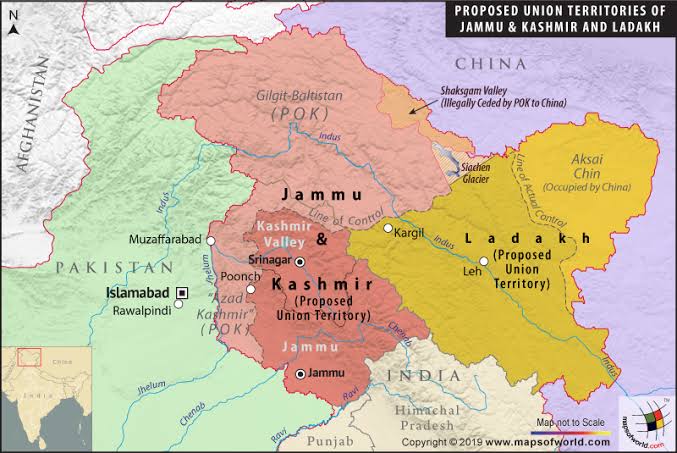
However, Article 370 was removed from the Indian Constitution in 2019. Further, the state has been divided into Jammu & Kashmir and Ladakh which are now recognised as union territories. 
Issues over Article 370

What is Article 370 ?

  1. Article 370 was drafted under Part XXI (Part 21) which deals with “Temporary, Transitional and Special provisions
  2. Article 370 under the Constitution of India gives special status to the state of Jammu & Kashmir.
  3. The article came into effect in 1949.
  4. All the provisions of the Constitution which apply to other states do not apply to J&K until and unless the state legislative assembly separately passes such provision.
  5. Except for defence, foreign affairs, finance, and communications, Parliament needs the state government’s concurrence for applying all other laws. 
  6. The residents of the state of Jammu & Kashmir live under a separate set of laws including those related to :
    • Citizenship
    • Ownership of property
    • Fundamental rights
  7. The Directive Principle of State Policy and Fundamental Duties do not apply to the state of J&K

What is Article 35A?

  1. Article 35A was inserted through the Constitution (Application to Jammu and Kashmir) Order, 1954.
  2. President Rajendra Prasad issued it under Article 370
  3. No outsider can own a property in J&K 
  4. No outsider can get a state job in J&K

It would be good to understand the background of Article 370 of the Indian constitution which gave special status to Jammu & Kashmir. Article 370 was temporary, transitional with special provisions. Whereas Article 35A was meant for residents of Jammu & Kashmir with a separate set of laws including those of citizenship and fundamental rights and ownership of the property in that state.

On August 5, 2019 Government of India has superseded both provisions and both clauses of Article 370 & 35A have become inoperative and now State of Jammu & Kashmir have become Union Territories and Ladakh being separate Union Territory.

Now Jammu & Kashmir can make their own rules for permanent residency, ownership of property and fundamental rights. Present Government says that they have scrapped the provisions of Article 370 so that Kashmir can be integrated with rest of India. Whereas the critics of the Government are of the view that the Kashmir issue is continuing to burn and the present Government is unnecessarily going with the issue to avoid the side effects of Economic slowdown.

On the ground people in general are abiding with the laws but opposition is not buying the points of the Government.

Hopefully in the months to come people of Jammu & Kashmir will come up for the cause of Nation and all will be settled for growth of economy.

The abrogation of Article 370 by the present-day Modi Government has divided the country. Some are for it and some against. With the Article 370 being scrapped, J&K will not enjoy any special status and the Indian constitution will be applicable to all its residents from now. Right to Information & Right to Education will be applicable and minorities in the region will l enjoy 16% reservations. Also, women from J&K can still retain their rights and citizenship even if they marry someone outside the state.  While a certain sect is happy with these implications, many consider it as a threat to human rights and the Indian Democracy.

Here are the advantages and disadvantages of repealing Article 370 and Article 35A.

Advantages of Scrapping Article 370

  • Attempts to unite Kashmir with other states of India.
  • Propagates One Nation One Constitution Slogan
  • Open doors for growth and development in the valley
  • Private investors can invest and boost the economy of the state
  • Better medical and education facilities can be provided to the residents of the Valley
  • Central government can curb corruption since it is a UT now.
  • Authorities are in a better position to curb terrorism and instill peace in the Valley

Disadvantages of Scrapping Article 370

  • Instilled insecurity in the locals as they have to give away their dual citizenship
  • Kashmiri Muslims feel it threatens the state’s unity and integrity
  • Add on to the political vulnerability and instability in the Valley
  • Hampers the delicate relationship with Pakistan. It is like a nail in the coffin
  • Implants the seeds of insecurity in certain section of citizens.
  • The implementation of the abrogation of Article 370 is a threat to the democracy. It is an attempt to polarize and appease the Hindu population in the valley.
  • Safety of Kashmiri girls is questioned. Certain Hindu fascists have threatened to marry girls of the region. This is outrightly exist.

The advantages and disadvantages can be subjective. We expect reader’s discretion.

Issues over Article 370

On 5th August 2019, the Union Home Minister of India, Shri Amit Shah announced the abrogation of Article 370 and Article 35A of the Indian Constitution which granted the state of J&K special status. The state is now divided into two union territories – Jammu & Kashmir (with a legislature) and Ladakh (with no legislature). This is a very significant step when it comes to managing ‘things’ in the valley and will have grave consequences for future generations as well. As always, there is a divided opinion.

Implications of Removal of Article 370

  1. J&K will no longer enjoy special status now
  2. The Indian Constitution laws will be 100 percent applicable to all residents of Jammu & Kashmir.
  3. Part 4 of the Indian Constitution, the Directive Principle of State Policy and Fundamental Duties will now apply to the state of J&K
  4. There will be no separate flag for J&K now
  5. Article 360 (Financial Emergency) of the Indian Constitution will now be applicable
  6. Minorities (Hindus & Sikhs) will have 16% reservation now
  7. Right to Information & Right to Education will be applicable now
  8. The duration of the legislative assembly will now be five years instead of 6
  9. Article 35A will be nullified. A woman from J&K can still retain her rights and citizenship even if she marries someone out of the J&K state
  10. The Panchayats will enjoy the same powers as in other states.

Enough has been said and written about Article 370 and its abrogation earlier in August 2019. While political and social analysts were predicting such a move, a few believed that the existing government will not be able to implement any changes. Eventually on August 5, 2019 the President of India issued the Constitution (Application to Jammu & Kashmir) Order, 2019, C.O. 272 and the special status of J & K was revoked. The state of J&K is now divided into two union territories – Jammu and Kashmir (with a legislature) and Ladakh (without a legislature).

Article 370 : Current Situation

This decision has garnered a lot of criticism by a large section of general population and the opposition. There have been mass protests organized in different cities in India in the last few months. Some have been in support of it and some opposing it. The current Modi government has been criticized at a national and global level on the way the changes were implemented. It is considered as a hazard to the human rights.

Major leaders of the popular political parties were house arrested. Internet and telephone services were revoked. Heavy troops were deployed all across the streets to curb any unrest or protests. Public movements were banned and schools and offices were shut. Such steps are considered an outright threat to the democracy. With no direct communication with the local residents of the Valley, the Government clearly denies any protests took place. However, certain media outlets have confirmed that there have been protests. Also, forceful arrests are being taken to infuse fear in the locals so that no unrest outbreak.

For almost four months Kashmir was completely cutoff with the rest of the world. Gradually schools, shops and offices have opened. The internet services still remain suspended in the Valley.

Article 370 : Government’s Take

The current Government believes to have corrected the historical blunder. It urges it was necessary to scrap Article 370 to integrate Kashmir with the rest of the country. The government aims to restore peace, curb corruption and enable growth in the Valley with this step. But only time will tell the implications of this decision.

India’s Kashmir Conflict

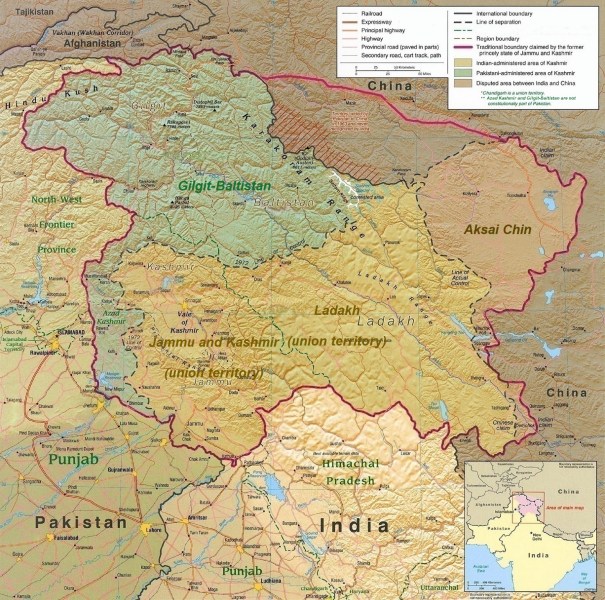
The Conflicted Map Of J&K with Ladakh

With over seven decades crossed since 1947 followed a continuous stretch of never-ending bloodsheds in the Kashmir valley or for the reason of it.  Just in past 27 years, around 41,000 lives have been lost due to this Indo-Pak dispute. The Indian army had lost many of its brave soldiers who sacrificed themselves for the safety and security of people in the valley and rest of India. With more than 950,000 soldiers deployed in Kashmir, making it world’s most strongly guarded place, shows the threat level in the valley. The current Kashmir when compared to the Maharaja Hari Singh’s Kashmir is divided into 3 major parts. Two pieces of territory are illegally occupied by the Pakistan (30%) and China (15%). The regions under Pakistan are Gilgilt, Baltistan and the Pakistan occupied Kashmir (POK) and the region under China is Aksai-Chin which is vastly inhabited by humanity.

The Indian controlled Kashmir (55%) owns 60 per cent of the population of Kashmir in total. The Jammu and Kashmir initially under the Sikh Empire of Maharaja Ranjit Singh, saw a shift in powers with arrival of east India company and british. The empire then switched into the Dogra Empire which was overtaken by Maharaja Gulab Singh and this continued until the independence of India in the year 1947. It was this time, when the britishers before leaving Indian territory kept an opportunity for all the 565 princely states of Indian peninsula to either join an Islamic state named Pakistan or a democratic republic of India. This stretched the long run tensions between the communities of muslims (in favour of an Islamic state) and the rest of people into a massacre of centuries. A bloodshed that no one in the world saw before, it is estimated that up to one million people were killed during the violence in 1947, and around 50,000 women were abducted. Some 12 million people were displaced from their homes in the divided province of Punjab alone, and up to 20 million in the subcontinent as a whole. Few princely states opt to merge with Islamic state of Pakistan and majority of them joined the republic of India. Kashmir on the other side chose to remain an independent state under Maharaja Hari Singh. He decided to stay independent because he expected that the State’s Muslims would be unhappy with accession to India, and the Hindus and Sikhs would become vulnerable if he joined Pakistan. On 11 August 1947, the Maharaja dismissed his prime minister Ram Chandra Kak, who had advocated independence. Observers and scholars interpret this action as a tilt towards accession to India. Pakistanis decided to pre-empt this possibility by wresting Kashmir by force if necessary. Pakistan made various efforts to persuade the Maharaja of Kashmir to join Pakistan. In July 1947, Mohammad Ali Jinnah is believed to have written to the Maharaja promising “every sort of favourable treatment,” followed by the lobbying of the State’s Prime Minister by leaders of Jinnah’s Muslim League party. Faced with the Maharaja’s indecision on accession, the Muslim League agents clandestinely worked in Poonch (west territory of Kashmir) to encourage the local Muslims to an armed revolt, exploiting an internal unrest regarding economic grievances. The authorities in Pakistani Punjab waged a ‘private war’ by obstructing supplies of fuel and essential commodities to the State. Later in September, Muslim League officials in the Northwest Frontier Province, including the Chief Minister Abdul Qayyum Khan, assisted and possibly organized a large-scale invasion of Kashmir by Pathan tribesmen. Several sources indicate that the plans were finalised on 12 September by the Prime Minister Liaquat Ali Khan, based on proposals prepared by Colonel Akbar Khan and Sardar Shaukat Hayat Khan. One plan called for organising an armed insurgency in the western districts of the state and the other for organising a Pushtoon tribal invasion. Both were set in motion.

With Pakistan’s tribesmen invasion, the Kashmir was set on fire, loot, and atrocities to Kashmiris by the Pathan’s were so grieve that it could be hardly penned down. The pathan’s did whatever they could to terrorize Kashmiri’s, they abducted, raped and murdered thousands of girls and women of all ages. This was being done to scare Kashmir and its ruler for their indecision for accession into Islamic state of Pakistan. The Pakistan’s muslim league and its military knew this for sure, that newly formed independent nation of Jammu & Kashmir is heavily outnumbered with its line of defence and weapons. The Maharaja made an urgent plea to Delhi for military assistance. Upon the Governor General Lord Mountbatten’s insistence, India required the Maharaja to accede before it could send troops. Accordingly, the Maharaja signed an instrument of accession on 26 October 1947, which was accepted by the Governor General the next day.

While the Government of India accepted the accession, it added the proviso that it would be submitted to a “reference to the people” after the state is cleared of the invaders, since “only the people, not the Maharaja, could decide where Kashmiris wanted to live.”; it was a provisional accession. The largest political party, National Conference, headed by Sheikh Abdullah, endorsed the accession. In the words of the National Conference leader Syed Mir Qasim, India had the “legal” as well as “moral” justification to send in the army through the Maharaja’s accession and the people’s support of it. The Indian troops, which were airlifted in the early hours of 27 October, secured the Srinagar airport. The visiting journalist at Srinagar city witnessed an incredible sight where volunteers of National Conference (Local political party of Kashmir) was patrolling the city from tribal Pakistani invaders and Minority Hindus, Sikhs were moving freely among Kashmiri Muslims. This was a true example of community harmony in Kashmir.

After securing Sri Nagar, the Indian army troops were set to retrieve other portions of Kashmir, captured by the Pakistani tribesmen and military. Yet, in the meantime the then prime minister of India, Mr J. L. Nehru made an announcement over all India radio, that India would seek United Nation’s (UN) mediation into this matter. This was greatly opposed by the then home minister of India, Sardar Vallabhbhai Patel. Later, with intervention of United Nations group under Sir Owen Dixon (UN mediator) who came up with a plan of seizing the military conflict by mapping a stamp on territories already under control. This led regions already secured by the two countries under their jurisdictions and UN formed a Line of Control between the western and Eastern parts of Kashmir. To this day, India claims the entire region of Kashmir as per the legal instrument of accession signed by the Maharaja of Kashmir, making the whole of Kashmir an integral part of Republic Of India.

Later in the year of 1962, another war broke but this time it was between India and China. The war zone was the regions of Ladakh province to the east of Kashmir. After this Indo-China war of ’62, China captured another part of Maharaja Hari singh territory, the Aksai-Chin. India to this date demands both of its territories and had raised its voice into United Nations Security Council from time to time in the recent past. Whatever is good for Kashmir and safe for Kashmiri dreams should be implemented, to make sure that no more innocent lives are lost, no more brave soldiers are sacrificed for the love of their motherland.

COVID19: CAN SURGICAL MASKS OR RESPIRATORS PREVENT CORONA VIRUS?

COVID19:
 CAN SURGICAL MASKS OR RESPIRATORS PREVENT CORONA VIRUS ?

The world is suffering from the deadly infection of Coronavirus. The World Health Organization (WHO) has declared the infection as ‘pandemic’. The early symptoms of this deadly infection are high fever, shortness of breath, tiredness and dry cough. So, the entire world is under lockdown to break the chain of COVID-19 with certain precautionary steps is to be ensured. The contemporary ways to sanitize oneself is the 20 seconds formulae of hand wash or using disinfectant containing at least 60% alcohol, avoid touching surfaces and handshakes and no unnecessary contacts. The use of mask and covering face using napkin or elbow while coughing and disposing the napkin would add an added advantage.
We all know that sanitizer containing good quality alcohol can kill most of the germs, bacteria and viruses including fatal Coronavirus . In a research, it was found that the Coronavirus can survive for 3 days (72 hours approx.) on surfaces like steel or plastic.
Now , the question arises whether any face masks or covering mouth with any cloth helps to prevent Coronavirus from invading our body ?
Firstly, I want to let you know that no mask can provide 100% safety from Corona Virus. There are different types of masks available in market and most common of them are Surgical masks and Respirators.
They act as a barrier to prevent the foreign body from entering our body, but the main difference between them is that Surgical masks are used only to prevent dust particles or large particle droplets that enter through our nose or mouth while Respirators can prevent vapours, airborne microorganisms, fumes or particulate matter that enter through nose or mouth . But as we know that the virus can enter our body through eyes so the person wearing a spectacles or googles can help prevent Covid19 to enter body to some extent . As spectacles or googles are left open from its sides so virus can reach our eyes easily. Hence, it is advised to stay at home and take precautionary steps while stepping out of home. The frontline workers including police, media persons, essential service and sweepers wear face shield along with N95 masks to safeguard themselves.
Surgical masks are mostly used by people who are not into any essential services as these are not designed to protect the wearer from breathing in airborne bacteria or viruses. Coronavirus is smaller than the PM 2.5 cutoff but bigger than some regular dust particles and gases. These masks can be used by a person with weak immune system or suffering from chronic health diseases. Persons dealing with severe respiratory or breathing issues are more prone to get infected from coronavirus, hence it is advisable for the infected person to use face mask as well in order to protect others from getting infected. The use of masks is also recommended to healthy person from getting infected. Surgical masks are of three types-: 2-layered surgical mask , 3-layered surgical mask and 6-layered surgical mask
The protection also depends on the number of layer, more number of layers contribute more protection. A 3-layered mask is better than 2-layered masks, the cost of 3-layered mask is also higher than 2-layered mask. While the 6-layered masks are best till now as it can protect us from some of the viruses but cannot protect from SARS CoV-2 to enter the body This type of mask is loose-fitting and virus can easily enter through the opening sides. And one more drawback is that it is not having any particular side from which a person have to wear it. So as a human it’s common to make mistake and use different side to wear while reusing, keeping it anywhere after using can spread risk of virus at that particular place and without knowledge of its proper way of wearing help the virus to enter the body. Also, the outer layer of the mask consists of virus and accidental touching can lead to the novel coronavirus.
As mostly surgical masks tend to be disposable, it get wet due to water vapours generated during respiration, that means they need to be replaced with new mask or washable 6-layered mask, washing it with 60°C hot water with a disinfectant to kill the germs can help in reusing them.
Respirators are used by health professionals as they are having contact with infected person quite often. These are at a risk of getting contaminated by infected person that’s why they use it along with face shield to be more secure from the Coronavirus. N95 mask is most common respirator consisting of filters that can prevent 95% i.e 0.3 micron airborne particles. It is a type of mechanical filter respirator and is better than any type of surgical mask. Respirator is tight fitting and have no opening , it protects in a better way. It protects us from most of the viruses which enter from mouth or nose openings but still protects against SARS CoV-2 to small extent. When someone around us coughs or sneezes then the germs or droplets exhaled can stick on a person’s clothes or long hair especially in women, so the hair must be covered with a cloth while going out and changing clothes after coming back to home is recommended. For men too keeping a long bushy beard and facial hair are also prone to Corona virus so best way is to avoid going out or to keep short or no beard on face or clean it after every outside tour. It contains valve which releases unfiltered air when the wearer breathes out, hence the spread cannot be stopped just by using respirator.
So along with respirator, using a sanitizer is must, to clean our hands from time to time. A respirator cannot be reused and after a particular time period of usage it becomes difficult for us to breath through it and it indicates the time to replace or dispose after use. Most of the doctors and nurses who are curing the Corona patients use surgical masks, face shield, Personal Protective Equipments (PPE) kits and respirator to get best protection. No doubt, for full day wearing casuse skin irritation and problems especially in the summer season, discomfort due to sweat on the human body, but still to save life and to contribute the nation, the Corona Warriors are doing their best work to keep us safe during this crucial period.
Therefore, for the common people, the best way is isolation and social distancing. Mask is better than no mask. A common man must keep physical distance from everyone and use sanitizers to kill the microorganisms on hands and wrist. Infact if we apply some sanitizer over the mask before using then the germs which stick will be killed at the moment and the mask will be more risk free. And if a person is having any symptoms of COVID-19, then he much contact the health care team or can go to a hospital for checkup. As prevention is better than cure, all things must be kept in mind to fight this virus. If tested positive than he can get cured. Either the person has good immunity or should intake healthy foods for boosting immune system, for example, Citrus fruits, broccoli, garlic, ginger, spinach, curd and almonds are best immunity boosters, drinking plenty of normal water everyday also help in keeping our body fit. Immunity system helps in recovery.
If we, common people maintain social distancing and use just any cloth mask or scarf or just simple 3-layered or 6-layered, it is enough with respect to follow all precautionary measures then there will be no problem as such balefully.
That’s why Stay Home, Stay Safe, Stay Healthy & Stay Fit and the world will soon defeat this Coronavirus.

  • Sahaj Sabharwal 
  • Jammu city, Jammu and Kashmir, India

Pincode -: 180001

©️All Rights Reserved 

Contact-: 

Email-: sahajsabharwal12345@gmail.com

Phone -: +917780977469

 https://www.sahajsabharwal.blogspot.com

J&K Domicile Rules Notification

Describing the Jammu & Kashmir Domicile Rules Notification as the dawn of a new era for Jammu & Kashmir, Union Minister Dr Jitendra Singh said here today that history will vindicate us and prove that this course correction was in keeping with the principle of equality and the norms of a healthy democracy.

Dr Jitendra Singh said that a serious miscarriage of history had been undone after 70 years by the Jammu & Kashmir Domicile Rules Notification.

Addressing the media, Dr Jitendra Singh said, it was an anomaly waiting to be corrected and perhaps it was God’s will that it should get corrected only when Sh Narendra Modi takes over as the Prime Minister of India. He also complimented Home Minister Sh Amit Shah for the clarity with which the entire exercise has been carried out.

Dr Jitendra Singh noted that three generations of people in Jammu & Kashmir had been denied the right to live with justice and dignity, and it was heartening to see this redemption happening in our lifetime, which would prove to be a blessing for the future generations. He also expressed satisfaction that he and some of his contemporaries got an opportunity to be a part of this exercise, if not wholly, at least in a very small measure.

While the West Pakistan Refugees and displaced persons from PoJK have been restored their legitimate rights, Dr Jitendra Singh said, a discrimination of several decades has been undone and those who are opposing this move are only exposing themselves to the accusation that for the last 70 years they had been thriving on the politics of discrimination.

It is an irony, said Dr Jitendra Singh, that All India Services Officers, including IAS and IPS, who devoted 30 to 35 years of their life to serve in Jammu & Kashmir were, at the end of the day, after superannuation, asked to pack up, leave and look for a place elsewhere to settle. This was, he said, quite in contrast to the arrangement in several States and UTs where the All India Service officers of State Cadre are not only allowed to settle but are also provided plots of land for the same.

Similarly, he said, a gross injustice was being done to the children of these officials who did their entire schooling in Jammu & Kashmir but were debarred from applying for admission to higher education institutions.

Dr Jitendra Singh said, this should be seen as an opportunity for wider exposure and capacity building for our children, so that they could prepare themselves to flourish in global India.

 <><><><><>