

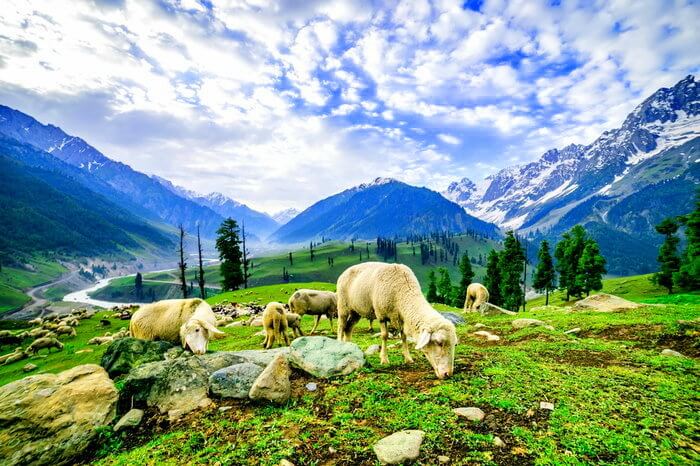
HISTORY OF KASHMIR: This place was known as KASHYAPAMAR, later KASHMIR. During 300BC, Kashmir Was Ruled By King Abisares Princely Kingdom Part Of Indian Rulers. A few Years Later Kashmir Was Re-Captured By Indian King Ashoka, during this period Kashmir was the hub of Hindus and Buddhists, this was the time when Mauryan Empire built the City of Srinagar.
Kashmir was ruled by the Afghan Durrani Empire from 1752 to 1819. After that, in 1846, Gulab Singh took the title of Maharaja of Jammu & Kashmir, till 1947, Maharaja’s of Gulab Singh’s Dogra dynasty ruled Kashmir as a princely state under British Paramountcy.
At the time of partition, the rulers of princely states were given the right to choose between being the part of either India or Pakistan or to remain independent. Maharaja Hari Singh decided not to be the part of any country; neither India nor Pakistan, and to stay neutral. India respected the decision, but Pakistan did not! Pakistan tried a lot to make Maharaja of Kashmir agree for being ready to part of Pakistan. The soldiers of Pakistan attacked J&K, Maharaja asked India for the help of the people of Kashmir who were being killed and looted, he agreed for making J&K part of India. Prime Minister Jawaharlal Nehru agreed to rescue his people from Pakistani attackers. Indian soldiers were thrown out the Pakistani raiders from J&K, but, a large area remained in their control. Their areas were not so easy to reach as they were surrounded by big mountain ranges. The fight ended in 1949 as India did not want the war to continue. The state was termed as ‘Distributed Territory’.
KASHMIR: A HAPPY PLACE!
The state is divided into three administrations under Article 370 – J&K under India, Azad Kashmir under Pakistan and Aksai Chin under china. Kashmir Valley is under Indian governance. The most beautiful tourist spots are in Kashmir, Shalimar Bagh, Chasme Shahi and Pari Mahal, few lakes such as Dal Lake, Wular lake, Manasbal lake – lie within the Kashmir Valley. The Kashmiris have dual citizenship, Indian as well as Kashmir citizenship. Asia’s fourth longest railway tunnel is located in Kashmir, the Banihal railway tunnel which is 11,215 km long. Lives in Kashmir were full of enthusiasm and joy, there were no friendship barriers based on caste and religion, but, Pakistan wanted to rule over the whole state, which leads to several fights and protests.
CHANGED KASHMIR!
In July 1988, the Jammu Kashmir Liberation Front (JKLF) started speaking for the independence of Kashmir from India. On 14 September 1989, they killed Tika Lal Taploo and a prominent leader of Bhartiya Janta Party. This incident made the Kashmiri Pandit’s anxious, they felt unsafe there. On 4 November 1989, Highcourt judge Neelkanth Ganjoo was killed in Srinagar, and, this continued.
On 4 January 1990, a threatening message was printed for Kashmiri Pandits in Srinagar-based newspaper about leaving Kashmir immediately, On 14 January 1990, the same warning was re-published. The walls were painted with threatening messages for Kashmiri pandits for accepting Islamic rules, The buildings, shops were coloured green as a sign of Islam. Homes, factories, shops of Kashmiri Pandits were burned and destroyed. All these actions were being held for forcing Hindus to leave Kashmir. On 18 and 19 January, during the middle of the night, a blackout took place in Kashmir Valley except for the Mosques. On 21 January 1990, Gawkadal massacre took place, many Kashmiri Pandit’s were killed, burnt alive. this resulted in the mass migration of Kashmiri Pandits. On 29 April 1990, a Kashmiri poet, Sarwanand Kaul was brutally murdered. On 2 February 1990, Satish Tikoo, a young Hindu social-worker was murdered near his own house. Many Hindu women kidnapped, raped and murdered.
 Eduindex
You must be logged in to post a comment.