

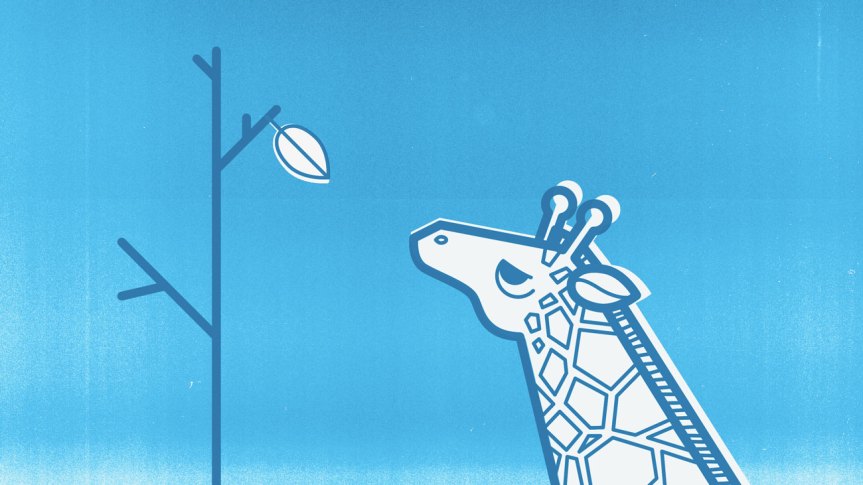
The most important question that has always been exciting to human mind is about human origin and destination. Where did we come from and where are we heading to?
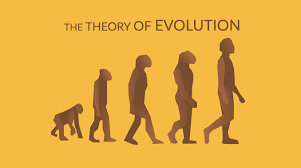
To understand the human origin and evolution, we have to first look in to the emergence of life on the earth. It is believed that life is originated from inorganic matters due to many physical-chemical conditions
Theories of Organic Evolution
The term evolution was first applied by the English philosopher Herbert Spencer, to mean the historic development in life. Evolution is a process that results inheritable changes in a population spread over many generations.
Lamarckism
Jean Baptist de Lamarck (1744-1829) was a French biologist. He spent the early part of his life as a botanist. Then at the age of 50, he turned his attention to zoology, particularly to the study of invertebrates. His extensive studies on invertebrates formed a base in zoological classification. As a result of his systematic studies, he became convinced that species were not constant but rather were derived from pre-existing ones. By consolidating all these ideas, he proposed his theory of evolution in his book Philosophie Zoologique 1809 which is known as Lamarckism.
Lamarck believed that organic changes seen in animals resulted from the influence of environment. According to him, when the environment changes, animals need to change their body structure as well. He proposed his ideas as two different laws as the following-
i) The law of use and disuse: A living body is influenced by environmental factors, and ultimately this phenomenon initiates an adaptation of organisms to their surroundings. As per the necessity, some parts of the body may be used more and more. Therefore, those parts tend to show more development or changes in the course of time, while the other parts of the body, which may not be required much, will become weak or degenerate due to constant disuse.
ii) Inheritance of acquired characters: Modifications produced during the lifetime of organisms become hereditary and will be inherited by the offspring. All the modifications that the organism acquires during its lifetime in adaptation to the environment are automatically transmitted to the next generation and so become a part of heredity
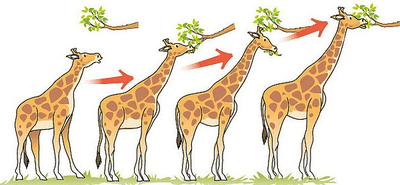
To support his theory, Lamarck presented several examples. The most remarkable one is associated with the long neck and tall front legs of giraffes. According to Lamarck, the ancestors of giraffe were normal animals with reasonably long neck and forelimbs. They depended on grass and bushy vegetation for their survival. But a sudden scarcity of leafy vegetation due to some environmental factors, forced the giraffe to depend on leaves of tall trees and for that they had to stretch their neck and forelimbs. The continuous stretching of these organs resulted in the long neck and long forelimbs of present day giraffe.
In another example, he mentioned that the ducks are unable to fly because their wings became weak, when they stopped flying. Again, the birds that started to live in an aquatic environment, gradually acquired webbed feet through the conquest of survival.
Criticism of Lamarckism
Lamarck’s theory has been criticised from many angles. The German scientist August Weismann criticised the essence of Lamarck’s theory of inheritance acquired characters by his experiments, which involved cutting off the tails of mice for over twenty-one generations. All tailless mice in all generations produced their offspring with tails. Therefore, he reached to the conclusion that the environmental factors might influence the body cells, but it is not enough to profess a change of reproductive cells. Characters of an organism would not be inherited unless the change could occur in the reproductive cells.
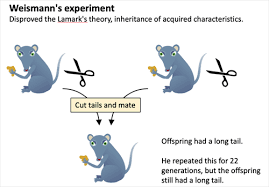
Characters of an organism would not be inherited unless the change could occur in the reproductive cells. According to Weismann the body of an animal is composed of two parts viz. germ plasm (germ cells) and somato plasm (body cells). Only those characters which are located in the germ plasm will be inherited.
As a result of these experiments, Lamarckian law of inheritance of acquired characters lost its evolutionary ground. But the effort towards finding facts related to organic evolution continued. Charles Darwin’s interest in this field gave birth to new findings (Darwinism).
 Eduindex
You must be logged in to post a comment.