

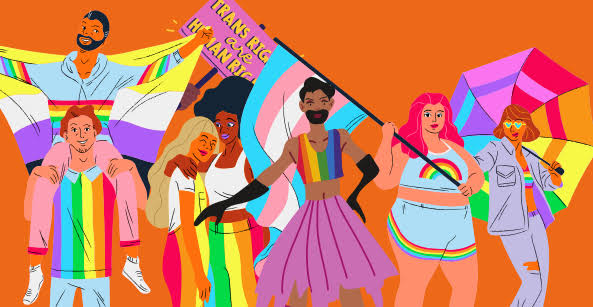
Recognising the singularity within the LGBTQ+ community is of extreme importance. Many fail to understand the difference and club them all together, thus, their identities should be properly understood and respected by society. They have been discriminated against, labelled as a disease, disrespected and their acts criminalised by law. Understanding, accepting and respecting the community is the least the society can do to compensate for the past.
Let’s get right to the terminology so that we can do proper justice to the community-
- Lesbian
People who identify with this identity are generally women who are attracted to other women. This attraction may be sexual or romantic in nature. The term ‘lesbian’ was derived from Lesbos, an island in Greece, where lived the poetess Sappho. The remnants of her poetry are about women, describing their lives, relationships, role and also expressing her love for other women. It was with the growth of female education and feminism that lesbians first started to rise and demand respect.
2. Gay
Initially, ‘gay’ was used as an umbrella term for all those attracted to the same sex. However, now it refers to men who are attracted to the same gender. The term originally meant cheerful, however, in the 17th century, it was used to refer to prostitutes or womanisers. It was in the 1950s that the term ‘gay’ described homosexuality. Laws of many countries have been amended to favour the community but there is still a long way to go.
3. Bisexual
Bisexuality is romantic or sexual attraction to more than one gender. Commonly, it is understood as an attraction towards men as well as women but it is quite a fluid term. Earlier, the term ‘bisexual’ was used for those who had both male and female genitals. It was in 1892 that bisexual was used to refer to those who were attracted to the opposite as well as the same gender. Bisexuality is wrongly perceived as a transitioning phase, rather than a sexual identity.
4. Transgender
Transgender, an umbrella term, includes those whose gender identity does not coincide with the gender assigned at birth. They may also undergo medical procedures to change their sex as they don’t identify with their birth sex. In 1965, the term ‘transgender’ was coined by John F. Oliven. The sexual orientation of trans people may be heterosexual, homosexual, bisexual, asexual, et cetera.
The ‘Q’ in the LGBTQ+ may stand for Queer or Questioning.
5. Queer
Queer is often used to refer to people with sexual identities and orientation other than heterosexual and cisgender. It includes the entire LGBT+ community. Initially, this word meant ‘odd’ or ‘peculiar’ but now it has transformed into a term inclusive of all genders and sexual minorities which have a collective history of prejudice and discrimination. However, people of the LGBT+ community may or may not identify as queer.
6. Questioning
It This terms may refer to those who are still discovering themselves, who are questioning their sexual identity or orientation. It may also be used by people who do not want to put a label on themselves due to personal reasons or societal pressures.
Always remind yourself that you deserve respect, independent of your sexuality and identity.
(I, as the writer, sincerely apologise if I was unable to properly define your identity. There are multiple genders, sexual identities and orientations that I have not covered in this article).
 Eduindex News
You must be logged in to post a comment.