
LGBT COMMUNITY

BY: VAIBHAVI MENON

LGBT or GLBT is an initialism that stands for lesbian, gay, bisexual, and transgender. In use since the 1990s, the term is an adaptation of the initialism LGB, which began to replace the term gay in reference to the broader LGBT community beginning in the mid-to-late 1980s. The first widely used term, homosexual, now carries negative connotations in the United States. It was replaced by homophile in the 1950s and 1960s, and subsequently gay in the 1970s; the latter term was adopted first by the homosexual community. As lesbians forged more public identities, the phrase “gay and lesbian” became more common. A dispute as to whether the primary focus of their political aims should be feminism or gay rights led to the dissolution of some lesbian organizations, including the Daughters of Bilitis, which disbanded in 1970 following disputes over which goal should take precedence.

As equality was a priority for lesbian feminists, disparity of roles between men and women or butch and femme were viewed as patriarchal. Lesbian feminists eschewed gender role play that had been pervasive in bars as well as the perceived chauvinism of gay men; many lesbian feminists refused to work with gay men, or take up their causes. Lesbians who held the essentialist view, that they had been born homosexual and used the descriptor “lesbian” to define sexual attraction, often considered the separatist opinions of lesbian-feminists to be detrimental to the cause of gay rights. Bisexual and transgender people also sought recognition as legitimate categories within the larger minority community. After the elation of change following group action in the 1969 Stonewall riots in New York City, in the late 1970s and the early 1980s, some gays and lesbians became less accepting of bisexual or transgender people. Critics said that transgender people were acting out stereotypes and bisexuals were simply gay men or lesbian women who were afraid to come out and be honest about their identity. Each community has struggled to develop its own identity including whether, and how, to align with other gender and sexuality-based communities, at times excluding other subgroups; these conflicts continue to this day. LGBTQ activists and artists have created posters to raise consciousness about the issue since the movement began.

From about 1988, activists began to use the initialism LGBT in the United States. Not until the 1990s within the movement did gay, lesbian, bisexual, and transgender people gain equal respect. This spurred some organizations to adopt new names, as the GLBT Historical Society did in 1999. Although the LGBT community has seen much controversy regarding universal acceptance of different member groups (bisexual and transgender individuals, in particular, have sometimes been marginalized by the larger LGBT community), the term LGBT has been a positive symbol of inclusion. Despite the fact that LGBT does not nominally encompass all individuals in smaller communities (see Variants below), the term is generally accepted to include those not specifically identified in the four-letter initialism. Overall, the use of the term LGBT has, over time, largely aided in bringing otherwise marginalized individuals into the general community. Transgender actress Candis Cayne in 2009 described the LGBT community as “the last great minority”, noting that “We can still be harassed openly” and be “called out on television”.
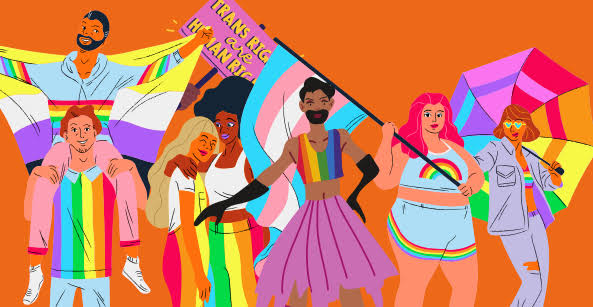
Basic LGBTQ+ Terms That You Should Know

Recognising the singularity within the LGBTQ+ community is of extreme importance. Many fail to understand the difference and club them all together, thus, their identities should be properly understood and respected by society. They have been discriminated against, labelled as a disease, disrespected and their acts criminalised by law. Understanding, accepting and respecting the community is the least the society can do to compensate for the past. 

Let’s get right to the terminology so that we can do proper justice to the community-

  1. Lesbian 

People who identify with this identity are generally women who are attracted to other women. This attraction may be sexual or romantic in nature. The term ‘lesbian’ was derived from Lesbos, an island in Greece, where lived the poetess Sappho. The remnants of her poetry are about women, describing their lives, relationships, role and also expressing her love for other women. It was with the growth of female education and feminism that lesbians first started to rise and demand respect. 

2. Gay

Initially, ‘gay’ was used as an umbrella term for all those attracted to the same sex. However, now it refers to men who are attracted to the same gender. The term originally meant cheerful, however, in the 17th century, it was used to refer to prostitutes or womanisers. It was in the 1950s that the term ‘gay’ described homosexuality. Laws of many countries have been amended to favour the community but there is still a long way to go. 

3. Bisexual

Bisexuality is romantic or sexual attraction to more than one gender. Commonly, it is understood as an attraction towards men as well as women but it is quite a fluid term. Earlier, the term ‘bisexual’ was used for those who had both male and female genitals. It was in 1892 that bisexual was used to refer to those who were attracted to the opposite as well as the same gender. Bisexuality is wrongly perceived as a transitioning phase, rather than a sexual identity. 

4. Transgender

Transgender, an umbrella term, includes those whose gender identity does not coincide with the gender assigned at birth. They may also undergo medical procedures to change their sex as they don’t identify with their birth sex. In 1965, the term ‘transgender’ was coined by John F. Oliven. The sexual orientation of trans people may be heterosexual, homosexual, bisexual, asexual, et cetera. 

The ‘Q’ in the LGBTQ+ may stand for Queer or Questioning.

5. Queer 

Queer is often used to refer to people with sexual identities and orientation other than heterosexual and cisgender. It includes the entire LGBT+ community. Initially, this word meant ‘odd’ or ‘peculiar’ but now it has transformed into a term inclusive of all genders and sexual minorities which have a collective history of prejudice and discrimination. However, people of the LGBT+ community may or may not identify as queer. 

6. Questioning

It This terms may refer to those who are still discovering themselves, who are questioning their sexual identity or orientation. It may also be used by people who do not want to put a label on themselves due to personal reasons or societal pressures. 

Always remind yourself that you deserve respect, independent of your sexuality and identity. 

(I, as the writer, sincerely apologise if I was unable to properly define your identity. There are multiple genders, sexual identities and orientations that I have not covered in this article).

Section 377

Section 377 of Indian penal code criminalizes homosexuality and says whoever voluntarily has carnal intercourse against the order of nation with any man; woman or animal shall be punished with imprisonment for life. However, the Supreme Court on 6 September, 2018, decriminalized the section 377 of IPC. The sc said that it is natural and people have no control over it. Being homosexual is not a disease but people in India still don’t accept. Before moving further we need to know what homosexuality is.

It is basically same sex attraction and attraction can physical, emotional or psychological of the same sex.LGBT means lesbian, gay, bisexual, transgender. The LGBT community is harassed now also they still are not respected in our society even after law has accepted. Their human rights are violated. These people suffer a lot they even can’t approach to police station if there is any case of sexual assault and rape on them. HIV AIDS are mostly found in same sex but they are neither provided with proper heath facilities nor aware about these diseases transmission. There are separate schools for them that are discriminatory. They are prevented from seeking legal protection from violence just because they are attracted to same sex people. A culture of silence in society is created about homosexuality that results to their denial and rejection at home as well as discrimination in workplaces and public places. They are people like us so why to treat them like this. They are called by different names like chakka, hijra and many others. They too have the same right to live in society with all dignity and respect. We all must respect them as they faced a lot in this society.

‘Made in Heaven’ one of the popular series that indicate to very serious problem LGBT where a person can’t even open to his family about his homosexuality. After knowing the truth his mother tortures her son and their landlords file a case against him. Even a married person can’t stand up for himself. It is our society who makes people so weak that they couldn’t speak up for themselves. We all should encourage such people instead of making their jokes and calling with different names and treating them with discrimination. Our law has decriminalized this section 377 but society didn’t accept this. We must give time to each other for this acceptance.

Current developments in section 377

1.       To decriminalize sexual intercourse in private between consenting adults

2.       The age of consent should be 18 or above

3.       The phrase ‘against the order of nature’ should be removed because it is not against nature, it is a natural process.

One has to understand that fight cannot be achieved only through legal amendments but you should ask yourself if you are able to accept this orientation in which one female is attracted to another female or vice versa. So it should be accompanied by awareness campaigns to educate parents, children. To adopt a healthy and supportive attitude towards homosexuals and to have broader approach to gay lifestyle or lesbian lifestyle or any other lifestyle should be considered normal.

Acceptance

I’m gay. I’ve wanted to tell you for a long time. I thought doing it this way would be a piece of cake. I hope you still love me. I mean, it’s hard not to love someone who baked you a cake. All my friends know and still love me. Your acceptance would be the icing on the cake. I hope you, much like this cake, are not in tiers. I hope we can look back on this and say ‘boy, this one really takes the cake!’ It gets better. Love, Aman.(sorry for so many puns)”

This is a story of thousands of people who came out this way by sending text messages to their parents because they are afraid to face them in the fear of being disowned.

Coming out takes a lot of courage and finesse. Some people use humor. Some use emotion. And sometimes, their families react the “right” way. But not everyone can be so lucky.

And for those who aren’t ready to come out yet, that’s okay. Come out when you’re ready and when you’re in a safe position to do so.

Decriminalising homosexuality may have come as a huge relief to the LGBTQ community in India but things have not changed much yet. Coming out continues to be a challenge.

Both sides of coming out stories are important to share. Our society has come far but we also have a long way to go.