

Dreamy Colorful Auroras

In the northern and southern pole, beautiful lights show in the sky, best seen at night. They are colorful and mesmerizing to watch. They are called aurora or polar lights. Auroras were first seen in 1791 in New England. The word Aurora is the name of a Roman goddess of dawn. These are mostly seen in high altitude regions that is around Arctic and Antarctic regions.

There are auroral zones between 10o to 20o from the geomagnetic poles. “Auroral oval” is the name given to the region which displays the aurora. The Aurora that appears in the region near to northern pole are called Aurora Borealis and the Aurora that appears in the region near to southern pole are called Aurora Australis.

how this colorful auroras are formed?

You may wonder to know that the reason behind this beautiful event, which mostly appears at night, is our very own star, The Sun. He is boiling and burning continuously since formation. The temperature of the sun at his surface is 5,505o C. But inside in the core of the sun, the temperature is 15 million degree Celsius. As the temperature fluctuates, some charged particles are thrown out of his outermost surface and travel outwards. The technical term for this is “The Solar Wind”. This wind reaches the earth and the charged particles strike with the atoms in the atmosphere. Because of this, excitation in the energy of the electrons occur and when they are returning to the original energy level, release photons which is the light we see. The earth`s magnetic field diverts these charged particles towards the poles. Hence these phenomena can only be seen in these areas.

How the light is of differnt colors?

Aurora of different colors are seen. Sometime they are green, blue and sometimes they are yellow or violet. The reason for the different colors are the atoms with which the charged particles colloid. Collision with Oxygen molecules caused yellow and green light. Collision with nitrogen caused blue, red and violet colors. the molecular nitrogen gives purple color but the atomic nitrogen gives blue.

Altitude also affects the colors produced. At a height of 150 miles green light will appear and above that red will appear. Blue lights appear up to 60 miles and above that purple and violet colors appear.

These auroras can be seen in other planets also. But the planet must be having its atmosphere and active magnetic field. In our solar system Jupiter, Saturn, Uranus and Neptune experience auroras.

The Aurora borealis is always present. But they can be seen when the sky and air are clear. September-October and March-April are the best time to watch these phenomena. NASA says after 2 days of sun spot activity these lights are brighter.

best places to watch aurora:

Darker the place better you can view the aurora. Choose a place away from light pollution and air pollution. Get a place with a larger view of open sky free of clouds. The places near to the Arctic circle are best. This may include Alaska, Iceland, Greenland Norway, Finland etc.
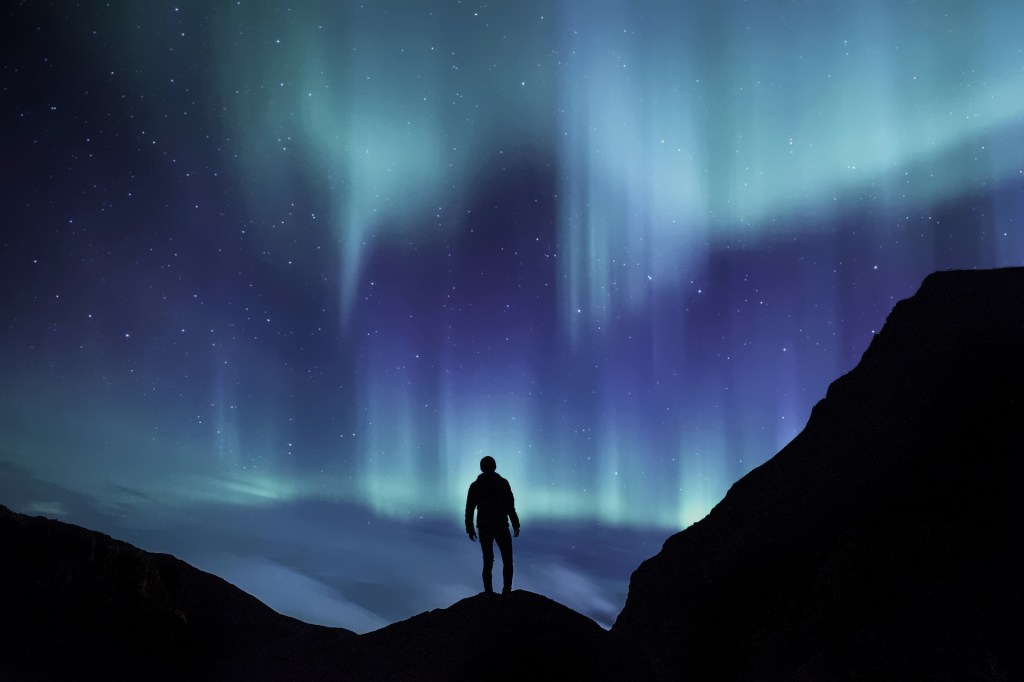
To capture this beauty you don’t need any expensive camera. A normal camera with a tripod will be more than enough for you. The Aurora Borealis appears and disappears very fast, hence you must be patient and quick enough to take a good picture of this beautiful event.
TACHYON A PARTICLE THAT HELPS US TO TIME TRAVEL…

Tachyonhypothetical subatomic particle whose velocity always exceeds that of light. The existence of the tachyon, though not experimentally established, appears consistent with the theory of relativity, which was originally thought to apply only to particles traveling at or less than the speed of light. Just as an ordinary particle such as an electron can exist only at speeds less than that of light, so a tachyon could exist only at speeds above that of light, at which point its mass would be real and positive. Upon losing energy, a tachyon would accelerate; the faster it traveled, the less energy it would have.

The name ‘tachyon’ (from the Greek ‘tachys,’ meaning swift) was coined by the late Gerald Feinberg of Columbia University. Tachyons have never been found in experiments as real particles traveling through the vacuum, but we predict theoretically that tachyon-like objects exist as faster-than-light ‘quasiparticles’ moving through laser-like media. (That is, they exist as particle-like excitations, similar to other quasiparticles called phonons and polaritons that are found in solids. ‘Laser-like media’ is a technical term referring to those media that have inverted atomic populations, the conditions prevailing inside a laser.)

an experiment at Berkeley to detect tachyon-like quasiparticles. There are strong scientific reasons to believe that such quasiparticles really exist, because Maxwell’s equations, when coupled to inverted atomic media, lead inexorably to tachyon-like solutions.

“Quantum optical effects can produce a different kind of ‘faster than light’ effect (see “Faster than light?” by R. Y. Chiao, P. G. Kwiat, and A. M. Steinberg in Scientific American, August 1993). There are actually two different kinds of ‘faster-than-light’ effects that we have found in quantum optics experiments. (The tachyon-like quasiparticle in inverted media described above is yet a third kind of faster-than-light effect.)

“First, we have discovered that photons which tunnel through a quantum barrier can apparently travel faster than light (see “Measurement of the Single-Photon Tunneling Time” by A. M. Steinberg, P. G. Kwiat, and R. Y. Chiao, Physical Review Letters, Vol. 71, page 708; 1993). Because of the uncertainty principle, the photon has a small but very real chance of appearing suddenly on the far side of the barrier, through a quantum effect (the ‘tunnel effect’) which would seem impossible according to classical physics. The tunnel effect is so fast that it seems to occur faster than light.

“Second, we have found an effect related to the famous Einstein-Podolsky-Rosen phenomenon, in which two distantly separated photons can apparently influence one anothers’ behaviors at two distantly separated detectors (see “High-Visibility Interference in a Bell-Inequality Experiment for Energy and Time,” by P. G. Kwiat, A. M. Steinberg, and R. Y. Chiao, Physical Review A, Vol. 47, page R2472; 1993). This effect was first predicted theoretically by Prof. J. D. Franson of Johns Hopkins University. We have found experimentally that twin photons emitted from a common source (a down-conversion crystal) behave in a correlated fashion when they arrive at two distant interferometers. This phenomenon can be described as a ‘faster-than-light influence’ of one photon upon its twin. Because of the intrinsic randomness of quantum phenomena, however, one cannot control whether a given photon tunnels or not, nor can one control whether a given photon is transmitted or not at the final beam splitter. Hence it is impossible to send true signals in faster-than-light communications.

Pin on The Laws of Relativity