An assertion like ‘Had you invested in the stock markets in 2011, your investments would have doubled by now’ triggers an urgent rush to invest in the market, bringing in the feel good hormones in most people. But often times, it is extremely misleading and the results could be catastrophic.
A stock market bubble is when the prices of assets rise exponentially, often not justifying their actual value.
Investors in 2020 faced a similar conundrum. With the pandemic induced lock-downs causing normal life and businesses to go haywire, the general investor felt it was better if they pulled their money out of the market. This led to the leading market index NIFTY50 dropping to 7,500 levels,a 40% decline from its value in January 2020(NSE india). As a result, the market became almost risk free and the only way ahead was up.
Investments started pouring in as the Covid-19 cases eased by August and significant institutional and foreign investors started pouring in money into the Indian stock markets because of their abnormally low levels. The domestic average investor soon followed suit and the markets saw a revival. In fact they rose to record highs( From record lows just a few months ago!) and the expectation of ‘winning’ a trade led to impulsive buys.
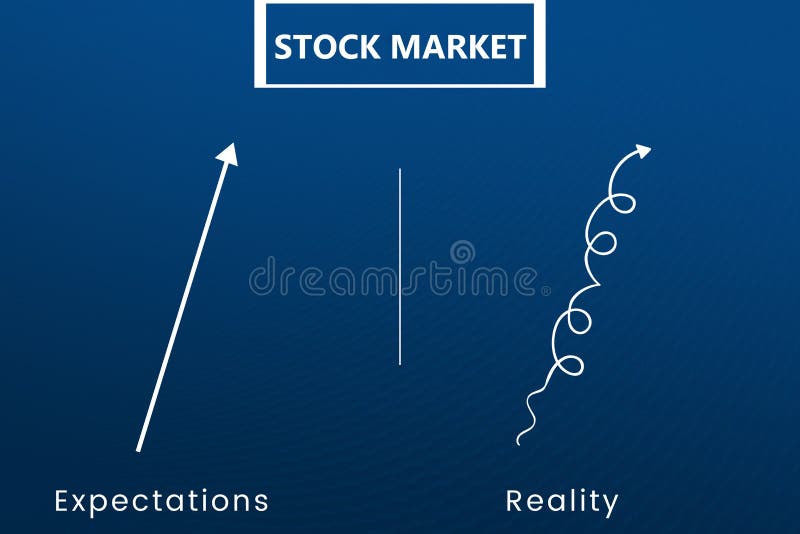
Perception versus Reality
Investors are not always sensible or rationale in their investing decisions and can be prone to various types of ‘bias’. These phenomena can explain the prevailing overtly optimistic market sentiments even when the macro-economic indicators are lacking behind.
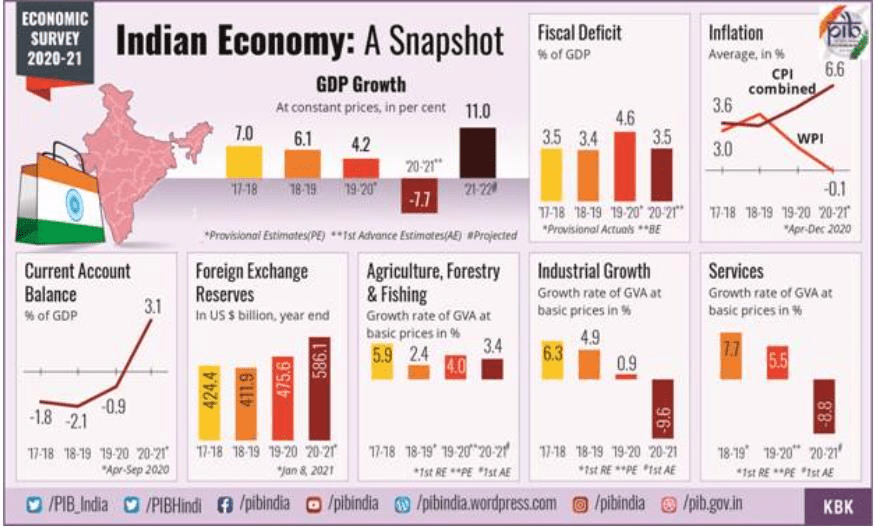
Even with parameters like the G.D.P and inflation on the wrong side of desirable, and unemployment rate sky rocketing in 2021, the profits that the top 50 companies made in India in the last fiscal year has increased. This resulted in a lot of investors ignoring those macro-economic trends and could be the reason as to why the stock market segment is rising irrespective of it.
Hence the ever increasing corporate profits and the ‘feel good’ hormones can attribute to the ascend of the stock market levels from the previous years ruins but the question remains, ‘How long can this last’? Established wisdom suggests that corporates cannot sustain a contacting economy for long and that it is bound to catch up with it sooner rather than later. Caution is advised to investors with a majority of their money in these instruments. A bubble burst is in the realm of recurrent reality and cannot be ignored as a figment of the imagination.
The following research paper discuses about the various aspects of the Indian economy, GDP, Economic slowdown etc. The COVID-19 pandemic ensued global economic downturn, the most severe one since the Global Financial Crisis. The lockdowns and social distancing norms brought the already slowing global economy to a standstill. Global economic output estimated to fall by 3.5% in 2020 (IMF January 2021 estimates).Governments and national banks across the globe conveyed different arrangement instruments to help their economies, for example, bringing down strategy rates, quantitative facilitating measures, and so forth India received a four-column methodology of control, financial, monetary, and long haul underlying changes: Calibrated financial and money related help was given, padding the defenseless during the lockdown and boosting utilization and speculation.
PRICES AND INFLATION
Averaged 6.6% during April-December, 2020 and remained at 4.6% in December, 2020, principally determined by ascend in food swelling (from 6.7% in 2019-20 to 9.1% during April-December, 2020, attributable to develop in vegetable costs) CPI feature and its sub gatherings saw swelling during April-October 2020, driven by significant expansion in value energy – because of the underlying interruptions brought about by COVID-19 lockdown Moderated value force by November 2020 for most sub gatherings, combined with positive base impact.
Sustainable Development and Climate Change
Voluntary National Review (VNR) presented to the United Nations High-Level Political Forum (HLPF) on Sustainable Development . Limitation of SDGs is significant to any methodology pointed toward accomplishing the objectives under the 2030 Agenda. Sustainable advancement remains center to the improvement technique regardless of the remarkable COVID-19 pandemic emergency .Eight National Missions under National Action Plan on Climate Change (NAPCC) zeroed in on the targets of variation, relief and readiness on environment chances. India’s Nationally Determined Contributions (NDC) states that money is a basic empowering influence of environment change activity . The financing contemplations will subsequently stay basic particularly as the nation ventures up the objectives considerably .The objective of mutually preparing US$ 100 billion every year by 2020 for environment financing by the created nations has stayed tricky.
GDP
India’s real GDP has recorded a growth of 11 per cent in 2021-22 and the nominal GDP by 15.4 per cent- which has been the the highest since independence. The V-shaped economic recovery is supported by the initiation of a mega vaccination drives with the hopes of a robust recovery in the services sector and prospects for robust growth in consumption and investment. The Union Minister for Finance & Corporate Affairs, Nirmala Sitharaman presented the Economic Survey 2020-21 in Parliament, which stated that the rebound will be led by the low base and continued normalization in economic activities as the rollout of COVID-19 vaccines gathers traction. The fundamentals of the economy remain strong as gradual scaling back of lockdowns along with the astute support of Atmanirbhar.
Conclusion
India has evolved through the pandemic on the back of strong policy initiatives by the government, along with an optimistic outlook for economic recovery. India has administered ~4 million doses of COVID-19 vaccines in two weeks since January 16, 2021, becoming the fifth-largest inoculated country globally. India has become the world’s vaccine hub and extended support to 90+ countries seeking to stock up vaccines.
Since March 2020, early lockdown, health-infra ramp-up, incremental unlocking, blanket testing, social distancing, tailored fiscal stimulus (to reduce supply-side disruptions and revive demand) and structural reforms initiated by the government have helped restrict the fatality rate in India to 1.2%—one of the lowest in the world. India is emerging as the world’s fastest-growing major economy, with the IMF holding its growth forecasts as high as 6.8% for FY23. Also, the Economic Survey 2020-21 has drawn attention to the V-shaped economic growth—a testament to the burgeoning Indian economy and its intrinsic strength. India is not yet out of the danger of the pandemic. Social distancing continues to be the most effective tool to combat the pandemic as activity levels continue to rise in the economy boosted by the rapidly escalating inoculation drive in the country. Infrastructure to boost sectors to grow with unlocking of economy Terming investment in infrastructure “quintessential” to boost growth, the Economic Survey on Friday said post unlocking of the economy, infra sectors are poised for growth and construction of roads is expected to return to the high pace attained before COVID-19. The infrastructure sector will be the key to overall economic growth and macroeconomic stability, the Survey said emphasizing that the year after the crisis (2021-22) will require sustained and calibrated measures to facilitate the process of economic recovery and enable the economy to get back on its long term growth trajectory.



![AN ANLYSIS ON OVERALL GROWTH IN THE INDIAN ECONOMY [2020-2021]](https://eduindex.org/wp-content/uploads/2021/06/1609833276_axhez7_istock_indian_economy_stocks_markets_915768_1605451970.jpg?w=700&h=1&crop=1)
 Eduindex
You must be logged in to post a comment.