
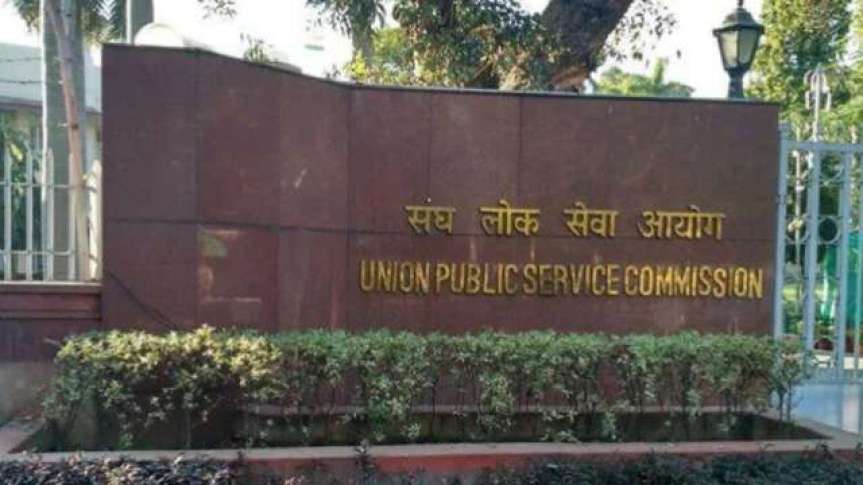
All about Civil Services Exam

UPSC has declared the final result for Civil Services 2021 in which Shruti Sharma, Ankita Agarwal and Gamini Singla have secured the first, second and third rank respectively.

Civil Services Examination (CSE) is one of the examinations conducted by the Union Public Service Commission to recruit suitable candidates into civil services of India including IAS, IPS, IFS, and other allied services.

The prescribed UPSC exam eligibility criteria are that the candidate should be a graduate and must have attained 21 years of age. There is also an upper age limit and a number of attempts restriction based on the candidate’s category. Generally, the upper age limit is 32 years, but the commission gives age relaxation for OBC, SC, ST and PH candidates.

The UPSC exam is held in three stages. The three stages are Prelims, Mains and Interview/personality test. The prelims exam consists of two papers of objective type questions. Paper 1 is GS paper Paper 2 is CSAT (Qualifying in nature- 33%). The mains exam consists of nine descriptive type papers. The last stage consists of an interview round with the UPSC board. Candidates should clear each round in order to qualify for the subsequent round. Final merit is based on combined marks obtained in Mains and Interview.

In Mains there is one Essay Paper, 4 GS papers and 2 Papers for Optional Subject (all of 250 marks) which a candidate has to select from a prescribed list according to his/her interest. Some of the optional subjects are – Agriculture, Animal Husbandry and Veterinary Science, Anthropology, Botany, Chemistry, Civil Engineering, Commerce and Accountancy, Economics Electrical Engineering, Geography, Geology, History, Law, Management, Mathematics, Political Science and International Relations, Public Administration, Sociology etc.

  • PAPER-I: Essay: 
  • PAPER-II: General Studies-I: Indian Heritage and Culture, History and Geography of the World and Society. 
  • PAPER-III: General Studies- II: Governance, Constitution, Polity, Social Justice and International Relations. 
  • PAPER-IV: General Studies-III: Technology, Economic Development, Biodiversity, Environment, Security and Disaster Management. 
  • PAPER-V: General Studies- IV: Ethics, Integrity, and Aptitude 
  • Paper-VI and VII: Optional Paper-I and Optional Paper-II

There are to more papers which are qualifying in nature.

“JEE-MAINS”- The first step to a new beginning

JEE-MAINS stands for JOINT ENTRANCE TEST-MAINS which was earlier called as All India Engineering Entrance Examination (AIEEE). This is an undergraduate entrance test for taking admissions in various engineering and architecture institutes, mainly in 31 National Institutes of Technology (NITs), 23 Indian Institutes of Information Technology (IITs), and Government Funded Technical Institutes (GFTIs). This test is organized every year by National Teaching Agency (NTA) in India. This test was introduced in the year 2002.


STRUCTURE OF THE EXAM –
Until 2018, it was held only once after the CBSE exams, nearly in first week of April by the NTA since 2019 has decided to take this entrance test twice a year. Earlier, it held either electronically or online but now it happens only in the online mode.
It is a computer based entrance exam which consists of 2 papers:

  1. Paper 1 is for B.E. / B.Tech courses which only occurs in online mode from 2019, earlier there was an option of OMR based exam also. The qualification required for this paper is Physics, Chemistry and Mathematics as main subjects in class 12th.
  2. Paper 2 is for BArch and BPlanning courses. The knowledge of Mathematics, Aptitude, Drawing and Planning is required for being a part of this paper.
    The duration of the exam is 3 hours and candidates can apply for 3 subsequent years. LANGUAGE OF THE ENTANCE TEST –
    The exam was offered in English, Hindi and Gujarati. From January 2021, It has been planned to take the exam in eleven different languages namely Assamese, Bengali, English, Hindi, Gujarati, Kannada, Marathi, Odiya, Tamil, Telugu, Urdu.
    MODE OF EXAMINATION –
    • B.E. /B. Tech. (Paper 1) Physics, Chemistry and Mathematics, part 1, 2 and 3 respectively will be conducted in Computer Based Test mode only.
    • B. Arch (Paper 2) Mathematics and Aptitude Test, part 1 and 2 respectively will be held in Computer Based Test mode only. While Drawing Test or part 3 will be in offline mode on drawing sheet.
    • B. Planning (Paper 3) Mathematics, Aptitude Test and Planning Based Questions, part 1, 2 and 3 respectively will be held in Computer Based Test mode only.

PARTICIPATING INSTITUTES –
Institutes participating in the 2017 centralized seat allocation process included:
• The 31 National Institutes of Technology,
• The 24 Indian Institutes of Information Technology,
• 19 other central government or state government funded institutions including the three Schools of Planning and Architecture.
• Several self-financed institutes (during the spot round).
• Many other institutes used JEE (Main) ranks to fill seats through their own seat allocation processes.

NUMBER OF APPLICANTS

There are lakhs of students who appear in the entrance exam every year. The number of applicants has varied over the years, with the peak of over 1.35 millions in 2014.

  1. Starting from 2012, there were 1,220,000 students who appeared in the exam.
  2. In the year 2013, 1,282,000 students appeared.
  3. In 2014, 1,356,805 students appeared.
  4. In 2015, 1,304,495 students appeared.
  5. In 2016, 1,194,938 students appeared.
  6. In 2017, 1,186,454 students appeared.
  7. In 2018, 1,259,000 students appeared.
  8. From 2019, exam was conducted in two different phases. So, in 2019 in the first phase 929,198 students gave the exam while in second phase 935,741 students appreared for the exam.
  9. In 2020, in the first phase of the exam 921,261 students appeared whereas the second phase is still to be held.