HENRI FAYOL: THE FATHER OF MANAGEMENT

Henri Fayol is the universalist and he father of general management and Fayol developed the Theory of Management and he has given his opinion that managerial excellence is technical ability and can be acquired and he developed theories and principles of management which are universally accepted and made him a universalist. He was a pioneer of the formal education in management, Fayol’s principles of management meet the requirements of modern management, as such, he is rightly accepted as the “Father of General Management”.
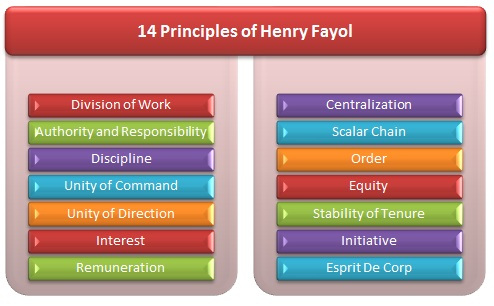
Fayol’s long practical experience in the field of management is reflected in his written work and He did not develop a logical theory of management, nor evolved a philosophy that answered all questions and satisfied all doubts about its practicability and based on his own experience in the field, Fayol set forth 14 Principles of management and they are:

1. Division of Work

The division of work is applied to all kinds of work- technical as well as management and division of work also means specialization and division of work promoted efficiency.

2. Authority and Responsibility

Authority and responsibility go together and Fayol stressed that right and power to give orders should be balanced by the responsibility for performing necessary functions and according to Fayol “The result of authority is responsibility. It is the natural result of authority and essentially another aspect of authority and whenever authority is used, responsibility is automatically born”.

3. Discipline

According to Fayol, “Discipline is in essence obedience, application, energy, behavior and outward marks of respect observed following the standing agreements between the firm and its employees”. Agreements must be obeyed in totality, without any dissent and discipline is essential for the smooth running of the business.

4. Unity of Command

A subordinate should take orders from only one boss and Fayol claimed that if the unity of command is violated “Authority is undermined, discipline is endangered, order disturbed and stability threatened” if there are two or more superiors for an employee then confusion and conflict of interest arise and everyone has to make sure that this doesn’t happen.

5. Unity of direction

 Fayol advocates, “One head and One plan” for a group of activities having the same objectives, and this will create dedication of purpose and loyalty. Unity of direction for achieving unity of action in the pursuit of common objectives by a group of persons.

6.Subordination of Individual Interests to general Interests

This is a home truth and, in a family, the interests of its members should be subordinated to the interests of the family as a whole.

7. Remuneration to employees

Remuneration should to fair and adequate and it should be supported by both types of incentives- Financial as well as non-financial.

8.Centralization and Decentralisation

There should be one central point in the organization that exercises control over all the parts but the degree of centralization of authority should vary according to the needs of the situation.

9. Scalar Chain

The Scalar chain is a chain of supervisors from the highest to the lowest rank and this principle suggest that there should be a clear line of authority from top to bottom linking all managers at all level.

10. Principle of order

This principle applies to the arrangement of material and people and there should be a place for everything and everything should be in a place.

11. Principle of Equity

Kindness and justice should be exercised by management in dealing with their subordinates and this will infuse loyalty and devotion among the employees.

12. Stability of Tenure of Personnel

An employee with all the requisite abilities needs some time to gain specialization and stability is linked with a long tenure of personnel in the organization and efficiency is promoted by a stable workforce.

13. Principle of Initiative

The initiative is the power of thinking out a plan and ensuring its successful implementation. Initiative on the part of its employees can become a great source of strength, but it must not be against the established practice.

14.Esprit-de-corps

 It means the spirit of loyalty and revolution which unites the members of a group or society and Fayol said that there is strength in unity and the two enemies of sprit-de-corps are:

i. Divide and rule

ii. Abuse of written communication

LEVELS OF MANAGEMENT

The level of management is an important classification needed for an organization to work smoothly and operationally to complete the needed work and all the employees working in an organization/institution can be divided into two categories:

                             1. Managerial Members

                             2. Non-Managerial Members

1. Managerial Members

 In this category, all such persons are included who manage somebody, they are called managers because they manage some of the other people. Thus they have all the subordinates. The Chief Executive officer or CEO ranks higher in this hierarchy and departmental managers are subordinate to the CEO. Supervisors work under the departmental managers and so they are subordinate to them. In the same manner, workers are subordinate to supervisors. Except for workers, all others are called managers irrespective of their designation. He is the manager only who builds managerial levels. “The best executive is the one who has sense enough to pick good men to do what he wants done, and self-restraint to keep from meddling with them while they do it.” 

Employees working in an organization build a chain of hierarchy and that is known as “ Chain of Authority”. This chain links all ranks in a vertical form. In this manner, this chain from top to bottom builds many managerial posts, which are termed as managerial levels. The term level of management refers to a line of demarcation between various management positions in an organization. As we move from top to bottom the degree of authorities goes on decreasing. In the top management, the members who occupy the seat are entrusted with the responsibility of planning and executing broad policy decisions. Manages of all major activities areas can be referred to as top management. The top management generally performs the following functions:

  1. Laying down guidelines for the various departmental heads.
  2. Organizing the business into various sections and departments for the accomplishment of predetermined goals.
  3. Setting out general objectives and policies.
  4. Making appointments to top positions such as appointments of managing director, secretary, departmental heads, etc.
  5. Reviewing the work of executives and ensuring their performance at different levels.
  6. Budgets prepared by different managers are given final shape i.e., approval is given to the budget.
  7. To understand the interlocking of departments in major policies.
  8. To ensure that there is coordination between the different parts of the organization.
  9. To build the company spirit where all are working to provide a product or service wanted by others.

2. Non-Managerial Members

In this category, those employees are included who work directly on the job. The place at which such employees work is known as a platform area. Since they are at the lowest level of the chain in an organization, they do not have any subordinates, that is why they cannot be called as managers. For this very this they are not counted among the level of management and that is why they form the Non-Managerial level. They are the main base or the building block for the organization as the company depends upon their work to run the company smoothly and efficiently and greater the workforce the greater the productivity.

MBA-Personal Interview(PI)

Topics for preparation

Master of Business Administration or MBA is one of the most popular post-graduate programmes in India.The two-year programme is a gateway to job opportunities in the corporate world.Admissions to all MBA college typically take place through an admission test(CAT).The qualifying exam is usually followed by a second level screening round that could be a group discussion or a personal interview (accounting for more than 50%)conducted by the college that the student has qualified for.

1.Importance- The most crucial stage of MBA admission is Group discussion and Personal Interview (PI).It is the final round test of your verbal communication skill, presence of mind and how do you present your views and knowledge skillfully to convince the experts who are interviewing you. It also tests your stress management skill, ability to work under pressure and decisive skills.

2. PI consists of- The personal interview panel consists of 3-4 business experts of respective organization.

  • Duration- 15-20 minutes
  • Subject Matter-about yourself,educational details, work experience, current affairs and interests.

3.Tips for PI-

  • Student must stay calm and confident.
  • Greet the panelists with a warm welcome smile.
  • If you are not sure about an answer, be humble and tell them that you don’t know the answer.
  • Respecting others’ views and showing your point will win you points in the PI round.
  • The honest approach during the interview also makes the given responses natural and genuine.

4.Topics to prepare for PI-

  • Tell us something about yourself.
  • Why do you think should we give you admission in our college?
  • Tell us about your key strengths and skills.
  • What are your long term goals?
  • Why MBA? What do you want to do after an MBA?
  • Tell us about your hobbies and interests.
  • How will you define your personality?
  • How do you deal with failures?
  • As a leader, what would you advise to your fellow team members?

5.General Knowledge-

  • Questions on your graduation subjects.
  • Your personal take and views on Social Media.
  • Current events and situation.
  • About Indian economy.

Students must improve their communication skills, keep updated to latest information. All over personality and intelligence is measured in personal interview and those who masters, is selected.I hope this article must be helpful for aspirants of mba…..

MANAGEMENT

Management has become an important Economic organ of the present industrial society. Every person in the world from the family head to the prime minister of the country or from the worker to the Managing director of a Joint-stock company is busy in managing different types of affairs that he has to perform in discharging his/her entrusted duties. Management is the coordination of human and physical resources towards the attainment of objectives. By managing different activities, we can best utilize our available scarce resources. As the mind of a person controls his activities, similarly management controls the business organization, men, machines, and materials in getting the work accomplished.

TRADITIONAL AND MODERN CONCEPT OF MANAGEMENT

Management is related to the dynamic process of establishing objectives of the organization, harnessing and coordinating its human as well as other resources, and ultimately to the attainment of goals. It is a process of creating a creating conducive environment for humanitarian efforts, to reach the organization’s goals effectively and efficiently. According to  C.S George who describes management as “Management is a distinct process consisting of planning, organizing, actuating and controlling, performed to determine and accomplish the objectives by the use of people and resources” Traditional concept of management restricted management to getting things done.

According to the modern view, management covers a wide range of business-related activities. According to modern thinkers, “Management is a process of an activity a discipline and an effort to coordinate, control and direct individuals and group efforts towards attaining the cherished goal of the business”. Another aspect of management is presented by Harold Koontz and O’ Donnell, “Management is the art of getting things done through and with the help of a formally organized group”. To be more specific, to manage is to forecast and to plan, to organize, to command, and to control.

CONCEPT OF MANAGEMENT

Management is a set of functions directed at the efficient utilization of the resources in the pursuit of organizational goals. To be more specific, to manage is to forecast and to plan, to organize, to command, to coordinate, and to control. To foresee means examining the future and drawing up the plan of action. To organize means building up the dual structure, material, and human of the undertaking. To command means maintaining activity among the personal. To coordinate means binding together, unifying, and harnessing all activities and efforts. To control means seeing that everything occurs in conformity with the established rules and expressed command. By efficient utilization of resources using resources wisely and in a cost-efficient manner. By effectiveness, we mean making the right decisions and successfully implementing them. Efficiency and Effectiveness are interrelated, for instance, it is easier to be effective if one ignores efficiency. The effect of good management is nothing short of remarkable. Take an under-performing-even chaotic-organization and install a skilled manager and him/she soon can have the enterprise humming like a well-tuned machine. Studies have shown that 90 percent of the business fail generally due to poor management.