Big Surprising News: Planet Nine does exist in our Solar System …///

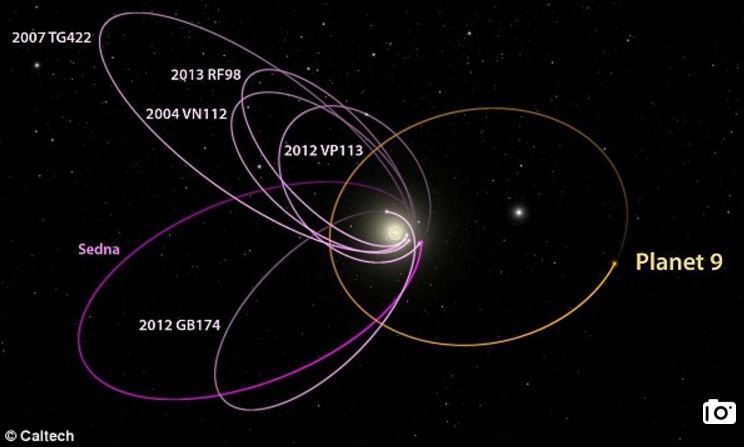
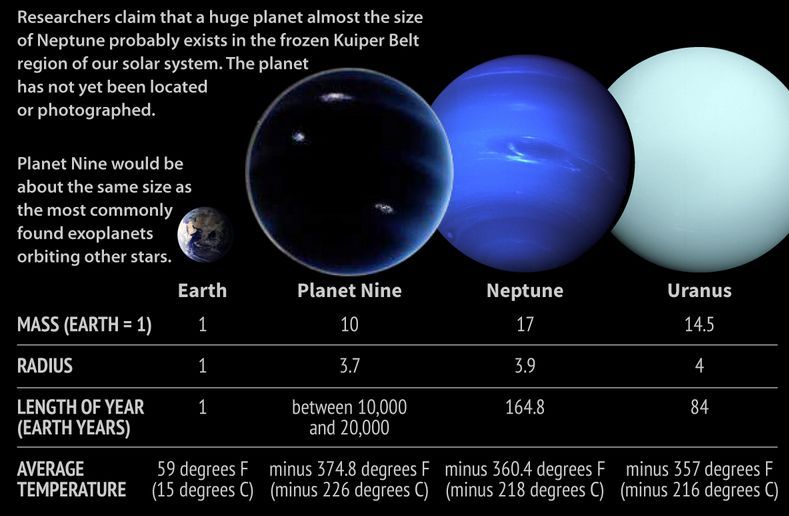
Two recent studies have shown that the existence of a mysterious, hypothetical Planet Nine could explain why the planets in our Solar System don’t fully line up with the Sun. Researchers have been speculating about a ninth planet since January this year, and these latest studies add more weight to the hypothesis that, at some point in time at least, there was an extra planet orbiting our Sun.

In fact, if Planet Nine does exist (or did), it would help to explain something that scientists have puzzled over for decades – why the Solar System is tilted.

Credit : Third Party Reference

What does that mean? 

Well, basically, all of the prime 8 planets that orbit our Sun do so on the same plane, making the Solar System look like a disc. The problem is that the Sun spins at a different angle, with its axis roughly 6 degrees off from the rest of the planets.

In the past, researchers have attempted to explain this slant by blaming the temporal tug of passing star or interactions between the Sun’s magnetic field and the disc of the dust that formed an our planets. But none of these hypotheses have fully accounted for the misalignment.

“Using an analytic model for secular interactions between Planet Nine and the remaining giant planets, here we show that a planet with similar parameters can naturally generate the observed obliquity as well as the specific pole position of the sun’s spin axis, from a nearly aligned initial state,” the team states.

“Thus, Planet Nine offers a testable explanation for the otherwise mysterious spin-orbit misalignment of the solar system.”
Credit: Third Party Reference

In the French study, conducted by astronomers at the Côte d’Azur Observatory in Nice, the team suggests that Planet Nine’s tilt is likely to blame for this misalignment, rather than its mass.

According to the researchers, while mass is often used to explain why objects in space influence one another – and that’s what the Caltech team looked into – in this case, it would mean that Jupiter – the juggernaut of our Solar System – could have caused the tilt, which it didn’t.

Instead, their models showed that Planet Nine’s tilt could have skewed everything else – coming to the same conclusion as the Caltech researchers. Combined, the results of both the studies add a significant amount of evidence that Planet Nine exists, though not enough to actually prove it.

Instead, the studies seem to say that something influenced the early Solar System and made the mysterious 6-degree tilt – and Planet Nine fits the profile.
Credit: Third Party Reference

While Planet Nine will stay hypothetical until researchers manage to actually find it in the night sky, it’s not stopping researchers from piling up evidence of its existence. For example, revert in April, a team started devising a way to spot the planet using black-body radiation, which basically scans the sky for hotspots that could be planets cooling down.

These latest results haven’t been peer-reviewed as yet, so we need to take them with a grain of salt for now. While the debate over Planet Nine will likely continue well into the future, it’s exciting to see that it fits into models explaining why our Solar System is the way it is.

Reference- divyanshspacetech.wordpress.com
Big Bang Theory has refrased as Universe Origin Theory : World Exclusive …………

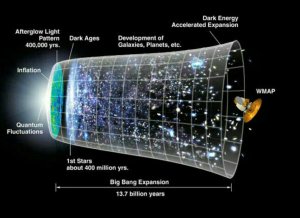
Big-bang model, widely held theory of the evolution of the universe. Its essential feature is the emergence of the universe from a state of extremely high temperature and density —the so-called big bang that occurred 13.8 billion years ago. Although this type of universe was proposed by Russian mathematician Aleksandr Friedmann and Belgian astronomer Georges Lemaitre in the 1920s, the modern version was developed by Russian-born American physicist George Gamow and colleagues in the 1940s.

The Big bang theory itself is the outcome of thousands of brilliant minds put all together in astronomy and cosmology cautiously for exploring the origin of our universe.

Let’s move back in time. 13.82 billion years ago, what was there?

Credit: Third Party Reference

A point of singularity, extraordinary small and hot where no laws of physics were applied, the time has no existence, all four fundamental forces exist forming a unified force called super force suddenly exploded because of no reason.

”SOMETHING CAME FROM NOTHING”

In less than one second, gravity split off from the super force. Three minutes later, the temperature dropped to 10 billion degrees of Fahrenheit, an appropriate temperature for the formation of atoms to take place. Lighter element, hydrogen came into existence.

Credit: Third Party Reference

After 380,000 years, light travelled through the darkness. 4 billion years later, stars started shaping due to the presence of heavier elements such as nitrogen, oxygen, carbon etc. At the age of 13.7 billion years, the sky filled with stars and galaxies.

Credit: Third Party Reference

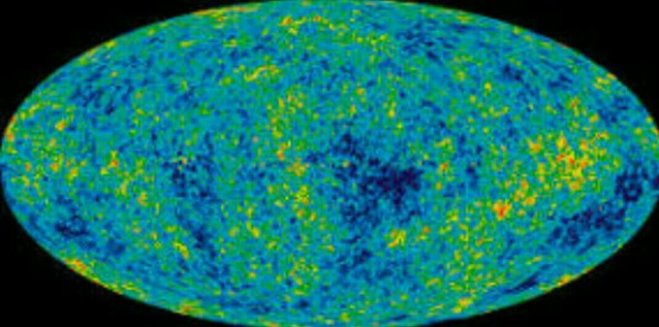
In 1965, Arno Penzias and Robert Wilson build a radio receiver which accidentally recorded echo or aftershock noise of big bang docking from everywhere and every corner of the universe. This was experimentally proved by NASA’S Wilkison microwave Anisotropy probe on 3 June 2001.

In February 2003, Cosmic microwave background provided a baby picture of our universe. Some of the major anomalies with the big bang theory were the unanswerable questions –

IS THERE SOMETHING OUT OF OUR UNIVERSE?

WHAT HAPPENED AT THE POINT OF SINGULARITY?

WHAT’S THE EXACT SHAPE OF OUR UNIVERSE?

HOW IS SPACE STRETCHING ITSELF FASTER THAN THE SPEED OF LIGHT?

WHAT WAS THE REASON BEHIND BIG BANG EXPLOSION?

Many alternate theories exist claming answer to these questions but none of them is experimentally verified.In 1980’s Alan Guth came up with the hypothesis of cosmic inflation i.e expanding universe which is now accepted as part of big bang theory.

Reference- https://divyanshspacetech.wordpress.com and https://www.britannica.com/science/big-bang-model

We are not lonely in the Universe : CETI World Exclusive Report >>>>>>

We are alone in the Universe ! It’s one of the biggest questions that haunts our imaginations. Astrobiologist Adam Frank argues in his new book “Light of the Stars” that we have never been in a better position to answer that question, thanks to a revolution in our knowledge gained by powerful telescopes like Hubble and space probes like Voyager. Indeed, the chances that there has never been another civilization in the universe are as low as one in ten billion trillion. But whether there is still one out there today is a more complicated question.

Your book centers on a relatively new field of study known as Astrobiology, which you call revolutionary. Explain what it means and why it is giving us new insights into our place in the universe.

Astrobiology is the study of life in its planetary or astronomical context. People will say we have only one example of life—here on Earth. But, if you take that position, you miss three revolutions that have happened in the last 30 years.

The first revolution is that we have been visiting other planets in our solar system. We have now sent probes to pretty much every kind of object in our solar system, including Mars. And from this we’ve learned about climate and how planets work in a generic sense. There’s an app you can pull up that will give you the weather on the Mars. We have climate models for Mars, Venus, and Saturn, and we know a huge amount about climate as a generic planetary phenomenon, not just on Earth.

Credit: Third Party Reference

The second revolution is studying the Earth’s history going back 4.5 billion years. We have been able to unspool in some detail the long history of the Earth and its life co-evolving over that time. We see that Earth has been many different kinds of planets, sometimes a snowball world, sometimes a hothouse world without ice. In the beginning there were no continents; it was pretty much a water world.

The last big revolution is the  revolution. When I was a school student in 2006, I did not know whether there were any stars in the universe with planets around them. Now we know that the universe has ten billion trillion planets that are in the right place for life to form. Those three revolutions completely changed not only how we think about life and planets, but also leads us to think very differently about exo-civilizations.

There are two possibilities, we are either alone in the universe or we are not. Both of these are equally terrifying.” Arthur C Clarke.

Workers in the search for extraterrestrial intelligence (SETI) would have needed more than a little luck in the first 45 years of the modern hunt for like-minded colleagues out there. Radio astronomer Frank Drake’s landmark Project Ozma was certainly a triumph of hope over daunting odds. In 1960, Drake pointed a 26-meter radio telescope dish in Green Bank, West Virginia, at two stars for a few days each. Given the vacuum-tube technology of the time, he could scan across 0.4 megahertz of the microwave spectrum one channel at a time.

Credit: Third Party Reference

Almost 45 years later, the SETI Institute in Mountain View, California, completed its 10-year-long Project Phoenix. Often using the 350-meter antenna at Arecibo, Puerto Rico, Phoenix researchers searched 710 star systems at 28 million channels simultaneously across an 1800-megahertz range. All in all, the Phoenix search was 100 trillion times more effective than Ozma was.

If Other beings live out there, if we’re to find them, we must do so before one or either of us is expired by the universe.” ~ Simon Farnell

Time as I have said before is such a relative thing, based on what we can perceive and measure with our minds. If we imagine the universe as a giant entity existing in its place we can maybe imagine that our existence is a fleeting and insignificant thing, a moment of time too short to measure and other races that may or may not exist will also be a similar fleeting moment.

Reference- divyanspacetech.wordpress.com and nationalgeographic.com

Missions to exploring Sun: World Exclusive Report @2020-21

The Indian Space Research Organization (ISRO) is preparing for its first scientific expedition to study the Sun, Aditya-L1. It would be placed into a point in space known as the L1 Lagrange point.

  • Aditya L1 will be ISRO’s 2nd space-based astronomy mission after AstroSat, which was launched in 2015.
  • Aditya 1 was renamed as Aditya-L1. The Aditya 1 was meant to observe only the solar corona.

AstroSat

  • AstroSat, was launched in September, 2015, by PSLV-C30 from Sriharikota (Andhra Pradesh).
  • It is the first dedicated Indian astronomy mission aimed at studying celestial sources in X-ray, optical and UV spectral bands simultaneously.

Key Points

  • Launch Vehicle: Aditya L1 will be launched using the Polar Satellite Launch Vehicle (PSLV) XL with 7 payloads (instruments) on board.
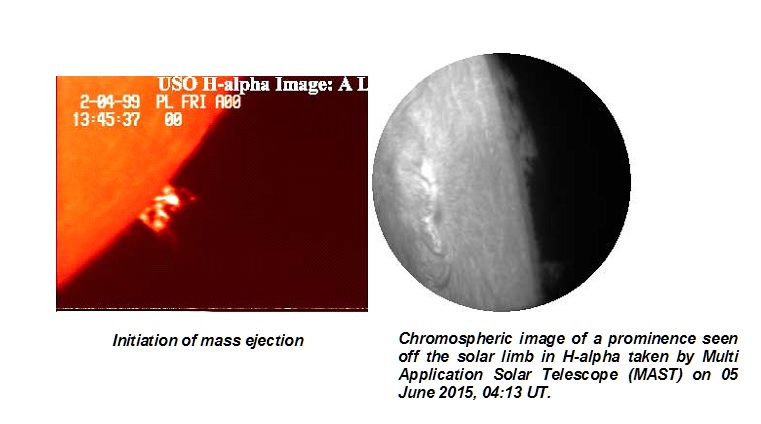
  • Objective: Aditya L1 will study the Sun’s corona (Visible and Near infrared rays), Sun’s photosphere (soft and hard X-ray), chromosphere (Ultra Violet ), solar emissions, solar winds and flares, and Coronal Mass Ejections(CMEs), and will carry out round-the-clock imaging of the Sun.
  • Challenges: The distance of the Sun from Earth ( approximately 15 crore kms on average, compared to the only 3.84 lakh kms to the Moon).This huge distance poses a scientific challenge.
    • Due to the risks involved, payloads in earlier ISRO missions have largely remained stationary in space; however, Aditya L1 will have some moving components which increases the risks of collision.
    • Other issues are the super hot temperatures and radiation in the solar atmosphere. However, Aditya L1 will stay much farther away, and the heat is not expected to be a major concern for the instruments on board.
Credits- Third Party Reference

Importance

  • Evolution of every planet, including Earth and the exoplanets beyond the Solar System, is governed by its parent star i.e the Sun in our case. The Solar weather and environment affects the weather of the entire system. Therefore, it is important to study the Sun.
  • Effects of Variation in Solar Weather System: Variations in this weather can change the orbits of satellites or shorten their lives, interfere with or damage onboard electronics, and cause power blackouts and other disturbances on Earth.
  • Knowledge of solar events is key to understanding space weather.
  • To learn about and track Earth-directed storms, and to predict their impact, continuous solar observations are needed.
  • Many of the instruments and their components for this mission are being manufactured for the first time in the country.

Lagrange Point 1

  • Lagrange Points, named after Italian-French mathematician Josephy-Louis Lagrange, are positions in space where the gravitational forces of a two-body system (like the Sun and the Earth) produce enhanced regions of attraction and repulsion.
  • The L1 point is about 1.5 million km from Earth, or about 1/100th of the way to the Sun.
  • L1 refers to Lagrangian/Lagrange Point 1, one of 5 points in the orbital plane of the Earth-Sun system.
  • These can be used by spacecraft to reduce fuel consumption needed to remain in position.
  • A Satellite placed in the halo orbit around the Lagrangian point 1 (L1) has the major advantage of continuously viewing the Sun without any occultation/ eclipses.
  • The L1 point is home to the Solar and Heliospheric Observatory Satellite (SOHO), an international collaboration project of National Aeronautics and Space Administration (NASA) and the European Space Agency (ESA).

Aditya L1 Mission

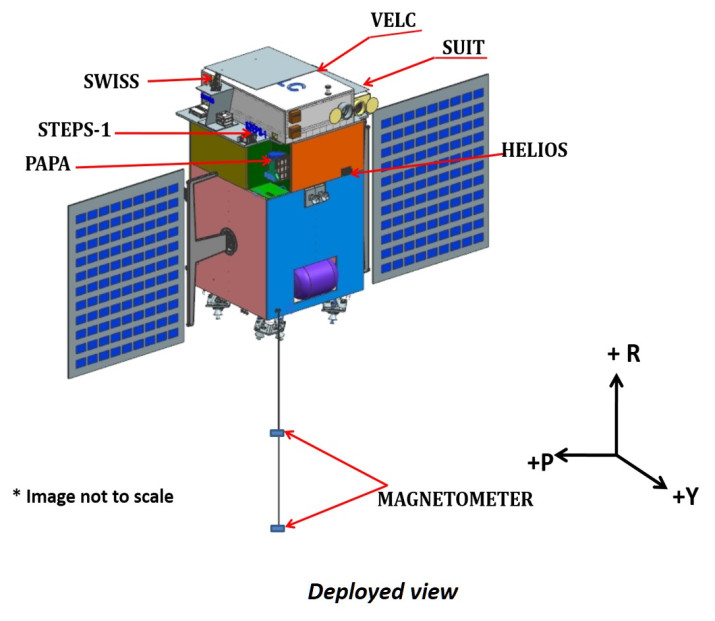
The Aditya-1 mission has conceived as a 400kg class satellite carrying one payload, the Visible Emission Line Coronagraph (VELC) and was planned to launch in a 800 km low earth orbit.  A Satellite placed in the halo orbit around the Lagrangian point 1 (L1) of the Sun-Earth system has the major advantage of continuously viewing the Sun without any occultation/ eclipses.  Therefore, the Aditya-1 mission has now been revised to “Aditya-L1 mission” and will be inserted in a halo orbit around the L1, which is 1.5 million km from the Earth.  The satellite carries additional six payloads with enhanced science scope and objectives.

The project is approved and the satellite will be launched during 2019 – 2020 timeframe by PSLV-XL from Sriharikota.

Aditya-1 was meant to observe only the solar corona.  The outer layers of the Sun, extending to thousands of km above the disc (photosphere) is termed as the corona.  It has a temperature of more than a million degree Kelvin which is much higher than the solar disc temperature of around 6000K. How the corona gets heated to such high temperatures is still an unanswered question in solar physics. 

Aditya-L1 with additional experiments can now provide observations of Sun’s Corona (soft and hard X-ray, Emission lines in the visible and NIR), Chromosphere (UV) and photosphere (broadband filters).  In addition, particle payloads will study the particle flux emanating from the Sun and reaching the L1 orbit, and the magnetometer payload will measure the variation in magnetic field strength at the halo orbit around L1.   These payloads have to be placed outside the interference from the Earth’s magnetic field and could not have been useful in the low earth orbit.

Credit- Third Party Reference

The main payload continues to be the coronagraph with improved capabilities.  The main optics for this experiment remains the same.  The complete list of payloads, their science objective and lead institute for developing the payload is provided below:

  • Visible Emission Line Coronagraph (VELC): To study the diagnostic parameters of solar corona and dynamics and origin of Coronal Mass Ejections (3 visible and 1 Infra-Red channels); magnetic field measurement of solar corona down to tens of Gauss – Indian Institute of Astrophysics (IIA)
  • Solar Ultraviolet Imaging Telescope (SUIT): To image the spatially resolved Solar Photosphere and Chromosphere in near Ultraviolet (200-400 nm) and measure solar irradiance variations – Inter-University Centre for Astronomy & Astrophysics (IUCAA)  
  • Aditya Solar wind Particle Experiment (ASPEX) : To study the variation of solar wind properties as well as its distribution and spectral characteristics – Physical Research Laboratory (PRL)        
  • Plasma Analyser Package for Aditya (PAPA) : To understand the composition of solar wind and its energy distribution – Space Physics Laboratory (SPL), VSSC        
  • Solar Low Energy X-ray Spectrometer (SoLEXS) : To monitor the X-ray flares for studying the heating mechanism of the solar corona – ISRO Satellite Centre (ISAC)
  • High Energy L1 Orbiting X-ray Spectrometer (HEL1OS): To observe the dynamic events in the solar corona and provide an estimate of the energy used to accelerate the particles during the eruptive events – ISRO Satellite Centre (ISAC)and Udaipur Solar Observatory (USO), PRL
  • Magnetometer: To measure the magnitude and nature of the Interplanetary Magnetic Field – Laboratory for Electro-optic Systems (LEOS) and ISAC.

With the inclusion of multiple payloads, this project also provides an opportunity to solar scientists from multiple institutions within the country to participate in space based instrumentation and observations.  Thus the enhanced Aditya-L1 project will enable a comprehensive understanding of the dynamical processes of the sun and address some of the outstanding problems in solar physics.

Other Missions to the Sun

  • NASA’s Parker Solar Probe’s aim is to trace how energy and heat move through the Sun’s corona and to study the source of the solar wind acceleration.
    • It is part of NASA’s ‘Living With a Star’ programme that explores different aspects of the Sun-Earth system.
  • The earlier Helios 2 solar probe, a joint venture between NASA and space agency of erstwhile West Germany, went within 43 million km of the Sun’s surface in 1976.

A more recent technical report on this topic by Dr. Angel, in which the idea is taken to another stage in development using only electromagnetic launch from Earth and no construction on the Moon or at L1

So we hope these mission will able to unveiled the secret of Sun’s Atmosphere and its Corona. Aditya L1 mission will create history for Indian Space Program and proved to be landmark as expected.

Reference- https://www.drishtiias.com/