Hindi is the language of coexistence. Its growth will never be at the cost of any other language: Shri Amit Shah

Union Minister of Home Affairs Shri Amit Shah graced the Hindi Divas Samaroh 2019 as Chief Guest today at Vigyan Bhawan in New Delhi. Also present on the dais were Ministers of State for Home Affairs Shri Nityanand Rai and Shri G Kishan Reddy, as well as Secretary and Joint Secretary, Department of Official Language.
Shri Shah said that while unity in diversity is India’s defining trait, a common language is needed as a culturally unifying factor. Shri Shah remarked that even Gandhi ji and Sardar Patel, who forged a united India, appealed to people to accept Hindi as the national language. Shri Shah lauded the work done by the Department of Official Language in popularizing Hindi, and appealed to citizens to work towards making Hindi the most widely used language in the world. Shri Shah also emphasized Hindi as a factor that unites India.
Shri Shah appealed to all to get connected with Hindi. He noted the unanimous consensus for Hindi as national language in the Constituent Assembly, in spite of the Assembly’s sheer diversity. He said that this decision was an important factor in ensuring cultural unity of India. Noting on the linguistic richness of India, he said that the nation was home to 122 languages and more than 19500 dialects.
Shri Shah said that a country that forgets its language kills its cultural existence. Language connects us to the roots of the nation. Addressing the youth of India, Shri Shah called for introspection and said that if we lose our language, we will be cut off from our culture. He asserted that the richest languages of the world belong to India. The depth of Indian languages is unparalleled, because of the equally unparalleled depth of Indian culture. 
Shri Shah said that we must leave the inferiority complex towards Hindi and our other languages that has set in due to colonial hangover. He called for greater use of the national language in all aspects of life. He said that only when we understand the importance of Hindi, can it thrive and prosper. He said that we must be proud of our language. Noting the role played by teachers in the growth of languages, he said that teachers and educators must instil a sense of pride about Hindi in students.
Shri Shah said that while diversity in languages is the strength of our nation, a national language needed so that foreign languages and cultures do not overpower our own. He proclaimed that next year, the Hindi Divas Samaroh would be a public program, as Hindi belongs to the people. He said that the Government would take Hindi Divas outside Delhi, and would celebrate a Hindi Saptah across the country. He called Hindi the heart and soul of the freedom struggle.
Shri Shah noted Vinoba Bhave’s love for Hindi and Gandhi ji’s assertion that a nation is mute without its national language. He said that our power to express our culture will die in the absence of our national language. Quoting Dr. Ram Manohar Lohiya, Shri Shah said that without Hindi, democracy is not possible in India. The language of the state should be that which people can understand. He remembered Purushottamdas Tandon, who proclaimed national language to be the lifeblood of a nation.
Shri Shah remembered former Prime Minister Shri Atal Bihari Vajpayee as the first Minister of External Affairs to give a speech in Hindi at the United Nations in 1977. He hailed this as a seminal step to break the inferiority complex of Indians with respect to Hindi. He also hailed former Minister of External Affairs Sushma Swaraj’s contribution to the global growth of Hindi, who encouraged the UN to use more Hindi, including on Social Media. This eventually led to the Hindi Twitter account of the UN.
Praising the Prime Minister’s commitment to Hindi, he noted that  wherever the Prime Minister addressed expatriates, he spoke in Hindi. Shri Shah noted that the Prime Minister addressed even the  UN General Assembly and the World Economic Forum in Davos in Hindi, making him the first head of government to address WEF in a national language other than English. 
Shri Shah called upon institutions and individuals to be committed to the growth and use of Hindi. He spoke of the need to proliferate Hindi in technical fields like medicine, engineering and law. He expressed confidence that Hindi would have reached ever greater heights by 2024 elections. He asserted that the growth of Hindi will never be at the cost of any other language and added that Hindi is the language of coexistence.
Speaking on the occasion, Minister of State Shri G Kishan Reddy said that while Telugu was his mother tongue, he had equal love for Hindi. He said that a mother tongue and national language must go together. He noted that the Constituent Assembly accepted Hindi as a national language, as it had been the unifying thread between cultures,  religions and regions during the freedom struggle. He called Hindi a source of self-pride for the country. He noted the famous Tamil poet Subramania Bharathi’s love for Hindi. He added that Hindi is India’s greatest social and cultural heritage and is emerging as a powerful cultural capital of India. He remarked that even multinational firms were accepting Hindi as a functional language. He noted the growing popularity of Hindi with India’s films, and said that the growth of Hindi on the global stage adds to India’s soft power. He advocated a greater use of IT for the development and popularization of Hindi.
Minister of State Shri Nityanand Rai said that languages are the souls of societies and nations. People express themselves in their languages. He added that Hindi consists of our emotions and aspirations, and acts as a connecting language for the whole of India. He called Hindi the symbol of India’s democratic system and said that our nation’s identity depends on the strength and popularity of our national language. He noted that the Constitution has given us the responsibility of the growth and development of Hindi and called for greater use of Hindi in the official work of Union Government and that of various regional languages in the official work of State Governments. He said that Antyodaya is our goal, and Hindi plays a vital role in achieving that goal, as it is the commonest language of communication across the nation. 
Shri Shah launched the E-Saral Hindi Vakya Kosh and E-Maha Shabda Kosh Mobile App, both initiatives of the Department of Official Language that aim to harness information technology for the growth of Hindi. He awarded Rajbhasha Gaurav Puraskar and Rajbhasha Kirti Puraskar to government departments and public sector units respectively for their contribution to Hindi.

The 15th Finance Commission meets with the Ministry of Women and Child Development

The 15th Finance Commission headed by Shri N.K. Singh and including Members and senior officials of the Commission held a meeting with the Union  Minister for Women & Child Development Smt. Smriti Z Irani and her team of senior officials of the Ministry of WCD.
  
The Ministry’s proposals for enhanced allocations for its important schemes covering Anganwadi Services, Poshan, Women Welfare, Women Safety, Women Empowerment were discussed in details.
Among its major recommendation for the consideration of the Commission: 
  • The Ministry of WCD has requested the 15th Finance Commission to include gender Budgeting in its fiscal devolution formula. 
  • In the Commission’s Vertical Devolution the Ministry has requested for prioritizing gender concerns within schemes/ programmes – with a minimum compulsory allocation of 25% to 40%.
  • In its horizontal devolution the Commission has been requested to incorporate gender criteria (Child Sex Ratio and Female Labour Force Participation) as a criteria for horizontal devolution of funds between States. 
  • The Commission has also been asked to provide for basic and performance grants under which additional activities could be added to current activities of Local Bodies for promoting gender equality.
The Ministry of WCD has also called for: 
  • Incentivizing performance: States with better performance in Women Education/ Health Outcomes/ LFPR/ Nutritional Outcomes may be considered for incentive grants.
  • Fiscal Equalization: Gap funding for States to reach normative levels of social sector spending.
  • Enhanced Funding: up from 1% to 1.5% of the Union Budget for WCD.
  • Development of CDI/ GDI based on International Practice.
  • Revamped indicator for women participation in workforce.
  • Increased allocation for Health and Education.
  • Reservation of certain percentage of funds for Women centric development works by local bodies.
  • Increased funding for capacity building of elected women representatives.
  • Women & Wataer: Jal Shakti Abhiyan / Augmentation of Water Resources.
  • Mechanism for single data source for SDGs with Annual Measurements.
The Commission has noted all the issues raised by the Ministry and has assured that they would look into all of them carefully while framing its  report to the Union Government

JALDOOT’ will encourage people’s participation for Water Conservation

Union Minister for Environment, Forest & Climate Change and Information & Broadcasting, Shri Prakash Javadekar said today that ‘Jaldoot’ is a unique initiative and it will take the message of water conservation to masses.  After flagging off  the ‘Jaldoot’  a travelling exhibition arranged by Regional Outreach Bureau , Pune under the Ministry of Information and Broadcasting, Mr. Javadekar said that Jaldoot will visit 8 districts of Maharashtra in next 2 months will also tell about the work done by the government in last 100 days. The exhibition highlights bold initiatives and decisive actions taken by the government.   
 
The Jaldoot will travel trough Pune , Ahmadngar, Nashik, Jalgaon , Buldhana, Amravati  and Solapur districts. Mr Javadekar further said that Modi government has given the priority for water conservation; a new ministry of Jalshakti has been formed to ensure that there will not be scarcity of water in the country. The central government is committed to provide water to every household by 2024 he added. On this occasion ‘Swachhta’ oath was administered by Shri Javadekar to participants. Shri Javadekar also appreciated the exhibition prepared for this.  
 
Shri Girish Bapat, Member of Parliament ,Smt Supriya Sule, Member of Parliament , Shri Satyendra Sharan, Director General, Regional Outreach Bureau, Shri R . N. Mishra Director General Press Information Bureau West Zone, Shri D J Narein ADG , Shri Santosh Ajmera Joint Director ROB Pune and other dignitaries were present.   
Jaldoot: Backgrounder
  • The Hon’ble Prime Minister, has launched the campaign on ‘Janshakti se Jalshakti’ abhiyan. The people are to join hands for water conservation and create a jan-andolan along the lines of the Swachh Bharat Mission, to save water and secure the future.
  • To tackle the water crisis looming the country, the Government of India launched the JALSHAKTI ABHIYAN, a water conservation campaign focusing on 1592 stressed blocks in 256 districts across the country.
  • The Regional Outreach Bureau, ROB, with its headquarter at Pune for Maharashtra and Goa region is the office under the Ministry of Information and Broadcasting, Government of India. It takes care of various outreach activities and development communication needs of the Central Government.
  • ROB in association with MSRTC (Maharashtra State Road Transport Corporation) is launching the Jaldoot campaign. The ROB has redesigned the bus, to create the Jaldoot : Travelling Exhibition on Jalshakti Abhiyan. The exhibition consists of various information display panels and Audio-Visual components. The Song &Drama Division cultural troupes and artists travelling along the bus would create awareness about the Government’s initiative.
  • The field units at those locations would have different activities like competitions, rallies, cultural programmes on the side-lines of visit of the bus, in order to create awareness on water conservation efforts.
  • The JALSHAKTI ABHIYAN focus on five key aspects:
  • Water Conservation and Rain Water Harvesting
  • Renovation of Traditional and other Water Bodies
  • Reuse of Water and Recharging of structures
  • Watershed Development
  • Intensive Afforestation

Nine Lakh Youth from Pune have benefitted from MUDRA Scheme: Union Minister Shri Prakash Javadekar

Nine Lakh Youth from Pune have benefitted from Mudra Scheme, schemes like Bharatnet, Ayushman Bharat, Pradhan Mantri Matrutv Vandana Yojana too are making rapid progress, said Union Minister for Environment, Forest & Climate Change and Information & Broadcasting, Shri Prakash Javadekar. He was speaking after the first meeting of District Development Co-ordination and Monitoring Committee (DISHA) in Pune, which took place today under the chairmanship of Shri Javadekar.
The Minister said, “Meetings of Disha are held to plan for the schemes, and monitor their execution. Mudra scheme is making rapid progress in the district and 9 lakh youths from district have been allotted loans worth Rs 8000 crore under it. Out of 58 railways stations in Pune division, 46 have been equipped with wifi facility. 5 Escalators too have been installed.”
“The Passport Seva Kendra in Baramati has distributed 5000 passports so far and has made the life of layman easier. Passport seva kendras have been started at 50 places in 5 districts. Bharatnet has given optical fibre connections to 790 Gram Panchayats in district and among them 155 have wifi facility, with average daily use of 20 GB. The schools are being provided with sports material and sports hour too will be made compulsory in schools”, Shri Javadekar added.
The Minister further said that National Health Mission comprising Ayushman Yojana and othe schemes has succeeded in reducing the Infant Mortality rate, Maternal Mortality rate, birth rate and death rate in Pune. “60,000 women in Pune have so far benefitted from Pradhan Mantri Matrutva Yojana.The target for building of toilets has also been achieved and the ranking of Pune in Swachhta has jumped from 10th place to 2nd place. The anganwadis are making rapid progress due to participation of people”.
While wishing the people on the occasion of Hindi Divas, Shri Javadekar reiterated the government policy of promoting all regional languages. He allayed the fear of local languages dying out and cited the increasing use of Hindi on the internet. He further said, rarely ever is such linguistic diversity seen in any other country. 
Members of Parliament Shri Girish Bapat and Smt Supriya Sule were also present on the occasion.

Photojournalism

Photojournalism is a specific type of journalism that utilizes pictures
so as to recount to a news story. It is presently typically comprehended
to allude just to even now pictures, yet at times the term likewise
alludes to video utilized in communicate news coverage. Photojournalism
is recognized from other close parts of photography by consenting to an
unbending moral system which requests that the work be both fair and
fair-minded while recounting to the story in carefully journalistic
terms. 
Photojournalists make pictures that add to the news media, and
help networks associate with one other. Photojournalists must be very
much educated and proficient about occasions happening directly outside
their entryway. They convey news in an innovative arrangement that isn’t
just educational, yet additionally engaging. Photojournalism began to
come to fruition when picture takers could without much of a stretch
transport cameras into combat areas.

Media Ethics

Media ethics is the subdivision of connected morals managing the
particular moral standards and benchmarks of media, including
communicate media, film, theater, expressions of the human experience,
print media and the web. The field covers many differed and very
questionable points, running from war reporting to Benetton
advertisement battles. Worldwide media ethics goes for building up a far
reaching set of standards and models for the act of reporting during a
time of worldwide news media. New types of communication are reshaping
the act of a once parochial art serving a nearby, provincial or national
open. 
A similar innovation enables news media to spread this data to
gatherings of people dissipated the world over. Media ethics includes
advancing and safeguarding qualities, for example, a general regard
forever and the standard of law and legality. Writing with respect to
the manners by which explicitly the Internet impacts media morals in
news coverage online is rare, subsequently confounding the thought for
an all-inclusive code of media ethics.

Career options in India: Disaster Management as a career Option

Disaster Management is an essential requirement of a modern society. Growing population and critical ecological balance have increased the risk of disaster. Natural disasters like- flood, cyclones, tsunami, flash floods, earthquakes; and man-made disasters like- fire incidents, train/plane crashes, civil structure collapses are just around the corner. The dense population and intense economic activities have raised the potential of the impact of these disasters astronomically. Natural disasters alone have taken 2 million lives according to UN estimates and another 800 million lives were affected directly or indirectly.
Therefore, the need of managing such disasters is more than ever before. The society and governments need to be ready for disasters beforehand; manage the disasters when they occur so that the impact is minimal and rehabilitating fast so that life gets back on the track. Disaster Management is basically a course to do these activities professionally and more systematically.


Career Options

Disaster Management roles can be categorized in 3 major categories-
  1. Disaster Prevention- Disaster prevention is one of the major and most important task of disaster managers. It is focused on activities and measures undertaken to prevent the occurrence of natural disasters and human hazards.
  2. Disaster Preparedness- This would concern with planning, monitoring and policy making regarding disaster management and safety practices.
  3. Disaster Relief- This is managing the disaster hit. Here the focus would be on the immediate recovery- minimizing impact on economy and lives.
  4. Disaster recovery- Here the focus is on bringing the lives back to normalcy. Rehabilitation of people, rebuilding of houses and restarting of economic activities. It would also involve studying the impact of the disaster and cultivating the learning to mitigate the disaster better the next time.


Pros and Cons of a career in Disaster Management

Pros
  • This career gives opportunity to help disaster victims and save lives.
  • By helping to prepare better for disasters, you can help country and society to save millions 
  • The work is exciting and adventurous.
  • As world is learning more about the disasters, the career options are on growth.
Cons
  • The field is still emerging, and the career options and payments are somewhat limited.
  • The work is often in remote areas and on the disaster struck locations.
  • The adventure also comes with significant risk.


How to pursue a career in Disaster Management?

You can complete your graduation in any stream and pursue masters in Disaster Management. You can follow this up with PhD.
The alternative path can be- after competing graduation and take a diploma in Disaster Management.


Top Disaster Management Institutes in India

College
Location
Website
Jamsetji Tata Centre for Disaster Management, Tata Institute of Social Sciences (TISS)
Mumbai
Indian Institute of Ecology and Environment
New Delhi
National Institute of Disaster Management (NIDM)
New Delhi
Indira Gandhi National Open University
New Delhi
School of Distance Learning (Annamalai University)
Annamalai, Tamil Nadu
University Centre for Disaster Management (Guru Govind Singh Indraprastha University)
Dwarka, Delhi
School of Distance learning (Sikkim Manipal University of Health, Medical and Technological Sciences)
Manipal
Department of Geography (Panjab University)
Chandigarh
International Centre of Madras University (Madras University)
Chennai
The Global Open University
Nagaland
National Civil Defense College
Nagpur
Asian Institute of Fire Safety
Chattisgarh
Faculty of Environmental Science, Rajiv Gandhi University
Arunachal Pradesh
North-Eastern Hill University
Shillong


Job Opportunities

As discussed earlier, the job opportunities are still growing in this sector. However, government is updating regulations about this regularly. Manufacturing plants are already required to have safety officers. Government has also constructed NDRF team. 

Other than the organized sector, plenty of opportunities lie with World Bank, UN agencies and NGOs.

The allure of the journal impact factor holds firm, despite its flaws

Many researchers still see the journal impact factor (JIF) as a key metric for promotions and tenure, despite concerns that it’s a flawed measure of a researcher’s value.
A journal’s impact factor indexes the average number of citations its recently published articles receive. As critics have noted, it’s often driven by a small number of highly cited articles, is vulnerable to being gamed by editorial policy, and is not calculated in a transparent way. Nonetheless, it remains an integral part of the Review, Promotion and Tenure (RPT) process at many academic institutions.
A recent survey of 338 researchers from 55 universities in the United States and Canada showed that more than one-third (36%) consider JIFs to be “very valued” for promotions and tenure, and 27% said they were “very important” when deciding where to submit articles.
The survey was led by Meredith Niles, assistant professor at the Department of Nutrition and Food Sciences at the University of Vermont, and was part of a larger study, published as a preprint on bioRxiv, investigating how researchers feel about the JIF.
It found that the respondent’s age or status had no bearing on what they perceived to be the value of the JIF in the RPT process. But non-tenured and younger researchers, for whom RPT matters most, put more weight on JIFs when deciding where to publish.
The respondents also indicated a belief that their peers placed more importance on the JIF than they did. Niles describes this as a form of “illusory superiority”, whereby people tend to view themselves in a more favourable light than others.
This result indicates the need for “honest conversations” about what really matters when communicating academic research, Niles says.
“If we don’t actually care about the JIF as much as factors such as readership and sharing the results of our work with people who can most advance our field, then let’s stop pretending we care and treating it as the gold standard.”
A call for research assessment reform
The survey follows a study from the same project, published in eLife last month, which analyzed the text of 864 RPT documents from 129 North American universities.
Overall, 30 of the institutions (23%) referred to impact factors or related phrases such as “high impact journal” in at least one of their RPT documents. That figure rose to 40% for research-intensive institutions.
“Faculty often talk about impact factors as featuring heavily in evaluations, but we weren’t aware of any studies that had tried to quantify its use,” says lead author, Erin McKiernan, professor in the Biomedical Physics programme at the National Autonomous University of Mexico.
Among the 30 universities that mentioned impact factors, the majority (87%) supported their use. Just four (13%) expressed caution against using them.
McKiernan notes that the analyses did not include possible indirect references to JIFs such as “top-tier journal”. “We may be seeing only the tip of the iceberg,” she says.
According to Björn Brembs, a neuroscientist from the University of Regensburg, in Germany, who reviewed the study for eLife, the continuing deference to the JIF shows how scientists can be highly critical in their own subject domain, yet “gullible and evidence-resistant” when evaluating productivity.
“This work shows just how much science is in dire need of a healthy dose of its own medicine, and yet refuses to take the pill,” he says.
Anna Hatch, community manager of the San Francisco Declaration on Research Assessment(DORA), which cautions against the use of journal-level metrics in academic evaluations, adds that the results provide an important benchmark by which to measure progress in research assessment reform.
“I hope the findings inspire faculty, department chairs, and other university administrators to examine their RPT documents and, if necessary, have frank discussions about how to best evaluate researchers without relying on proxy measures of quality and impact,” she says.

A Guide For Building Sustainable Smart Cities

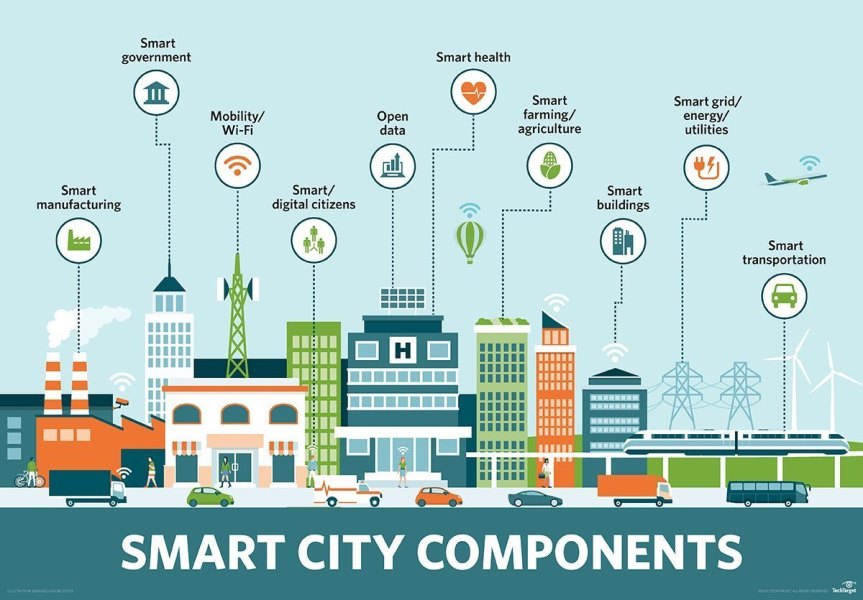
Smart cities must fulfil the need for sufficient fresh water, universal access to cleaner energy, ability to travel efficiently from one point to another, sense of safety and security, among others. Smart cities need to be able to efficiently combine a smart physical layer (ability to use sensors to connect physical assets like buildings, public transportation, energy grid, etc) with a smart digital layer (increasingly mixing capabilities like Big Data, AI, the IoT and the like) to crunch data collected and turn it into actionable decisions on the field, in a cost-efficient way.
Smart cities help create an urban environment for adapting to the needs of the population in the most environment-friendly, economically and socially-conscious way. These cities use data from people, vehicles, buildings and things to improve citizens’ life and minimise the environmental impact of the cities. These are continuously monitored through the Internet of Things (IoT) to maximise efficiency. Smart cities operate as one big data-driven ecosystem to avoid accidents, emissions and congestion. These employ a combination of low-power sensors, wireless networks, and Web and mobile-based applications, and use technology and data purposefully to make better decisions and deliver a better living experience.
Smart cities are collaborative projects that bring together technology, industry and governments. Technologies used for smart cities should be able to share data in an efficient, secure and open manner. Successful smart-city projects collect, manage and use data to improve living and workplace standards. Application-driven data is used by both humans and artificial intelligence (AI) to deliver back innovation and efficiencies to the cities.

Why a city needs to be smart

Cities are a pillar of our economic growth. But these can have several inefficiencies with the growing population due to migrators from less-developed cities and villages. Cities can be called developed when there is availability of good education, healthcare facilities, job opportunities, transport facilities, sanitation facilities, and good law and order practises to provide safe and secure places to live.Making a city smart means utilising digital technology and data to solve such problems as traffic management, waste management, monitoring available parking spaces, controlling humidity and temperature levels in the environment, maintaining quality of tap water, waste-water management, sound monitoring and so on.
Cities can be smart but still not livable. Hence, the aim of making smart cities should be to use technology as a tool to deliver sustainable solutions. Technologies like the Internet, the IoT, smartphones, smart meters, smart plugs, smart taps or showers, and other networks of sensors can be used to develop such cities.

What makes a city smart

Smart cities must include infrastructure that helps provide a better quality of life for its citizens. Adapted smart solutions should create a cleaner and more sustainable environment. Data helps in accessing patterns or inefficiencies to improve living standards for the citizens. The same data can be used to better plan the cities in the future and create a framework for smart cities that constantly get more efficient over time.
Smartphones help provide instant information about transit, traffic, health services, safety alerts, community news and everything else needed to know about the cities, in real time. These provide notifications about the best times to travel, personalised energy usage, tips for improving eating habits, etc.
Stephane Dejean, chief marketing officer, Kerlink, says, “From rural towns to bustling metropolises, municipal officials around the world are facing increasing challenges raised by climate change, population growth, appropriate infrastructure development and access to basic sanitation. Leveraging IoT networks, authorities can streamline the use of city infrastructure and deliver tailored services to citizens, while monitoring critical indicators.
“Cities now have the opportunity to easily, flexibly and cost-efficiently deploy, operate and monetise carrier-grade IoT connectivity on their own. These networks turn out to be key assets that cities want to control, financially and/or operationally, and that can be combined to power a growing diversity of use cases. Considering their budget challenges, cities are also looking for a better trade-off between financial sources and possible business models over time. Opting for a relevant alternative like low-power wide-area networks (LPWAN) and selecting a partner that can quickly and easily adapt to evolving collaboration models enable cities to address both their technical needs and financial challenges.”

Developing a sustainable city

To build future-ready smart cities, there are a few fundamental things that are required to establish a stable and adaptable framework.

Smart infrastructure

This is required to establish a foundation for digital economic development. Heating, energy usage, lighting and ventilation in buildings are managed and optimised by technology. Water-leakage detection and water potability monitoring are integrated into smart buildings. Rooftop gardens or side vegetations are integrated into building designs to produce oxygen and absorb carbon-dioxide.
Smart infrastructure also includes city-wide Wi-Fi for public use to provide real-time information on traffic congestion, parking spaces and other amenities. The aim of smart parking is to reduce both car emissions and traffic.
Smart roads are prepared for autonomous vehicles and self-driving car traffic system integration. With smart drainage systems and filtration, cities could drastically improve local living conditions. Smart lighting control systems reduce energy consumption, carbon emissions and maintenance costs, while providing a safe environment.

Security

Creating cities that are affordable and safe should be the priorities. This ensures secure and efficient operation of critical applications developed for the smart cities, which rely on constant connectivity to volumes of data from stationary and moving sensors, which is transformed into useful information through data analytics to provide a better quality of life. Failure to secure this data can cause extreme damage.
Be it a residential complex, market, school, hospital, district centre or public transport, sustenance of any urban setup is impossible without robust security measures. But with the advent of AI, the concept of a smart city is viable as well as feasible. AI has empowered security to automatically learn and detect crimes.

Sustainable energy

Solar panels are integrated into building design, replacing traditional materials. Solar and wind energy can be collected throughout the day by fully integrating these into roads, buildings and residential areas. Smart grids are used for energy consumption monitoring and management. These conserve energy in places that might not need power and then send it to areas that may need even more power.
A building can become entirely self-sufficient by using technology like solar windows. Unused energy generated can be offered to vehicles in the local area. By 2060, cargo will travel through hyperloop and will be moved rapidly around the world in smart containers that know their contents and their destination. Ports themselves will be automated, running on renewable energy and having zero carbon emissions.
Development of smart cities will require more energy, so the focus should be on sustainable energy sources. For example, cities can pave the roads with some kind of material that converts solar energy into electricity. Automobiles can be equipped with solar panels on roofs. Autonomous, environment-friendly, efficient transport can save time and money, too.

Digitalisation and automation

Smart cities use IoT devices and sensors to gather and analyse information across the infrastructure. This helps city authorities to intelligently manage their assets, increase efficiency, revolutionise transport, reduce costs and enhance the overall quality of life for residents.

Management

This is the last but the most important stage of building a smart city. It requires a platform that features AI and machine learning to monitor and improve smart city projects.

Initiatives for making smart cities

A prime example here is managing energy use in buildings—heating, air-conditioning and lighting—while maintaining comfortable room temperatures, monitoring facility status like occupancy and availability. These end-to-end solutions offer user-friendly apps on officials’ smartphones and provide programmed, automatic rule-based responses to changing environmental or weather conditions. Monitoring and counting the movements and whereabouts of building occupants or citizens in public areas also bring an effective smart-city application. The same way, LoRaWAN’s native geolocation capability also enables cities to track their assets.
Sustainability is a critical aspect of smart-city networks. Outdoors, cities can leverage low-power wide-area (LPWA) sensors and networks for traffic monitoring, streetlighting, parking availability, waste collection in addition to noise detection, like gunshots, and environment sensing.
In Kakinada, India, Kerlink’s Wirnet TM stations are powering a comprehensive, ambient air-quality monitoring system designed by Oizom that monitors air and noise pollutions and other environmental hazards.
Chengyang is a smart city project established by Huawei. It converts a wasteland into arable land capable of growing seawater rice using a combination of sensors, wireless and deep learning technologies. It feeds 80 million people using previously unusable land. This innovation is now being applied in other parts of the world.
India Maven, a smart-city solution provider from Pune, provides smart solutions in the fields of water and energy metering, lighting, agriculture, ambulance tracking, medical wearables, firefighting, city-pollution monitoring, smart parking, renewable energy management system and intelligent traffic management.
Dejean adds, “With increasing vital IoT deployments for cities, utilities, airports, harbours, farms, manufacturing plants and other sectors, we have LoRaWAN IoT connectivity building block. We also have industrial-grade network infrastructure—indoor and outdoor carrier-grade range of LoRaWAN gateways—with a full suite of user-centric value-added services that empower cities of any size to efficiently manage their IoT connectivity. The Wanesy Management Center, Kerlink’s Wanesy Geolocation and Wanesy Device Management solution value-added services can help cities not only manage/locate their assets and remote sensors, but also help them improve the services they grant to their citizens, like traffic information, parking availability, weather forecast, public-building attendance and public-private partnerships (PPP).”
Smart City Expo World Congress is looking to establish frameworks that will shape the collaborative approach to establish smart cities of the future. Its theme for 2018 was to determine how to structure smart cities in a future-proof and innovative manner.
International Electrotechnical Commission (IEC) Market Strategy Board brings together chief technology officers of leading companies to guide city planners and regulators, and develop standards in an effort to move cities to greater smartness.
Many places have a number of projects implemented on the ground, but these do not scale up because there are no steps taken at the national level or by individual government bodies. As more and more people are migrating towards cities, it is essential to develop a sustainable environment to make these places worth living. Human behaviour as a city dweller is changing, so everything has to be taken into account, including building material, climate, technology and so on while designing and building the cities of tomorrow.

Conclusion

Smart cities must fulfil the need for sufficient fresh water, universal access to cleaner energy, ability to travel efficiently from one point to another, sense of safety and security, among others. Smart cities need to efficiently combine a smart physical layer (ability to use sensors to connect physical assets like buildings, public transportation, energy grid, etc) with a smart digital layer (increasingly mixing capabilities like Big Data, AI, the IoT and the like) to crunch data collected and turn it into actionable decisions on the field, in a cost-efficient way. These cities need to meet the needs of current and future generations, and to maximise benefits while minimising the negative aspects of their daily living.

Land Pooling : A transformative step for Urbanisation

Shri
Hardeep S Puri, Minister of State (I/C) for Housing & Urban Affairs
has stated that the land pooling policy based on public private
partnership in land assembly in urban development represents a
paradigmatic shift, wherein land is being pooled and is to be developed
by private landowners. He further informed that the owners/group of
owners can pool land parcels of any size for development as per
prescribed norms and guidelines based on sectors as delineated in ZDPs.
“The Policy mandates that each sector will have a 60:40 ratio with 60%
of the land to be developed by Land owners/consortium for residential,
commercial, partly Public Semi Public (PSP) land uses and 40% of the
land to be used for various city level infrastructure requirements
including roads, greens, PSP facilities, development of utilities i.e.
water, sewerage, electricity etc. with involvement of private sector”,
he added.  He was speaking at a Conference on ‘Land Pooling : Building
India Capital – Opportunities in Real Estate and Infrastructure
organized by Delhi Development Authority(DDA) in association with the
Federation of Indian Chambers of Commerce & Industry(FICCI), here
today.   Shri Anil Baijal, Lieutenant Governor of Delhi, Shri Tarun
Kapoor, Vice Chairman, DDA besides land developers, stakeholders and
urban planners were also present at the Conference.
Land Pooling :  A transformative step for Urbanisation

Dwelling
on DDA’s commitment towards operationalization of the policy on fast
track mode, the Housing Minister said that DDA had launched portal for
inviting Expression of Willingness for participation earlier
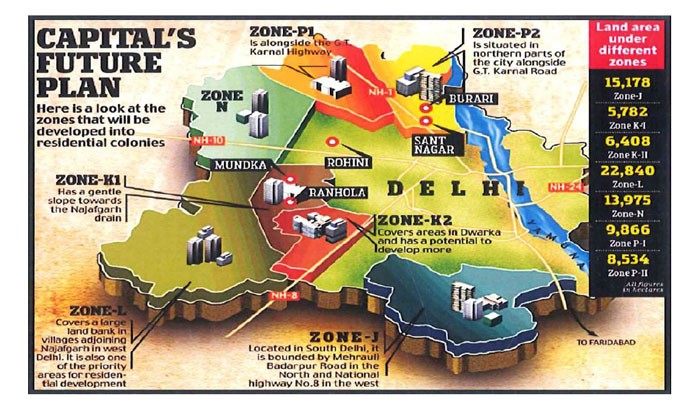
this year wherein any landowner of contiguous land parcel of any size
falling in 95 villages of Planning Zones K-1, L, N and P-II could come
forward to register on the website. DDA conducted an extensive public
outreach program to raise awareness about the policy and educate the
citizens of Delhi on its benefits. This outreach program has paid
dividends – as on 06.09.2019, a total of over 6000 hectares (approx) of
land has been registered under the portal expressing their willingness
for participation with maximum registrations in Planning Zone N.
The
Land Pooling Policy augurs well for shaping Delhi’s urban landscape,
bolstering economic growth and improving living standards. DDA proposes
to take up planning of the sectors which are likely to achieve the
minimum threshold of 70% as Model Sectors on priority to generate
momentum in real estate and infrastructure sector. Under the policy,
every 1000 hectares of pooled land will accommodate about 3,85,000
persons in approx. 85,000 Dwelling Units. About 17 lakhs Dwelling Units
are expected to be constructed  of which approx. 5 lakhs will be
available under EWS category. The housing generated under the Land
Pooling Policy will be a key input in economic, social, and civic
development of the city. Simultaneously, development of the trunk
infrastructure i.e. roads, water supply, electricity supply, etc. will
be taken up by DDA in coordination with the service providing agencies.
Shri
Anil Baijal, LG of Delhi during his address stated that the success of
the policy largely depends on the provision of fast, time bound planning
and development of city level infrastructure and infusion of capital
which will act as a catalyst for integrated development of the sectors
and zones. “While, DDA in close coordination with service providing
agencies such as Transco, DJB, local bodies etc will work towards it,
the participation of the private sector is equally important.  The
required capital investment for development of smart infrastructure,
housing, schools, medical facilities etc. requires deliberation on
collaborative models between DDA, Service providing Agencies, landowners
with investors/real estate segment. This conference is a step towards
this effort to partner and get on board Investors, Real Estate
Developers, Banking sector and experts for making this policy a
success.   Delhi is at the cusp of urban innovation and presents an
untapped opportunity for Real Estate and Infrastructure Development. It
is envisaged that Smart city solutions deployed in 109 land pooling
sectors will turn these new urban centres in ‘smart neighbourhoods’. The
envisioned city level development under the Policy will provide the
high speed transport system, world class infrastructure facilities i.e.
24 hours water supply, power, pipe gas connectivity, health and
education facilities in these green field areas. Therefore, it is
anticipated that significant yields for both land owners and investors
will be garnered with the implementation of the Policy”, he added.
Shri
Tarun Kapoor, VC, DDA expressed hope that this Conference will provide
an opportunity to deliberate key issues pertaining to development of
Delhi.  The industry perspective was provided by Mr.Sanjay Dutt,
Chairman, FICCI Real Estate Committee & Managing Director and Chief
Executive Officer, Tata Realty and Infrastructure Ltd.

Scholastic Journalism

Student journalists request brilliance
in training from their news coverage counselors and projects. They
request educating in media law and morals, mindful announcing, and
successful journalistic practices. They gain best from counsels who have
been prepared in expert gauges. Journalists teach people in general
about occasions and issues and how they influence their lives. 
They
invest quite a bit of their energy talking with master sources, looking
open records and different hotspots for data, and in some cases visiting
the scene where a wrongdoing or other newsworthy event occurred


Gender Equality

Gender equality is the condition of equivalent straightforward entry to
assets and openings paying little respect to gender. Gender equity is
accomplished when ladies and men appreciate similar rights and openings
over all divisions of society, including monetary interest and basic
leadership, and when the diverse practices, yearnings and requirements
of ladies and men are similarly esteemed and supported. 
The world is
gaining ground on propelling gender orientation uniformity. In any case,
there is still no place on earth where ladies are equivalent to men.
Ladies and young ladies overall face boundaries to accomplishing their
potential just due to their gender. These boundaries show from numerous
points of view and appear to be unique for some ladies. Gender equality
is the objective, while impartiality and sex value are practices and
mindsets that assistance in accomplishing the objective. Gender equity
is more than equivalent portrayal; it is firmly attached to ladies’
rights, and regularly requires strategy changes.

Art and Science of Teaching

Abstract

Teachers are the flag bearers of humanity. They spend their entire
lives making next-generation wiser and more productive to society. Demands from
the roles of teachers have been increasing with the growing vastness of the
subjects. Mere knowledge is not sufficient to be a good teacher. It is an art
to make the subjects lucid and interesting enough to get through the restless
younger generations; it is a science to keep the learning process more
objective and accurate. Teaching is perhaps the most perfect example of the
amalgamation of science and art into one.


Introduction

Our ability to think and process
information is what sets us apart from the monkeys. Humans are the only species
who have benefited from the number of years of their existence because they
accumulate knowledge and pass on to fellow human beings. We do not need to take
pain of learning to light fire or make wheels, because our forefathers did it
for us thousands of years back! And some of them took the responsibility of
teaching this skill to their next generation and the same has been being passed
on ever since. Unless there were responsible teachers in each generation, this
power of humanity would vanish.

Role of a Teacher

A teacher is the most important person
in our lives after our parents who kindles the life of others with his
knowledge and make them humane and productive. One cannot really learn things
without having a teacher in his life- formal or informal, but a teacher is must
to learn anything. Scriptures across the world sing of the praises of teachers.
In fact one Hindi proverb even goes to say that the teacher is even more
respectable than God himself.
Of course, the subjects to learn
have gotten more and more complicated over time. Early teachers like Aristotle and
Chanakya could have afforded to teach all the subjects ranging from political
science to philosophy to mathematics to science to economics. But now the
subjects have become much more complex. One person may really need to spend his
entire life to understand probably just one concept of one subject! Therefore,
the job and qualifications demanded of a teacher has become more complex.
A good teacher needs to have
sufficient professional or specialized knowledge in a particular subject. As Brad
Henry once said “A good teacher can inspire hope, ignite the imagination, and
instill a love of learning.

T
eachers need to accumulate knowledge and invest this in their students to
pave path of a good future to them with widen up thinking and absorbing ability
giving sense about the truth of life, and thus making them a more productive
member of society.
The teacher has to act as a
mediator between books and students and try to make ease their way of
understanding subjects.  He has to
encourage and build a friendly environment to facilitate learning, encourage
Q&A. He builds up a student confident enough to face the society, confident
enough to put their knowledge to test in the real world.
Therefore, behavioral training is
also a part of teaching that grows reciprocity and cooperation among students. The
teacher has to teach moral and ethical values to students.

Is teaching a science or an art?

Good teaching has
to blend emotions and feelings with objectivity of observations, measurements
and the precision of language. To make learning effective, the process has
to be interactive and objective. Without the use of the scientific method, the
learning may not have necessary impact. Therefore, it is essential to
scientifically proven processes like- discussions, active learning, distance
learning, and case studies, to facilitate learning.
But identifying
the correct set of tools to facilitate learning and perfect delivery of the
tool is actually an art. Creating a healthy environment is important for having
the desired impact of these techniques.
 Therefore good teaching is the perfect blend
for art and science.

Popular online Game – White Wizard slot game

Prepare to experience a whole new world of gaming with White Wizard slot, a slot game which is certain to captivate and put a spell on you. Well known for their character focused games, this White Wizard slot from Eyecon are sure to leave you spell bound. White Wizard slot submerges the player in worlds which collide and where magic and mystery are shrouded in the legacies of the wizards. You can play some of these games at Slotsbaby.com.
Loved in pop culture, it’s not a surprise that white wizard slot has already gained much momentum in the gaming world, and if you were a fan of harry potter, you’re sure to be a fan of white wizard slot. The word White in the title of the game, is so due to the good side of the world of magic, as the negative side of that is called black magic, as most of us know already. Like Gandalf from the Lord of the Rings, you’ll find plenty of white wizards in this captivating slot game, and these White Wizards are not to be missed, as they’ll be getting you the best possible wins throughout the game.
The playing aesthetic is vivacious, bright and colourful, but still with a simple overall look which looks as though it’s taken straight from a book of shadows. A colourful cartoon style backdrop of starts and wizards hats and other clothing transports you to a world of magic as you play. 
Gameplay on this UK slot game
The reels feature traditional playing card symbols which make up the lower values, and of the higher value symbols these consist of the things you’d find in any Wizard’s world, a magic wand, a book of spells – known as a grimoire or book of shadows – a cauldron with some spell liquid inside and a unicorn, could that be the wizard’s loyal trusty companion?
The wizard is a wild, and subs for all other symbols, and the scatter is an adorable blue dragon. 
White Wizard slot special features
The special features of White wizard slot are simple but none the less as effective. Which is great, as it does not distract from the game itself.
You get a free spins bonus which is the main special feature – to get this, just get three dragons on your reels and you will be rewarded with 15 free spins.
But what’s more, the fun doesn’t stop there – get more and find four of these and you get a massive total of 20 free spins! And, you guessed it, find 5 and you’ll get 25 free spins.
During the time when the dragon shows up more often you will also see the wizard more often, a massive perk of the game that some others don’t give players during bonus rounds.
This white wizard slot also features a gambling round, where you can win or lose fifty fifty depending on what choice you make, but do bear in mind win and your total is doubled, so gambling is a good choice if you’re feeling lucky.
Verdict
A great game full of fun and surprises that most other slot games don’t offer players. Well worth a go if you’re into all things magic.

Should I pay for additional Google One storage?

Best answer: If you use Google Drive for a home-based or small business, are a student, or have a hobby, such as photography, that requires a lot of online storage, then it’s best to bump up your storage space a bit. But the amount of free space you get with a basic account may be tapped out even if you use Google Drive for personal use, too, so go ahead and invest in some storage space and give yourself a safe buffer. Price vary depending on your country.

What you get with a basic account

A free Google Drive account gives you 15GB of online storage space. This is shared among all Google’s programs including Gmail, Docs and Photos. This means all the messages in your Gmail inbox, plus the files saved in Drive folders, chip away from that 15GB of space. For a lot of people, this is plenty of space to keep a few personal documents, photos, and email messages saved for later, but there are times when more space is definitely warranted, and even necessary.

Do you need more space?

One situation where more online space is needed is when using Google Drive to save a substantial number of digital images. If you sync your Google Drive to your phone’s camera, you can upload pictures taken with your camera to your Google Photo files, which is a great way to keep your images in one place and free up space on your devices.
However, because images are much larger than a document or email message files, they will gobble up 15GB pretty quickly. If you’re a photography junkie than you’ll definitely need some extra space. If you use photography for work, it’s probably even mandatory.
Google Drive storage
For students, especially college students, Google Drive is invaluable. It’s a great place to keep all your research notes, essays and projects together. This lets you reference old assignments, notes, and ideas throughout your college career. From Drive, you can also share editing access to teachers and study groups or submit finished homework from right within Drive. With four, or more, years of college, students need a good amount of space. Google offers several packages that fit within a student’s budget.
If you run a home-based business, whether you have an Etsy store or freelance, having more than 15GB of online storage is needed. With purchase orders, contracts, shipping tracking, price sheets, and invoices, plus all the messages coming through Gmail, a paid Drive account would be helpful. Google has several packages that make it easy to step up as your need and budget grows, so you don’t have to feel trapped with an expense that’s hard to pay while working on your bottom line.

Additional storage packages and pricing

Google Drive has six different storage upgrade packages available ranging from 100GB to 30TB of space. Each one is paid through a monthly or yearly subscription, meaning you need to continue to pay the subscription so you don’t lose files saved beyond the 15GB of the basic, free plan.
Google recommends its 100GB tier for most people. Prices vary via country, but this costs $2 per month, or $20 a year, which is very reasonable for nearly 600% more storage. All Google’s paid plans let you add family members to your account so they, too, can use the storage space, and access Google Experts, specialty tech support personnel that will help you set up and maneuver through all that Google Drive has to offer. Paid Google Drive accounts also tap you into a few extra perks including Google Play and special hotel and travel rates.
Other packages available include 200GB for $3 per month and 2TB for $10 per month. For between $100 and $300 per month, you can pay for between 10TB and 30TB of space, although most people won’t need that much.