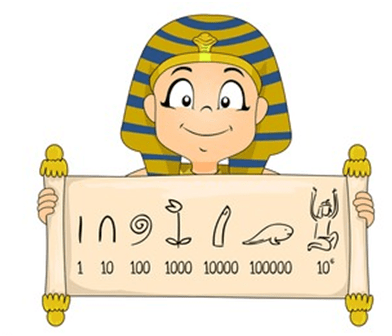
Bans, they are measures taken by the government to control whatever they feel is threatening to their rule or to the general populace. They say the pen is mightier than the sword, and authorities have often agreed. From outlawed religious tracts and revolutionary manifestos to censored and burned books, we know the potential power of words to overturn the social order. But as strange as it may seem, some numbers have also been considered dangerous enough to ban. Our distant ancestors long counted objects using simple tally marks. But as they developed agriculture and began living together in larger groups this was no longer enough. As numbers grew more complex, people began not just using them, but thinking about what they are and how they work.
By 600 B.C.E ancient Greece, the study of numbers was well developed. Pythagoras, one of the most famous mathematicians and his school of followers found numerical patterns in shapes, music and stars. For them math held the deepest secrets of the universe. But one Pythagorean named Hippasus discovered something disturbing. Some quantities like the diagonal of a square with sides of length one each couldn’t be expressed by any combination of whole numbers or fractions, no matter how small. These numbers which we call irrational numbers, were seen as a threat to the Pythagorean notion of a perfect universe. They imagined a reality that could be described with rational, numerical patterns. Historians write that Hippasus was exiled for publicizing his findings while legends of the Pythagorean era claim he was drowned by the god themselves as punishment for his blasphemous findings. While irrational numbers upset philosophers, later mathematical inventions would draw attention from political and religious authorities as well. In the middle ages, while Europe was still using roman numerals other cultures had developed positional systems that included a symbol for zero. When Arab merchants brought this system to Italy, its advantages for merchants and traders was clear. However, the authorities were wary as Hindu- Arabic numerals were quite easy to forge or alter, especially since they were less familiar to customers than to merchants. And since the concept of zero opened the path to negative numbers and the recording of debt at a time when money-lending was regarded with suspicion. In 13th century, Florence totally banned the usage of Hindu- Arabic numerals for record keeping. Even though they were immensely useful, controversies regarding zero and negative numbers continued for a long time. Negative numbers were dismissed as absurd and prominent mathematicians like Gerolamo Cardano avoided using zero despite the easier route it provided to solve cubic and quartic equations. Even today it is illegal to use various numbers for a plethora of reasons. Governments usually ban the usage f numbers which have symbolic meanings or connections to opposing political figures and parties. Some numbers are banned because of the sensitive information they carry. These days any image, file, video or executable program can be translated into a string of numbers. So, this means protected materials such as copyrights and state secrets can also be represented as numbers, so possessing or publishing these are considered a criminal offense.
Thus, in a world where calculations and algorithms, shape more and more of our lives, the mathematicians pen grows stronger each passing day.



 Eduindex News
You must be logged in to post a comment.