
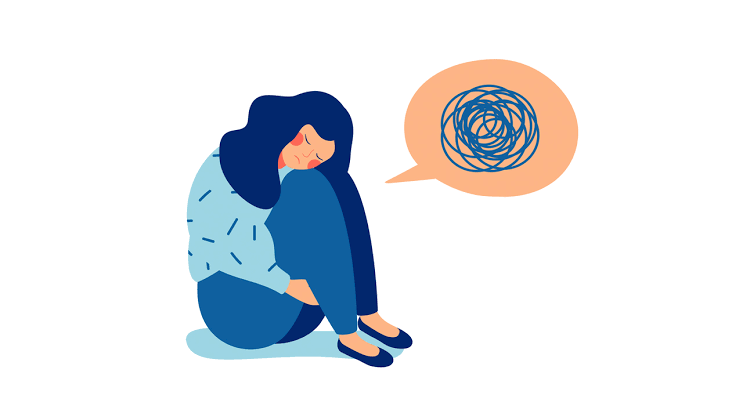
ANXIETY A GROWING PROBLEM

Anxiety a problem faced by millions in the world. Some know about it; others are not even aware of it. They are suffering it all alone. Some suffer with minor, others with major anxiety to the extent that they even try to take away their own life.

What is anxiety ?

So, let’s first know what anxiety is? This is really important to know what anxiety actually means, because there are many who are suffering from it, but are not even aware of it.

Anxiety in simple sense means having worry, fear in some stressful or tensed situation, which is normal. But when somebody experiences it on a daily basis in an intense and excessive manner on small-small things, is actually suffering from anxiety disorder. And this is a very severe disorder to the extent that people are not able to overcome it and end up taking their lives.

Cause

The main causes of anxiety disorder are:

  • Not Living in Present : the first and in most of the cases it is caused to youngsters because of the uncertainty and worry about their future. Their worry rises day by day, and it grows to become a disorder.
  • Expectations: the other cause is worry of not being up to the mark of their expectations or having over-expectations.
  • Results : worry about result is another cause.
  • Thinking negative : what ever they think they are always seeing it negatively.
  • Overthinking : another main cause is overthinking. They keep on thinking about one thing and their mind goes on to think of other related things with it. And ultimately they go into so much deep thinking that they themselves don’t realize.
  • Hopelessness : they become hopeless and think they are of no worth to the world.
  • Being altruistic : it simply means always thinking what others or the world would think about them, which makes them more nervous.

These we some of the causes their might be other reasons too. But now we should look at the solution, because for every problem their is a solutions as every night has a day.

Solutions

  • Start to Live in Present : the first and foremost thing is to start living in the present. Don’t worry about the future as that is not in your hand; what you have is the present just live in the present.
  • Stop Expecting: the other thing is that do not expect anything from time(future) or anyone, because you are disheartened only when you have expection. When you do not expect anything, then whatever you get you are satisfied with it.
  • Don’t worry about results : Stop worring about results as it is not in your hand, just leave it ot God, everything will be fine. You just do your work and don’t worry about the result (hindi saying : karm Kar phal ki chinta mat kar).
  • Think positively : try to be positive as being negative never helps. And just think it yourself as even if you are negative what ever the destiny has decided it will happen. Just keep one thing in your mind whatever happens happens for good (joh hota hai achhe ke liye hota hai).
  • Do Yoga : the one of the most effective way to calm your mind is doing Yoga. By doing yoga you to try to make balance between your mind and body. Try to meditate. Whenever any negative thoughts comes to your mind just stop, what ever you are doing and do simple yoga. Watch videos on internet. Try to divert your mind.
  • Don’t worry about what people think : just keep in mind that, whatever you do, you do it for yourself and not to get somebody’s remark or happiness, it’s for you. Just do whatever you like, don’t let them affect you as it’s not worth it because they have no importance in your life.
  • Stop overthinking : when every you realize that you are getting trapped in your endless thinking, just keep everything aside and immediately stop thinking, just take two deep breath and try to relax yourself. And try to remember all the above points, you will feel relaxed.
  • Take a nap : just take a nap if you are feeling stressed.

Just try it once. If then too you are not feeling well, then please do contact a psychiatrist or any friend or your parents or anyone close to you to share your feelings with them. And be positive.

Empathy vs Covid-19

The Covid-19 pandemic has affected everyone disproportionately and unfairly. Health care workers face the harsh realities of the virus head-on. Teachers have had to adapt their years of experience gained from conventional teaching to suit online classes. Millions face the harsh reality of poverty and hunger everyday. Millions have lost their hard-earned jobs. Businesses have been forced to shut down. Hate crimes against groups of society that are baselessly and cruelly accused of spreading the virus have drastically increased. Mental health issues have risen and fueled by isolation, anxiety, uncertainty, and fear. More than 150 million people have gone and continue to battle with this invincible enemy. More than 3 million people have lost their lives because of this virus. Families have lost their loved ones and the world has lost countless dreamers. This virus cossets no one.  

Early notions such as the pandemic would be ephemeral and infections were punitive for those who flouted the necessary precautions and rules have diminished during the ongoing second wave of the Covid-19 pandemic. In my opinion, this is due to a rise in empathy amongst the people of India. Simply put, empathy is the ability of a living being to understand and share the feelings of another living being. Colloquially, it is referred to as “putting oneself in someone else’s shoes” 

The Government of India has had no shortage of opportunities to show empathy and alleviate the suffering of Indians. The Government has neglected its duty to serve the country and as Arundhati Roy put it, has committed a crime against humanity. The government has failed on many fronts. I would like to highlight a few that showcase an egregious lack of empathy. 

Firstly, the poorly planned nationwide lockdown, which was imposed with a mere 4 hours of notice, left thousands of migrant workers helpless, stranded, and vulnerable. With no help from the government, these migrant workers bravely decided to walk back to their villages. This lockdown was stained by police brutality and hate crimes against people that just wanted to survive. The lack of condemnation and apology by the government showcases a lack of empathy. 

Secondly, in an attempt to alleviate the suffering of Indians, the government launched the risibly named PM CARES (Citizens Assistance and Relief in Emergency Situations) fund and its primary objective was “to deal with any kind of emergency or distress situation, like posed by the COVID-19 pandemic and to provide relief to the affected”. The fact that a government that has never shied away from repeatedly putting their plans such as “Make in India”, “Swachh Bharat”, “Beti Bachao Beti Padhao”, etc on the highest possible pedestal has created such an opaque and inaccessible fund shows a lack of empathy. 

Thirdly, the government’s actions before the second wave hit can be described as complacent, incompetent, and overconfident. On the 21st of February 2021, a resolution was passed in the BJP National Office Bearers meeting that “unequivocally hails its leadership for introducing India to the world as a proud and victorious nation in the fight against Covid”. Additionally, the government decided to export vaccines to other countries without ensuring adequate supply was available for Indian citizens. This not only leaves Indian citizens in danger but also betrays all the countries that depended on “the pharmacy of the world” as vaccine exports were abruptly stopped. None of this would’ve happened if the government showed empathy towards the people of India and established appropriate contingent plans.

Fourthly, while the second wave virulently spread and claimed thousands of lives, the government showed no empathy. While a strong case can be made to prohibit sitting union ministers from campaigning in elections that they are not contesting during a crisis, a complete stop to the democratic process would have been detrimental. The occurrence of huge rallies during a pandemic is untenable and all politicians are guilty of this. The myopic and unsympathetic nature of the government is accentuated by the needless comments that they have made throughout the pandemic.  

Finally, the iniquitous lack of co-operation between the centre and states to fight this pandemic showcases a pathetic lack of empathy. The failure to come up with a comprehensive and transparent plan for the distribution and supply of oxygen and vaccines has caused unimaginable suffering to the people of India. Any attempt by the government to set aside pride and partisanship, as leaders have done before when facing a crisis, and listen to good advice and imploration would be a sign of empathy. No such attempt has been made. Their lack of action and belated action have had fatal effects, but the government has not shown a sign of remorse or empathy.    

But all is not lost. There have been instances in which the government has shown empathy. Most states have decided to offer a Covid-19 vaccine for free for different age groups. The central government also has plans to allow final-year MBBS students to join Covid duty before completing the NEET exam. This will drastically reduce the strain faced by health care workers taking care of Covid patients. The government of Karnataka also announced that it would form a team of 15,000 civil defence volunteers in Bengaluru for tracking and tracing Covid-19 patients. This is a significantly more empathetic and humane approach to managing the crisis than the sadistic and vicious approach used last year that made victims of Covid-19 feel like criminals.

However, none of these actions are as consequential and empathetic as the profound empathy amongst the ordinary people of India. Early displays of empathy were seen when people started taking care of stray animals during the lockdown. Furthermore, countless rations and donations were given to the stranded migrant workers to help them cope with the dire situation they faced. From providing meals, oxygen, assistance to the elderly and handling cremations, Gurudwaras around the country have been the perfect embodiment of empathy. Conspicuously, the empathy and equanimity shown by the youth of India has truly been remarkable. With the help of social media, the relentless youth are constantly doing their part by helping those in need. 

Empathy also provides a strong basis for our everyday fight against Covid-19. Precautions like wearing a mask, staying indoors as much as possible, social distancing when outside, and getting vaccinated as soon as possible would not be flouted if people were more empathetic. For those of us who have not been directly affected by the virus yet, empathy goes a long way in helping and caring about those who have. 

Perhaps, the most optimistic and quixotic change that we can hope for during this precarious and seemingly inexorable situation is the crippling of traditional barriers that have separated us before. If we, as ordinary citizens of India, continue to disregard gender, caste, religion, wealth, age, ethnicity, language, political ideology, and other barriers when helping those affected by this pandemic, we could truly be united in this fight against the invisible enemy. Together, we shall overcome.  

Poverty – A Global Concern

“Overcoming poverty is not a gesture of charity. It is an act of justice. It is the protection of a fundamental human right, the right to dignity and a decent life.” – Nelson Mandela, former President of South Africa.

Poverty is generally considered to be a measure of deprivation of the basic needs that a person, household or community requires to have a basic standard of living. Deprivation can be measured either in terms of a lack of resources (for example: income, other assets), capabilities (such as skills, knowledge, technology) or both. Children who grow up in poverty are more likely to be deprived of having health problems and shorter life expectancy , not attending preschool, dropping out of high school and having lower educational attainment.


People can be said to be in poverty when they are deprived of income and other resources needed to obtain the conditions of life such as diets, material goods, amenities, standards and services that enable them to play the roles, meet the obligations and participate in the relationships and customs of their society. Understanding and addressing poverty requires a dynamic view of how poor people and households fare overtime in terms of income and expenditure thresholds. Hence vulnerability is a risk for a person or a household of falling deep into poverty. The other factors include household demographics (which is the size of the household [number of people], the age structure, the dependency ratio and the geographical location which may be rural or urban) , and individual characteristics (such as a person’s sex, age, employment status, level of educational attainment, property owned and socio-economic profession.)

Poverty has various indications such as lack of income and productive resources sufficient to ensure sustainable livelihoods, hunger and malnutrition, ill health, limited or lack of access to education and other basic services, increased morbidity and mortality from illness, homelessness and inadequate housing, unsafe environments , social discrimination and exclusion and is characterized by lack of participation in decision-making and in civil, social and cultural rights. The root cause of poverty is considered to be the increasing population. Rising population is putting the burden on the resources and budget of countries. Governments are finding difficult to provide food, shelter and employment to the rising population. The other causes include lack of employment opportunities ( people who face situations of unemployment and joblessness are unable to fulfill the basic necessities of their family resulting in poverty), lack of education and skills ( limits people’s ability to access decent jobs to develop themselves and participate fully in society) , war, natural disaster, lack of infrastructure , political instability etc. Natural disasters like flood, earthquake also contribute to poverty.


Poverty encompasses not only material deprivation but also many other forms of deprivations in different aspects of life such as unemployment, ill health, lack of education, vulnerability, powerlessness, social exclusion etc. Hence, poverty should be viewed as the deprivation of basic capabilities rather than merely as low level of income and strong, effective economic and social policies should be taken to eradicate poverty and improve people’s lives and the economic productivity of the country.

Glossophobia

what comes to your mind when you see the word glossophobia, it may have occurred to you that as it something to do with the fear and then glosso may be, the fear of glasses, or the fear of glossy things. Actually this is a fear of speaking in front of many people, this   may be felt by most of you at first but it does not mean you are phobic. When a person has anxiety attacks and starts to feel really uncomfortable to actually keep his view in public. A fear of getting judged instills that person that stops him from speaking and he feels of just running away from the situation.

This phobia has many causes firstly being that if the person has a past experience of trauma that triggers the person every time one faces the stage. A child is not born with any such fear, there are only two innate fears that is fear of falling and fear of loud sounds. This phobia can be genetic but one comes to know only after growing up as they are put into the circumstances that enables them to recognize their fears. Its not like it does not have a cure, it does but it would take sometime and patience.

In 1860 a headlines was published saying ” The nervous side of Lincoln”  this was a letter which reveals his stage fear. Many people have shared this fear in them so if you have this fear you are not alone my friend!

What is important is to eliminate this fear rather than living with this, for how many days will you run away from presenting an amazing project you have designed, to your boss or to give a seminar in the class. Unfortunately in this present generation it is required that you not only have an amazing idea but also the calibre to present it, in front of the people. The most important thing is to overcome this fear  and to do that you have to work in small steps.

  1. Prepare a speech, and practice it in front of the mirror, till you become confident of delivering it to others without mistake
  2. Then ask your friends and family to listen to it, take their suggestions and improve your speech.
  3. Keep delivering speeches to your family and friends till the time you realize its time to take this to the next level and  that is to speak in front of unknown people.
  4. Then face your fear, go and  talk to unknown people and request them to listen to your speech, slowly and steadily try to increase the audience. Always make yourself remember why are  you doing this.
  5. Do this for a number of times, then lastly to test if your fear is fully gone, arrange audience but  dont prepare any speech let the talk be impromptu.  This guarantees that you are now free from the fear and now there is nothing stopping you from achieving anything in life.                                                                                                   This is just a way that is popularly used , it can take varied time to overcome fear for different people, this depends on how much they are motivated and how much they are learning each day.