
World Ozone Day 2022

World Ozone Day 2022 falls on
September 16 to commemorate the signing of the Montreal Protocol, an
international treaty to protect the ozone layer by phasing out the production
of many substances.

World Ozone Day 2022 is
celebrated around the world on September 16 every year to start a conversation
and raise awareness about the depletion of the ozone layer. Each year, the
United Nations announces a theme for World Ozone Day, focusing on immediate
action that must be taken by people and governments. Ozone is a protective
layer in the Earth’s atmosphere that absorbs most of the ultraviolet radiation
that reaches Earth from the Sun. World Ozone Day 2022 is celebrated to spread
awareness about ways that are effective in protecting the ozone layer.


Date of World Ozone Day 2022

World Ozone Day is celebrated
every year on September 16 to highlight and spread awareness about the
importance of the ozone layer in protecting the Earth.

Theme of World Ozone Day 2022

The theme of World Ozone Day 2022
is “Global Cooperation to Protect Life on Earth”. The theme of World
Ozone Day, proclaimed by the United Nations, emphasizes the collective efforts
that must be made to protect life on Earth.

History of World Ozone Day 2022

World Ozone Day was first
observed in 1995 and was celebrated to raise awareness of the importance of the
ozone layer to the environment. When scientists discovered in the 1970s that
humanity was making a hole in the ozone layer, they expressed their concerns.

Based on it, the governments of
the whole world adopted the Vienna Convention on the Protection of the Ozone
Layer in 1985 and decided to save it.

World Ozone Day on 16 September
commemorates this achievement and shows that collective decisions and action
are the only way to solve major global crises led by science.

World Ozone Day 2022: Montreal
Protocol?

The main objective of the
Montreal Protocol is to protect the ozone layer by taking measures to control
the total worldwide production and consumption of substances that damage it,
with the ultimate goal of eliminating them based on the development of
scientific knowledge and technological information. Groups of chemicals are
classified by chemical group and are listed in annexes to the text of the
Montreal Protocol. The protocol calls for the control of nearly 100 chemicals
in several categories. For each group or annex of chemical substances, the
Agreement establishes a schedule for the gradual cessation of production and
consumption of these substances, with the aim of eventually eliminating them
completely.

The schedule established by the
Protocol applies to the consumption of ozone-depleting substances. Consumption
is defined as the amount produced plus imported minus the amount exported in a
given year. There is also a deduction for certified destruction. Percentage
reductions refer to the specified baseline year for the substance. The Protocol
does not prohibit the use of existing or recycled controlled substances after
the phase-out date.

There are a few exceptions for
essential uses where no acceptable substitutes have been found, such as in
metered dose inhalers (MDIs) commonly used to treat asthma and other
respiratory problems, or in halon fire extinguishing systems used in submarines
and aircraft.

In 1994, the United Nations
General Assembly declared 16 September the International Day for the
Preservation of the Ozone Layer, commemorating the signing of the Montreal
Protocol on Substances that Deplete the Ozone Layer in 1987 (resolution
49/114).
Can we fix our Ozone layer? The Montreal protocol

Imagine that one day our Ozone layer was disappeared. What will happen? How long can we survive without it?  The Ozone layer is a region of Earth’s atmosphere that contains a high concentration of Ozone (O3). Ozone is a highly reactive gas composed of three oxygen atoms. It is found in the lower portion of Earth’s atmosphere. It absorbs 97 to 99 percent of the Sun’s ultraviolet rays. Direct exposure to UV rays can cause serious skin problems including sun burn, skin cancer, premature ageing of the skin, solar elastosis. It can also cause eye problems and can ruin our immune system.

  The depletion of ozone layer was first observed by a Dutch chemist Paul crutzen. He described the Ozone depletion by demonstrating the reaction of nitrogen oxide with oxygen atoms which slowing the creation of Ozone (O3). Later in 1974, American chemists Mario Molina and F. Sherwood Rowland observed that chlorofluorocarbon (CFC) molecules emitted by man-made machines like refrigerators, air conditioners and airplanes could be the major source of chlorine in the atmosphere. One chlorine atom can destroy 100,000 ozone molecules.

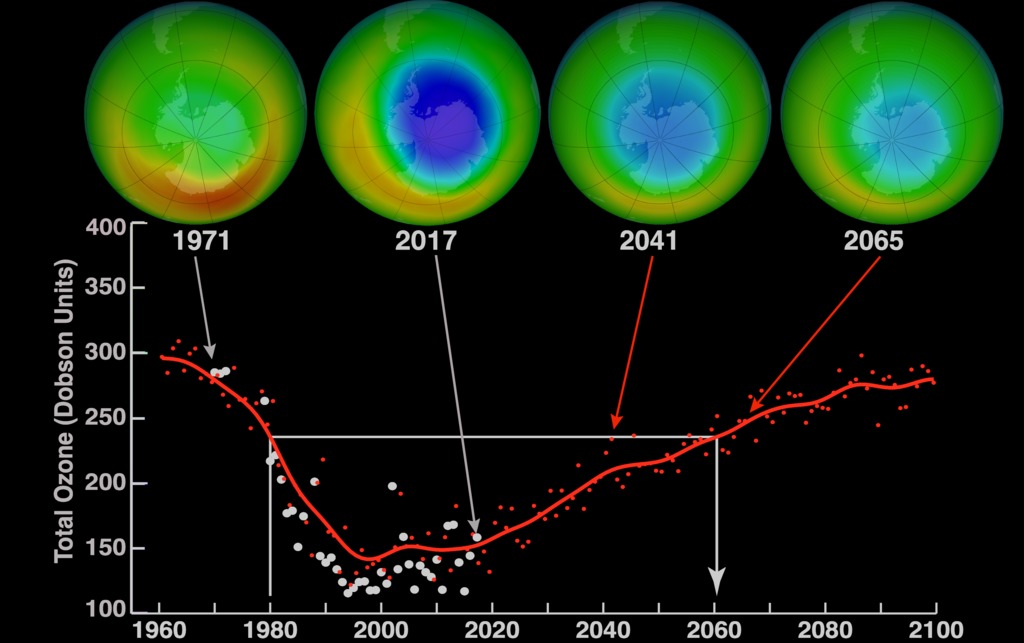
Not all chlorine molecules contribute to ozone layer depletion; chlorine from swimming pool, sea salt, industrial plants, and volcanoes does not reach the stratosphere. The ozone hole in Antarctica is one of the largest and deepest depletion which was discovered by the British scientists. This became worldwide headlines after that. According to NASA scientist Paul Newman, if this depletion continues in this rate our ozone layer can be likely disappeared in 2065. If that happens UV rays from sun directly reach earth and cause severe health issues, Humans can last 3 months and plants may die in 2 weeks because of heavy UV radiation. Thus Earth will become inhabitable.

 Fortunately in 1987, Montreal protocol was made that bans chlorofluorocarbon and other chemicals that cause ozone depletion. Surprisingly it works, researches made in 2018 tells that the ozone layer is repairing itself at a rate of 1% to 3% per decade since 2000. Still it will take at least 50 years for complete recovery. The greenhouse effect allows the short wave radiation of sunlight to pass through the atmosphere to earth’s surface but makes it difficult for heat in the form of long wave radiation to escape. This effect blankets the earth and keeps our planet at a reasonable temperature to support life. Earth radiated energy, of which about 90 percent is absorbed by atmospheric gases like water vapor, carbon dioxide, ozone, methane, nitrous oxide, and others. Absorbed energy is radiated back to the surface and warms earth’s lower atmosphere.

The gases have come to be called greenhouse gases because they hold in light and heat, just as a greenhouse does for the sake of the plants inside. Greenhouse gases are essential to life, not only at an appropriate balance point. These gases increased during the 20th century due to industrial activity and fossil fuel emissions. For example, the concentration of carbon dioxide I the atmosphere have recently been growing by about 1.4 percent annually. This increase in greenhouse gases is one of the contributors to be observed patterns of global warming. On September 16th world ozone day, we can celebrate our success. But we must all push to keep hold of these gains, in particular by remaining vigilant and tackling any illegal sources of ozone depleting substances as they arise, says UN ozone-secretariat. So without the Montreal protocol, life on earth could be a question mark, so keep working hard. “OZONE FOR LIFE”.