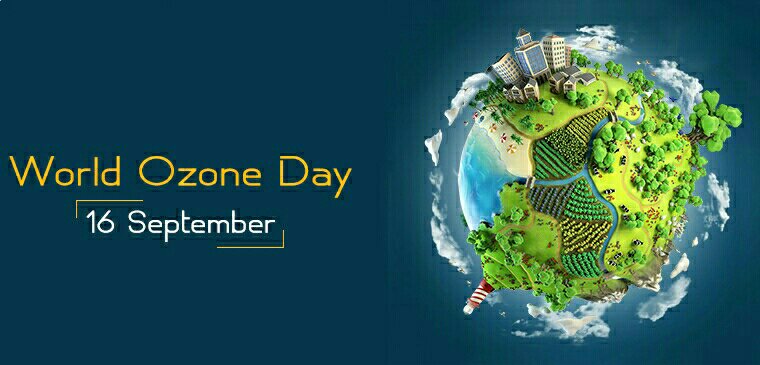
International Day for Preservation of Ozone Layer : 16th September.

The world observes September 16th as International Day for the Preservation of the Ozone Layer or World Ozone Day. The day marks the anniversary of the Montreal Protocol which was signed to keep in check Ozone depleting substances. On this day, people from all over the world hold talks and seminars on the ozone layer.  Educators teach students about the benefits of the Ozone layer and special events and activities are organised to spread awareness.

The ozone layer is a fragile shield of gas that protects the Earth from the harmful portion of the rays of the sun, thus helping preserve life on the planet. Ozone is a protective layer that protects us from harmful radiations of the sun. It is crucial for sustaining life on this planet. Montreal Protocol was an effort countries made to collaborate and protect the ozone layer. The principal aim of the Montreal Protocol is to protect ozone layer by taking measures to control total global production and consumption of substances that deplete it.

World Ozone Day 2022 Theme “Montreal Protocol@35: global cooperation protecting life on earth” is the theme of World Ozone Day 2022.

Let us understand what Ozone is and how it is being depleted.

Ozone is made up of three atoms of oxygen. It is highly reactive gas and is represented by O3. It occurs naturally as well as a man-made product in the Earth’s upper atmosphere i.e. stratosphere and lower atmosphere i.e. troposphere. The Ozone layer is present in Earth’s atmosphere (15-35km above Earth) in the lower portion of the stratosphere and has relatively high concentrations of ozone (O3). Naturally, it is formed through the interactions of solar UV radiation with molecular oxygen O2. It reduces the harmful UV radiation reaching the Earth’s surface.

 The main cause of ozone depletion and the ozone hole is manufactured chemicals, especially manufactured halocarbon refrigerants, solvents, propellants, and foam- blowing agents (chlorofluorocarbons (CFCs), HCFCs, halons). Since the early 1970’s, scientists observed reduction in stratospheric ozone and it was found more prominent in Polar Regions. ODS substances have a lifetime of about 100 years.

International Day for Preservation of Ozone Layer : 16th September.

The world observes September 16th as International Day for the Preservation of the Ozone Layer or World Ozone Day. The day marks the anniversary of the Montreal Protocol which was signed to keep in check Ozone depleting substances. On this day, people from all over the world hold talks and seminars on the ozone layer.  Educators teach students about the benefits of the Ozone layer and special events and activities are organised to spread awareness.

The ozone layer is a fragile shield of gas that protects the Earth from the harmful portion of the rays of the sun, thus helping preserve life on the planet. Ozone is a protective layer that protects us from harmful radiations of the sun. It is crucial for sustaining life on this planet. Montreal Protocol was an effort countries made to collaborate and protect the ozone layer. The principal aim of the Montreal Protocol is to protect ozone layer by taking measures to control total global production and consumption of substances that deplete it.

World Ozone Day 2022 Theme “Montreal Protocol@35: global cooperation protecting life on earth” is the theme of World Ozone Day 2022.

Let us understand what Ozone is and how it is being depleted.

Ozone is made up of three atoms of oxygen. It is highly reactive gas and is represented by O3. It occurs naturally as well as a man-made product in the Earth’s upper atmosphere i.e. stratosphere and lower atmosphere i.e. troposphere. The Ozone layer is present in Earth’s atmosphere (15-35km above Earth) in the lower portion of the stratosphere and has relatively high concentrations of ozone (O3). Naturally, it is formed through the interactions of solar UV radiation with molecular oxygen O2. It reduces the harmful UV radiation reaching the Earth’s surface.

 The main cause of ozone depletion and the ozone hole is manufactured chemicals, especially manufactured halocarbon refrigerants, solvents, propellants, and foam- blowing agents (chlorofluorocarbons (CFCs), HCFCs, halons). Since the early 1970’s, scientists observed reduction in stratospheric ozone and it was found more prominent in Polar Regions. ODS substances have a lifetime of about 100 years.

Ozone and its Depletion

The ozone layer or ozone shield is a region of Earth’s stratosphere that absorbs most of the Sun’s ultraviolet radiation. It contains a high concentration of ozone in relation to other parts of the atmosphere, although still small in relation to other gases in the stratosphere. The ozone layer contains less than 10 parts per million of ozone, while the average ozone concentration in Earth’s atmosphere as a whole is about 0.3 parts per million. The ozone layer is mainly found in the lower portion of the stratosphere, from approximately 15 to 35 kilo meters (9.3 to 21.7 mi) above Earth, although its thickness varies seasonally and geographically.

The ozone layer was discovered in 1913 by the French physicists Charles Fabry and Henri Buisson. Measurements of the sun showed that the radiation sent out from its surface and reaching the ground on Earth is usually consistent with the spectrum of a black body with a temperature in the range of 5,500–6,000 K (5,227 to 5,727 °C), except that there was no radiation below a wavelength of about 310 nm at the ultraviolet end of the spectrum. It was deduced that the missing radiation was being absorbed by something in the atmosphere. Eventually the spectrum of the missing radiation was matched to only one known chemical, ozone.

 Its properties were explored in detail by the British meteorologist G. M. B. Dobson, who developed a simple spectrophotometer (the Dobsonmeter) that could be used to measure stratospheric ozone from the ground. Between 1928 and 1958, Dobson established a worldwide network of ozone monitoring stations, which continue to operate to this day. The “Dobson unit”, a convenient measure of the amount of ozone overhead, is named in his honor. The ozone layer absorbs 97 to 99 percent of the Sun’s medium-frequency ultraviolet light (from about 200 nm to 315 nm wavelength), which otherwise would potentially damage exposed life forms near the surface.

In 1976, atmospheric research revealed that the ozone layer was being depleted by chemicals released by industry, mainly chlorofluorocarbons (CFCs). Concerns that increased UV radiation due to ozone depletion threatened life on Earth, including increased skin cancer in humans and other ecological problems, led to bans on the chemicals, and the latest evidence is that ozone depletion has slowed or stopped. The United Nations General Assembly has designated September 16 as the International Day for the Preservation of the Ozone Layer.

Ozone Depletion:

Ozone depletion consists of two related events observed since the late 1970s: a steady lowering of about four percent in the total amount of ozone in Earth’s atmosphere (the ozone layer), and a much larger springtime decrease in stratospheric ozone around Earth’s polar regions. The latter phenomenon is referred to as the ozone hole. There are also springtime polar tropospheric ozone depletion events in addition to these stratospheric events.

The main cause of ozone depletion and the ozone hole is manufactured chemicals, especially manufactured halocarbon refrigerants, solvents, propellants, and foam- blowing agents (chlorofluorocarbons (CFCs), HCFCs, halons), referred to as ozone-depleting substances (ODS). These compounds are transported into the stratosphere by turbulent mixing after being emitted from the surface, mixing much faster than the molecules can settle. Once in the stratosphere, they release halogen atoms through photodissociation, which catalyze the breakdown of ozone into oxygen.  Both types of ozone depletion were observed to increase as emissions of halocarbons increased.

Ozone depletion and the ozone hole have generated worldwide concern over increased cancer risks and other negative effects. The ozone layer prevents most harmful wavelengths of ultraviolet (UV) light from passing through the Earth’s atmosphere. These wavelengths cause skin cancer, sunburn, permanent blindness, and cataracts, which were projected to increase dramatically as a result of thinning ozone, as well as harming plants and animals. These concerns led to the adoption of the Montreal Protocol in 1987, which bans the production of CFCs, halons, and other ozone-depleting chemicals.

The ban came into effect in 1989. Ozone levels stabilized by the mid-1990s and began to recover in the 2000s, as the shifting of the jet stream in the southern hemisphere towards the south pole has stopped and might even be reversing. Recovery is projected to continue over the next century, and the ozone hole is expected to reach pre-1980 levels by around 2075. In 2019, NASA reported that the ozone hole was the smallest ever since it was first discovered in 1982.

World Ozone Day 2020 – Ozone For Life!

There are problems that human beings should not interfere in the environment and this is also true. For our protection, all humans on earth have been placed in the middle of a protective shield which is being contaminated by humans nowadays. People may not know much about the ozone layer, but it acts as a protective shield for the Earth and the Environment and protects it from the sun’s dangerous ultraviolet rays. 

In this era of technology, man is killing everything that is hindering his progress. Similarly, for his comfort and convenience, man is determined to destroy the ozone layer which protects him from the dangerous ultraviolet rays emanating from the sun. The ozone layer that saved our lives has become a threat today due to the industrial activities that have taken place day after day.

What is Ozone after all?

Ozone is a light blue gas that is a compound of three atoms of oxygen (O3). The ozone layer is generally found between 10 km to 50 km above the ground level. This gas acts as a good filter for ultraviolet rays emanating from the Sun.

Danger from damage in ozone layer

The ozone layer is very important which protects us from the sun’s dangerous ultraviolet rays. If the ozone layer is damaged then all skin diseases can occur in humans.
Without the ozone layer, we cannot survive because these rays can cause cancer, damage to crops and threat to marine organisms and the ozone layer protects us from these ultraviolet rays. Another danger is the melting of the poles due to this. There is a large hole in ozone in Antarctica. The Antarctica region has large icebergs. If these icebergs melt, coastal areas can face many hazards, including flooding. Apart from this, heat will also increase, which will be harmful. Damage to the ozone layer also affects biological diversity and can destroy many crops. They have an effect on microorganisms. Apart from this, it also affects small plants in the sea, which can reduce the quantity of fish and other animals. 


History of World Ozone Day

Keeping in mind the importance of the ozone layer, work has been done to protect it from the last decade. But on January 23, 1995, the United Nations General Assembly passed a resolution to celebrate December 16 as International Ozone Day to bring awareness to people all over the world. At that time, the goal was to create an ozone friendly environment by 2010 across the world. Although the target is still far away, the world has done remarkable work in the direction of saving the ozone layer. 

The result of the exercise to protect the ozone layer is that today ozone-friendly fridges, coolers etc. have come in the market. To protect this layer it is necessary that foam mattresses are not used. Use of plastic should be minimized. Room fresheners and chemical perfumes should not be used and ozone-friendly refrigerators, air conditioners should be used only. Apart from this, the design of your house should be done in an ozone-friendly manner, using natural sources for light, air and energy. 

We have got this earth as an inheritance which we also have to give to the coming generation. We should take such a path that not only benefits us but also our upcoming generations can enjoy this very beautiful earth.