
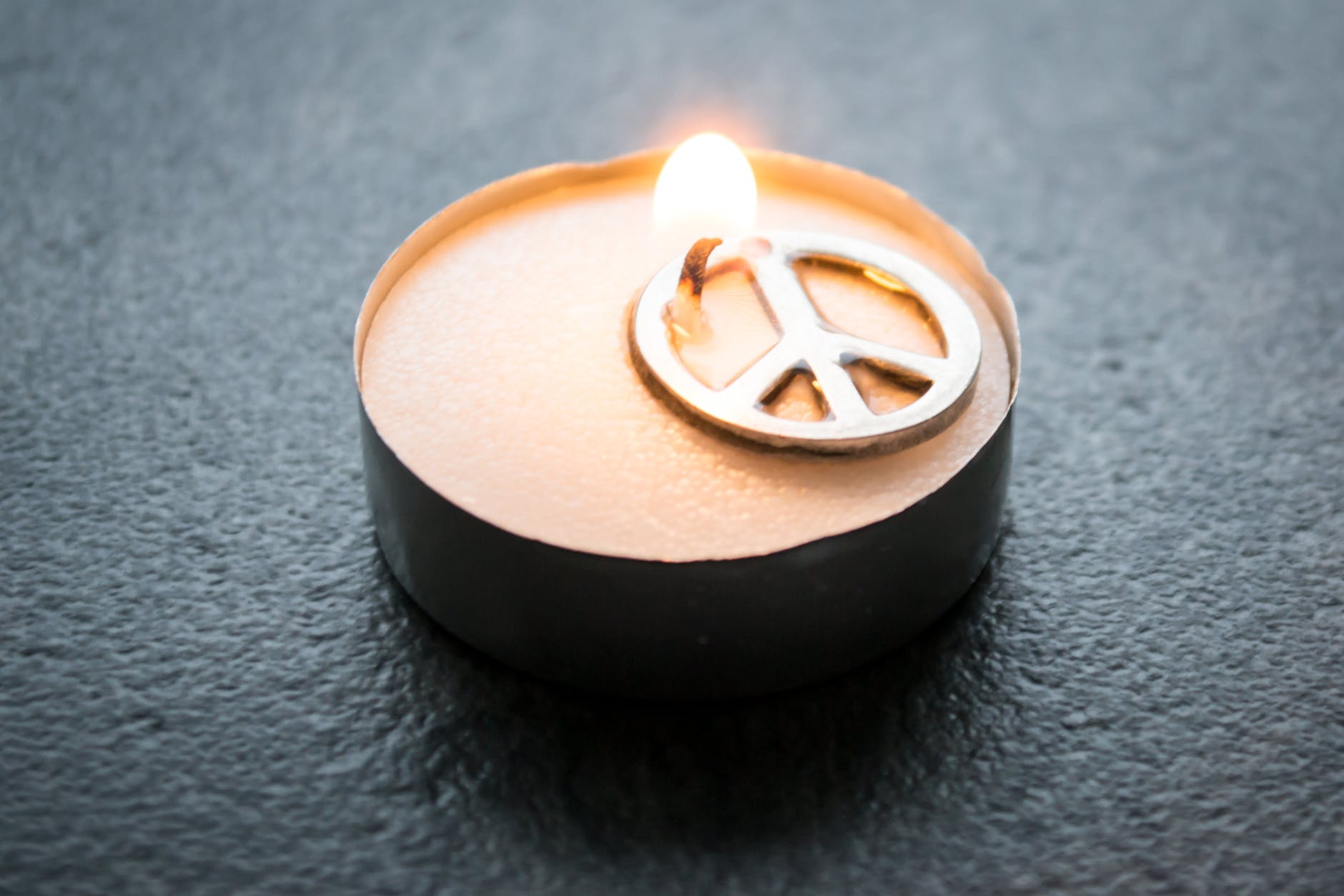
International Day of Peace.

In 1981, the United Nations General Assembly declared the third Tuesday of September as International Day of Peace. This day coincided with the opening day of the annual sessions of the General Assembly. The purpose of the day was and still remains, to strengthen the ideals of peace around the world.

Two decades after establishing this day of observance, in 2001, the assembly moved the date to be observed annually on September 21. So, beginning in 2002, September 21 marks not only a time to discuss how to promote and maintain peace among all peoples but also a 24-hour period of global ceasefire and non-violence for groups in active combat.

Peace is possible. Throughout history, most societies have lived in peace most of the time. Today, we are much less likely to die in war than our parents or grandparents. Since the establishment of the United Nations and the creation of the Charter of the United Nations, governments are obligated not to use force against others unless they are acting in self-defense or have been authorized by the UN Security Council to proceed.

Life is better in a world where peace exists and, today, we look to those who have been peacemakers and peacekeepers to learn what we can each do individually to make the world a more peaceful place.

The United Nations invites all nations and people to honour a cessation of hostilities during the day and to otherwise commemorate the Day through education and public awareness on issues related to peace.

Every year, the International Day of Peace is celebrated under a specific theme. This year, according to the UN, the theme of World Peace Day 2022 is ‘End racism , Build peace.’ There will be many events, workshops, and educational seminars on the eve of World Peace Day 2022 to create awareness among people about how to develop a world free of racism and racial discrimination.

According to the United Nations, “Racism continues to poison institutions, social structures, and everyday life in every society. It continues to be a driver of persistent inequality. And it continues to deny people their fundamental human rights. It destabilises societies, undermines democracies, erodes the legitimacy of governments, and the linkages between racism and gender inequality are unmistakable.”

HUMANITY

Humanity is defined as the quality of being human; the unique nature of man that distinguishes him from other beings. Being human does not imply that one has humanity. If you want to know how human a person is, look at what he does for others who don’t return the favour. Mother Teresa has beautifully portrayed one of the most extraordinary examples of extra-ordinary humanity in a human being. When and whenever possible, humanity entails caring for and assisting others. 

Humanity entails putting other’s needs before your own, and putting others’ needs ahead of your own when they want assistance. Humanity entails expressing unconditional love to all living things on the planet. The following anecdote serves as an excellent illustration of humanity.

Importance of Humanity:

As humanity progresses towards the future, the true essence of humanity is increasingly distorted. It is critical to remember that actions of humanity must not be motivated by selfish benefit such as celebrity, money, or power. Borders divide the world we live in today, but our reach is infinite. We are fortunate in that we have the ability to travel wherever we choose and experience whatever we desire. Countless nations struggle incessantly over territory, resulting in the deaths of many innocent people.

Similarly, other humanitarian crises such as those in Yemen, Syria, Myanmar, and others have claimed the lives of millions of people. Because the situation is unlikely to be resolved anytime soon, humanity is required. Most importantly, humanity is concerned not only with humans but also with the environment and all living things. We must all band together to display true humanity and aid in the healing and prosperity of other humans, animals, and the environment.

Instead of fighting about democracy in other nations, we should ask ourselves if we have a voice in our own. Because power corrupts even the most strong-willed, we should exercise our right to vote and enhance the government’s procedures. Stop photographing flora and animals to show your friends and relatives. Look at the trees, animals, and natural beauty with your real eyes, not through the lens of a camera. Bring your friends and family to see the breathtaking beauties that surround us and share this beauty with them.

While technology and democracy have given us the ability to accelerate the pace of change in our society, they have also corrupted us. It has given us a sense of unlimited power and knowledge, making us feel as if we are Gods. No, we aren’t gods, and we have no power over other people’s lives. Only that right is theirs. However, we can and must alter ourselves by making informed selections, making the best life choices, and not allowing others to make our decisions for us.

The narrative of a king is an excellent illustration of mankind. When a dove and an eagle were fighting, a kind-hearted king witnessed it. He could communicate with birds and other animals. The pigeon requested the king’s assistance in escaping the eagle’s clutches. The king promised the eagle that in exchange for saving the pigeon, he would pay any price. The eagle requests from the monarch that he be given the same amount of flesh as the pigeon. The king agrees to the Eagle’s condition and begins hacking off his own flesh in proportion to the pigeon’s meat. He finds the pigeon heavier even after donating a small amount of his flesh. Finally, he gives the Eagle his entire being to consume. The Eagle and the Pigeon both transform into angels at that point, appearing on the ground to test the king’s humanity. 

For his deeds of humanity, the monarch has now been awarded with the most beautiful prizes and afterlife heaven. This narrative can be interpreted as an overblown statement intended to make people realise the importance of humanity in their daily lives. One crucial truth to remember is that “an individual’s life is measured not by the number of degrees he or she holds, but by the degree of humanitarian actions that one engages in on a daily basis.”

GANDHI JAYANTI

The birthday of Mohandas Karamchand Gandhi is celebrated as ‘Gandhi Jayanti.’ On October 2nd, 1869, India’s “Father of the Nation,” Gandhiji, was born. Thus, every year on October 2nd, Gandhi Jayanti is commemorated. In India, Gandhi Jayanti is observed as a public holiday. The International Day of Non-Violence is observed on this date around the world. Mahatma Gandhi’s contribution to Indian politics is incomparable. Gandhi suffered and was imprisoned multiple times throughout the tumultuous days of the campaign for Indian independence, but freedom for his motherland remained his cherished objective. He was a key figure in several freedom fights and was the founder of the “Quit India Movement.”

ABOUT MAHATMA GANDHI:

On October 2, 1869, in Porbandar, Gujarat, India, Mohandas Karamchand Gandhi was born. His father was the dewan (chief minister) of Porbandar, and his deeply religious mother was a staunch follower of Vaishnavism (the worship of the Hindu god Vishnu), influenced by Jainism, an ascetic faith built on self-discipline and nonviolence. Mohandas Gandhi left home at the age of 19 to study law at the Inner Temple, one of London’s four legal schools. In mid-1891, he returned to India and opened a law office in Bombay, but it was a flop. He quickly took a job with an Indian company, which dispatched him to its South African branch. Gandhi stayed in South Africa for approximately 20 years with his wife Kasturbai and their children. Mohandas Karamchand Gandhi, also known as Mahatma Gandhi, was a well-known freedom activist and a significant political figure in India’s fight for independence from British control. He was also known as the country’s founding father. He had, without a doubt, made a difference in the lives of India’s impoverished. Every year on Gandhi Jayanti, his birthday, is commemorated. Many people were impacted by his idea of truth and nonviolence, which was embraced by Martin Luther and Nelson Mandela for their respective battle movements.

SIGNIFICANCE OF MAHATMA GANDHI AND GANDHISM:

Mahatma Gandhi was a pivotal figure in both the Indian Independence Movement and the Indian National Congress, and is considered one of the most influential figures in Indian history. Gandhi was born in the city of Porbandar, in western British India, on October 2nd, 1869. Mohandas Karamchand Gandhi was his birth name. He was given the epithet ‘Mahatma’ later in life, which means ‘Great Soul,’ and refers to his role in assisting India in gaining independence from Britain.

“I have nothing new to teach the world. Truth and non-violence are as old as the hills. All I have done is to try experiments in both on as vast a scale as I could.” – M K Gandhi

Gandhism is an amalgamation of Mahatma Gandhi’s ideals and practices, as well as his activities, in plain and simple terms. It comprises of Mahatma Gandhi’s thoughts, which he gave to the world, and his acts, which he termed as “truth experiments.” We know that he lived his life to the fullest extent feasible in accordance with his principles; therefore, people who believe that Gandhism is defined solely by his ideas are mistaken. Mahatma Gandhi cannot be compared to Karl Marx, whose ideas are referred to as Marxism. It would be incorrect to label the Mahatma’s views as Gandhism because he was also a man of action.