

Ocean acidification is defined as a drop in the pH of the ocean over time, largely due to the uptake of carbon dioxide (CO2) from the atmosphere. Defining it simply, as we all know human activities releases CO2 into the atmosphere which leads to atmospheric warming and climate change. The seas absorb around a third to half of the CO2 produced by human activities. While this serves to slow atmospheric warming and climate change, it also has a direct chemical impact on seawater, which we refer to as ocean acidification.
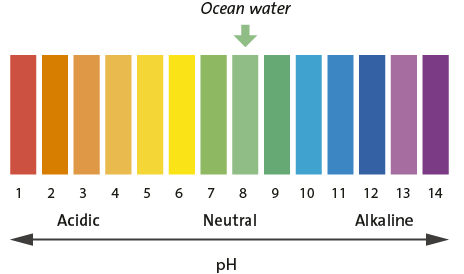
pH as mentioned above is frequently used to describe ocean acidification. The pH scale measures acidity and alkalinity. A pH of less than 7 is acidic, whereas a pH of higher than 7 is alkaline, or basic.
Currently, the average pH of ocean water is 8.1. Because the pH scale is logarithmic, a one-point change in concentration corresponds to a tenfold change in concentration. Carbon dioxide (CO2) levels in the atmosphere have been rising for more than 200 years, or since the industrial revolution, mainly to the combustion of fossil fuels and changes in land use. The ocean absorbs roughly 30% of the CO2 that is emitted into the atmosphere, and as atmospheric CO2 levels rise, so do ocean CO2 levels.
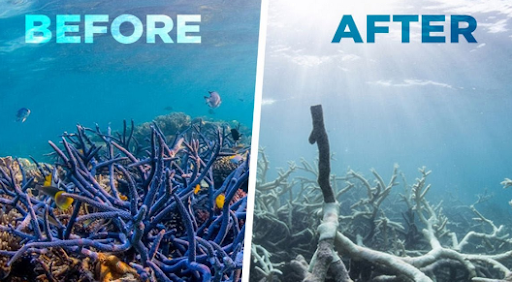
As a consequence, the median pH of ocean surface waters has dropped somewhat, from 8.2 to 8.1. This translates to a 26% increase in ocean acidity, which is about 10 times quicker than any other period in the previous 55 million years.
But now, the question arises why the seawater becomes acidic. So to answer this we must understand that When co2 is consumed by seawater, it triggers a chain of chemical processes that result in an increase in hydrogen ion concentration. As a result of this rise, saltwater becomes more acidic and carbonate ions become less prevalent. Carbonate ions are essential mainly for marine shells and carol skeletons because these ions are the building components of it. Reduced carbonate ions can make it difficult for calcifying animals including oysters, sea urchins, shallow water corals, deep sea corals, and calcareous plankton to develop and maintain shells and other calcium carbonate structures.
Due to such increased acidification, whole world’s seas especially coastal estuaries and rivers, are being affected by ocean acidification and it eventually affects the ocean chemistry because In more acidic environments, certain fish’s ability to detect predators is harmed. And when these creatures feel threatened, the entire food web feel threatened as well.
Taking the future world in view, due to the increase in atmospheric co2 , it will have a direct impact on the degree of future ocean acidification. So if, current greenhouse gas emissions continue, ocean acidity might rise by 0.4 units by the end of the century. However, Ocean acidification will not be consistent throughout the planet. Polar waters and upwelling zones, which are frequently located along continents’ west coastlines, are predicted to acidify more quickly than temperate or tropical regions. Depending on the environment, the pH will vary substantially.
Therefore, While the ultimate answer to lessen the ocean acidification is to reduce global greenhouse gas emissions. It can be done by adopting certain difficult decisions and activities which can help us prepare for the negative impacts of ocean acidification. On a smaller scale, Water quality improvements, Development of fisheries management methods that are sustainable, New technology implementation such as development of aquaculture industry and protecting Marine ecosystems that are very fragile and endangered may assist marine ecosystems adapt better with changing environmental circumstances by mitigating the negative impacts of other local factors.
 Eduindex
You must be logged in to post a comment.